What is Raydium? The Solana DEX that powers the memecoin machine
Every memecoin on Solana that survives longer than a few hours ends up on Raydium. When a token graduates from Pump.fun's bonding curve, it lands on a Raydium liquidity pool. When traders want to swap SOL for the latest dog-themed token, Raydium routes the trade. When a DeFi protocol on Solana needs deep liquidity, Raydium provides it.
Raydium is the largest automated market maker and decentralized exchange on Solana. Launched in February 2021, it crossed $1 trillion in cumulative trading volume in July 2025. TVL sits at about $1.4 billion. On January 19, 2025, the day the TRUMP memecoin launched, Raydium processed $16 billion in a single day. That is more than most centralized exchanges handle on a busy week. If Uniswap is Ethereum's backbone DEX, Raydium is Solana's.
This article covers how Raydium works as a DEX and AMM, why it dominates Solana liquidity, how the RAY token fits in, and where the platform stands in 2026 after surviving both a major hack and a memecoin explosion.
How does Raydium work?
Raydium is an automated market maker. That means trades happen against liquidity pools instead of a traditional order book. You want to swap SOL for USDC? A pool holds both tokens. You put SOL in, the AMM calculates the exchange rate based on the ratio of tokens in the pool, and you get USDC out. A small fee goes to liquidity providers who funded the pool.
What made Raydium different from day one was its integration with Serum's central limit order book. Standard AMMs like early Uniswap only had pool-based pricing. Raydium combined its AMM liquidity with Serum's order book, creating a hybrid system where trades could route through whichever venue offered the better price. That gave Raydium deeper liquidity than a standalone AMM could provide.
After Serum collapsed along with FTX in November 2022 (Serum was an FTX/Alameda project), Raydium lost that order book integration. The team rebuilt around a pure AMM model and added concentrated liquidity market maker (CLMM) pools. CLMM lets liquidity providers focus their capital within a specific price range instead of spreading it across all possible prices. It is the same concept as Uniswap V3 concentrated liquidity but running on Solana with sub-second finality and near-zero gas fees.
Today Raydium runs two types of liquidity pools:
Standard AMM pools use the constant product formula (x * y = k). Simple, predictable, and easy to provide liquidity to. These are what most new token pools start as.
CLMM pools let LPs pick a price range. If you think SOL will trade between $50 and $70 for the next week, you concentrate your capital in that band. You earn more fees per dollar deployed compared to a standard pool, but you earn nothing if the price moves outside your range. More capital efficient, more hands-on.
The platform charges a 0.25% trading fee on standard pools. Of that, 0.22% goes to liquidity providers, 0.03% goes to the RAY staking pool. CLMM pool fees vary and are set by the pool creator.
Raydium is non-custodial. Nobody at Raydium touches your tokens. Trades settle through smart contracts on the Solana blockchain. Your wallet connects, the swap happens on-chain, and you keep control the whole time.
Raydium and the Solana memecoin economy
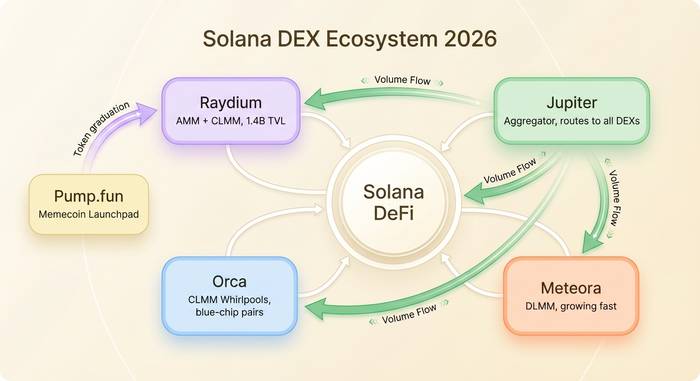
This is the part that changed everything for Raydium. In 2024 and 2025, Solana became the epicenter of memecoin trading. Pump.fun launched millions of tokens. And every single one that graduated from Pump.fun's bonding curve migrated to a Raydium AMM pool.
Here is how that works. On Pump.fun, new tokens start with a bonding curve where early buyers get in cheap and the price rises with each purchase. When a token hits a market cap threshold (roughly $69,000), it "graduates." Pump.fun deposits the accumulated SOL and the remaining token supply into a new Raydium standard AMM pool. From that point, the token trades on Raydium like any other Solana asset.
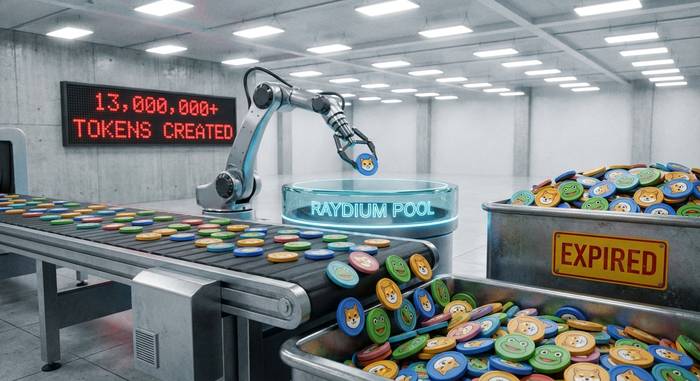
The numbers are wild. Pump.fun generated over 13 million tokens in 2025. Even though 98.6% of those tokens eventually collapsed, the ones that survived drove enormous trading volume through Raydium. At peak memecoin activity, Raydium was processing more daily volume than Uniswap on certain days.
This created a flywheel. More tokens on Raydium meant more trading activity. More trading meant more fees. More fees attracted more liquidity providers. Deeper liquidity made Raydium the default choice for any Solana project launching a token. Whether you were building a serious DeFi protocol or a joke coin with a dog logo, your token ended up trading on Raydium.
The relationship with Pump.fun is not a formal partnership. It is an ecosystem dependency. Pump.fun chose Raydium as the graduation destination, and that single integration made Raydium the most active DEX in the Solana ecosystem.
Raydium vs Jupiter vs Orca: where Raydium fits
Solana has multiple DEXs. Raydium is not the only game in town. Jupiter is the dominant aggregator. Orca runs its own concentrated liquidity pools. Meteora is growing fast. How do they relate?
Jupiter is not a direct competitor. Jupiter is an aggregator, like 1inch on Ethereum. It scans Raydium, Orca, Meteora, and other Solana DEXs, then routes your trade through whichever combination gives the best price. A lot of Raydium's volume actually comes through Jupiter. When Jupiter routes a swap through a Raydium pool, Raydium LPs earn the fees.
Orca is a direct competitor. It runs its own concentrated liquidity pools (called Whirlpools) and competes for the same LP capital and trading volume. Orca tends to dominate in stablecoin and blue-chip pairs (SOL/USDC, etc.) while Raydium captures more long-tail and memecoin liquidity.
Meteora emerged as a strong third player, especially with its Dynamic Liquidity Market Maker (DLMM) product that helps LPs manage volatile pairs more efficiently.
| DEX | Type | Strength | Weakness | Memecoin exposure |
|---|---|---|---|---|
| Raydium | AMM + CLMM | Pump.fun graduation pipeline, deepest long-tail liquidity | Less UI polish than competitors | Extremely high |
| Jupiter | Aggregator | Best execution across all Solana DEXs | Not a DEX itself, depends on underlying pools | Indirect (routes through Raydium/Orca) |
| Orca | CLMM (Whirlpools) | Strong for blue-chip pairs, clean UI | Less memecoin activity | Medium |
| Meteora | DLMM | Innovative LP tools, growing fast | Smaller TVL | Growing |
The honest picture: Raydium owns the memecoin layer. Every Pump.fun graduate lands there. Orca owns the premium swap experience for established tokens. Jupiter sits on top as the router that sends volume to both. They are more complementary than competitive in practice, though they do compete directly for LP deposits.
The RAY token
RAY is Raydium's native token. Total supply is 555 million, all minted at launch. About 263 million are in circulation as of 2026.
What RAY does:
- Governance: RAY holders vote on protocol proposals
- Staking: stake RAY to earn a share of trading fees (the 0.03% cut from standard AMM pools)
- Farm rewards: RAY is distributed as incentive to liquidity providers in certain pools
The token allocation from launch: 34% mining reserve, 30% partnerships and ecosystem, 20% founding team, 8% liquidity, 6% community and seed, 2% advisors.
RAY trades at about $0.64 in April 2026 with a market cap of roughly $170 million. It peaked above $16 during the Solana bull run, crashed under $0.20 after the FTX collapse, and has lived in between since. The token's value tracks Solana trading activity closely: when volume spikes, more fees flow to stakers and LPs, and RAY price follows.
| RAY token snapshot | Value |
|---|---|
| Total supply | 555 million |
| Circulating supply | ~263 million |
| Token allocation (team) | 20% |
| Token allocation (mining) | 34% |
| Trading fee split | 0.22% to LPs, 0.03% to RAY stakers |
| Primary utility | Governance + staking rewards + farming |
The 2022 exploit and recovery
In December 2022, Raydium was hit by an exploit. An attacker compromised a private key belonging to the pool owner authority account, which had admin access to withdraw fees from liquidity pools. The hacker drained approximately $4.4 million worth of tokens across multiple pools.
Raydium's response was faster than most. The team identified the vulnerability, patched the admin access, and removed the compromised authority. A compensation plan was put together for affected LPs. The protocol did not shut down. Trading continued on unaffected pools within hours.
The exploit was not a smart contract bug. It was a key management failure. One compromised key gave the attacker access to accumulated fees. Raydium fixed this by redesigning the admin authority structure so that no single key could drain pool funds.
Three years later, the exploit is a footnote. Raydium rebuilt its security, grew its TVL back, and benefited massively from the 2024-2025 memecoin wave. But the incident is worth knowing about because it shows that even established DeFi protocols have operational risks beyond smart contract code.
Is Raydium allowed in the US?
Raydium does not restrict US users from accessing the protocol directly. The smart contracts are permissionless and anyone with a Solana wallet can interact with them. However, Raydium does not operate as a registered exchange in the United States, and using the platform may carry regulatory risk depending on future enforcement.
Jupiter, which routes through Raydium, also does not block US users. Most Solana DeFi remains accessible globally without geo-restrictions, unlike some Ethereum-based protocols that have added IP blocks.
This could change. As US regulation develops, Solana DeFi protocols may face the same compliance questions that Ethereum projects have dealt with. For now, access is open but the legal status is unresolved.