DeBank: DeFi Portfolio Platform, Rabby Wallet, and Web3 Social App
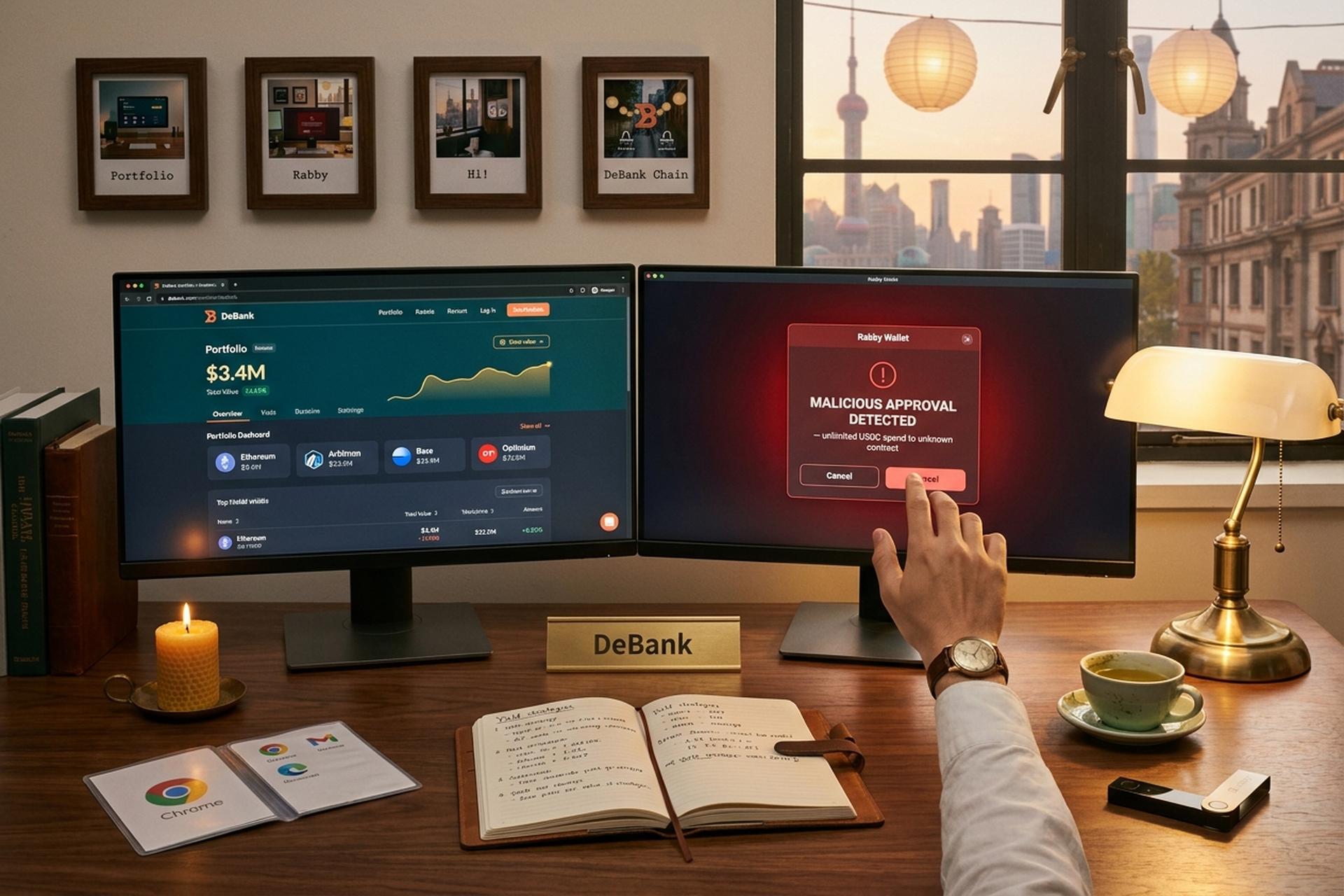
DeBank started in 2018 as a way to see all your DeFi positions in one place. By 2026 it is several things at once. A portfolio tracker covering more than a thousand DeFi protocols across dozens of chains. A self-custody EVM wallet called Rabby. A Web3 social network called Hi!. And an OP Stack Layer 2 on Ethereum that the company itself runs. The shorthand "DeFi portfolio tracker" no longer covers the surface area of what DeBank actually ships.
This rewrite goes through the four pieces of the DeBank stack — what each one actually does, what works and what doesn't, where the company stands competitively in 2026, and the long-running question of whether there will ever be a DeBank token. The article is written for readers who already understand DeFi at a basic level and want to know whether DeBank is the right tool for their wallet.
What DeBank Actually Is in 2026: A Stack, Not a Tracker
DeBank was founded in 2018 in Shanghai by Tang Hongbo and Xu Yong. The original product was a clean dashboard that read public on-chain data and surfaced a user's DeFi positions, balances, and yield across multiple protocols. Eight years later, the dashboard is still the public face — but the company sits on a layered platform that also includes a wallet, a social product, an L2 chain, and a paid developer API.
In December 2021 the team raised $25 million at a $200 million valuation in a round led by Sequoia China, with Coinbase Ventures, Circle, Crypto.com, Ledger, Dragonfly Capital, and Hash Global participating as strategic investors. That is the only named round on the public record, and DeBank has not raised announced capital since. The investor list matters. It explains the integrations the platform later quietly delivered. Circle-issued USDC support is native. Coinbase coverage is unusually granular. Ledger hardware support in Rabby is first-party rather than a community contribution.

The Portfolio Layer: Tracking DeFi Across Chains
The portfolio dashboard is still where most users meet DeBank for the first time. Connect a wallet, or paste in any public address. The platform pulls real-time positions from across the chains and protocols it indexes. That includes tokens, LP positions, staked assets, lent and borrowed positions, yield-farming deposits, and NFTs. Each item is valued in USD with a 24-hour change figure.
Public sources disagree on exact numbers. BitDegree counts roughly 800 protocols across 15 chains. Bitget Academy reports more than 1,300 protocols across more than 35 chains. DeBank's own homepage no longer prints a precise figure. The safe summary is more than a thousand DeFi protocols across dozens of EVM chains. Ethereum, Arbitrum, Optimism, Base, Polygon, and BNB Chain are all natively supported.
The free tier covers the basics. Paid features include the Time Machine (compare your portfolio between any two historical dates), deeper transaction history analysis, larger follow lists for tracking other wallets, NFT and PnL accounting, and customizable profile elements. Gate.io's ecosystem write-up cites roughly 2.5 million registered users and around 80,000 daily active users on the portfolio side, though those figures are single-source and worth treating as directional.
For developers, DeBank Cloud exposes most of the same data through an OpenAPI surface. The public Pro tier offers 100 requests per second; higher limits are quoted directly to enterprise customers, mostly wallets, exchanges, and on-chain analytics shops that need normalized DeFi balance and position data without building their own indexer.
Rabby Wallet: DeBank's Self-Custody Browser and Mobile EVM Wallet
The most quietly important product in the stack is probably Rabby Wallet. DeBank launched it as a Chrome extension in 2021. The wallet has since added a desktop application and iOS and Android mobile apps. Rabby is a self-custodial EVM wallet covering more than 100 EVM-compatible chains. It is open-source on GitHub and audited annually by SlowMist, with the most recent report dated August 2025, plus additional Least Authority audits.
The feature that distinguishes Rabby from MetaMask, Phantom, and the rest is pre-signing transaction simulation. Before a user confirms any transaction, Rabby spins up a fork of the relevant chain and replays the transaction against it. It then shows in plain language exactly what will happen. Which tokens leave the wallet. Which approvals are granted. What gas the transaction burns. What state changes occur. If a dApp tries to drain your wallet through a malicious approve() call, Rabby flags it before you sign.
That feature matters. Wallet-drainer scams remain the single largest source of consumer crypto losses. The Chainalysis Crypto Crime Report tracks billions in drained funds annually from approval-based phishing alone. Most affected wallets sign because their interface tells them they are approving "Token X." It does not show that the spender is an attacker contract. Rabby's simulation closes that gap.
Other notable Rabby features include automatic chain switching, hardware-wallet support for Ledger and Trezor, and a built-in token approval manager that reads from the DeBank backend. Chain switching detects which chain a dApp expects and offers to switch you. Privacy is by design. Rabby does not require an account. It does not transmit private keys. It operates entirely client-side.
The wallet's monthly active users have not been disclosed publicly. The Chrome Web Store shows install counts in the hundreds of thousands, which puts Rabby in the same tier as the smaller MetaMask competitors. Among Web3-native developers and the security-conscious portion of the DeFi crowd, Rabby has become the default recommendation for new users in 2025–2026.
DeBank Hi!: A Web3 Messenger That Pays for Attention
DeBank Hi! launched in October 2022 as a Web3-native messaging product. The team calls it "Attention-as-a-Service." The mechanic is unusual: senders pay tokens to message a recipient, and the recipient earns those tokens for reading. The premise is that high-value wallet addresses have scarce attention that the market already prices. Think institutional treasury operators, well-known protocol founders, influential traders. A small fee gates spam while compensating attention.
Each Hi! user has an on-chain Web3 ID tied to their wallet address. The ID is a mintable credential that establishes identity for messaging, comments, posts, and the platform's social graph. Minting costs vary by tier; the older premium tier ran around $96, while more recent tiers start at roughly $25. Posts and replies on Hi! are timestamped on-chain, which produces a verifiable record of who said what.
Gate.io's 2025 DeBank ecosystem report cites 3.2 million Hi! users, though that figure is single-source and the team has not published its own metric. What the product clearly is, in 2026: the most-used Web3-native social product attached to a major DeFi platform, with a model that explicitly monetizes the attention economy that Twitter and Farcaster do not.
DeBank Chain: The OP Stack L2 Behind the Brand
In July 2024 DeBank launched its own Layer 2, called DeBank Chain, built on the OP Stack and settling to Ethereum. The mainnet went live on July 19, 2024. The team's framing positions DeBank Chain as the settlement layer for Hi! interactions, Web3 ID mints, and the on-chain components of the broader ecosystem, not as a general-purpose L2 competing with Base or Arbitrum.
The L2BEAT scaling dashboard tells a sober story. As of May 2026, DeBank Chain's Total Value Secured is roughly $447,000. The chain runs on a single sequencer and a single proposer. A 2-of-4 DeBank multisig controls upgrades. No live fraud-proof system is in operation yet. Data is posted to Ethereum at an average of 1.97 MiB per day. That totals around 721 MiB across the April 2025 to April 2026 window.
In practical terms, that means DeBank Chain in mid-2026 is still effectively a permissioned chain operated by DeBank — fast and cheap for users of DeBank's own products, but not yet a credible neutral execution environment. Gate.io and similar promotional write-ups cite "350,000+ wallet addresses" and "4,000 TPS" capacity, but L2BEAT's verified activity data doesn't support those numbers as sustained operational metrics.
Web3 ID, Approvals, and the Tools Around the Edges
A handful of smaller DeBank products are worth knowing about. Web3 ID, mentioned above, is the company's on-chain identity primitive. It is used for Hi! but also for governance signals, badge collection, and reputation features across the broader platform.
The Approval tracker at debank.com/approve is a Revoke.cash-style scanner. It walks all of a wallet's token approvals across every supported chain and offers one-click revocation. Approving infinite spend allowance to a dApp once is convenient. Leaving that approval live forever is a known source of loss, especially when the contract has since been compromised. The Approval tracker makes auditing those allowances trivial.
DeBank Stream surfaces real-time wallet activity for any address the user follows (large transfers, swaps, mint events, position changes), which makes it functionally a wallet-feed analogue to Etherscan's transaction view, but cross-chain and surfaced as a social feed. Power users build watchlists of smart-money wallets and treat the stream as a discovery feed for new protocols — the modern Web3 equivalent of following Bloomberg terminals at a trading desk.

DeBank Token, XP Program, and the Airdrop Question
DeBank has not issued a token. There is no on-chain governance token. There is no validator-staking token. There is no formal claim against the platform's revenue. What the company does run is an XP loyalty program launched in May 2024 that distributes points for activities across the ecosystem: using the platform, posting on Hi!, holding NFTs, providing liquidity on DeBank Chain. By the July 4, 2024 snapshot, roughly 51 million XP points had been issued to participants.
That XP program has, predictably, fueled speculation about a future $DBANK token airdrop. The team has not confirmed any allocation. They have not confirmed a snapshot date. They have not confirmed a token-generation event. Community airdrop trackers continue to list DeBank as a likely candidate. The honest answer is that the airdrop is plausible, the design choices look airdrop-shaped, but no announcement exists as of May 2026, and any deadline being quoted by third parties is invented.
How DeBank Compares: Zerion, Nansen, Zapper, Arkham
DeBank does not compete with one platform. It overlaps with several, depending on what a user actually wants. The 2026 wallet-tracker rankings from DEXTools and Nansen's own roundups slot the major players roughly as follows:
| Platform | Best at | Pricing model |
|---|---|---|
| DeBank | All-around DeFi portfolio + ecosystem (Rabby, Hi!, Chain) | Free + paid tiers; API tiered |
| Zerion | UX, mobile-first portfolio | Free + paid Pro |
| Nansen | Smart-money labeling, on-chain analytics | Subscription, professional pricing |
| Zapper | NFT-heavy portfolio, in-app swaps | Free + paid |
| Arkham | Entity intelligence, wallet attribution | Subscription |
For a typical DeFi user with positions across multiple chains who also wants a safer wallet and occasional Web3-social engagement, DeBank's combined stack is the strongest single bet. For analysts hunting smart money, Nansen and Arkham each beat DeBank on their specific edge. For NFT-heavy portfolios, Zapper still wins. The cost calculation matters too: Nansen and Arkham start at meaningful subscription prices, while DeBank's free tier covers most retail use cases. Where DeBank quietly leads on cost is the API: its Pro tier at 100 requests per second is priced into a flat plan that competitors like Covalent and Moralis hit only at enterprise commitments.
A note on payment processors. Plisio, which hosts this article, sits at a different layer entirely. Plisio is a crypto payment gateway for merchants. DeBank is a read-only tracker plus a wallet plus an L2. There is no direct integration between them. The two compose cleanly nonetheless. A Plisio merchant can route incoming USDC or ETH payouts to a Rabby wallet, then watch the resulting balance and yield in DeBank's portfolio view.