Paper Trade Stocks and Crypto Without Risk: A Beginner Guide
Most people who try to trade for a living lose. Not some of them. Most. A 2024 study by India's market regulator found that 93% of individual derivatives traders lost money across three years. A separate academic study of Brazilian day traders put the number at 97%. The pattern repeats in every market anyone has bothered to measure.
So here is a reasonable question: why would you risk real money learning a skill that wrecks nine out of ten people? You wouldn't, if you had a place to practice first. That place is a paper trade — a simulated trade that uses live market data and fake money, so the only thing you can lose is your pride. This guide covers what a paper trade is, how to start, which platforms are worth your time, how to rehearse real crypto strategies before you go live, and the one thing no simulator can ever teach you.
What a Paper Trade Is and How the Simulator Works
A paper trade is a fully specified hypothetical: you pick an asset, decide to buy or sell, set a size, and record the entry, the exit, and the result — all without a single dollar changing hands. The name is literal. Before software, traders wrote their imagined positions on paper and tracked them by hand against the newspaper quotes.
Today a trading simulator handles the bookkeeping for you, turning the concept into what practitioners call simulated trading. It pulls real-time market data, lets you buy and sell at current prices, and updates your virtual balance as the market moves. The result is a trading environment that behaves like the real one in every way but the stakes. The discipline is the same as it ever was, though. A paper trade is only useful if you treat it as a real decision and write down why you made it.
How a trading simulator fills your orders
When you place an order in a simulator, it usually fills instantly at the price you clicked. That sounds great. It is also the first quiet lie a paper trading account tells you, and we will come back to it, because in a live market your order competes with everyone else's.
Paper trading vs a stock market simulator
People ask whether paper trading and a stock market simulator are the same thing. Mostly, yes. A stock market simulator is just one flavor of paper trading focused on equities. The broader idea covers stocks, ETFs, options, forex, and crypto. Some simulators are games with leaderboards; others mirror a real broker's platform exactly. The second kind teaches more.
Is it real or fake, and is it legal
A paper trade is fake money on real prices, and yes, it is completely legal. Nobody regulates practice. You are not placing orders on an exchange, so there is no counterparty and no settlement. The trades are real in the sense that the prices are real and your decisions are real. The profit and loss is imaginary.
Practice Trading Risk-Free Before You Go Live
The phrase "risk-free" is true for your wallet and false for your habits, and that distinction is the whole point. Paper trading is risk-free in that you cannot lose a cent. It is not consequence-free, because the habits you build, good or sloppy, are the ones you carry into the live market.
The value is reps. A new trader does not yet know how their chosen broker's order ticket works, what a stop-loss does under pressure, or how a position feels when it moves against them. Practice trading lets you make every rookie mistake for free instead of risking real money on lessons that belong in a simulator. Removing the cost of inexperience is the single best argument for it. You get to be bad at trading in private, which is exactly where you should be bad at it.
What should you actually drill? Start with the boring mechanics: practice buying and selling with both a market order and a limit order, placing each and watching how they fill differently. Set a stop-loss and let a position run into it so you see what a triggered exit looks like. Practice sizing a trade so the loss, if your stop hits, is a fixed slice of the account. These are the skills that feel obvious in a tutorial and vanish the moment a real chart is moving fast.
How to Start Paper Trading in Four Steps
Here is the mistake almost everyone makes when they start paper trading: they load up a $1,000,000 demo balance, swing it around like Monopoly money, and learn nothing that survives contact with reality. Treat the demo like it is real, or it teaches you nothing.
Choosing a trading platform that fits your assets
Pick a trading platform based on what you actually intend to trade. If you want to trade stocks and ETFs, a broker simulator is fine. If you want crypto, you need a platform with a crypto demo. Once you pick one, you open an account, flip it to demo mode, and you are trading in minutes. Matching the tool to the asset matters more than any feature list.
Setting a realistic paper trading account balance
Set your paper trading account balance to the amount you plan to fund a live account with. If that number is $2,000, trade $2,000. A position that is 30% of a real account feels nothing like the same position at 0.2% of a fantasy balance. Realistic size is what makes the practice transfer.
Placing your first simulated trades and journaling them
Now place a few simulated trades. Before each one, write down the reason, the entry, the stop, and the target. After it closes, write down what happened and how you felt watching it. That journal, not the profit and loss, is where your trading strategies get refined. A trader who reviews thirty logged trades learns more than one who places three hundred and remembers none.
Best Paper Trading Platforms for Stocks and Crypto
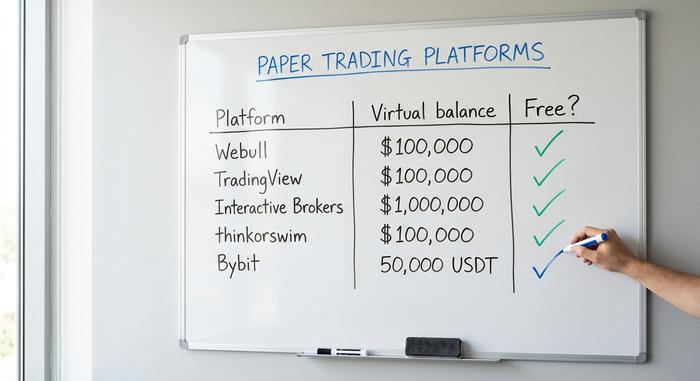
You should choose the best paper trading platform by the realism of its fills and the asset it covers, not by the size of the fake balance it hands you. A bigger pretend account is not a better one. Below are the simulators most worth your time, across stock trading and crypto.
| Platform | Assets | Virtual balance | Free | Best for |
|---|---|---|---|---|
| Webull | Stocks, ETFs, options | $100,000 | Yes | Mobile-first beginners |
| TradingView | Stocks, forex, crypto, futures | $100,000 | Yes | Charting and strategy testing |
| Interactive Brokers | Almost everything | $1,000,000 | Yes | Advanced, multi-asset |
| Schwab thinkorswim | Stocks, options, futures, forex | $100,000 | Yes | Options practice |
| Bybit Demo | Crypto spot and futures | 50,000 USDT + more | Yes | Crypto derivatives |
Webull gives a clean mobile app and a $100,000 demo for stocks and options. TradingView, which offers paper trading with a default $100,000 virtual balance, is the one I reach for when testing chart-based ideas, since it covers crypto and lets you script strategies in Pine Script. Schwab's thinkorswim is the classic for options. For crypto, an exchange demo such as Bybit is the realistic choice because it mirrors the live trading interface exactly.
Test Crypto Trading Strategies Without Risk
This is where paper trading earns its keep for crypto, and where it leaves every stocks-only guide behind. Crypto derivatives are brutal for beginners. In 2025, traders lost roughly $150 billion to liquidations, and on a single day in October over $19 billion was wiped out, with 85 to 90% of those positions on the long side. Perpetual futures now make up around 78% of all crypto derivatives volume. You can learn how that machine eats people for free, in a demo, instead of paying it. It is also the safest place to try new strategies, because the worst case is a blown-up pretend account.
Rehearsing DCA and spot entries
Start with the calm stuff. Use the simulator to test a dollar-cost-averaging plan or a set of spot entries: buy a fixed amount on a schedule, or scale into a position at planned levels. There is not much to blow up here, but you will learn how your platform handles partial fills and how a plan feels when the price keeps dropping after your first buy. A crypto exchange demo such as Bybit hands you a fat virtual balance (tens of thousands in stablecoins plus a little fake Bitcoin and Ethereum) on the same screens as the live exchange, so the muscle memory carries over when you switch to real funds.
Scalping and why the fills lie to you
Scalping in a simulator is where the illusion gets dangerous. The demo fills your order at the exact price you see, instantly. The real market does not. Spreads widen, liquidity vanishes in a fast move, and your "guaranteed" entry slips. If your scalping strategy only works because of perfect simulated fills, it does not actually work. Treat every scalp result with suspicion.
Futures, leverage, and liquidation math
Futures are where you should spend most of your demo time and none of your early real money. Open a leveraged position, set it too large on purpose, and watch the liquidation price creep toward you. Do it ten times. Learn exactly how much a 5x or 20x position can move before the exchange closes it and takes your margin. I learned more about leverage from liquidating a demo account a dozen times than from any explainer I ever read. This is the cheapest lesson in crypto, and the simulator is the only place to take it before you go live.
Paper Trading vs Live Trading: The Psychology Gap
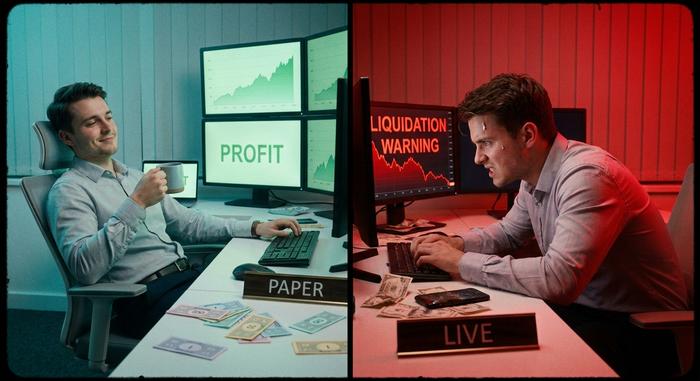
Now the honest part. A paper trade removes the one variable that actually breaks traders: money on the line. Fear and greed only show up when there is real money on the line. The simulator deletes the exam and hands you a practice sheet with the answers already filled in.
This is not a small footnote. Brokers and educators routinely observe that demo win rates run well above live results for the same person in their first months, and the reason is simple — nobody panic-sells a paper position at the bottom or doubles down out of fear. The classic finance study by Barber and Odean tracked real brokerage accounts and found the most active traders earned 11.4% against a 17.9% market return, and pinned the gap on overconfidence. Paper trading, left unchecked, manufactures exactly that overconfidence. You feel like a genius right up until your own money is at stake.
| Factor | Paper trading | Live trading |
|---|---|---|
| Money at risk | None | Real |
| Order fills | Instant, ideal | Slippage, partial fills |
| Emotional pressure | Almost none | High |
| Win rate signal | Often flattering | Honest |
Where Paper Trading and Demo Brokers Fall Short
Beyond psychology, the simulator lies by omission, and a good trader knows the list. Most demo brokers give you instant ideal fills, infinite liquidity, and no real spread. A live account gives you slippage, partial fills, commissions, and a market that moves while you hesitate. None of that friction exists in practice.
Fees are the quietest gap. A demo rarely subtracts the spread or the commission, but in a live account those costs come off the top of every trade. A strategy that nets a few cents per share is profitable on paper and underwater once the broker takes its cut and the spread eats the rest. If you trade often, model the fees by hand before you trust any demo result.
Fast strategies suffer the most. Manual paper trading and even most simulators cannot fairly test high-frequency scalping, where real-world execution and fees decide whether you make money at all. Market conditions matter too: a strategy that prints in a quiet demo can fall apart in a volatile real trade when everyone is hitting the exit at once. The simulator shows you the chart. It hides the stampede.
Who Should Paper Trade and for How Long
Beginners should paper trade until two things are true: they have a written plan, and that plan is green across thirty to forty trades in different market conditions. Experienced traders should paper trade only when learning a new platform or testing investment strategies that are genuinely new to their playbook. And nobody should paper trade forever. Past a point it becomes procrastination dressed up as preparation. The goal was never to win a game. It was to stop making dumb mistakes before they cost you.
Build Trading Skills That Survive Real Money
Use the demo for what it is good at: killing the avoidable errors, learning the order ticket, and proving a strategy is not obvious garbage. That is how you sharpen your investment process without paying for it. Then size in with real money — small, almost insulting amounts — because the only way to learn the part the simulator hides is to feel a real loss you can shrug off. Paper trade to remove the stupidity. Go live, tiny, to learn the rest. Which of your strategies do you actually believe in enough to fund?