Webull Crypto Review: Trading Coins, Stocks and ETFs

You can buy Bitcoin on Webull in about two taps. You can never move it off the app. Hold those two facts side by side and you already understand most of what Webull crypto is, and most of what it isn't.
Webull is a self-directed brokerage first and a crypto venue a distant second. It built its name on commission-free stock and options trading, then bolted a crypto buy-and-sell feature onto the same screen. For a lot of people that is exactly enough. For anyone who thinks of crypto as something you own and control, it falls short in ways the marketing never spells out. This review walks through how crypto actually works on Webull, what it costs, what the platform quietly won't let you do, and when a real exchange is the better call.
What Webull Corporation Actually Is
Start with the company, because it explains the product. Webull launched in 2016 and runs out of St. Petersburg, Florida. In April 2025 the parent, Webull Corporation, went public on the Nasdaq through a SPAC merger and now trades under the ticker BULL. So the same firm selling you a Bitcoin balance is itself a listed stock you could buy on its own app.
The scale is real. Webull reported 27.6 million registered users and 5.1 million funded accounts in the first quarter of 2026, with about $24 billion in customer assets, according to its Q1 2026 results. Customer assets were up roughly 90% year over year, and full-year 2025 revenue came in at $571 million on net deposits of $8.6 billion. This is a serious trading business that turned its first annual profit in 2025.
One word in the marketing tells you how the company sees itself: self-directed. Webull does not give you advice or manage a portfolio for you. You make every call. That suits confident traders, and it is also why the crypto experience is built for buying and selling rather than for the things a crypto holder usually wants to do next. Crypto is a small, recent feature inside a stock business, and that framing matters for everything below.
How Crypto Trading Works on the Webull App
Crypto on Webull is custodial buy-and-sell, run through a third-party custodian, presented as cleanly as the rest of the app. You fund your account, tap a coin, enter a dollar amount, and confirm. There is no separate wallet to set up and no seed phrase to write down. That convenience is the whole pitch, and it is also the whole catch.
Which coins you can actually buy
Webull pulled crypto from its US app in 2023, then brought it back into the Webull mobile app in August 2025. At the relaunch it listed more than 50 coins, and the current marketing page claims 70-plus. The usual majors are there: Bitcoin, Ethereum, Solana, Litecoin, Cardano, Avalanche, and a rotating set of large-cap altcoins. The minimum order is one dollar, so you can test the flow without committing much.
How an order is filled
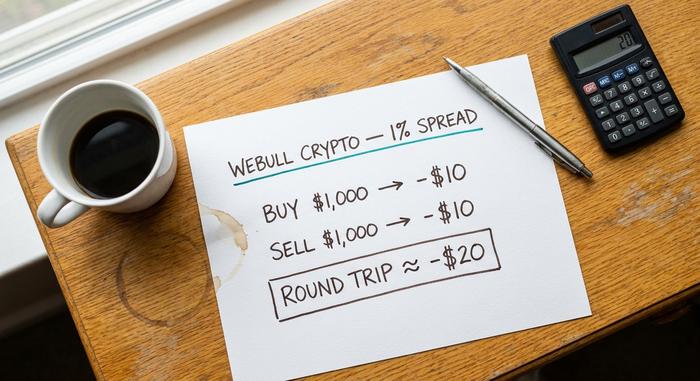
There is no flat commission. Instead Webull charges a 1% spread on each side of the trade, per its own fee disclosure. Buy a coin and you pay 1% over the reference price; sell it and you pay 1% under. Stablecoin conversions are quoted without that spread. Put real numbers on it: a $1,000 Bitcoin buy costs about $10 going in, and another 1% when you sell, so a quick round trip gives up roughly $20 before the price has done anything. It is simple to understand, which is more than you can say for some exchange fee tables.
Custody: who holds the keys
Here is the part the app does not advertise. Your coins sit with an institutional custodian, not in a wallet you control. Webull moved that custody to Coinbase Prime in 2025, replacing its earlier provider. Coinbase Prime is a respected institutional custodian, so this is not a fly-by-night arrangement. But it changes the question you should be asking. On a real exchange you can argue about whether to leave coins on the platform or move them to your own wallet. On Webull there is no second option to weigh, and that is the part I keep coming back to. Practically, you are holding a claim on a balance that Webull and its custodian manage for you. You see a number go up and down. You do not hold the asset itself — and you cannot choose to.
What the Webull Platform Won't Let You Do
The biggest crypto limitation on Webull has nothing to do with fees. The coins simply are not yours to move. If your mental model of crypto is self-custody, this is where the Webull platform and a real exchange part ways. The short version:
| What you might do with crypto | On Webull? |
|---|---|
| Buy and sell for US dollars | Yes |
| Watch live prices and charts | Yes |
| Withdraw coins to an external wallet | No |
| Trade coin-to-coin pairs | No |
| Stake for yield | Limited |
| Send or spend on-chain | No |
No external wallet withdrawals
US users cannot withdraw crypto from Webull to an outside wallet. You can buy it and you can sell it back to dollars, but you cannot send your Bitcoin to a hardware wallet, to a friend, or to a self-custody address. The crypto you "own" lives and dies inside the app. For a stock that is normal. For crypto it defeats half the point.
No crypto pairs, limited staking
You also cannot trade one coin directly for another. Every trade routes through your cash balance. Staking was announced as a Coinbase-powered feature, but it has stayed limited, with no clear published yield for most users. So the toolkit that crypto-native users expect — on-chain transfers, coin-to-coin swaps, real staking — mostly is not here.
What custody means for your risk of loss
People repeat "not your keys, not your coins" so often it sounds like a slogan. On Webull it is just a description. Because you never hold the private keys, you cannot spend the crypto directly, move it to a cheaper venue, or use it in any application off the platform. If you want to actually use Bitcoin rather than watch its price, you will eventually need a setup where you control the wallet. A good primer on running your own cryptocurrency wallet is worth reading before you decide Webull is enough.
Fees, Spreads and Real-Time Market Data Costs
On the stock side, Webull is hard to beat on price. Stock, ETF, and standard options trades carry no commission. The crypto spread is where the math gets more interesting, and it sits in the middle of the pack rather than at the bottom.
| Venue | Crypto trading cost | Notes |
|---|---|---|
| Webull | 1% spread per side | No commission, $1 minimum, no external withdrawals |
| Coinbase (simple buy) | ~1.49% and up | Convenient, expensive for small buys |
| Kraken (Instant Buy) | ~2% | Higher than Kraken Pro |
| Coinbase Advanced | 0.05%–0.60% taker | Cheapest, but a steeper learning curve |
Read that table as a tradeoff, not a verdict. Webull undercuts a casual Coinbase or Kraken buy, based on each platform's published pricing, while a pro trading interface still wins on raw cost. Watch the edges, too. Webull charges a $75 outbound transfer fee if you move your brokerage account elsewhere, and real-time Level 2 market data sits behind a paid subscription rather than coming free. A Webull Premium plan unlocks deeper data and cash management features that pay a higher rate on idle balances, recently around 3.6% APY, but the subscription is required to get there. Foreign-stock and OTC trades cost more than the headline "zero commission" suggests as well. None of that is unusual for a broker. It just adds up if you are an active trader, and it is worth pricing before you assume the whole app is free.

Is Webull Safe? FINRA, SEC and SIPC Coverage
Webull is a regulated US broker, and that is not a small thing. The brokerage entity, Webull Financial LLC, is a FINRA member, registered with the Securities and Exchange Commission, and a member of SIPC. Your securities are protected up to $500,000, including a $250,000 cash sub-limit, if the broker itself fails.
Read the disclosure carefully, though, because the protection has an edge. SIPC covers stocks and cash, not crypto. Your coins are not SIPC-insured and not FDIC-insured. SIPC also does not protect you against market losses; it steps in only if the broker itself fails and your assets go missing. With crypto, even that narrow backstop is absent, and you are additionally trusting the custodian in the chain to keep the coins safe. Webull has also drawn past scrutiny over its China ties and data-security practices, which is worth knowing even though it has continued to operate as a registered US broker. Safe for stocks does not automatically mean safe for crypto in the same way.
Webull Crypto vs a Dedicated Crypto Exchange
This is the decision that actually matters, and it comes down to what you want crypto to do. If you want price exposure in one app, next to your shares, with a clean interface and a quick tax summary, Webull does that well. If you want to own, move, spend, or stake your coins, you need a different rail.
| Capability | Webull | Dedicated exchange |
|---|---|---|
| Buy and sell coins | Yes | Yes |
| Withdraw to your own wallet | No | Yes |
| Coin-to-coin pairs | No | Yes |
| Staking | Limited | Common |
| Number of coins | 50–70+ | Often hundreds |
| Self-custody possible | No | Yes |
| SIPC on the crypto | No | No |
A dedicated exchange plus a self-custody wallet lets you take coins on-chain, send them, and even spend them. That last step is its own ecosystem; merchants that want to take digital assets typically use a dedicated crypto payment gateway rather than a brokerage. There is also a tax angle worth flagging: because you can never move coins off Webull, every position has to be closed back into dollars on the platform, which keeps records tidy but removes any option to transfer, gift, or hold long-term in your own wallet. Webull is a closed loop: dollars in, a price ride, dollars out. A real exchange is an open door.
Stocks, ETFs and Options for Self-Directed Traders
Step back from crypto for a second, because it is not why most people open the app. Webull is built for self-directed traders who like charts, options, and extended hours. The advanced tools are the draw: paper trading to practice, Level 2 depth, customizable charting, and a desktop platform that holds up for active use.
The depth here is the real selling point. Paper trading lets you rehearse a strategy with fake money before risking real cash, which is rare among free apps. Level 2 data shows the order book rather than just the last price, and the screeners and charting hold up for someone who watches markets daily. If you trade options or futures, the analytics are a genuine step above the beginner apps.
The gaps are specific. There are no mutual funds, the OTC selection is thin, and foreign-stock trades cost more. None of that touches the crypto experience, but it tells you who the Webull trading platform is really for: an intermediate stock and ETF trader who wants a little crypto on the side, not a crypto-first user. If you came for the coins alone, you are using a stock app that happens to sell crypto, and the limits will start to chafe quickly.
The Bottom Line on Webull Crypto Today
Webull crypto is a convenience feature welded onto a strong trading app. For a quick Bitcoin position sitting next to your shares, with a fee that beats a casual exchange buy and a tax report that arrives in one place, it does the job. The moment you want to control your coins, move them, stake them, or spend them, the walls show up fast, and a real exchange paired with your own wallet becomes the answer.
So the question to settle before you tap "buy" is not which app has the slickest screen. It is what you actually want crypto for. Decide that first, and the right rail picks itself.