Best Crypto Exchange in Europe 2026: MiCA-Licensed Picks

The list of crypto exchanges Europeans can legally use just got a lot shorter. When the EU's MiCA grandfathering window closed on 1 July 2026, every platform serving EU customers needed a full license or had to stop. Most did not have one. By the deadline, more than 80% of crypto firms operating in the bloc were still unlicensed, and only around 14 trading platforms held full authorization.
That changes what "best" even means. A year ago, picking the best crypto exchange in Europe was about fees and coin selection. Now the first question is simpler and harder: is it actually licensed to take your money? Binance, the largest exchange in the world by volume, was rejected for a license in Greece and spent the run-up to the deadline warning EU users. Size, it turns out, is not the same as permission. This guide ranks the European exchanges worth using, starting with the one filter that now sits above all the others: the license. We will cover who holds it, what each platform charges, how they handle euros, and where the safety claims hold up, so you can match an exchange to the way you actually trade.
Why "licensed" is the new "best" under MiCA
MiCA, the Markets in Crypto-Assets regulation, pulled off something the EU had never managed: one license for the whole bloc. Get authorized as a crypto-asset service provider, a CASP, in any single member state, and that approval passports across all 30 EU and EEA markets. One regulator. One rulebook. The entire bloc.
But the license is no rubber stamp. By mid-2026 regulators had cleared about 231 CASPs across the EU and EEA, and only a sliver of those are actual trading exchanges. The rest are wallets, brokers, and custodians. The 1 July deadline came with no grace period. Miss it, and you lose the right to serve EU users overnight. That is why the field thinned so fast. Some venues geoblocked Europeans without warning. Others sold their order books to a licensed rival or just went dark. For you, the user, that is the real danger of an unlicensed exchange: it can disappear from your country with your money still inside.
And it is not a formality you can fake your way past. To get a license, a cryptocurrency exchange has to hold capital, keep your funds separate from its own, disclose how it operates, and run anti-money-laundering checks to one EU standard. That is the floor. Every platform below has cleared it.
Why does this matter to you? Because Europeans are not dabbling anymore. Eurozone crypto ownership hit 9% of adults in 2024, double the 4% of 2022, per an ECB survey. Euro trading volume reached roughly €362 billion in 2025, up 31% in a year. When that much money is moving, the gap between a MiCA-licensed exchange and an unlicensed one is the gap between a regulated counterparty and a wish. So the best crypto exchange in Europe now starts with one non-negotiable: the license.
| Europe crypto, by the numbers | Figure |
|---|---|
| Eurozone adults owning crypto (2024) | 9% (up from 4% in 2022) |
| EUR-denominated trading volume (2025) | €362B (+31% YoY) |
| Ownership: Netherlands / Germany / France | 20% / 17% / 11% |
| Authorized CASPs across the EU and EEA | ~231 |
| Fully authorized trading platforms | ~14 |
How we ranked the best European exchanges
These are the criteria used to rank the best crypto exchanges in Europe, starting with the filter that now sits above everything else. License first. An exchange that cannot legally operate in the EU does not make the list, however low its fees. After that, the ranking weighs the things you actually feel day to day:
- Fees, including the spread and deposit or withdrawal costs, not just the headline trading rate.
- EUR access through SEPA, since a free euro on-ramp beats a cheap trade you can only fund by card.
- Coin selection and liquidity, which decide whether you can buy what you want without moving the price.
- Security track record, because a clean history and cold storage are worth more than a slick app.
- Ease of use and support, which matter most to newer users.
We leaned on the official ESMA register and each platform's own disclosures, then sense-checked the fees and security claims against independent reviews. No exchange paid for its place, and none is a perfect fit for everyone.
Gensler-era securities regulators like to point out that finance is distinctive because firms are handling other people's money. That is the bar here. A license proves a platform cleared the rules. The rest of this list is about which one earns the trust on top of it.
Best crypto trading platforms in Europe for 2026
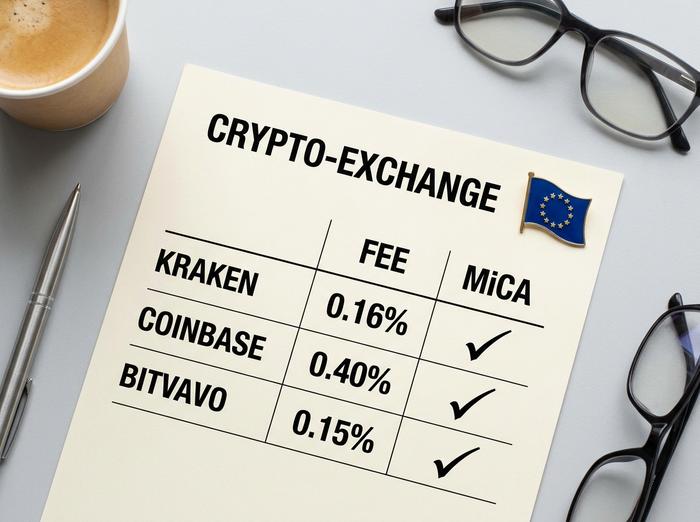
Fees below are representative spot rates and move often, so confirm the current numbers before you fund an account. Remember that trading fees are only part of the cost: deposit method, withdrawal charges, and the spread baked into a simple buy can matter more than the headline rate. Every platform in this table holds a MiCA license.
| Exchange | MiCA license (regulator) | Spot fee (approx.) | EUR via SEPA | Best for |
|---|---|---|---|---|
| Kraken | Ireland (Central Bank) | 0.16-0.40% | Free | Overall, security |
| Coinbase | Luxembourg | 0.6-1.2% | Free deposit | Beginners |
| Bitvavo | Netherlands (AFM) | 0.15-0.25% | Free | Low EUR fees |
| Bitpanda | Austria (FMA) | up to ~1.49% | Instant | All-in-one |
| Bitstamp | Luxembourg | 0.30-0.50% | Free | Long track record |
| Crypto.com | Malta | 0.25-0.50% | Supported | Card and app |
| OKX EU | Malta | ~0.35% | Supported | Advanced trading |
Kraken: best overall
Kraken is the one I would hand to most people. It was among the first major global exchanges to win a full MiCA license, granted through the Central Bank of Ireland, and it has run since 2011 without a major breach, which in this industry is its own headline. Spot fees sit in the 0.16-0.40% range from maker to taker fees, among the lower fees you will find on a regulated venue, and liquidity is deep enough to fill large orders cleanly. Beyond plain Bitcoin buys it supports margin and futures for active crypto trading, with a security posture that is genuinely conservative. The trade-off is a platform that can feel busy for a first-timer, though its customer support and documentation are solid once you settle in.
Coinbase: best for beginners
Coinbase is the easiest place to start. It holds a MiCA license out of Luxembourg, keeps about 98% of customer assets in cold storage, and built the cleanest onboarding in the business, so buying your first Bitcoin takes minutes. The price of that polish is the fee: the simple buy flow can run 0.6% to well over 1% once the spread is counted, so it is not where you go for low fees. Customer support is broad, with chat and phone options most rivals lack. Be honest about the other side too, Coinbase disclosed a customer data breach in May 2025, a reminder that even careful firms get tested.
Bitvavo: best low-fee EUR on-ramp
For European users who fund in euros, Bitvavo is hard to beat on cost. Licensed by the Dutch AFM, it charges roughly 0.15-0.25% on spot trades, some of the lowest fees among regulated EU exchanges, offers free SEPA transfers, and publishes proof of reserves so you can check that customer assets are backed. It lists more than 300 coins, so it covers far more than Bitcoin, and it is the market leader in the Netherlands for a reason. The feature set is leaner than Kraken's, which is the price of that simplicity.
Bitpanda: best all-in-one
Bitpanda is the European-native option that wants to be your whole portfolio. It holds MiCA licenses from Austria's FMA plus Germany and Malta, and alongside crypto it offers stocks, ETFs, and precious metals with instant SEPA funding. The convenience costs more: its broker-style pricing can reach around 1.49%, higher than the pure exchanges. But the experience is built for newcomers, with German-language customer support and a design that does not assume you already speak the jargon. For a beginner who wants to manage a crypto portfolio alongside a few stocks and some gold in one app, that premium may be worth it.
A few more licensed names deserve a mention. Bitstamp, running since 2011 and now MiCA-authorized via Luxembourg, is the quiet veteran with a long unblemished record and fees around 0.3-0.5%. Crypto.com, licensed in Malta, pairs a popular app and Visa card with a vast coin list and mid-tier costs. OKX EU, also out of Malta, is the pick for advanced traders who want derivatives and staking under an EU license. And Gemini, which secured its MiCA license in Malta in 2025, leans on security and regulatory credibility for users who value custody over rock-bottom pricing. None topped the four above on overall balance, but each is a legitimate, licensed choice.
Binance, Bybit, and what "licensed" does not promise
Two honest caveats keep this from being a tidy story. The first is Binance. It is the biggest exchange on earth, with the deepest liquidity and the lowest headline fees at 0.1%, and it is not MiCA-licensed. Its bid was rejected in Greece, and through 2026 it operated in a shrinking set of EU countries while it sought authorization elsewhere. If regulatory certainty is your priority, the market leader is, for now, the wrong pick in Europe.
The second is Bybit, and it cuts the other way. Bybit holds a valid MiCA license from Austria's FMA, granted in May 2025. It also suffered the largest crypto hack in history three months earlier: roughly $1.5 billion drained in February 2025, an attack the FBI attributed to North Korea. The company covered the gap within 72 hours and kept operating, which is itself a sign of deep reserves. The lesson is not that Bybit is uniquely unsafe; it is that even the best crypto exchange in Europe on paper can be tested by a state-level attacker, and a license is a floor, not a guarantee. Security track record is a separate column, and you should read it. The two facts sit side by side: regulators vouch for a platform's compliance, not its immunity to a state-sponsored hacking crew. That is why this guide weighs history alongside the license, rather than treating the paperwork as the finish line.
How to choose the best crypto exchange for you
Match the platform to how you actually trade, then verify it yourself before you deposit a cent.
Start with the official source. ESMA and your national regulator publish the register of authorized CASPs; if a platform is not on it, that is your answer. Then read the fees in full, the spread and the deposit method often cost more than the trade. Funding by SEPA is almost always cheaper than a card.
From there it is about fit. Choosing the best crypto exchange in Europe starts with your use case: a first-timer is best served by Coinbase or Bitpanda for the gentle learning curve. A cost-conscious euro user should look at Bitvavo or Kraken. Someone chasing a long tail of coins or advanced order types for serious crypto trading will lean toward Kraken or OKX. If you mostly want to buy and hold Bitcoin, almost any of them works, so optimize for the lowest fees and the easiest euro funding. Check the customer support options too, because the day something goes wrong with a withdrawal is the day you learn whether a real human answers.
And if you are in the UK, note that you are under the FCA regime, not MiCA, so the licensed list looks different. Whichever cryptocurrency exchange you pick, turn on two-factor authentication, prefer platforms with cold storage and proof of reserves, and never keep more on an exchange than you need to trade.
The best European exchange comes down to fit
In the MiCA era, the best crypto exchange in Europe is a licensed one that fits how you actually trade. Kraken earns the overall nod on security and balance, Coinbase on ease, Bitvavo on euro costs, and Bitpanda on breadth. But the cheapest fee on an unlicensed venue is a false bargain, and the biggest brand is not automatically the safest. MiCA did the hard part by shrinking the field to platforms that cleared a real bar. Your job is the easy part that everyone skips. Check the register, match the features to how you trade, and only then move your money.