No KYC Crypto Exchange: How to Trade Crypto Without KYC
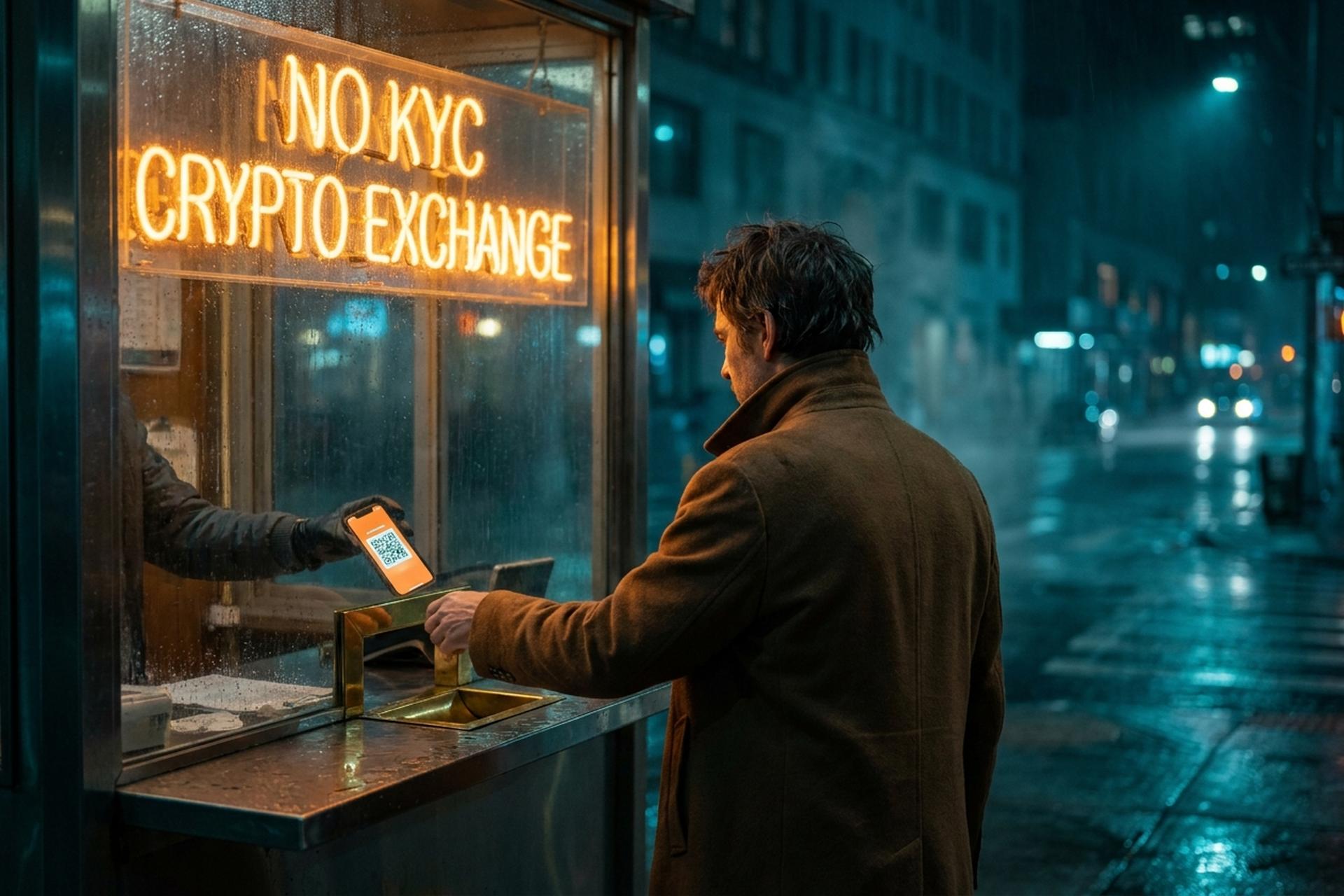
The no KYC crypto exchange most people still picture — sign up with an email, move the value of a house, never once show a passport — has mostly stopped existing at the big venues. The doors that used to be wide open closed quietly between 2021 and 2025. What replaced them is messier and more interesting. It is a patchwork of decentralized exchanges, instant swap tools, and peer-to-peer markets where the rules are different because the structure is different.
This is a practical guide, not a sales pitch. It covers what "no-KYC" actually means in 2026, why most platforms now require KYC, the categories of no-KYC crypto exchange you can still use, an honest list of the best options with their limits, and the parts nobody likes to mention, like risk and tax. The goal is simple. You should be able to trade crypto without KYC with your eyes open.
What is a no-KYC crypto exchange?
Strip it to one line. A no-KYC crypto exchange lets you trade cryptocurrency without identity verification. No government ID. No selfie. No personal information handed over before you can move a coin. KYC, short for Know Your Customer, is the identity check banks and regulated platforms run to tie an account to a real person, and a no-KYC venue skips it.
Most guides stop there, and they shouldn't, because "no-KYC" almost never means "no identity, ever." The gap matters, and it splits two ways. A decentralized exchange has no company behind it to ask who you are; you trade from your own wallet, and the software never learned your name in the first place. A centralized exchange that markets itself as no-KYC is playing a different game. You sign up with an email, trade up to some withdrawal or volume cap, and the instant you cross it, the verification screen appears.
So one is account-level identification and the other is transaction-level. That sounds like jargon. It is the whole ballgame. A platform sitting on your funds and your personal data behind a flimsy email login is nothing like one that never touched either. Hold onto that split; everything below depends on it.
Why most crypto exchanges now require KYC
Read mandatory KYC as exchanges being annoying and you miss the point. They had a gun to their head. KYC was never a product choice; it is anti-money-laundering law, and somewhere along the way the cost of ignoring it stopped being a fine and turned into a prison-shaped problem.
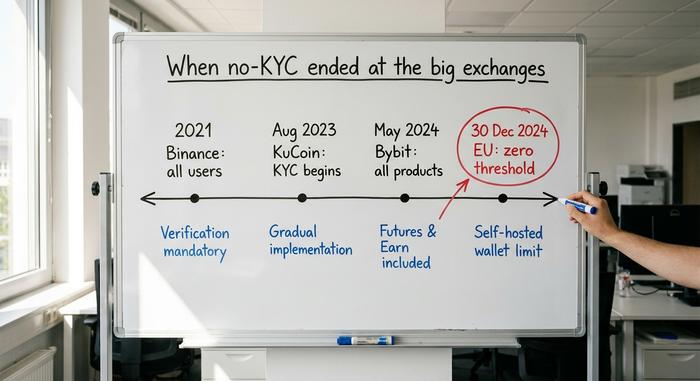
The mechanism is the Financial Action Task Force "Travel Rule," which forces platforms to collect identity data and pass it along with transfers. As of its mid-2025 update, the FATF counted 99 jurisdictions implementing it. The European Union went further and set its threshold at zero euros from 30 December 2024. Every transfer, no floor. Stay open to anonymous users under rules that strict and you are not edgy. You are exposed.
The enforcement spelled it out. KuCoin pleaded guilty in the United States and agreed to pay more than 297 million dollars, after prosecutors said it had run without real KYC until August 2023. Binance had already made verification mandatory for everyone back in 2021. Bybit followed for every product on 8 May 2024. One by one, the big venues that grew on frictionless anonymous sign-ups did the legal math and walked away from it.
| Venue | No-KYC era ended | What forced it |
|---|---|---|
| Binance | 2021 (all users) | Global AML pressure |
| Bybit | 8 May 2024 | Mandatory KYC, all products |
| KuCoin | Aug 2023 | DOJ case, $297.4M settlement (Jan 2025) |
| EU platforms | 30 Dec 2024 | Travel Rule, €0 threshold |
So the no-KYC option did not vanish. It moved to corners of the market where the Travel Rule has no one to serve a notice on.
Types of no-KYC crypto exchange explained
The single most useful thing you can learn here is that "no-KYC" is not one product. It is four, and the type you pick sets your privacy and your risk in the same stroke. They pull against each other.
Decentralized exchanges (DEXs)
A decentralized exchange is a set of smart contracts. You connect a self-custody wallet, swap one token for another, and no company ever creates an account for you. Uniswap, PancakeSwap, and dYdX are the names you will meet first. There is no withdrawal limit because there is no withdrawal; the coins live in your wallet the whole time. The trade-offs are real. You pay network gas fees, you carry smart-contract risk, and you need to already hold crypto on-chain. This is also the fastest-growing corner of the market. According to CoinGecko, DEX spot trading climbed from roughly 6.9% of all spot volume in January 2024 to about 13.6% two years later — the clearest sign that the practical center of no-KYC trading is shifting on-chain.
Instant swap services
Services like ChangeNOW, StealthEX, and Godex sit in the middle. StealthEX and Godex also support Monero swaps, making them a common route for users who want a privacy coin without an account. You do not register; you paste a receiving address, send coins, and get the swapped asset back minutes later. They custody your funds only for the length of the swap. Two honest caveats: the fee is baked into the exchange rate rather than shown as a line item, and large transactions can trip a verification request even on a "no-KYC" service. For small to medium swaps between coins, they are the least friction you will find.
P2P marketplaces
Peer-to-peer platforms like Bisq, Hodl Hodl, and RoboSats connect buyers and sellers directly, with multisig escrow holding the trade until both sides deliver. Bisq runs as a desktop app with no registration; Hodl Hodl lets you trade Bitcoin without holding user funds; RoboSats leans on the Lightning Network and throwaway identities. The privacy is excellent and so is the patience required. Settlement can take anywhere from minutes to days, and liquidity is thinner than on a big exchange. There is a fourth, weaker category worth naming. Tiered centralized exchanges like MEXC and CoinEx still allow no-KYC trading but cap withdrawals low, often a few thousand dollars a day, until you verify.
Best no-KYC crypto exchanges for 2026
There is no single best no KYC crypto exchange, and anyone who hands you a "number one" is selling something. There is a best option for each thing you are actually trying to do: swap two coins, trade on-chain, buy Bitcoin privately, or run perpetuals. Here is the honest shortlist, with the limits that matter.
| Platform | Type | No-KYC limit | US access | Best for |
|---|---|---|---|---|
| Uniswap | DEX | None (self-custody) | Yes | On-chain ERC-20 swaps |
| PancakeSwap | DEX | None (self-custody) | Yes | Low-fee BNB Chain swaps |
| dYdX | DEX | None (self-custody) | Limited | Perpetuals from a wallet |
| ChangeNOW | Instant swap | High; can trigger checks | Yes | Fast no-account swaps |
| StealthEX / Godex | Instant swap | Threshold-based | Yes | Coin-to-coin conversions |
| Bisq | P2P | None | Yes | Private BTC, full control |
| Hodl Hodl | P2P | None | Limited | Non-custodial BTC trades |
| RoboSats | P2P | Small trades | Yes | Lightning, max privacy |
| MEXC | Tiered CEX | Low daily cap | Varies | Spot and futures range |
| CoinEx | Tiered CEX | ~10k USDT/day | No | Broad altcoin spot trading |
If you already hold crypto and want to swap it without an account, an instant swap service or a DEX wins. If you want to buy Bitcoin from another person and keep custody throughout, a P2P market like Bisq or Hodl Hodl is the tool. If you want deep order books and derivatives, the tiered exchanges still let you start small before verification, though that runway is short. One more option sits slightly outside the trading frame. Payment processors such as Plisio let merchants accept crypto without forcing KYC on the customer paying, which is useful if your goal is to receive crypto privately rather than to trade it.
No-KYC vs traditional crypto exchange
The choice is a trade, not a free lunch. A no-KYC venue and a traditional cryptocurrency exchange can list the same cryptocurrencies; what differs is everything around the trade. You buy privacy and open access; you sell recourse, easy fiat, and depth. Lay it side by side and the decision gets honest.
| Dimension | No-KYC exchange | Traditional KYC exchange |
|---|---|---|
| Identity | Email or wallet only | Full identity verification |
| Custody | Often self-custody | Exchange holds your funds |
| Withdrawal limits | Low or none, by type | High after verification |
| Fiat on-ramp | Limited or absent | Bank cards, transfers |
| Recourse if hacked | Usually none | Support, sometimes insurance |
| Liquidity | Thinner, varies | Deep, tight spreads |
How to trade crypto without KYC safely
The privacy is genuine, but so is the friction, and the step people get wrong is the first one. Here is the actual flow.
Start by setting up a self-custody wallet you control, whether that is MetaMask for on-chain swaps or a Bitcoin wallet for P2P. Then fund it, which is the genuinely hard part: getting your very first crypto without any identity trail usually means buying from another person on a P2P market or using cash, because almost every fiat card on-ramp runs KYC somewhere. Once you hold crypto, pick your venue by type: a DEX or instant swap for coin-to-coin, a P2P market to buy or sell against fiat. Before you confirm a DEX swap, check the token contract address and the slippage setting; a wrong contract is how most beginners lose money on their first decentralized trade. Execute, then withdraw straight to your own address rather than parking funds on any platform, and write down the date, amount, and value of each trade. That last step is not optional, and the tax section explains why. Treat the whole flow as a habit, not a one-off; the discipline is what keeps both your privacy and your records intact.

Risks of using a no-KYC exchange
Skipping KYC does not delete risk. On any no-KYC exchange, it moves the risk off the platform's compliance desk and onto you. Treat that as the headline, not the footnote.
Custody and smart-contract risk
On a DEX, the code is the counterparty, and code gets exploited. Drained liquidity pools, malicious token approvals, and outright exit scams have cost users hundreds of millions, and there is no support line and no insurance to call. On a custodial no-KYC platform you face the older danger. The exchange holds your coins, and if it vanishes or freezes withdrawals, an anonymous account gives you almost no recourse to get them back.
Scams and counterparty risk
P2P trading introduces a human on the other side. Reversible payment methods invite chargeback fraud, where a buyer claws back the fiat after you release the crypto. Impersonation is common, and so are fake "no-KYC" front-ends that look like a real swap service and simply keep your deposit. Escrow helps; it does not make the other person honest.
Privacy is not anonymity
This is the misconception that burns people. A public blockchain is pseudonymous, not anonymous, and chain-analysis firms are good at their jobs. The moment your funds touch any KYC venue, whether an off-ramp or a centralized exchange, your identity links back to the wallet, and analysts can work outward from there. For honest context, Chainalysis put illicit crypto volume at roughly 154 billion dollars in 2025, real money, yet still under 1% of on-chain activity. Privacy and crime are not the same thing, but the tools that trace one can trace the other.
No-KYC exchanges and crypto tax
Here is the line that saves people from trouble: skipping KYC skips the paperwork, not the tax bill. Your obligation follows your residency and your activity, not the logo on the exchange.
In the United States, capital gains on crypto are reportable whether or not a platform sent you a form, and new 1099-DA broker reporting begins phasing in from 2026, which is exactly why centralized venues are racing to verify everyone. Tax authorities lean on the same blockchain analytics described above to connect "anonymous" wallets to named people. The practical consequence of going no-KYC is that recordkeeping becomes your job: every trade, its date, and its cost basis. Do it as you go, not in April.
The future of no-KYC crypto trading
Two forces are pulling in opposite directions. On one side, regulation keeps tightening. The EU's MiCA transition has wound down, the DAC8 reporting rules are coming, and the Travel Rule's zero-euro threshold leaves no anonymous gap at compliant venues. On the other, on-chain trading keeps growing, with DEX volume touching a 24.5% share of spot at its 2025 peak. The likely shape of things is plain enough. The centralized no-KYC tier keeps shrinking, while genuinely decentralized trading absorbs the demand. The space narrows at the edge that regulators can reach. It does not close.
No-KYC crypto trading: the takeaway
The honest takeaway is not "anonymity is dead" and it is not "trade freely, nobody is watching." It is that no-KYC trading in 2026 is a set of specific tools, each with a specific cost. Match the tool to the job: a DEX or swap to move coins you hold, a P2P market to buy Bitcoin privately, a tiered exchange only for small starts. The part I would underline is that privacy is a spectrum, not a switch, and that your records are now your responsibility. The real question is not whether you can still trade without KYC. You can. It is how much friction, and how much risk, that privacy is worth to you.