The best decentralized exchanges in 2026: compared by volume, fees, and chains
Decentralized exchanges processed $4.9 trillion in spot volume during 2025. Perpetual DEXs added another $8 trillion on top. In November 2025, the DEX-to-CEX spot ratio hit an all-time high of 21.2%. One in every five crypto trades happened without a centralized exchange.
That market is not one thing. It is dozens of protocols across dozens of chains, each doing something slightly different. Uniswap dominates Ethereum. Raydium and PumpSwap fight over Solana. Aerodrome owns Base. Hyperliquid took over perpetual futures and now controls 60-70% of the on-chain derivatives market. PancakeSwap runs BNB Chain.
This article compares the DEXs that actually matter in 2026 by the numbers: trading volume, TVL, fee structures, which chains they run on, and what each one does best.
What is a decentralized exchange?
No account. No KYC. No company holding your coins. You plug in a wallet, pick what you want to swap, and a smart contract does the trade. Your tokens move from your wallet through the contract and back. At no point does anyone else have custody.
Most DEXs run on AMMs. Liquidity pools hold token pairs. You trade against the pool instead of matching with another person. People who fund those pools earn a cut of every swap. The AMM sets the price by math, not by matching bids and asks.
Hyperliquid and dYdX are different. They run full order books on their own chains. Limit orders, market orders, the whole thing. Feels like Binance but runs on-chain. No middleman between you and the trade.
What you give up: customer support, easy fiat on-ramps, and the safety net of someone reversing your mistake. Send tokens to the wrong address on a DEX and they are gone. There is no helpdesk. The freedom is real. So is the responsibility.
The best DEXs in 2026 ranked by volume
Here are the platforms moving the most money right now, ranked by 30-day spot volume from DefiLlama data as of April 2026.
| Rank | DEX | 30-day volume | Primary chains | Type | Best for |
|---|---|---|---|---|---|
| 1 | Uniswap (V3+V4) | $37.5B | Ethereum, Base, Arbitrum, Polygon, OP | AMM (concentrated liquidity) | Ethereum DeFi, blue-chip pairs |
| 2 | PancakeSwap (all) | $27.3B | BNB Chain, Ethereum, Base | AMM | BNB Chain, low fees |
| 3 | Aerodrome | $8.69B | Base | AMM (ve(3,3) model) | Base ecosystem |
| 4 | Orca | $7.34B | Solana | CLMM | Solana blue-chip swaps |
| 5 | Raydium | $7.05B | Solana | AMM + CLMM | Solana memecoins, Pump.fun graduates |
| 6 | Fluid DEX | $6.29B | Ethereum, Arbitrum, Base | Lending-integrated DEX | Capital-efficient swaps |
| 7 | Curve | $3.56B | Ethereum, OP, Polygon, Avalanche | Stablecoin AMM | Stablecoin swaps, low slippage |
| 8 | Meteora | $3.45B | Solana | DLMM | Solana LP management |
| 9 | Hyperliquid Spot | $3.65B | Hyperliquid L1 | Order book | Spot + perp trading in one venue |
Uniswap still runs the show on Ethereum. $1.44 billion a day across three live versions. V4 added "hooks," bits of custom code developers plug into pools. That sounds nerdy until you realize it means on-chain limit orders, dynamic fees that adjust to volatility, and LP strategies that were not possible before. The moat keeps getting wider.
PancakeSwap snuck up on everyone. Started as a BNB Chain DEX for cheap swaps. Expanded to Ethereum, Base, and Arbitrum. Now does $27 billion monthly. On BNB Chain it holds 85%+ of volume and nobody is even close to challenging it.
Aerodrome is Base's secret weapon. A ve(3,3) model where AERO holders vote on where liquidity incentives go. Result: 50-63% of every trade on Base flows through Aerodrome. For a DEX that only exists on one chain, those numbers are absurd.
Solana is a battlefield. Raydium had 56% share in late 2024. Pump.fun launched PumpSwap in March 2025 and stole the memecoin traffic. Raydium dropped to 20.7%. Built LaunchLab. Fought back. Orca quietly holds 15% with the best concentrated liquidity for SOL/USDC. Meteora grows faster than either of them.
Perpetual DEXs: where the volume exploded
$8 trillion in perp DEX volume during 2025. Up from $2.4 trillion in 2024. One protocol ate most of that growth.
Hyperliquid built its own L1 chain for one purpose: trading. Order book. Sub-second fills. Zero gas. In Q1 2026 it moved $619.5 billion in perp volume. That is 60-70% of all on-chain derivatives. On busy days the protocol handles $5-7 billion. On the craziest day, it hit $65 billion. In March 2026 they launched S&P 500 perpetuals. $100 million daily volume in the first week. A DEX trading stocks. Think about that.
dYdX used to lead this category but Hyperliquid bulldozed it. dYdX still does $2.8 billion daily on its own Cosmos-based app chain. Clean order book experience. Closest thing to Binance in DeFi.
Jupiter Perps on Solana runs $500 million to $1 billion daily. GMX on Arbitrum does $200-400 million. Both use pool-based models instead of order books, which changes how LP risk works.
| Perp DEX | Daily volume | Market share | Chain | Model |
|---|---|---|---|---|
| Hyperliquid | $5-7B (up to $65B peak) | 60-70% | Hyperliquid L1 | Order book |
| dYdX | ~$2.8B | 10-15% | dYdX Chain (Cosmos) | Order book |
| Jupiter Perps | $500M-$1B | 5-8% | Solana | Pool-based |
| GMX v2 | $200-400M | 3-5% | Arbitrum, Avalanche | Pool-based |
Which DEX dominates each chain?
The DEX landscape is not one market. It is seven or eight markets, one per major chain, with different winners in each.
| Chain | Monthly DEX volume | Dominant DEX | Market share |
|---|---|---|---|
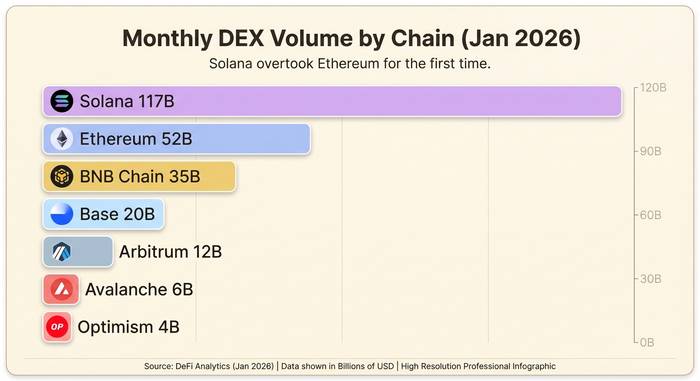
| Solana | $117B (Jan 2026, #1 overall) | PumpSwap / Raydium | PumpSwap ~42%, Raydium ~34% |
| Ethereum | $52B | Uniswap (V3+V4) | ~65-70% |
| BNB Chain | $30-40B | PancakeSwap | ~85%+ |
| Base | $15-25B | Aerodrome | ~50-63% |
| Arbitrum | $10-15B | Uniswap V3, Camelot, GMX | Fragmented (~40% Uniswap) |
| Avalanche | $5-8B | Trader Joe | ~35% |
| Optimism | $3-5B | Uniswap, Velodrome | ~50% Uniswap |
Nobody predicted this a year ago: Solana DEXs now move more money than Ethereum DEXs. January 2026 numbers: $117 billion on Solana versus $52 billion on Ethereum. Memecoins did the heavy lifting. Pump.fun and PumpSwap create the tokens, Raydium hosts the liquidity, Jupiter routes the trades, Orca handles the concentrated positions. The pipeline works. Whether it keeps working when memecoin mania fades is the real question.
How DEX fees work
DEX fees are not the same as exchange fees on Coinbase or Binance. On a DEX, you pay two things: the swap fee (which goes to liquidity providers) and the gas fee (which goes to the blockchain).
| DEX | Swap fee | Who earns it | Gas chain |
|---|---|---|---|
| Uniswap V3/V4 | 0.01%-1% (pool-specific) | LPs (some to protocol) | Ethereum ($0.50-$5), L2s ($0.01-$0.10) |
| PancakeSwap | 0.25% standard | LPs + CAKE buyback | BNB Chain ($0.05-$0.20) |
| Curve | ~0.04% | LPs + CRV holders | Ethereum ($0.50-$5) |
| Raydium | 0.25% (AMM), variable (CLMM) | LPs + RAY buyback | Solana ($0.001) |
| Aerodrome | Variable | LPs + AERO lockers | Base ($0.001-$0.01) |
| Hyperliquid | 0.01% maker / 0.035% taker | HLP vault + HYPE buyback | Hyperliquid ($0) |
Curve wins on swap fees: 0.04%. Makes sense for stablecoin pools where prices barely move. Uniswap charges 0.05% on major pairs and 0.3-1% on smaller ones. Hyperliquid charges 0.01% maker, 0.035% taker, with zero gas on top.
But here is what most people get wrong: the swap fee is not the expensive part. Gas is. One Ethereum mainnet swap costs $0.50 to $5. The same trade on Solana? $0.001. Base or Arbitrum? Under a dime. If you trade ten times a day, chain selection affects your bottom line way more than which DEX you pick on that chain.

How to pick the right DEX
Here is my honest cheat sheet.
Ethereum tokens? Uniswap. Not close. 70% of the chain's DEX volume. Deepest pools. Run your swaps through 1inch or CowSwap to make sure you get the best route across Uniswap and smaller venues.
Solana? Open Jupiter. It checks Raydium, Orca, Meteora, and PumpSwap in one shot and picks the best path. For memecoin launches specifically, go to PumpSwap or Raydium directly because that is where the fresh pools live.
BNB Chain? PancakeSwap owns it. 85%+ share. Gas is cheap. Swap fees are low. Done.
Base? Aerodrome has more than half the chain's volume. The ve(3,3) token model keeps liquidity deep. If you use Base at all, you will end up on Aerodrome.
Perpetual futures? Hyperliquid and it is not a contest. 60-70% of all on-chain derivatives volume. Zero gas. Order book. They even have S&P 500 perps now.
Stablecoins? Curve. 0.04% fee. Minimal slippage on USDC/USDT/DAI swaps. Nothing else competes on stables.
One rule for everything: use an aggregator first. Jupiter on Solana, 1inch on Ethereum. They check every DEX and route your trade through the cheapest path. Going directly to a single DEX without checking the aggregator is leaving money on the table.