BIP39: Mnemonic Seed Words for Bitcoin Wallet Backup
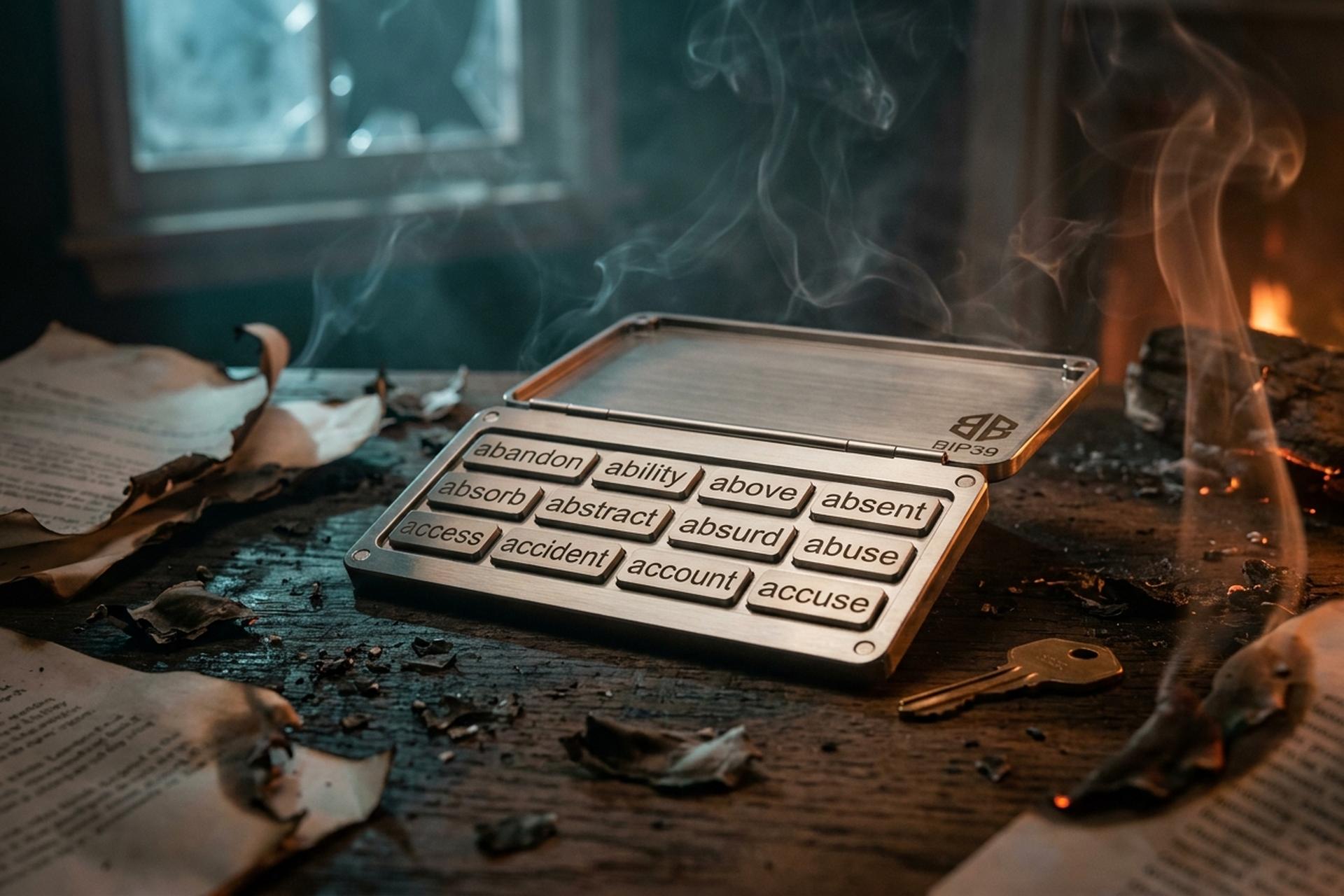
Roughly 3.7 million bitcoin sit in wallets nobody can open. That is around a fifth of every coin ever minted. A 2020 Chainalysis study estimated the number, and analysts keep quoting it in 2026 because the figure barely moves. Most of those coins belong to ordinary people who simply lost the seed phrase. On the other end of the same problem, Chainalysis counted 158,000 personal-wallet compromises in 2025, draining about $713 million out of roughly 80,000 victims. Two failure modes. One document at the centre of both. BIP39, the spec that decides what your twelve or twenty-four words really mean, sits underneath all of it.
Why BIP39 Backup Matters in 2026
A new wallet hands you a sheet of paper with twelve words on it and tells you, write these down somewhere safe. What you are looking at is a BIP39 mnemonic seed phrase. Treat it well and it is the safest backup you can hold. Treat it carelessly and it is the easiest thing in the world to lose. Get the words back into any compatible wallet on any device and your funds come back. Lose them and no helpdesk exists.
The scale of both outcomes is now measurable. That 3.7 million BTC figure was built from coins untouched for at least five years in early-era wallets, and it has barely budged. On the theft side, Chainalysis's December 2025 hacking report counts $3.4 billion stolen across the year, $713 million of it from 158,000 personal-wallet incidents. The same report attributes 43.8% of those personal-wallet losses to compromised private keys, which in plain English mostly means a stolen seed phrase.
Every modern wallet implements BIP39. Ledger, Trezor, MetaMask, Phantom, Trust Wallet, Coinbase Wallet, Exodus, Electrum, Atomic — all of them. Interoperability is the whole point of the standard, because a seed generated in one wallet has to be restorable in another. Understanding what BIP39 actually is, mathematically and operationally, matters more than memorizing any one brand's recovery flow.
What a BIP39 Mnemonic Seed Phrase and Wordlist Really Are
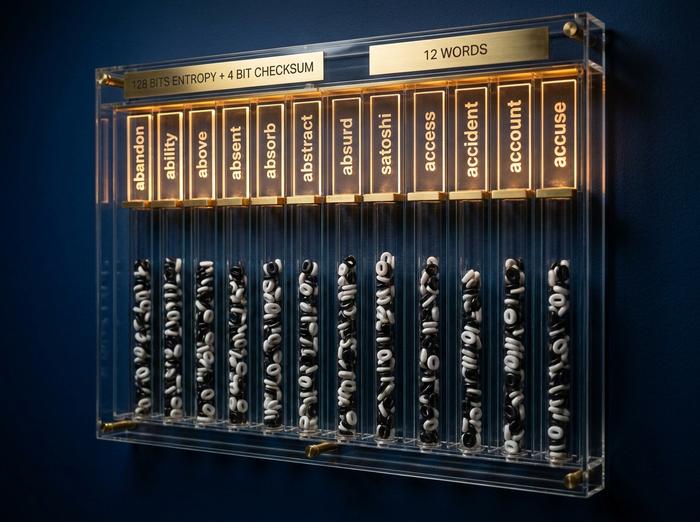
A BIP39 mnemonic goes by many names. Recovery phrase. Mnemonic phrase. Mnemonic code. Mnemonic sentence. Wallet seed. All describe the same thing: a string of words encoding the same information as a raw cryptographic key, just much harder to mis-write. Twelve or twenty-four words from a fixed list of 2,048 carefully chosen English words. "Abandon" sits at position 1. "Zoo" closes the list at position 2,048. "Satoshi" hides at position 1,532 in the middle, a small nod to Bitcoin's pseudonymous creator.
Marek Palatinus and Pavol Rusnak (Slush Pool, later SatoshiLabs and Trezor) wrote the spec on 10 September 2013, together with Aaron Voisine and Sean Bowe. Bitcoin Improvement Proposal 39 was never officially promoted to "Final" status in the BIP repository. It became the de facto industry default within about two years anyway. Today there are ten official wordlists, all exactly 2,048 words long: English, Japanese, Korean, Chinese Simplified, Chinese Traditional, Spanish, French, Italian, Czech, Portuguese.
The wordlist is intentionally forgiving. Every entry is uniquely identified by its first four letters, so "abandon" and "ability" never collide even at a glance, and trailing typos do not break the phrase. The authors curated out pairs sharing a four-letter prefix, words that were too rare or archaic, and obvious homophones.
| Wordlist position | Word | Notes |
|---|---|---|
| #1 | abandon | First word in the English list |
| #1,532 | satoshi | Nod to Bitcoin's pseudonymous creator |
| #2,048 | zoo | Last word in the English list |
Set against the hexadecimal key it represents, the mnemonic is short, scannable, and writable on a single sheet of paper. A 256-bit private key looks like `4a533d1654b17deecf2a6...`, while the same key, encoded as a BIP39 24-word seed, reads as twenty-four ordinary English words. Both contain the same entropy. Only one of them you can read aloud to a partner over the phone without sounding insane.
Generating the Mnemonic: How BIP39 Builds the Code
The generation is short and worth walking through. Step one. Take 128 bits of entropy out of a cryptographically secure random number generator (256 bits if you want the 24-word version). Step two. Run SHA-256 over those entropy bits. Grab the first 4 bits of the hash — or 8 bits, for the 256-bit case — and tack them onto your entropy. That is your checksum. You now hold 132 bits, or 264 bits.
Step three is mechanical. Slice the bits into 11-bit chunks. Every chunk is a number from 0 to 2,047, which maps directly into the wordlist. 132 divided by 11 gives 12 words. 264 divided by 11 gives 24. The checksum quietly does the heavy lifting later — when you restore, the wallet recomputes SHA-256 and refuses anything failing the check, so a typo in the last word usually surfaces immediately rather than silently restoring an empty wallet.
The brute-force search space is the part nobody quite communicates. A 12-word phrase has 2,048^12 ≈ 5.4 × 10^39 valid combinations after the checksum constraint. A 24-word phrase has 2,048^24 ≈ 3 × 10^79. Imagine a fantasy attacker guessing at 10^18 keys per second. The 128-bit case still takes around 10 quadrillion years. For perspective: about 10^80 atoms exist in the observable universe. No public attack in 2025 has ever brute-forced a BIP39 mnemonic. Every documented loss came from a stolen phrase, never a guessed one.
One more step before the words actually unlock anything. The mnemonic gets fed into PBKDF2-HMAC-SHA512, with 2,048 iterations, salted with the literal string "mnemonic" concatenated with an optional passphrase. The 512-bit result is the seed proper. That seed is what BIP32 (the next layer up) uses to derive every actual private key in the wallet.
Mnemonic, seed, keys — three different things, three layers. This split is why a passphrase can spin out a completely different wallet from the same twelve words. Change the passphrase and the salt changes, the seed changes, every key changes.
BIP39 vs BIP32 vs BIP44: How the Layers Stack
Here is the beginner moment of horror. You restore your twelve correct words into a different wallet. The new wallet shows zero balance. The words were fine. The derivation path was not. BIP39, BIP32, and BIP44 are three different Bitcoin Improvement Proposals that together turn your seed phrase into actual addresses, and any two pieces of software that disagree on the path will quietly look in the wrong branch of the tree.
| Standard | Year | Job |
|---|---|---|
| BIP32 | 2012 | Hierarchical deterministic wallets — turn one seed into a tree of keys |
| BIP39 | 2013 | Mnemonic encoding of the seed |
| BIP44 | 2014 | Standard derivation path: m/44'/coin'/account'/change/index |
If your wallet uses a non-standard path (some older or hardware-specific tools do), a restore in a different wallet shows nothing until you manually set the path. The words are not lost. The address list is just being read from a different branch of the same tree. Worth knowing before panicking.
12 vs 24 Words and the Passphrase
The 12-word vs 24-word debate is largely academic. Twelve words give you 128 bits of entropy, twenty-four give you 256. Both numbers are absurdly outside any feasible brute-force, and the 128-bit version is the AES standard for top-secret US government data. Twenty-four words protects against future quantum attacks on the search space; twelve still does not crack under current models.
The genuinely interesting control is the passphrase, sometimes called "the 25th word." Any string you choose, of any length, is mixed into the PBKDF2 salt before the seed is derived. Different passphrase, different wallet, same words. This enables a feature unique to BIP39: plausible deniability. There is no way to prove a passphrase exists, because every possible passphrase produces a valid (if empty) wallet. A user under coercion can hand over the twelve words to a "decoy" wallet holding small funds while the real holdings sit behind a passphrase only they remember. The catch is symmetrical. Lose the passphrase and the wallet behind it is gone permanently — no recovery, no helpdesk.
Real BIP39 Seed Phrase Theft: What 2023-2025 Taught Us
If the math is unbreakable, the humans around it are not. The last three years offered a textbook of failure modes.
In June 2023, Atomic Wallet was drained of more than $100 million across at least 5,500 user accounts. Elliptic attributed the operation to North Korea's Lazarus Group. Atomic claimed less than 0.1% of its 5 million users were affected. The root cause has still never been formally confirmed, but on-device seed material was clearly compromised.
On 14 December 2023, Ledger's "Connect Kit" npm package was hijacked for roughly five hours via a phished ex-employee's npm token. Malicious code from the Angel Drainer group was pushed in versions 1.1.5-1.1.7 and silently injected into many EVM dApps. About $600,000 was drained before Ledger pulled the package. This was not a flaw in the Ledger hardware. It was a supply-chain compromise of a JavaScript dependency that touched user wallets at a different layer.
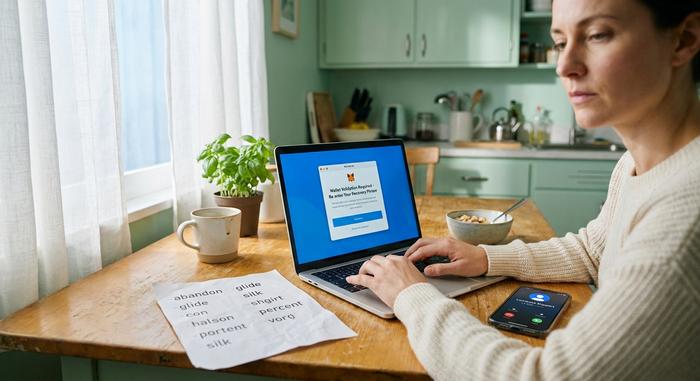
Industrial-scale wallet drainers continued through 2024. Scam Sniffer's January 2025 report tallied $494 million stolen via drainer scripts, hitting 332,000 victim addresses, with Inferno Drainer at 40-45% market share and Pink Drainer at 28% before exit. Many of these victims surrendered seed phrases voluntarily, into fake "wallet validation" popups that looked native to MetaMask or Phantom.
The most personal threat is clipboard malware. Kaspersky disclosed the "GitVenom" campaign in February 2025: roughly 5 BTC (around $485,000) was drained by clipboard-replacement code seeded through fake GitHub repositories, with victims concentrated in Brazil, Turkey, and Russia. A separate ClipBanker trojan, distributed inside a fake Proxifier installer in 2025, hit more than 2,000 Kaspersky users across BTC, ETH, XMR, DOGE, SOL, TRX, XRP, and XTZ — quietly swapping copied addresses for attacker-controlled ones during paste.
Chainalysis put the year-end number for personal-wallet losses at $713 million across 158,000 incidents, with 43.8% tracing back to compromised private keys. The theft is overwhelmingly seed-phrase theft.
Safe BIP39 Bitcoin Wallet Backup: Paper, Metal, Shamir
Practical defence is mostly physical. Paper survives ink and a careful filing cabinet for years, but paper ignites around 233°C and a typical house fire reaches 600-1,100°C. The Cryptosteel Capsule, made of 303/304-grade stainless steel, has been independently heat-tested with data legible at 1,350°C. Billfodl uses marine-grade stainless steel rated to roughly 1,400°C per vendor materials.
| Method | Heat | Water | Notes |
|---|---|---|---|
| Paper | Burns ~233°C | Ink runs | Cheapest, replaceable |
| Cryptosteel Capsule | Survives 1,350°C | Yes | Independent heat test |
| Billfodl | Rated 1,400°C | Yes | Vendor rating |
| SLIP-39 (Shamir) | Depends on substrate | Depends | Splits seed into M-of-N shares |
Beyond the physical medium, two structural choices matter. Keep two geographically separated copies, in case fire or flood takes one location entirely. And consider Shamir's Secret Sharing through SLIP-39, which Trezor launched on the Model T in August 2019. SLIP-39 splits a seed into multiple twenty-word shares, of which any M-of-N are sufficient to recover. The Casa team, by contrast, explicitly rejected Shamir in favour of geographic multisig as their recovery model. Both schemes are designed to eliminate the single-point-of-failure problem that plain BIP39 has by definition.
Crypto Wallets Supporting BIP39 in 2026
Almost everything supports BIP39, but interop has edges. Worth knowing which wallets use which derivation paths before you assume a restore will be clean.
| Wallet | Chains | Default path |
|---|---|---|
| Ledger Nano | BTC, ETH, 5,500+ assets | BIP44 m/44'/coin'/0' |
| Trezor Model T | BTC, ETH, many | BIP44 / SLIP-39 option |
| MetaMask | EVM | m/44'/60'/0'/0/index |
| Phantom | Solana, EVM | m/44'/501'/n'/0' for SOL |
| Coinbase Wallet | BTC, EVM, SOL | Standard BIP44 |
Beyond BIP39: Passkeys, MPC, and ERC-4337
2025 was the first year a credible mainstream alternative to BIP39 actually shipped. Coinbase Smart Wallet, built on ERC-4337 and WebAuthn passkeys, crossed one million accounts in August. It added 270,000 of those in a single day, on 16 August, during the Base App rollout. Users sign in with the Face ID or fingerprint they already use for everything else and never even see a seed phrase.
ERC-4337 smart accounts now sit at over 40 million deployments across Ethereum and Layer 2 networks. Cumulative UserOperations passed 100 million — roughly 10x growth year-on-year from 2023. EIP-7702, activated with the Pectra upgrade in May 2025, registered 11,000 EOA-to-smart-account authorizations inside its first week. The EIP-7702 design lets ordinary wallets behave as smart accounts on demand without throwing away their existing keys. On the infrastructure side, embedded-wallet providers Privy (75 million wallets), Dynamic (50 million-plus), and Web3Auth — now MetaMask Embedded — (20 million MAU) all rely on multi-party computation or threshold signatures. The end user never holds a single BIP39 seed.
None of this means BIP39 is dying off; the standard is far too embedded. Ledger shipped its eight-millionth device during 2025 and grew unit sales by 31%. What is actually happening is a clean bifurcation. The power-user tier — BIP39 plus a hardware wallet plus a passphrase — stays the gold standard. The mainstream tier, meanwhile, gets quietly absorbed by passkeys and account abstraction, designed for people who never wanted to think about words at all.
Quick Rules for Anyone Holding a BIP39 Seed
Five rules cover most of the harm. Never type the words into any internet-connected text field, because phishing popups specialize in catching the paste. Never photograph the phrase either, since photos sync to clouds you do not fully control. Metal beats paper for anything you intend to hold long-term. Test the restore on a second wallet before trusting it. And if you use a passphrase, store it physically separately — same threat model, different location, never the same drawer.