Cartesi (CTSI) on Ethereum: Linux Rollups and Cartesi Price 2026
There is a working Linux distribution running inside a smart contract on Ethereum mainnet. Almost nobody outside a small developer circle is talking about it. The project that put it there is called Cartesi. The token is CTSI. As of May 2026, the whole thing trades at a $26.87 million market cap — about the value of a mid-sized Brooklyn apartment building. That gap between what Cartesi shipped and what the market thinks it is worth is the most interesting story in optimistic rollups right now. This article walks through what Cartesi actually is, how the Cartesi Machine and Cartesi Rollups work, who is building real dApps on it, and where the CTSI price sits. It also asks whether the project's "we were too early" thesis still holds in 2026.
What Cartesi actually is, in one paragraph
Cartesi is an application-specific Layer-2 framework that lets developers run a full Linux operating system as the execution environment for Ethereum smart contracts. The core piece is the Cartesi Machine, a deterministic RISC-V virtual machine that boots a real Linux distribution. Cartesi Rollups bolt that modular framework onto Ethereum as optimistic rollups, with on-chain dispute resolution settling any disagreement and Ethereum acting as the base layer for settlement. The practical result is that a Cartesi dApp can be written in Python, Rust, C++, or any language that compiles for Linux, and still inherit Ethereum's security. It is the only Linux-on-blockchain project to ship this scaling stack to mainnet, letting developers build decentralized applications in mature programming languages instead of rebuilding everything in Solidity.
How Cartesi works: the Machine and Ethereum rollups
The Cartesi Machine is the heart of everything. It is a software emulator of the RISC-V instruction set. RISC-V is a deterministic CPU spec that anyone can build from scratch. Inside that emulator runs a stripped-down Linux OS built with Buildroot. The user-space tooling is what you would expect: a shell, glibc, Python interpreters, standard libraries, the GitHub world of compiled binaries. Every instruction the machine executes is bit-for-bit reproducible. If two honest nodes start from the same initial state and feed in the same inputs, they end at exactly the same final state, every time.
That determinism is the trick that makes a verifiable Linux on a blockchain possible. The Cartesi Rollups framework takes the machine and wraps it in a standard optimistic-rollup architecture. A dApp posts inputs to an Ethereum contract. The off-chain Cartesi node runs those inputs through its Linux machine. The resulting state is checkpointed and posted back on-chain. Most of the time, nothing else happens. Execution is cheap because it runs off-chain, and Ethereum is only the settlement and data-availability layer.
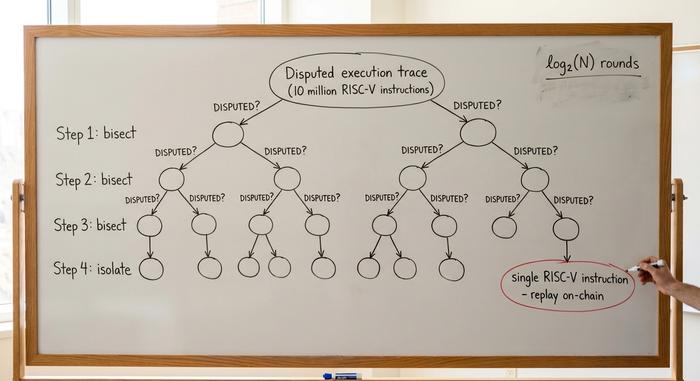
The hard part is what happens when somebody lies. Optimistic rollups assume any disputed state can be challenged. The on-chain referee needs to verify the disputed work without re-running the whole Linux session. Cartesi solves this with an interactive bisection protocol. Two parties drill down through the disputed execution trace until they isolate a single RISC-V instruction; that one instruction is then replayed on-chain inside a Solidity implementation of the machine. The contract is called Solidity Step, and version 0.14.0 shipped in April 2026. The on-chain referee declares a winner. The losing party loses a bond.
The 2025-2026 version of this story matters because Cartesi finally made the dispute system permissionless. The Permissionless Refereed Tournaments protocol, PRT for short, is paired with the Dave algorithm. It lets anyone join a multi-party tournament to challenge a bad state. The on-chain cost stays bounded no matter how many disputers show up. Before PRT, optimistic rollups everywhere relied on a small permissioned set of challengers. After PRT, the assumption you have to make is just that one honest party exists somewhere on the open internet. That is a meaningfully weaker trust model.
The Cartesi Machine Emulator also picked up zero-knowledge verification primitives in version 0.19.0 last year. Now it is possible to generate cryptographic proofs that a computation ran correctly, without having to re-run it. That helps when verifying inputs from sub-machines. It also opens the door to hybrid optimistic-ZK setups that several teams are now prototyping. The full software stack is open source on GitHub under the cartesi organization, and there were roughly 246 development events across the org in a single thirty-day window in April 2026 according to CoinMarketCap's developer tracker.
| Component | What it does | Lives where |
|---|---|---|
| Cartesi Machine | Deterministic RISC-V VM running full Linux | Off-chain on each node |
| Cartesi Rollups framework | Wraps the machine as an optimistic rollup | Off-chain node + Ethereum contracts |
| Solidity Step | On-chain RISC-V single-step emulator for dispute resolution | Ethereum mainnet |
| PRT and Dave | Permissionless multi-party fraud-proof tournament | Ethereum mainnet |
| Noether sidechain | Proof-of-stake side network used for staking CTSI | Separate sidechain |
Where Cartesi came from: founders and a Rio AI pivot
Cartesi was founded in 2018 in Rio de Janeiro by Erick de Moura, Augusto Teixeira, Diego Nehab, and Colin Steil. Teixeira and Nehab were academics at IMPA, the Brazilian institute for pure and applied mathematics; the original pitch was a decentralized marketplace for training AI models, with a verifiable computation layer underneath it. The marketplace concept did not survive contact with the market, but the verifiable-computation layer did. Serguei Popov, an IOTA co-founder, joined as an early advisor.
The token launched on Binance Launchpad on April 21, 2020, with 100 million CTSI sold at $0.015 each. The IEO raised $1.5 million from 22,169 lottery winners. By that point Ethereum gas wars were already a serious scaling problem, Bitcoin had just gone through its third halving, and the broader market had not yet figured out what an L2 was, much less what a fraud-proof tournament might be for. Cartesi was, by its own admission, building something the industry did not have a vocabulary for yet. Erick de Moura still runs the foundation as CEO, with the other three co-founders in CSO, Chief Scientist, and COO roles respectively. The leadership has stayed remarkably stable for an eight-year-old crypto project.
Building on Cartesi: real dApps in 2026
The most common question about any infrastructure-stage Layer-2 is whether anyone is actually building on it. With Cartesi the honest answer is: yes, more than you would expect, and less than the technology deserves. The official ecosystem registry at rolluplab.io lists working applications across gaming, on-chain art, lending, and trust-minimized machine learning, alongside a real and growing public-sector pilot effort in Brazil.
| dApp | Category | Status (mid-2026) |
|---|---|---|
| PRT Honeypot v2 | Fraud-proof bug bounty on Ethereum mainnet | Live, L2BEAT Stage 2 |
| RIVES | Retro on-chain gaming console | Migrated to Node V2 |
| World Tycoon | NFT city-builder, SimCity-style | Prototype |
| Bug Buster | Trustless bug-bounty platform | Live (on Optimism via Cartesi) |
| Drawing Canvas | Collaborative on-chain art | Live |
| DCA.Monster | AMM with ERC-20 streaming for dollar-cost averaging | Live |
| Locale Network | Web3 SME lending with dynamic loans | Live |
| ThinkChain | Trust-minimized LLM inference on-chain | Proof of concept |
| BikeFácil dApp | Tokenized carbon credits for e-bike sharing | Brazilian pilot |
| Niterói transit dApp | Public bus payments in Rio de Janeiro state | Brazilian pilot |
| ILIADA | National-scale research with Brazil's MCTI | Government supported |
The flagship is PRT Honeypot v2 itself, a Stage 2 optimistic rollup whose only job is to hold a bounty in CTSI and dare anyone to crack the fraud-proof system. The current bounty is symbolic ($1,000 in CTSI, designed to grow through 2026), but the earlier Authority Honeypot held 1,772,889 CTSI at peak and survived a year of attempts unhacked. RIVES is the more visible consumer-facing app, a fantasy-console environment where retro games run inside the Cartesi Machine and high scores are verifiable on-chain. World Tycoon, still a prototype, leans into the idea that a SimCity-grade simulation is too computationally heavy for the EVM but perfectly tractable inside a Linux VM.
The Brazilian public-sector strand is underrated. BikeFácil tokenizes carbon credits for e-bike sharing; the Niterói municipal transit pilot uses a Cartesi rollup to settle public bus payments; the ILIADA project is a multi-year research effort with the Brazilian Ministry of Science, Technology, and Innovation. None of these are going to print a billion in TVL, and Cartesi rollups are not meaningfully tracked on DefiLlama, which tells you something. But they are real software being used by people who are not crypto-native. That is rarer than it sounds.
Cartesi price today, CTSI tokenomics, and staking
The Cartesi price today is the part of the story that drags down everything else. CTSI has a hard cap of 1 billion tokens, of which roughly 913.7 million (91.4 percent) are in circulation. CTSI holders and other token holders use the cryptocurrency for governance votes. They also stake their tokens on the Noether sidechain. There, each validator earns rewards for helping secure the Cartesi network and its security features. CTSI staking has yielded around 12.92 percent average APY, with top venues like MyCointainer offering up to 22.8 percent for delegated stakers; the supply of Cartesi committed to staking varies across pools but represents a meaningful share of the circulating float.
| Metric | Value (May 19, 2026) | Source |
|---|---|---|
| Cartesi price (CTSI/USD) | $0.02939 | CoinGecko |
| Market cap | $26.87M | CoinGecko |
| Market cap rank | #749 | CoinGecko |
| Circulating supply | 913.7M CTSI | CoinGecko |
| Maximum supply of Cartesi | 1,000,000,000 CTSI | Binance Launchpad |
| All-time high | $1.74 on May 9, 2021 | CoinGecko |
| All-time low | $0.02134 on March 29, 2026 | CoinGecko |
| 7-day price change | -14.4% | CoinGecko |
The all-time high came in May 2021 at $1.74, roughly 59 times the IEO price. The all-time low was set six weeks before this article, on March 29, 2026, at $0.02134. CTSI has spent most of the past three years grinding sideways into that floor, and the current price sits only 38 percent above it. The Cartesi Foundation, to its credit, bought $500,000 worth of CTSI off the open market in 2025, a meaningful signal of internal confidence even if the chart has yet to reflect it.
PRT, L2BEAT Stage 2, and a boundless design space
The single 2025 milestone that justifies paying attention to Cartesi in 2026 is the L2BEAT Stage 2 classification. L2BEAT is the standard ranking of rollup maturity. Stage 2 means an L2 has decentralized fraud proofs, no upgrade backdoors, and limited governance over user funds. As of 2025 only three projects across all rollups had reached Stage 2. Cartesi's PRT Honeypot v2 is the only optimistic rollup in the set. Every other Stage 2 candidate is ZK-based.
PRT Honeypot v2 went live on Ethereum mainnet in June 2025. A liveness bug was discovered and patched in October that year. The Dave 2.1.1 algorithm — the latest refinement of the multi-party tournament — landed on testnet on March 13, 2026, and the team is targeting a mainnet release in the second quarter of 2026. Each new version reduces the worst-case bond a challenger has to lock up and tightens the worst-case timeout for fraud resolution. Underneath the engineering jargon, the boundless design space is real: optimistic rollups can now scale their security assumption from "one trusted challenger" to "anyone, anywhere, willing to put up a bond and respond on time."
This matters strategically. The optimistic rollup story has been losing mindshare to ZK proofs and other scalable rollup designs for two years, partly because the dispute-resolution problem for general DeFi workloads still looked unfinished. PRT decentralizes the fraud-proof tournament and pulls the optimistic side back into the conversation, with bounded on-chain cost and clean security and censorship resistance for the dispute path. Whether other rollups decide to decentralize their own dispute resolution around PRT or route around it through ZK is the question that decides Cartesi's next five years, and it touches the broader debate over decentralization and the practical limits of L2 scalability.

Cartesi versus the zkVM wave in 2026 crypto
Cartesi started shipping RISC-V execution for blockchains in 2018, several years before zkVMs were technically viable. The bet was that interactive verification with on-chain dispute resolution would always be cheaper than generating a SNARK over a Linux session. Then RISC Zero showed up.
| Project | Approach | 2024-2026 highlights | Capital raised |
|---|---|---|---|
| Cartesi | RISC-V + Linux + optimistic rollups (PRT/Dave) | Only optimistic rollup at L2BEAT Stage 2; ~$1M grants program | $1.5M IEO + foundation reserves |
| RISC Zero | RISC-V zkVM + Boundless proof marketplace | R0VM 2.0 proves Ethereum blocks in 44 seconds, down from 35 minutes; shut its own hosted prover in December 2025 to push everyone onto Boundless | $40M+ Series A |
| Succinct (SP1) | RISC-V zkVM | Widely adopted across rollup teams | Nine-figure private rounds |
| Boundless | Decentralized proof market launched by RISC Zero | Aims to absorb proof workloads from SP1, Cartesi, and others | Funded out of RISC Zero |
RISC Zero raised more than $40 million in Series A, twenty-six times Cartesi's IEO. Succinct closed similarly large private rounds. Boundless launched as a decentralized proof marketplace that, in the long run, may absorb Cartesi's proofs along with everyone else's. The honest competitive read is that Cartesi solved the harder problem first — running general-purpose Linux on a blockchain — but the industry rewarded the project that solved the marginally easier problem with twenty-five times more capital. I am not convinced that gap closes by good engineering alone.
Reality check: what the Cartesi ecosystem really says
The honest 2026 scorecard for Cartesi has three positives and three weak points. On the positive side: Stage 2 on L2BEAT is a real achievement. The dApp lineup is broader than most market-cap peers. The foundation has 3.5 years of runway excluding CTSI itself, more than enough to ship Dave mainnet and Wave 2 grants. On the weak side: the CTSI price sits within 38 percent of an all-time low set six weeks ago. Wave 1 of the grants program deployed only $191,000 to 6 grantees out of a $500,000 cap. The 2025 spending mix sent 41 percent to foundation ops and marketing versus 12 percent to ecosystem grants. Three signals are worth watching over the next twelve months. The Dave 2.1.1 mainnet launch. The pace of Wave 2 grants. Whether any single dApp from the current cohort breaks into mainstream usage. If two of those three land, the gap between fundamentals and price closes. If none of them do, Cartesi stays a beautiful piece of engineering that arrived a cycle too early.