Is Ethereum a Good Investment in 2026? An Honest Verdict
The contradiction in front of any honest investor is this: BlackRock and Fidelity have hoovered up roughly $13.6 billion of spot Ethereum into ETF wrappers, and the ETH/BTC ratio has still fallen to a 10-month low of 0.02835 (CoinDesk, mid-May 2026). That is the most institutional money the asset has ever attracted and one of the worst relative performances of the post-Merge era, happening at the same time.
I have been writing about this market for fifteen years, and I cannot remember a setup where the bull case and the bear case were both this loud. So I want to do something the average "is ethereum a good investment" article will not do, which is to commit to an answer. The short version sits a few paragraphs down. The long version is the rest of this piece: five concrete reasons to buy ethereum, five hard reasons not to, and the honest trade-offs in the middle.
What investing in Ethereum actually means today
Investing in Ethereum is not really buying "the world computer." You are buying a claim on settlement activity that happens above the base layer — stablecoin transfers, NFT trades, decentralized applications, and the long tail of smart contract calls that pay transaction fees in ETH. The asset earns from the ecosystem above it, from DeFi pools to NFTs and web3 apps. Roughly 120.7 million ETH exist; about 29% of that supply, or 35.86 million tokens, sits in proof of stake contracts run by ~1.1 million validators (Datawallet, 2026). Another slice sits inside exchange-traded products like BlackRock's ETHA. The rest moves around centralized exchanges, DeFi liquidity pools, and increasingly Layer 2 rollups that use ETH only as their final settlement asset.
So when you ask whether ETH is a good investment, you are really asking three questions at once. Will rollup activity keep accruing fees back to Ethereum as the primary settlement layer? Will the institutional adoption flow keep growing? And does the blockchain still have a unique role now that Solana, Base, and the rest can do most of what ethereum does, faster and cheaper? The answers are not the same, and the honest thing is to handle them separately rather than pretend a single verdict covers all three.
Is Ethereum a good investment? The honest verdict
Yes, ethereum is a defensible long-term position for an investor with a 3-to-7 year horizon, tolerance for a 50%-plus drawdown, and a portfolio rule that crypto stays below 10% of net worth. No, it is not a good investment for anyone who needs the money inside 18 months, or for anyone treating it as a recovery trade off the August 2025 high. The middle ground does not really exist; ethereum's volatility punishes half-conviction.
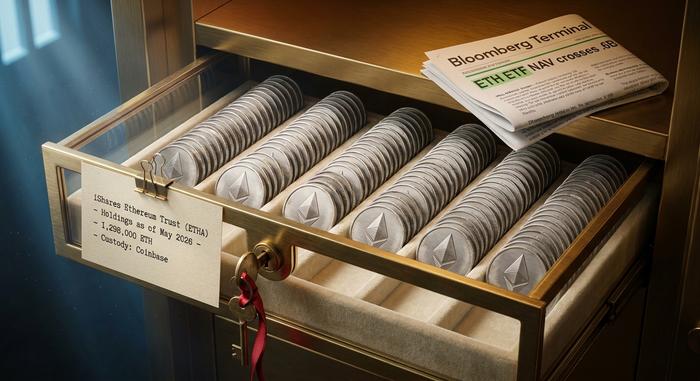
The bullish case rests on something specific and recent. Spot Ethereum ETFs absorbed $8.6–9.3 billion in net inflows from institutional investors during their first 12 months (CoinGape, anniversary data) and the full complex now sits at $13.6 billion in NAV, around 4.94% of ETH market cap (CoinGlass, May 2026). BlackRock's ETHA alone holds 1.298 million ETH (Laika Labs). That is a structurally sticky bid from financial institutions that did not exist before July 2024, and it changes the floor under bad weeks. The early-May 2026 inflow day of +$101.2 million across the complex (Coinfomania) is the kind of unremarkable headline that adds up over a cycle.
The bear case rests on something equally specific. Ethereum's deflation story is dead, at least for now. Post-Dencun and Pectra, the data activity that used to burn ETH on the base layer moved to L2s, and net supply has been growing at roughly 0.23%/yr (Zipmex citing on-chain data). The 3.5 million ETH burned since EIP-1559 is impressive, but it is mostly historical. January 2026 saw a net validator outflow of about 600,000 ETH (Datawallet), the first sustained exit since the Shapella unstaking unlock.
The historical return is the line that confuses most casual investors in the broader cryptocurrency market. Bankrate calculated that $1,000 invested in ETH five years ago, in mid-2020, was worth $11,145 by September 5, 2025. That is the headline an ETH bull will quote. The same chart shows the 2025 rally peaked at +250% to a $4,946 all-time high in August, then sank 55%. Past performance is no guarantee of future results for cryptocurrencies — that is a cliché because it is true, and ethereum's chart proves it twice per cycle.
My view, for what it is worth, is that ethereum belongs in the 5–10% sleeve of a crypto-curious portfolio, dollar-cost averaged in over months, never bought as a lump-sum entry near the top of a rally. If that sounds boring, that is the point.
Bull case: five reasons to buy Ethereum in 2026
| # | Bull-case argument | Hard number | Source |
|---|---|---|---|
| 1 | Structural ETF bid | $13.6B AUM (4.94% of mcap) | CoinGlass, May 2026 |
| 2 | Stablecoin settlement dominance | ~51% of $270B stablecoin float on Ethereum | Yahoo Finance, Aug 2025 |
| 3 | Fusaka scaling step | Gas limit 45M → 150M; 40–90% L2 fee drop | Fidelity Digital Assets |
| 4 | L2 moat | $47B TVL across 73+ rollups | L2Beat / Eco, Apr 2026 |
| 5 | Staking yield | 2.83–5% APY depending on venue | Compass STYETH / Bitget |
The ETF bid is the most underrated change. Spot Ethereum exchange-traded products did not exist as recently as July 2024. They now hold roughly one of every twenty ETH in circulation, and BlackRock and Fidelity are still net-buyers in the back half of most weeks. Corporate treasuries are starting to follow. JPMorgan launched its tokenized MONY money-market fund on Ethereum in December 2024. That is the kind of bullish flow that absorbs forced selling rather than amplifying it.
Stablecoins make ethereum the de facto dollar settlement layer. Over $270 billion of stablecoins currently circulate, and roughly 51% of that float settles on ethereum (Yahoo Finance, August 2025). Every Tether or USDC transaction touching the base layer pays a fee in ETH, deepening demand for ETH itself. EIP-1559 still burns a portion of those fees. McKinsey projects the broader tokenization market at $2 trillion by 2030 (cited by Motley Fool); even half of that touching Ethereum is a real demand driver and a meaningful market share lever versus Solana and Cardano.
Fusaka is the closest thing to a catalyst this cycle. The upgrade activated December 3, 2025, lifted the block gas limit from 45 million to 150 million, and introduced PeerDAS. Fidelity Digital Assets projects L2 fees dropping 40–60% in the first month and up to 90% as blobs scale. Theoretical throughput across the L2 ecosystem rose from ~12,000 to 100,000-plus transactions per second (CoinGecko).
The L2 moat is now a real economic moat, not a slogan. Arbitrum holds $13.8 billion in TVL (40% share), Base sits at $11.2 billion, and the long tail of 73+ rollups brings the total to roughly $47 billion (Eco / L2Beat, April 2026). L2 daily transactions hit roughly 2 million per day in 2026, exceeding mainnet — a healthy sign if you believe rollups eventually capture fees back to L1.
Staking is a passive yield baseline. Roughly 29% of ETH sits in staking contracts; the institutional reference rate (Compass STYETH) was 2.83% APY on May 1, 2026, while solo stakers earn closer to 5%. That is the kind of yield curve a traditional asset manager understands, even if it is well below the 5–6% range of 2023.
Bear case: where Ethereum loses in the cryptocurrency market
The bearish reading is not a single bad chart; it is five separate headwinds compounding.
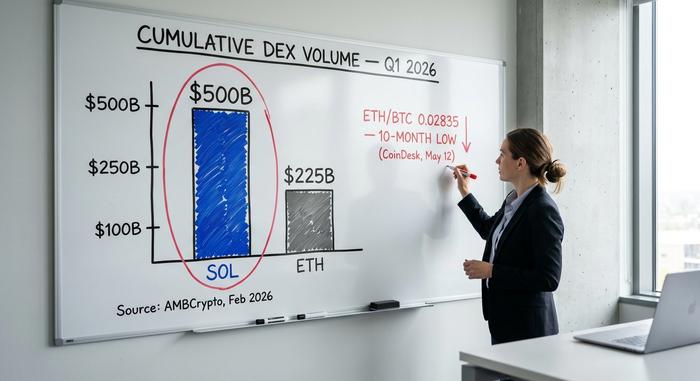
ETH is losing to Bitcoin in price terms. The ETH/BTC ratio sat at 0.02835 on May 12, 2026, a 10-month low and 35% below the August 2025 peak of 0.04324, well under the 200-week moving average of 0.04828 (CoinDesk). Technical traders are watching downside targets toward the 2020 floor of 0.0176. If you are buying ethereum because you expect it to outperform bitcoin, the chart has been telling you that thesis is wrong for almost a year.
Solana flipped ethereum on the metrics that matter for active users. Cumulative DEX volume reached $117 billion on Solana versus $52 billion on ethereum in early 2026 (AMBCrypto). Daily active addresses tell the same story: Solana around 3.6–3.9 million, ethereum about 530,000 most days, though it printed a 1.03 million peak in Q1 2026 (BitKE / CoinLaw). On weekly DEX volume the gap is now $11.49 billion versus $7.62 billion (KuCoin, April 2026).
The "ultrasound money" thesis is broken. EIP-1559 burned roughly 3.5 million ETH between August 2021 and today, but post-Dencun (March 2024) and Pectra (May 2025), most data activity migrated to rollups, which pay only a fraction of the burn the base layer used to capture. Net supply has been growing at about 0.23% per year (Zipmex). Add the 600,000 ETH net validator exit of January 2026, and the "deflation premium" some bulls assigned to ETH in 2022–2023 simply does not apply right now.
Staking is concentrated. Lido controls 23–24% of all staked ETH on its own (AMBCrypto, February 2026), and the top 10 staking entities account for over 60% of validator power (Datawallet). That is a meaningful systemic risk; a credibly neutral settlement layer is a harder sell when one operator is one bad governance vote away from a censorship threshold.
Restaking is the new tail risk. EigenLayer / EigenCloud holds between $8.9 billion (DeFiLlama view) and $19 billion (Fensory, including broader restakers) in restaked value. Re-hypothecating staked ETH across actively validated services is clever in a bull market and dangerous in a panic, exactly the same kind of cycle that took down DeFi platforms in 2022.
| Metric | Ethereum | Solana | Source |
|---|---|---|---|
| Cumulative DEX volume (early 2026) | $52B | $117B | AMBCrypto |
| Daily active addresses (avg 2026) | ~530K | 3.6–3.9M | BitKE / CoinLaw |
| ETF cumulative inflows | $8.6–9.3B (1-yr) | $476M | CoinGape / 247WallSt |
| 2025 ATH | $4,946 (Aug) | n/a | Seeking Alpha |
| Staking yield (institutional ref) | 2.83% APY | ~6.5% APY | Compass / Solana Beach |
ETH vs Bitcoin and Solana as a crypto investment
Most readers want the side-by-side, so here it is, briefly. Bitcoin is the digital-gold trade: a fixed 21 million supply, dominance of 58.2% of the crypto market (TradingView Hub, May 2026), and a 2025 peak of roughly $126,000 (Seeking Alpha). It is a macro hedge that increasingly trades like one. ETH is the productive asset: it generates fees and staking yield, but it also competes with faster chains every quarter.
Solana is the speed-and-throughput substitute. SOL spot ETFs took in around $476 million in cumulative inflows since launch (247WallSt, 2026), a fraction of ETH's $8.6 billion, but the on-chain metrics favor Solana on most user-activity dimensions. The decentralized finance debate now sounds different than it did in 2023: if you want maximum decentralization and the largest validator set, ethereum still wins; if you want the cheapest, fastest user experience for a retail trader, Solana usually does.
Most diversified crypto portfolios I see in 2026 hold all three rather than picking one — bitcoin for the macro bid, ethereum for the institutional and L2 story, Solana for the activity exposure. Analyst price targets for ETH cluster between $7,500 (Standard Chartered, 2026) and $11,800 (VanEck, 2030). Most published price predictions for ethereum in this range assume the stablecoin and web3 application stack keeps settling on its blockchain rather than migrating to faster chains.
How to invest in Ethereum without losing your shirt
The cleanest way to buy ethereum for a U.S. investor today is a spot ETF, either BlackRock's ETHA or Fidelity's FETH, held in a tax-advantaged account where possible. Expense ratios sit in the 0.20–0.25% range; you avoid private-key risk and you get standard brokerage-tax reporting. Trading fees on direct-purchase venues range from 1.5–2% on simple buys to 0.4–0.6% on advanced pairs (Yahoo Finance Personal Finance, 2026), with hidden spreads on retail apps like Robinhood adding another ~0.85%.
For investors who want yield, staking through Coinbase or Lido earns ~2.83–4% APY, but understand that the yield comes with smart-contract and slashing exposure. Dollar-cost average over 6–12 months rather than buying a single tranche. Never invest money you cannot afford to lose. The asset has been highly volatile in every prior cycle, and 2026 will not be the exception.