ASST Stock: Strive’s Bitcoin Treasury at a Discount

A stock that once printed $252 a share now changes hands near $14. The company behind it earns almost no revenue, posted a quarterly loss of more than a quarter of a billion dollars, and yet sits on roughly $1.2 billion worth of Bitcoin. Here is the strange part. Add up what the market thinks the whole company is worth, and the number comes out smaller than the Bitcoin pile it owns. The market is valuing the coins at less than face value.
Welcome to ASST stock, the Nasdaq ticker that no longer belongs to the company it was named for. It belongs to Strive. This piece explains what ASST actually is now, how its Bitcoin machine works, what the financials really mean, why the stock trades below the value of its own Bitcoin, and whether that discount is a bargain or a warning.
What is ASST? Asset Entities becomes Strive
The single most confusing thing about ASST is that the business you are buying barely exists in its old form. ASST was Asset Entities, a small social-media and marketing company built around Discord communities. That company is essentially gone. What carries the ticker today is a Bitcoin-treasury firm.
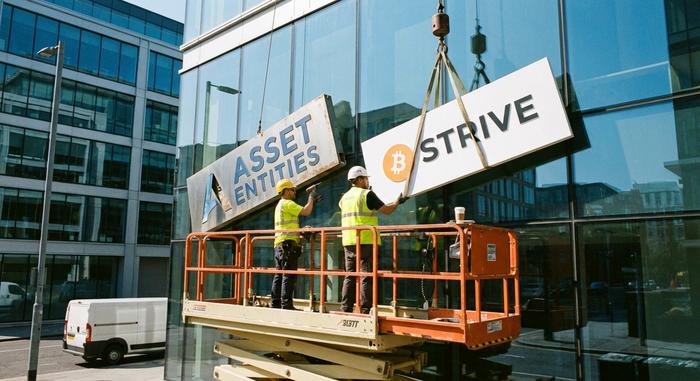
The change came through a reverse merger that closed on September 12, 2025. Strive Enterprises combined with Asset Entities, and the surviving company is legally named Strive, Inc. The ticker stayed ASST because keeping the listing was simpler than starting a new one. When the dust settled, former Strive holders owned about 94.2 percent of the combined company and legacy Asset Entities shareholders held the remaining 5.8 percent. In practice, Asset Entities was the shell; Strive was the substance. A reverse merger like this is a common shortcut: instead of running a slow traditional listing, a private company steps into an existing public one and inherits its ticker overnight. The old marketing business was small enough that almost nothing of it remains beyond the legacy revenue line.
Strive Asset Management was founded in 2022 in Dallas and is run today by chief executive Matt Cole. You will often see ASST described as Vivek Ramaswamy's Bitcoin company. That is a stretch. Ramaswamy co-founded Strive Asset Management, but he resigned in 2023 to run for president and holds no confirmed executive or board role in the company today. The brand carries his fingerprints. The day-to-day does not.
How a Bitcoin treasury company actually works
Before any of the numbers make sense, you have to understand what kind of machine ASST stock represents. It is not a technology stock. It is not really an asset manager either, despite the name. It is a vehicle for turning share sales into Bitcoin. Strip away the labels and the model is almost mechanical.
The strategy: sell shares, buy Bitcoin, repeat
The company issues new stock into the market, takes the cash, and buys Bitcoin. Then it does it again. By mid-2026 this had built a stack of roughly 19,000 BTC, worth on the order of $1.2 billion. Strive reports its progress using a metric it calls "BTC yield," which it put at about 36.7 percent for the year to date. Read that number with care. It is a proprietary, non-GAAP figure that measures how fast Bitcoin-per-share is growing, not a cash return you ever receive. It is a marketing yardstick, not a dividend.
Why would anyone buy this instead of Bitcoin itself? The honest answer is access and leverage. Some funds and retirement accounts cannot easily hold spot crypto, so a Nasdaq-listed proxy is the only door open to them. And because the company can keep raising money to buy more, the stock can, in good times, grow its Bitcoin faster than you could on your own. The pace can be aggressive: Strive spent roughly $185 million on Bitcoin in a single ten-day stretch in mid-2026, the kind of buying spree that keeps the company in the crypto news.
The MicroStrategy template
None of this is original. Strategy, the company formerly known as MicroStrategy, wrote this playbook years ago: use the public market as a funnel for buying Bitcoin, and let the share price act as leverage on the coin. The dream is a flywheel. The stock trades above the value of its Bitcoin, the company sells shares at that premium, buys more Bitcoin per share than it gave up, and the premium justifies itself. Strive is running the same play. Whether the flywheel actually spins is the open question. The danger is that it can turn the other way. When the stock falls below the value of its Bitcoin, selling shares to buy more coins destroys value for existing holders rather than creating it, because the company is handing out claims on its Bitcoin for less than they are worth. A premium machine in reverse becomes a dilution machine.
Where Vivek Ramaswamy fits, and where he does not
It is worth repeating because the headlines blur it. Ramaswamy helped start Strive Asset Management in 2022 as an anti-ESG investment house. He left the next year. The Bitcoin-treasury strategy that defines ASST today was built and executed by the current management team, not by him. If you are buying the stock because of a famous name, you are buying a brand association, not a manager.
ASST financials: $2.76M revenue, a $266M loss
Pull up ASST's latest quarterly earnings and your first instinct will be alarm. Resist it, because the usual numbers barely apply here.
| Strive, Inc. (ASST), Q1 2026 | Figure |
|---|---|
| Revenue | $2.76M |
| Net loss | -$265.9M |
| of which unrealized Bitcoin loss | ~$295.8M |
| EPS | -$4.53 |
| Bitcoin held | ~19,000 BTC |
| Avg cost per BTC | ~$96,316 |
Look at the revenue: $2.76 million. For a company with a billion-dollar balance sheet, that is a rounding error, the leftover trickle from the old business. The headline net loss of $265.9 million, reported in Strive's Q1 2026 filing with the SEC, looks catastrophic until you see that most of it, around $295.8 million, is an unrealized loss on Bitcoin, a paper markdown that exists only because accounting rules force the company to mark its coins to market. It sold nothing. The figure swings with the Bitcoin price every quarter.
What actually matters is the balance sheet and the share count. Strive built its Bitcoin position at an average cost near $96,316 per coin, well above where Bitcoin trades now, which leaves the portfolio underwater by something like $620 million on paper. And the funding never stops. The company has registered a combined at-the-market program of around $5.15 billion, and had already sold 19.2 million shares for $336.4 million by early June. That is the engine. It is also the threat, because every new share is a thinner claim on the same pile of coins.
The accounting deserves a word, because it trips up so many readers. New fair-value rules require companies to mark Bitcoin to its current price every quarter, so a falling Bitcoin price drives a large reported loss even when the company is doing exactly what it promised. The flip side is that a rising quarter can manufacture an enormous paper profit. Either way, the income statement tells you more about Bitcoin's price than about how the business is run.
The discount: why ASST trades below its Bitcoin
Here is the puzzle that makes ASST stock genuinely interesting. Pull up a price chart and the round trip is brutal: a near-vertical spike toward $252 in 2025, then a long slide lower on heavy volume. Most Bitcoin-treasury stocks trade above the value of the Bitcoin they hold. Strive trades below it.
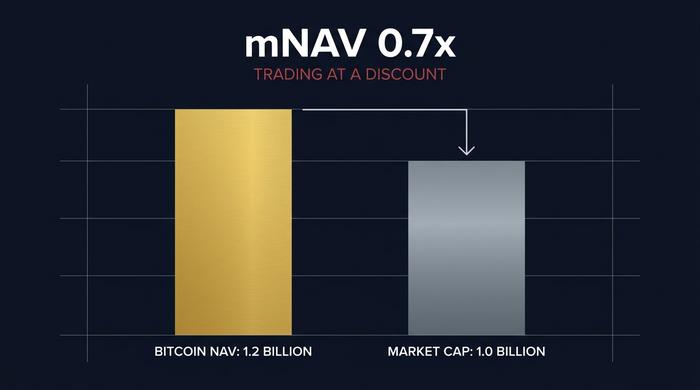
The shorthand the market uses is mNAV, or the multiple of net asset value. It compares a company's market capitalization to the net value of the Bitcoin it owns. An mNAV above 1 means investors pay a premium for the coins; below 1 means they pay a discount. Put concretely: if a company holds $1 billion of Bitcoin and the stock market values the whole company at $700 million, its mNAV is 0.7, and you are buying Bitcoin through it at thirty cents on the dollar. Strategy has long commanded a premium, with investors happily paying more than a dollar for each dollar of its Bitcoin in exchange for convenience and leverage. Strive, by contrast, has been quoted anywhere from about 0.5 to 0.9 times the value of its Bitcoin, depending on which tracker you trust and how they count.
| Company (ticker) | Bitcoin held | mNAV (mid-2026) |
|---|---|---|
| Strive (ASST) | ~19,000 BTC | ~0.5–0.9× (discount) |
| Strategy (MSTR) | very large | premium (above 1×) |
| Metaplanet (3350) | large | around 0.7–1.4× |
| MARA Holdings (MARA) | ~35,000 BTC | above 1× |
So why the discount? Three reasons, and none of them is a mystery. First, the at-the-market overhang: with up to $5.15 billion of stock authorized to sell, investors expect heavy future dilution and price it in today. Second, the underwater cost basis: buying coins at $96,000 and watching Bitcoin trade lower does not inspire confidence in the timing. Third, the flywheel has not started. A premium is a vote that the market trusts management to compound Bitcoin-per-share. Strive has not yet earned that vote — so it gets the opposite, a discount that reflects doubt.
ASST bull vs bear: opportunity or trap?
This is where reasonable investors split on ASST stock, and both sides have a real case.
The bull case is the discount itself. If you can buy a dollar of Bitcoin for seventy cents through ASST, you are getting leveraged exposure to the coin at a markdown, with a free option on the discount closing. Should the premium ever return the way it did for Strategy, holders would win twice, once on Bitcoin and once on the re-rating. There is no crushing debt load forcing a fire sale, and the company keeps adding coins.
The bear case is that a discount can be a trap. The same at-the-market engine that buys Bitcoin also dilutes you, and if management sells shares below NAV, it can shrink Bitcoin-per-share even as the total stack grows. Picture it simply: if the company issues a big slug of new shares at a discount to buy coins, the Bitcoin pile gets bigger but it is now split among many more shares, so your personal slice of it can fall. Growth in total Bitcoin and growth in your Bitcoin are not the same thing, and the gap between them is exactly what the discount is warning about. The operating business produces almost nothing. The cost basis is high. And a discount that "should" close can stay open for years if the market simply never trusts the strategy. Wall Street is cautiously positive but hardly euphoric: seven analysts cover the stock with a roughly Moderate Buy consensus and an average target near $28 for the ASST stock price, ranging from about $20 at the low end to $38 at the high.
Is ASST stock a buy or sell in 2026?
ASST only makes sense if two things are true for you at once. You want Bitcoin exposure, and you believe a treasury stock trading below its Bitcoin can re-rate higher rather than dilute lower. Get both right and the discount pays you twice. If you only want the coins, a spot Bitcoin ETF hands you the same exposure without the share issuance grinding away in the background. The entire reason to choose ASST over the ETF is a bet that the discount is a mistake the market will eventually correct.
Conclusion
ASST stock is a wager that the market has misjudged Strive, that a hoard of Bitcoin worth more than the entire company is a bargain rather than a warning. The discount is not a footnote to the thesis. It is the thesis. If it closes, you are rewarded twice over. If dilution wins the race instead, your share of the coins quietly thins out — while you wait for a re-rating that may never arrive. The number to watch is not the daily share price but Bitcoin-per-share, because that is the only figure that tells you whether the machine is working for you or against you.