Decodo (Formerly Smartproxy): A Proxy Setup Guide

Most of the web's traffic is not human anymore. In 2025, automated bots passed 51% of all traffic for the first time in a decade. Behind a lot of that automation sits an unglamorous tool: the proxy. It rents you real IP addresses so your requests look like they come from ordinary people in other places. Decodo is one of the largest providers of those addresses, and if the name is new to you, that is because it used to be called Smartproxy. This guide covers what Decodo is, the proxy types it sells, what it costs, how to set it up, how it stacks up against rivals, and the crypto use cases nobody else writes about.
What is Decodo, the proxy provider?
Decodo is a web data platform. That phrase does more work than it looks. It is not just a proxy seller; it bundles three things into one stack: a proxy network of pooled IPs, a set of scraping APIs, and a no-code scraper for people who do not write code.
The core product is still the proxies. You point your software at Decodo, it routes your traffic through one of millions of IP addresses, and the website you hit sees that address instead of yours. Need a hundred requests from a hundred different IPs? That is the whole pitch. The company is based in Lithuania, says it serves more than 135,000 clients, and, unusually for this corner of the market, it takes crypto as payment. The residential addresses themselves come from real users who opt in through partner apps in exchange for perks, which is how the pool reaches into ordinary home connections instead of data centers.
| Detail | Decodo |
|---|---|
| What it is | Proxy + web-scraping (web data) platform |
| Headquarters | Lithuania |
| Rebrand | Smartproxy, renamed Decodo (2025) |
| Residential pool | 115M+ IPs claimed, 195 countries |
| Proxy types | Residential, datacenter, mobile, ISP (static) |
| Clients | 135,000+ (company figure) |
| Crypto payment | Yes |
Decodo and the Smartproxy rebrand
Yes, Decodo is Smartproxy. Same company, same Lithuanian team, same IP pools, new name. The rename happened on April 22, 2025, and it was a full rebrand, not a sub-brand. Smartproxy the name is gone.
Why bother? The pitch was a shift in identity, from "we sell proxies" to "we are a web data platform." Marketing, partly. But it tracks a real change in what these companies do: the money has moved from raw proxies toward finished scraping tools. If you find old tutorials referencing Smartproxy, they still apply. Only the logo changed. One practical upshot: existing accounts, dashboards, and credentials carried straight over, so long-time users woke up to a new name and nothing else to do.
Decodo proxy types: residential, datacenter, mobile
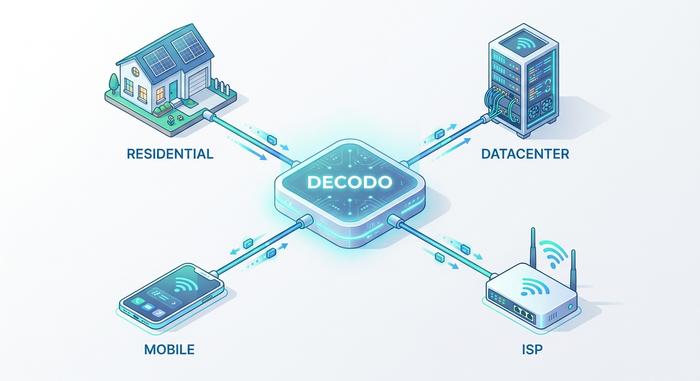
There is no single best proxy. There is the right proxy for the job, and picking wrong means either overpaying or getting blocked. Decodo sells four kinds, each selectable by location down to the city.
Residential proxies
These route through real home IP addresses, so to a website you look like an ordinary visitor. They are the go-to for hard targets that fight bots. Decodo's residential proxies cover a pool of more than 115 million IPs across 195 countries. Independent testing by Proxyway found just over 1.15 million unique IPs in a 1.2 million-request sample, with a 99.86% success rate, which is about as good as this market gets. You can rotate to a fresh IP on every request or hold a sticky session for several minutes when a site needs you to stay logged in.
Datacenter and ISP proxies
Datacenter proxies come from servers, not homes. They are cheap and fast, and fine for easy targets that do not scrutinize visitors, but they are also the easiest to detect and ban. ISP proxies — sometimes called static residential — are the middle ground: hosted in data centers but registered to real internet service providers, so they look residential while staying fast and sticky. Decodo also sells dedicated datacenter IPs that are yours alone.
Mobile proxies
Mobile proxies route through real phones on mobile carrier networks. Because carriers recycle a small range of IPs across thousands of users, blocking one mobile IP risks blocking real customers, so sites rarely do. Decodo's mobile pool makes them the hardest to ban and the most expensive option in the lineup. Reach for them only when residential is not enough.
Web scraping APIs and the Site Unblocker
Proxies are the raw material. The scraping layer is what most people actually buy now, and it is where the bot arms race shows up. With 51% of web traffic automated, sites have armed up: Cloudflare alone says it blocked 416 billion AI bot requests in roughly five months of late 2025. Beating that by hand is miserable.
That is also where the money is going. The web scraping market is projected to roughly double, from about $1.03 billion in 2025 to $2 billion by 2030, and most of that growth is in managed tools rather than raw proxies. Vendors noticed. The easy money is no longer renting IP addresses; it is selling the finished pipeline that turns a blocked URL into clean data.
So Decodo wraps it. The Site Unblocker takes a URL and handles the ugly parts automatically, bypassing blocks by rotating proxies, solving CAPTCHAs, rendering JavaScript, and retrying until it gets through. The Web Scraping API goes further and hands back structured data instead of raw HTML, so you skip writing parsers. There are ready-made code samples on GitHub and quick starts for Python, which matters when you just want a working request in five minutes rather than five hours.
Decodo pricing, packages, and free trials
Pricing splits by product, and the billing model matters more than the headline number. Residential and mobile are sold per gigabyte of traffic; datacenter and ISP are sold per IP. That means a cheap-looking residential rate can still add up fast if your scraper pulls heavy pages.
| Product | Listed starting price | Billed by |
|---|---|---|
| Residential proxies | ~$1.50 / GB | Bandwidth |
| Static residential (ISP) | ~$0.27 / IP | Per IP |
| Mobile proxies | ~$4.50 / GB | Bandwidth |
| Datacenter proxies | ~$0.026 / IP | Per IP |
| Site Unblocker | ~$1.60 / 1K requests | Requests |
| Web Scraping API | ~$0.08 / 1K requests | Requests |
Those are Decodo's listed entry prices, and they drop with volume. There is a free trial and a money-back window, so you can benchmark on your own targets before committing. Do that. Proxy performance is target-specific, and the only number that matters is the one you measure on the sites you actually scrape.
How to set up and use Decodo proxies
Setup is genuinely a five-minute job. Create an account, pick a plan, and open the dashboard. From there you authenticate one of two ways: whitelist your own IP address so Decodo trusts it, or use a username and password on each request. Then you copy the endpoint, the host and port Decodo gives you, and point your tool at it.
That is the whole flow for a script. If you do not code, the Chrome browser extension lets you flip proxies on and off by hand, and the company's anti-detect browser handles multiple profiles. Developers get copy-paste examples on GitHub and a quick-start for Python. The one habit worth forming early: rotate or whitelist deliberately, because a leaked endpoint is someone else's free bandwidth on your bill.
If requests start failing, the usual culprits are an expired IP whitelist, a session that outlived its sticky window, or a target that has simply blocked the subnet. Switch to fresh rotation, re-check your authentication, and test against a neutral IP-echo page before blaming the site you are after.

Decodo vs Bright Data, Oxylabs, IPRoyal
The honest framing is trade-offs, not a winner. Bright Data has the biggest pool and the most features, and it is also the most complex and expensive. Oxylabs targets enterprise budgets. IPRoyal is cheap with a small pool. Decodo sits in the value seat for the mid-market, and that is not just marketing: in Proxyway's test of 17 providers, it posted the fastest response time at 0.63 seconds and an overall score of 9.3 out of 10.
| Provider | Residential pool (claimed) | Standout | Note |
|---|---|---|---|
| Bright Data | 400M+ | Largest pool, most tools | Pricey, steep learning curve |
| Oxylabs | 175M+ | Enterprise features | Built for big budgets |
| Decodo | 115M+ | Price-to-performance | Proxyway's fastest in 2025 |
| IPRoyal | 32M | Low entry cost | Smaller pool |
Pool size is a vendor claim everywhere, so weigh it lightly. What you can verify — response time and success rate on your own targets — matters more than whose marketing page lists the biggest number. Decodo's edge in the Proxyway run was consistency, not just peak speed. A 99.86% success rate means roughly one request in 700 fails, which at scraping scale is the gap between a job that finishes overnight and one you babysit. For a mid-market team, that reliability usually beats a rival's larger but slower pool.
Decodo use cases for crypto and data
Here is the section the proxy reviews skip. In crypto, proxies quietly do three jobs — and Decodo taking crypto as payment is a small sign of who is buying.
Scraping crypto prices and on-chain data
Exchange APIs rate-limit you, and public endpoints block heavy traffic fast. Rotate through residential IPs and you can pull orderbooks, DEX pair data, and historical prices at the volume a trading model or a dashboard needs, without one IP getting throttled. This is the cleanest, most defensible use: gathering public market data at scale. A simple case: you want five years of hourly prices for fifty tokens to backtest a strategy. Hit one exchange endpoint from one IP and you are rate-limited within minutes. Spread the same job across a rotating residential pool and it finishes quietly, looking like fifty ordinary users checking charts.
Geo-testing and access
Exchanges and dApps behave differently by country, blocking some regions, showing different prices or terms in others. Proxies let you see your own product the way a user in Germany, India, or Canada sees it. The same tool does ad verification and price checks for e-commerce, which is the boring enterprise version of the same trick.
Multi-account, airdrops, and the sybil line
This is the grey zone. Airdrop hunters spin up many wallets behind many IPs to farm rewards, and projects fight back hard. LayerZero approved only about 1.28 million wallets out of 2.08 million applicants, cutting hundreds of thousands flagged for sybil behavior, one of the largest purges yet. Proxies are what make multi-account farming look organic, and also what gets flagged when the IPs cluster. Worth saying plainly: this often breaks a platform's terms of service, the detection is improving, and you carry the risk.
Is Decodo legit, secure, and reliable?
Decodo is a real, established company, not a fly-by-night reseller. It holds ISO 27001 certification, runs KYC checks at signup, and says it sources its IPs with consent while routing traffic to preserve user anonymity. Its infrastructure and performance are independently backed by Proxyway's benchmarks rather than only its own marketing. The honest caveat is the one that applies to every proxy: the tool is dual-use. Reliability is not the question; legality depends entirely on what you scrape and whether each site's terms allow it. That part is on you, not on Decodo.
Conclusion: Is Decodo the right proxy for you?
For most people who need proxies without an enterprise budget, Decodo is the strongest value pick: a fast, well-benchmarked pool plus a scraping layer that handles the anti-bot mess for you. Start small on pay-as-you-go residential, test it on your real targets, and scale by job rather than by hype. The bigger question is where the arms race goes next, because as bots cross half of all traffic, the line between gathering public data and getting blocked keeps moving.