The Complete Guide to Using Proxies for Web Scraping
Picture this. You wrote a neat little scraper last week. It worked perfectly on your laptop for the first forty or so pages. Then, somewhere around request number fifty, everything broke. The 429 errors started rolling in. A CAPTCHA popped up where real HTML used to be. The entire page you were loading looked like some completely different version of the site, because the anti-bot system quietly decided you were not a real human anymore. And then, a few minutes later, your IP was just gone. Banned clean. That is the exact moment you either ditch the project entirely or start actually learning about proxies for web scraping.
Turns out, this is a much bigger industry than people think. Mordor Intelligence has the web scraping market at USD 1.03 billion in 2025 and projects it to hit USD 2.00 billion by 2030, growing at a 14.2% compound annual rate. Research and Markets is even more optimistic at 18.2% CAGR. Almost all of that growth sits on top of one quiet layer of infrastructure nobody outside the industry ever sees. The proxies. The actual IP addresses that make any real-world data collection possible. Strip them away and modern scraping just... stops. At any serious volume, it is not happening without them.
So what does this guide actually cover? Everything you genuinely need to know about proxies for web scraping in 2026. The main types of proxy you can buy from real vendors. How to pick the right one for whatever you are trying to do. Honest price ranges across the category, provider by provider. Which companies actually deliver versus which ones just market hard. How automatic proxy rotation works in practice so your IPs do not get burned in the first hour. The current legal status of web data extraction at scale, after the big Meta v Bright Data ruling landed in 2024. And which web scraping tools will save you a weekend when you wire proxies into a Python scraper. By the time we are done, you will know which proxies for web scraping deserve your money, and which ones you can walk past without a second look.
Why Use Proxies for Web Scraping Projects in 2026
Proxies for web scraping exist for one reason. Scrapers need a layer of indirection between them and the rest of the internet, and they need one websites cannot easily fingerprint and block. A proxy is just a server sitting in the middle. Your request hits the proxy. The proxy forwards it along to whatever site you are scraping, using its own proxy IP addresses. The response comes back down the same road. From the site's side, everything looks like normal traffic from the proxy, not from you. And that one small piece of indirection is genuinely what makes modern web scraping activities possible at any real scale. It is exactly why proxies tend to be the very first piece of infrastructure any serious scraping team sets up before writing a single line of code.
So, why bother? The three reasons to use proxies for web scraping projects are honestly pretty boring. But every other decision about proxies for web scraping flows downstream from these.
Number one is anti-bot defense. Websites watch for that exact pattern of rapid-fire requests coming from one IP address, and they block it fast. Spread those same requests across a pool of proxies and suddenly your traffic looks like a thousand unrelated users poking around the site instead of one automated script hammering away. Number two is geographic access. Lots of websites serve totally different prices, inventory, or content depending on where the request is coming from. A residential proxy in Tokyo gets you the Japanese version of the page. A US proxy gets you the American version. Easy trick, enormous value. Number three is raw scale. Hitting any real production site at the volume a serious data project actually needs means firing off tens of thousands of requests per hour, and there is no way to do that from a single IP without getting banned within minutes. No way at all.
Proxies are often the only thing standing between a working data pipeline and a permanent ban, and every serious use proxies for web scraping workflow you can think of runs on top of these three things. Price monitoring. SEO rank tracking. Ad verification. Brand protection. Travel aggregation. Market research. And the LLM training data pipelines that just absolutely exploded starting in 2024. Every single one. Successful web scraping pipelines at this level treat proxies for your web scraping stack as a first-class infrastructure requirement, not some afterthought you bolt on later when things break.
What Is a Proxy Server for Scraping and How It Works
A proxy for scraping is a middleman that intercepts HTTP or HTTPS requests and forwards them on your behalf. Every proxy server for scraping follows this same basic pattern, whether it is running in a datacenter or on a real residential connection. Many proxies are available across almost every country you might want to target, which is why scraping the web at international scale is now a real option. The server maintains its own IP address, sits on its own network, and hands back whatever the target site returns. You configure your scraper to route every request through the proxy and everything else happens automatically.
There are two protocols that matter in practice. HTTP proxies handle standard web traffic and work for almost every scraping workflow you will ever build. SOCKS proxy options (SOCKS5 specifically) are lower-level, faster in some cases, and they can handle any TCP traffic (not just HTTP) which makes them useful for specialized work. Both are available from any high-quality proxy provider. For 99% of web scraping projects, HTTP is fine.
Under the hood, the proxy pool supporting your traffic can be built in four very different ways, and the way it is built decides how much you pay and how often you get blocked. The next section walks through all four.
Proxy Types: Datacenter, Residential, Mobile, ISP
The proxy type you pick is the single biggest decision when buying proxies for web scraping. It drives cost, success rate, and detection risk more than any other factor in your stack. The four main types each have a different source of IP addresses and a different cost profile.
| Proxy type | IP source | Typical price (2026) | Success rate | Best for |
|---|---|---|---|---|
| Datacenter | Commercial cloud and hosting providers | $0.10-$1 per GB, $0.50-$3 per IP | 70-85% | Public sites, high-volume low-sensitivity scraping |
| Residential | Real home ISP connections | $2-$15 per GB | 94-99% | Protected sites with anti-bot systems |
| ISP (static residential) | Static IPs hosted in datacenters but registered to ISPs | $2-$10 per GB, $2-$15 per IP | 90-97% | E-commerce, SEO monitoring, sneaker drops |
| Mobile (4G/5G) | Mobile carrier networks on real devices | $9-$25 per GB | 97-99% | Social platforms, hardest targets |
Sources: Decodo pricing, Bright Data docs, Oxylabs pricing, Proxyway 2026 benchmarks, IPRoyal, Webshare.
Datacenter proxies are cheap and fast but commercial IPs are flagged aggressively by any site running Cloudflare, DataDome, PerimeterX, or Akamai. Residential proxies borrow IPs from real home connections through SDK partnerships and pay-to-opt-in networks, which is why they pass almost every anti-bot check. ISP proxies are an interesting hybrid: the IPs look like residential to the target site but they live on datacenter hardware, which gives you residential-grade trust with datacenter-grade speed. Mobile proxies are the nuclear option. Traffic routes through a real 4G or 5G carrier, which is why the block rate drops below 1% on even the hardest targets.
Residential Proxies vs Datacenter Proxies in 2026
When comparing proxies for web scraping, the cheapest rational choice you have to make is residential proxies vs datacenter proxies. Almost every real scraping project starts with this question, and the answer depends entirely on the target.
Datacenter proxies are the right pick when the target site has weak or no anti-bot defenses, when the data is public and scale matters more than stealth, and when your budget is the hard constraint. Think public news sites, open APIs, static product catalogs, job board listings. You can buy datacenter IPs from Decodo at $0.02 per IP or from Webshare at roughly $3 per 100 IPs. At that price, you can run millions of requests per month for under a hundred dollars and nobody will care. Residential and datacenter proxies can even be mixed in the same pool if your use case benefits from both.
Residential proxies are the right pick when the site uses an anti-bot system, when the request volume is moderate, or when the data changes based on geography. Residential proxies use real home IP addresses borrowed from volunteer users, which is why they pass almost every trust check. E-commerce sites (Amazon, Walmart), social platforms (LinkedIn, Instagram), SERP pages from Google, and anything behind Cloudflare basically require residential ips to work at all. Residential and mobile proxies together cover the hardest targets on the open web. The price is the cost of doing business. Bright Data charges around $5.88 per GB on a subscription plan, Oxylabs sits at $4-$8, Decodo runs from $2 per GB, and budget providers like IPRoyal offer residential IPs starting at $1.75.
The honest rule of thumb: if your first test run with datacenter IPs gets a success rate above 85%, stay with datacenter. If it drops below that, upgrade to residential and save yourself the debugging. Mixing the two in the same pool is also fine and many providers will do it for you automatically under a single proxy endpoint.
Rotating Proxies and IP Rotation in a Proxy Pool
Rotation is the feature that makes proxies for web scraping actually work in practice. Using one IP for every request is the fastest way to get blocked. The whole reason to have a proxy pool is to rotate through many different proxies so each request comes from a fresh address. IP rotation is not optional if you are serious about web scraping. It is the entire point of the exercise, and the number of proxies in your rotation is often the single biggest factor in whether a project works at all. A proxy scraper that tries to cycle through different proxies without a proper proxy setup will hit the same walls as a scraper with no proxies at all.
There are three common rotation strategies and you should know the difference before you pick a plan.
Per-request rotation assigns a new IP to every single request your scraper makes. The target site sees each request coming from a different wallet of IPs, which defeats rate-limiting almost completely. This is the default behavior on most residential proxy plans and it is what you want for scraping product catalogs or SERPs where session continuity does not matter.
Sticky session rotation keeps the same IP for a configurable window (often ten minutes). This matters when the target site is tracking a login session, a shopping cart, or anything else that requires the same IP to persist across multiple requests. Rotating mid-session breaks the flow and triggers anti-fraud alarms. Most providers let you set sticky sessions from one minute to thirty minutes.
Time-based rotation changes the IP on a schedule (every N minutes) regardless of how many requests you made. This is a compromise between the two others and it is often how mobile proxies work because mobile carriers naturally rotate IPs on their own NAT cycles.
On any meaningful project, you are going to mix strategies. Use per-request rotation for public pages, sticky sessions for anything behind a login, and let your proxy manager handle the switching for you.
Free Proxies, Free Proxy Lists, and Free Proxy Servers
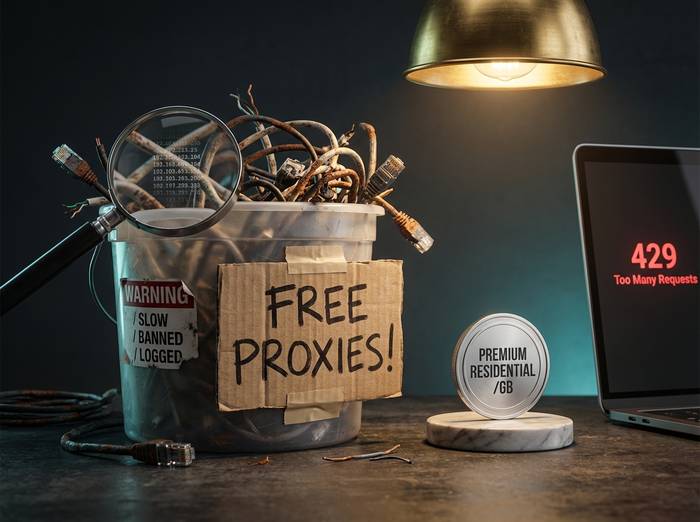
Yes, free proxies for web scraping exist. And yes, there is a reason every paid proxy vendor politely tells you not to use them for anything that matters.
Free proxy lists come from sites like Free Proxy Lists, ProxyScrape, Open Proxy Space, Spys.one, Geonode, Proxy Nova, and dozens of others. They aggregate IPs that have been scraped from public sources or donated by compromised machines. Free proxies might look impressive on the surface when you see the raw counts, but the pools are rarely what they advertise. Proxies may be counted as "active" even when most have been dead for days. ProxyScrape lists thousands. Free Proxy Lists updates every 30 minutes. Geonode offers 6,500+ free proxies with filters.
The catch is that free proxies almost never work on any site that matters. Public IPs are already flagged by every major anti-bot system. Speeds are slow and connections drop constantly. Worse, some free proxy servers are actively malicious. They log traffic, inject ads, modify responses, or try to steal credentials. Free proxies can prevent a project from ever reaching production, and they definitely cannot prevent your IPs from getting banned mid-run. For a hobby project on a toy site, fine. For anything involving real data, logins, or production reliability, you are paying for the free proxies with every minute of debugging you lose.
The practical advice is this. Use free proxies only for learning how proxies work. Use the free trial tiers from paid providers for quick tests. Decodo offers a 14-day trial, Webshare has a permanent free plan, and Bright Data runs a 7-day free trial on every paid tier. Once you hit any real volume, pay for a proper residential plan. The math works out cheaper almost immediately.
How to Choose a Proxy for Web Scraping Success
Here is the honest way to do this. Choosing a web scraping proxy really comes down to four questions you just answer in order. Target, volume, geography, budget. Nail these and the proxy type will basically pick itself. Choosing the right proxy solution for your project is the single biggest leverage point in the entire setup, so use a proxy that fits your actual use case and choose the best option on the merits. Not the cheapest. Not the most-advertised. The right proxy network matters way more than whatever brand name is printed on the box.
Target first. So, what site are you even scraping, and how aggressive is its anti-bot setup? Pop open the network tab and check if Cloudflare, DataDome, Akamai, PerimeterX, or Imperva shows up anywhere in the response headers or the page source. If you spot any of them, congratulations, you now need residential or ISP proxies. Datacenter will just get you banned. If the site is plain HTML with no bot protection at all, datacenter is absolutely fine and you can save a bunch of money.
Volume second. How many requests per day are we actually talking about? Under ten thousand a day, most free trials or the cheapest low-tier plans will honestly cover you just fine. Ten thousand to a hundred thousand, you want a proper paid residential plan from Decodo, Webshare, or IPRoyal, somewhere in the $50 to $200 a month range. Over a hundred thousand? You are now firmly in enterprise pricing territory and need to start talking to Bright Data, Oxylabs, or NetNut sales teams.
Geography third. Does the target site actually serve different content depending on country? If yes, you need a provider with genuinely good coverage in the countries you care about. Almost every major provider advertises 195+ countries on their landing page, but the actual IP counts in any given country vary wildly once you dig into it. Bright Data claims 150M+ residential IPs, SOAX claims 155M+, Decodo sits around 115M, Oxylabs at roughly 100M+, Webshare at 80M+, and IPRoyal at around 40M+. Very different pools.
Budget fourth. Proxies are a real line item, make no mistake. A small hobby project might only spend $30 a month. A serious commercial scraper can easily spend $5,000 a month without blinking. Set your hard ceiling before you go shopping so the sales team cannot upsell you to a plan you do not actually need.
Best Proxies for Web Scraping Providers in 2026
The best proxies for web scraping providers in 2026 are the ones you have probably already seen in every "top 10" list on the internet. These web scraping proxy providers have all consolidated into this short list, and choosing a web scraping proxy tends to mean picking from one of them. The big names have consolidated into a handful of serious players with overlapping feature sets and noticeably different pricing.
| Provider | Residential pool | Entry price (residential) | Notable strength |
|---|---|---|---|
| Bright Data | 150M+ | $5.88/GB (sub), $4/GB (PAYG) | Largest feature set, Web Unlocker API, enterprise support |
| Oxylabs | 100M+ | $4-$8/GB | Premium enterprise, dedicated account managers |
| Decodo (ex-Smartproxy) | 115M+ | $2/GB | Best value for money, 99.86% success rate |
| SOAX | 155M+ | ~$3.60/GB | Granular rotation controls, flexible filtering |
| NetNut | 85M+ | ~$3.50/GB | Direct ISP sourcing, high-speed connections |
| Webshare | 80M+ | $3.50/GB | Cheap plans, free trial, beginner-friendly |
| IPRoyal | 40M+ | $1.75/GB | Lowest entry price, good for small projects |
| Rayobyte | 300K+ datacenter focus | custom | Datacenter specialist, unlimited bandwidth |
Sources: provider pricing pages, Proxyway 2026 benchmarks, Decodo third-party testing.
The winners in each category look like this. Best overall and best web scraping proxies pick: Decodo, which is the rebrand of Smartproxy as of April 2025 and benchmarks at a 99.86% success rate with a 0.54-second average response time in third-party tests. Decodo's proxy service is often cited as the best premium proxy option for mid-market projects. Best enterprise: Bright Data, which has the biggest catalog and the most polished web scraping APIs. Best budget: IPRoyal or Webshare, which let you get started for under ten dollars. Best datacenter: Rayobyte, which specializes in high-volume datacenter pools with unlimited bandwidth plans.
Bright Data, Oxylabs, and Decodo Smart Proxy
These three are the most-compared names in the proxies for web scraping space, and they all come up in every buying decision. The differences are real but they are narrower than marketing copy suggests.
Bright Data (formerly Luminati Networks) is the biggest company in the market. The residential pool runs at 150 million+ IPs and the product catalog includes datacenter (1.3M+), ISP (700K+), and mobile (7M+) proxies on top of the core residential service. The company also ships a Web Unlocker API, a scraping browser, and ready-made scrapers, which moves Bright Data closer to "scraping platform" than "pure proxy provider." Pricing is on the higher end of the market ($5.88/GB on subscription, $4/GB pay-as-you-go) and enterprise customers get dedicated account managers.
Oxylabs is the enterprise-focused alternative. The residential pool is around 100 million+ IPs across 195+ countries, and the company leans hard into premium features: dedicated account managers, SLA guarantees, and a Web Scraper API that starts around $0.25 per 1,000 results. Entry pricing is higher than the budget tier ($4-$8/GB depending on plan), but if you are building a scraping product and need support that actually picks up the phone, this is where you land.
Decodo (the rebrand Smartproxy announced in April 2025) sits in the middle on everything. The residential pool is 115 million+ IPs across 195+ locations, pricing starts at $2/GB for residential, $0.02 per IP for datacenter, and $2.25/GB for mobile. Third-party benchmarks clocked Decodo at a 99.86% success rate with sub-second response times in 2026 testing. The "smart proxy" branding has been dropped but the product is the same. For most serious projects that are not enterprise-scale, Decodo is the best value pick.
Paid Proxy Options for Web Data and API Access
The industry has been shifting, and it has been shifting fast. Raw proxy endpoints are still around, but more and more of the action is now in paid proxy options that bundle proxies for web scraping with a full scraping API layered on top. The pitch is simple. Instead of renting a pool of IPs and then writing all your own rotation logic, you just hit one API endpoint and the service quietly handles everything for you. Proxy rotation. Browser rendering for JavaScript-heavy sites. CAPTCHA solving. Fingerprinting. Retries on failed requests. All of it.
These higher-level web data APIs cost more per successful request than raw proxies, sure. But they also collapse dozens of lines of Python into one HTTP call. If you value your time at anything above zero, that matters. Here is the short list of dedicated web scraping endpoints worth knowing about as part of your scraping infrastructure.
- Bright Data Web Unlocker is an unblock API aimed at the really hard targets, priced as a flat fee per successful request.
- Oxylabs Web Scraper API starts at around $0.25 per 1,000 results and handles rendering, proxy rotation, and retry automatically.
- Decodo Site Unblocker starts at around $0.95 per 1,000 requests and is designed for web scraping projects with serious anti-bot defenses.
- ScraperAPI is a proxy-less unified API, starting at roughly $49 per month for low volumes.
- Zyte API is yet another managed scraping endpoint aimed at enterprise clients who want powerful web scrapers without managing proxy networks themselves.
Which one is right for you? Honestly, it comes down to where you sit on the build-versus-buy spectrum. If you are a solo developer running one or two projects, you are almost always better off just paying for a scraping API and forgetting the whole infrastructure problem. Life is short. But if you are a data team running dozens of crawlers every single day, the math changes fast. At that scale, buying raw residential proxies and managing them in-house usually wins, because per-request API pricing adds up brutally fast when the request counts get big.
Python Web Scraper Code with a Proxy Manager
Okay so here is the good news. Wiring proxies for web scraping into a Python scraper is literally five lines of code. That is it. The real work, the part people actually struggle with, is managing rotation, retries, and sticky sessions once you start scaling up. A proxy manager handles that whole management layer for you, which lets your actual scraper code stay clean and readable. Most of the standard web scraping libraries already follow best practices out of the box, but you still need some kind of plan for when to hit a proxy endpoint directly and when to route everything through a proxy manager wrapper on top.
The bare minimum requests library example looks like this.
```python
import requests
proxies = {
"http": "http://user:[email protected]:10000",
"https": "http://user:[email protected]:10000",
}
response = requests.get("https://example.com", proxies=proxies, timeout=30)
print(response.status_code, response.text[:200])
```
That is the whole integration. Every major provider hands you a proxy endpoint URL in exactly this format, and their own server handles the rotation on the backend. Which means your code never has to actually know which specific IP is being used on any given request. Beautiful, really.
For anything more complicated, though, the proxy manager pattern is cleaner. Libraries like `scrapy-rotating-proxies`, `requests-ip-rotator`, or the built-in Scrapy downloader middleware all let you plug in a whole pool of proxy endpoints and rotate through them with retry logic, error handling, and session persistence already baked in. Zyte (the company behind Scrapy itself) also sells a managed Smart Proxy Manager service that abstracts the entire rotation layer into a single endpoint for you. For Python scrapers running at real production volume, that is usually the cleanest path forward. Advanced scraping setups almost always converge on the same pattern in the end. One managed rotation layer sitting on top of a raw proxy pool underneath.
Legal Side of Proxies and Web Scraping
Good news on this front. The legal status of proxies for web scraping has actually clarified quite a lot since 2022, and by 2026 the whole picture is mostly friendly to anyone operating on public data. Three court rulings are genuinely worth knowing about if you do any of this for a living.
Start with the hiQ Labs v LinkedIn case. It kicked off back in 2019 and finally wrapped up with a 2023 settlement, after the Ninth Circuit remanded it in 2022. The headline finding from that whole saga was clean enough. Scraping publicly accessible data does not violate the Computer Fraud and Abuse Act (CFAA). Then Van Buren v United States in 2021 narrowed the CFAA even further, this time at the Supreme Court level. That ruling basically said accessing a system you are already authorized to use does not suddenly become a federal crime just because you used it for a purpose the owner did not love. And then the big one landed. Meta v Bright Data. Summary judgment went Bright Data's way on January 23, 2024, and Meta dropped its appeal exactly a month later on February 23, 2024. That ruling confirmed two important things. Platform Terms of Service cannot bind former users in perpetuity, and scraping public data from a logged-out state is not a violation of the CFAA or any state computer crime law.
So the net effect in the US, right now, is pretty straightforward. Scraping public data with proxies is legal, and it is court-tested at this point. What you still cannot legally do is bypass authentication, scrape private or logged-in data without permission, violate GDPR rules around personal data, or use whatever you scraped in ways that infringe copyright or trademark. None of that changes just because you are using proxies. The proxies only change how you get the data. They do not change whether you were ever allowed to have the data in the first place. Keep that distinction sharp and you will stay out of trouble.
Pros and Cons of Proxies for Web Scraping Options
Summary of the trade-offs across the main proxies for web scraping options on the market.
| Pros | Cons |
|---|---|
| Residential proxies bypass almost every anti-bot system | Residential is the most expensive recurring cost in any project |
| Datacenter proxies are fast and cheap for public targets | Datacenter IPs get flagged on any protected site |
| Rotating proxies defeat rate limits automatically | Session-sensitive scraping needs sticky IPs instead |
| Managed scraping APIs abstract all the hard parts | Per-request pricing gets expensive at high volume |
| 2024 Meta v Bright Data ruling clarifies legal status | Private or logged-in data scraping remains risky |
| Top providers have 100M+ IP pools across 195 countries | Benchmark claims from vendors often disagree with third-party tests |
| Decodo, IPRoyal, Webshare make entry pricing affordable | Mobile proxies remain the most expensive type by far |
| Python integration is five lines of code | Proxy management at scale is a real engineering problem |
Who should care most: anyone running a price monitor, a SERP tracker, an ad verification system, a market research crawler, a travel aggregator, or an LLM training data pipeline. Proxies are the infrastructure layer that lets all of those things scale past the point where a single IP would get banned in hours.
Who can skip most of this: hobby projects scraping a couple of pages per day from non-protected sites. A single residential IP via free trial will probably get you through.
Final Take: Best Proxy for Web Scraping in 2026
The honest answer to "what are the best proxies for web scraping" is that it depends on the target. Start with datacenter proxies from Webshare or IPRoyal if the site is not protected. Upgrade to Decodo residential ($2/GB) the moment you see blocks or CAPTCHAs. Go to Bright Data or Oxylabs enterprise if you are running a commercial product that needs guarantees and support. Add mobile proxies only for the hardest targets (social platforms, sneakers, certain payment sites). Rotate per-request for public pages and stick IPs only when sessions matter.
Everything else is implementation detail. The legal situation is clearer than it has ever been after Meta v Bright Data, the price curves on proxies for web scraping have dropped steadily year after year, and the tooling has reached the point where a small team can run a production scraping pipeline for less than a senior engineer's monthly salary. In 2026, proxies for web scraping are no longer the bottleneck. The bottleneck is figuring out what data is worth collecting in the first place. That part of the decision is still on you, not the proxies for web scraping you choose.