Wormhole Crypto in 2026: Cross-Chain Bridge, Token, AI
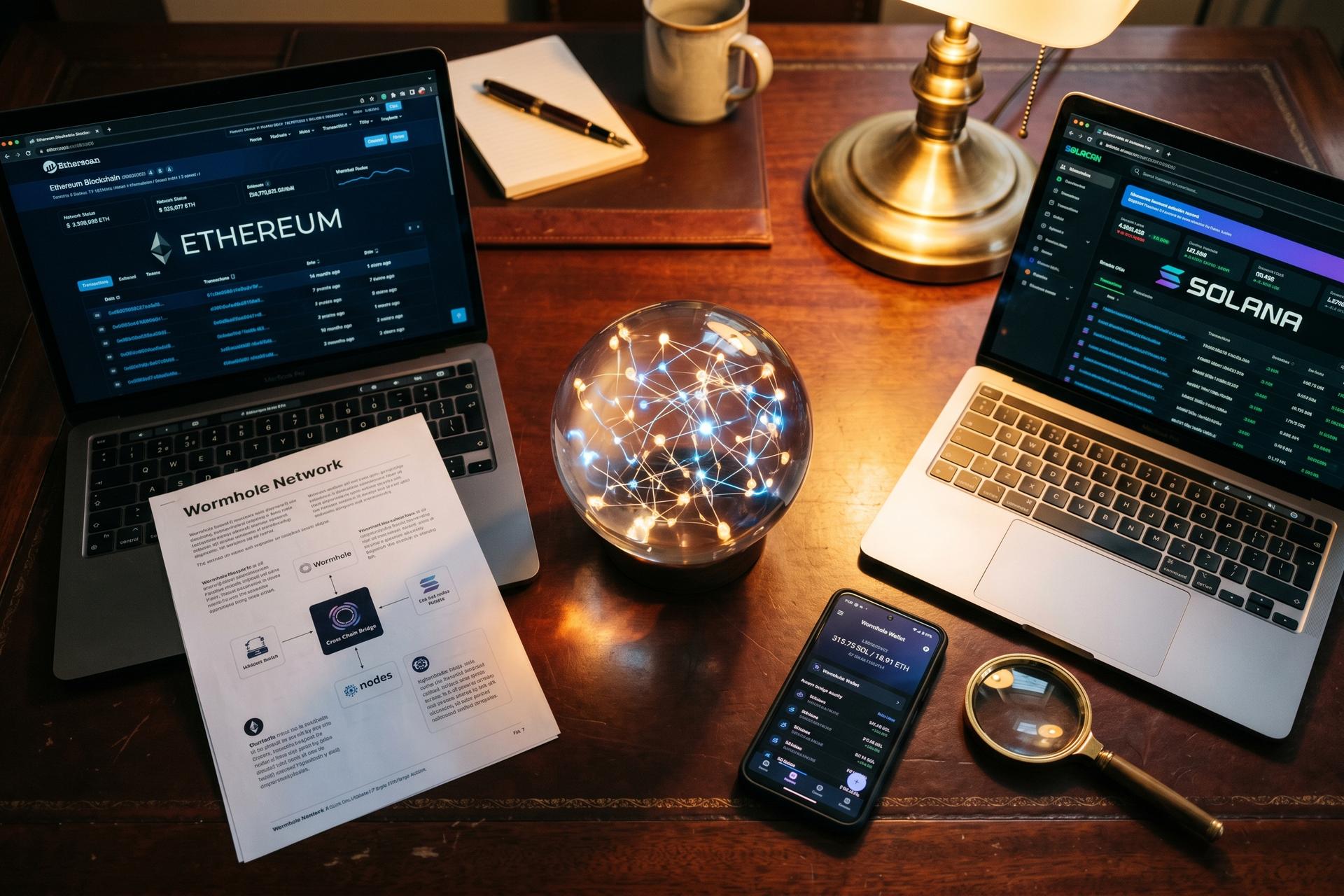
Fifty-eight point nine billion dollars. That is the cumulative value Wormhole has moved across blockchains since it went live in 2020, alongside more than 1.09 billion cross-chain messages. Now the awkward part. Over the same period, the protocol's native token, W, has lost ninety-nine percent of its value from the all-time high it printed at launch.
Both numbers are real. Both are accurate as of May 2026. The gap between them is the most useful entry point into what Wormhole actually is. The protocol scaled into one of the largest pieces of cross-chain plumbing in crypto. The token captured almost none of that growth. Most explainers blur the two together. This article keeps them apart. It walks through how the protocol works, compares it honestly to LayerZero, Axelar, and Chainlink CCIP, and looks at an angle few people have written about: AI agents using Wormhole as a cross-chain primitive.
What Is Wormhole? Cross-Chain Messaging in One Section
Calling Wormhole a "bridge" is the most common mistake. Wormhole is a generic cross-chain messaging protocol. It is an interoperability platform that lets any blockchain send data, tokens, and instructions to any other. A bridge — the kind that lets you move USDC from Ethereum to Solana — is an application built on top of Wormhole, not Wormhole itself. The distinction matters because it explains why a protocol with a $71 million token can still be embedded in BlackRock-issued tokenized funds.
The project began in 2020 inside Certus One, a validator-as-a-service company, and was incubated by Jump Crypto. The original goal was narrow: move SPL tokens between Solana and Ethereum. Within a year the scope had widened into general-purpose message passing, and by 2023 the Wormhole Foundation, registered in the Cayman Islands, had taken over governance.
As of May 2026, Wormhole supports more than forty blockchains. That list includes the heavyweights — Ethereum, Solana, Bitcoin via wrapped formats, BNB Chain, Arbitrum, Optimism, Base, Polygon, Avalanche, Sui, Aptos — and recent additions like Monad and Hyperliquid's HyperEVM. The protocol's market share of cross-chain message volume sat at roughly twenty percent in the fourth quarter of 2025, according to DefiLlama bridge data.
The product surface has expanded well beyond the original Solana-Ethereum pipe. Portal is the canonical asset bridge most retail users actually touch. NTT, or Native Token Transfers, is the standard major projects use when they want a token to exist natively on multiple chains rather than as a wrapped derivative. Settlement, launched in February 2025, is an intents-based layer for institutional cross-chain transactions. Queries lets a smart contract on one chain read state from another. Connect is the embed SDK that ties it all together for developers.
The headline statistic — $58.9 billion in cumulative value transferred — is the sum across all of those products. The protocol moves roughly $200 million in cross-chain value on a typical day in 2026 and processes well over a million messages per week.
How the Guardian Network Actually Works
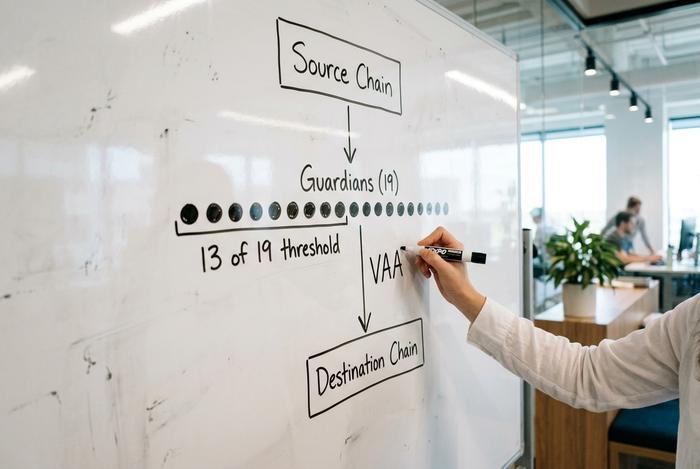
Wormhole's security model is straightforward enough to fit on one page, which is unusual in cross-chain land. Nineteen independent validators, called Guardians, observe transactions on every supported chain. When a smart contract emits a Wormhole message on chain A, each Guardian sees the event, individually signs it, and contributes to a threshold-Schnorr signature. Thirteen of nineteen signatures form a valid VAA — a Verifiable Action Approval. The destination chain's Wormhole contract verifies the VAA and triggers the requested action. That is the entire model.
The Guardian set is deliberately a known quantity. Members include Jump Crypto, Certus One, Everstake, Figment, ChainOdin, Staked.us, Forbole, P2P Validator, and as of 2024–2025, Google Cloud. The list is decentralised in one sense — no single entity controls thirteen votes. It is centralised in another — the validators are vetted and added by governance, not freely permissionless. The honest framing is "permissioned multi-party signer set" rather than "trustless decentralized network."
Two practical consequences fall out of this design. First, message latency is fast — on the order of a few minutes end-to-end — because the Guardians can sign as soon as the source-chain transaction finalises. Second, the protocol charges no fee on most products today. According to DefiLlama, Wormhole's protocol revenue in May 2026 sits at zero. Gas costs on source and destination chains are real, but the Wormhole contracts themselves take nothing. That is a material competitive fact, especially when you compare the token economics to LayerZero or to Chainlink CCIP.
| Element | Wormhole detail |
|---|---|
| Validator set | 19 Guardians, vetted by governance |
| Threshold | 13-of-19 t-Schnorr signature |
| Message type | Generic VAA (Verifiable Action Approval) |
| Protocol fee | None on most products (May 2026) |
| Average latency | Minutes (source-finality bound) |
| Notable Guardian | Google Cloud (added 2024–2025) |
The thirteen-of-nineteen threshold is the number to focus on. Compromising Wormhole at the consensus layer requires colluding or compromising thirteen separate well-known infrastructure providers. Possible, but not cheap.
The Wormhole Crypto Product Stack: Portal, NTT, Settlement
The 2024–2026 story of Wormhole is the shift from "bridge company" to "financial infrastructure company." Each product on the current stack targets a different cross-chain primitive, and together they form a connective layer across the broader blockchain ecosystem.
Portal is the canonical asset bridge — the user-facing interface most retail people associate with the brand. According to DefiLlama, Portal sits at roughly one billion dollars in total value locked. It is what handles wrapped tokens when an ERC-20 needs to appear on Solana or vice versa.
Native Token Transfers (NTT), launched in 2024, is the more important product strategically. Instead of wrapping assets, NTT lets a token exist natively on every chain it wants to live on. The protocol mints and burns supply across chains under a unified accounting model, so a holder on Solana and a holder on Ethereum own the same asset, not synthetic representations of it. Adopters as of May 2026 include Lido's wstETH (on BNB Chain), Ripple's RLUSD stablecoin, Bittensor's TAO token now on Solana, the Stacks $1.5 billion sBTC issuance, and Monad's native bridge.
Settlement went live on February 26, 2025. Settlement is an intents-based layer. Institutional users specify the outcome they want — "move 100M USDC from Ethereum to Solana, settled atomically" — and solvers compete on execution. The product consolidates cross-chain liquidity into a single flow. The first launch covered nine chains and bundled three protocols into a single suite. It is the product most likely to grow into a meaningful revenue source if the fee switch ever activates.
Queries is the read-side complement. A smart contract on chain A can request state from chain B and receive a Guardian-signed VAA proving the answer. It is what makes cross-chain governance, cross-chain price feeds, and cross-chain risk monitoring possible without trusted relayers.
Connect is the developer SDK that bundles all of the above into a few hundred lines of front-end code.
| Product | Launched | What it does | Notable users |
|---|---|---|---|
| Portal | 2020 | Canonical asset bridge | Retail bridging |
| NTT | 2024 | Native multichain token issuance | Lido wstETH, RLUSD, TAO, sBTC |
| Settlement | Feb 2025 | Intents-based settlement | Institutional flow |
| Queries | 2024 | Read state across chains | Cross-chain governance |
| Connect | 2023 | Embed SDK | Hundreds of dApps |
Securitize, the regulated tokenization platform behind BlackRock's BUIDL fund, named Wormhole as its official interoperability provider in May 2024. That single partnership is the reason BlackRock, Apollo, Hamilton Lane, and VanEck tokenized assets can move across chains today.
Wormhole vs LayerZero vs Axelar vs Chainlink CCIP
There is no single winner in cross-chain interoperability in 2026. There are three or four legitimate winners on different axes, and Wormhole occupies one of them. The honest comparison looks like this.
LayerZero is the chain-count champion. LayerZero V2 supports more than 165 chains and has shipped over 733 Omnichain Fungible Tokens (OFTs). Cumulative volume passed $166.9 billion as of early 2026. The ZRO token has held a higher market capitalisation than W throughout 2025–2026 — roughly $432 million versus $71 million in May 2026. LayerZero's edge is breadth and a strong OFT framework that competes directly with Wormhole's NTT.
Chainlink CCIP is the enterprise winner. Launched in July 2023, CCIP supports 60-plus chains but has captured the TradFi pipeline that Wormhole is still chasing. Coinbase routes roughly $7 billion in wrapped assets through CCIP. Lido uses it for wstETH on chains where NTT is not deployed. SWIFT and DTCC pilot CCIP for tokenised securities settlement. The integration story is enterprise sales, not retail volume.
Axelar is the smaller of the four. Sixty-plus chains, a DPoS validator set of around seventy-five active operators, and a cumulative lifetime volume last verified at $8.66 billion. Axelar's distinguishing feature is its more permissionless validator model — anyone with enough stake can become a validator — and a general-message-passing primitive that overlaps with Wormhole's approach to blockchain interoperability.
Wormhole is the raw-volume leader. The $58.9 billion lifetime number is larger than Axelar's by a wide margin and proportionally significant against LayerZero, given Wormhole has been operating one year longer. NTT competes head-to-head with OFT. Where Wormhole is structurally behind is two places: token fee accrual and TradFi enterprise integrations.
| Protocol | Chains | Cumulative volume | Security model | Token mcap (May 2026) | TradFi presence |
|---|---|---|---|---|---|
| Wormhole | 40+ | $58.9B | 13-of-19 Guardians | $71M (W) | BlackRock via Securitize |
| LayerZero | 165+ | $166.9B | DVN model (configurable) | $432M (ZRO) | Growing |
| Axelar | 60+ | $8.66B (May '24) | DPoS, 75 validators | n/a (AXL) | Limited |
| Chainlink CCIP | 60+ | Not disclosed | Decentralised oracle network | n/a (LINK) | SWIFT, DTCC, Coinbase |
The right framing for a reader: pick a winner by use case, not by brand. If you are building a dApp that needs the longest tail of chains, LayerZero. If you are a regulated institution settling tokenised securities, CCIP. If you want raw cross-chain transfer volume with an established Guardian model, Wormhole.

The February 2022 $325M Exploit and What It Changed
On February 2, 2022, an attacker found a signature-verification bug in Wormhole's Solana contracts. They exploited it to mint 120,000 wETH on Solana without backing collateral on Ethereum. At the time those tokens were worth roughly $325 million, then the largest exploit in DeFi history. Within twenty-four hours, Jump Crypto wired replacement funds and made depositors whole. The protocol contracts were patched the same week.
Two things changed because of the incident. First, Wormhole became one of the most actively audited protocols in the cryptocurrency ecosystem. Security review work since 2022 includes engagements with Neodyme, Trail of Bits, OtterSec, Certik, and Zellic. Second, the Jump Crypto refill turned what could have been a closure event into a credibility signal. Institutional partners learned that the people behind Wormhole would put $325 million of their own money on the line to keep the protocol alive. That memory is still buying goodwill in 2026.
W Token: What It Does, Why It's Down 99 Percent
The W airdrop happened on April 3, 2024, distributing roughly 1.7 billion tokens — seventeen percent of a ten-billion maximum supply. It hit an all-time high of $1.61 on its first day of trading and has been falling ever since. As of May 2026, W trades at $0.012 with a market capitalisation of $71 million, ranks around 308 by market cap, and has 5.89 billion tokens in circulation. The all-time low of $0.01172 was printed on April 14, 2026 — that is, last month.
The structural problem is straightforward. W is a governance token in a protocol with zero protocol revenue. There is no fee switch active. Holders cannot capture cross-chain message fees because there are no cross-chain message fees. The W 2.0 tokenomics upgrade announced in 2025 added more scope to governance. It did not change the core equation: protocol traction has grown, yet the digital asset itself captures none of that growth.
Compare the same metric for LayerZero. ZRO has its own governance scope, but a market capitalisation roughly six times W's despite carrying a comparable structural story. The difference is partly narrative, partly the fact that LayerZero shipped more chains faster.
The 2026 Angle: AI Agents and Cross-Chain Primitives
The newest layer of the Wormhole story is AI agents. Agent frameworks — autonomous software that swaps, lends, and arbitrages across the Web3 ecosystem on its own — need to move funds across chains as a matter of routine operation. Wormhole's NTT and Settlement products happen to be well-shaped primitives for that.
The canonical example is Bittensor. TAO, the native token of the Bittensor AI subnet network, came onto Solana via Wormhole NTT in 2026. Why does that matter? Because Bittensor is the largest "AI economy" asset in crypto, and an agent operating on Solana that wants to hold or pay in TAO can do so without bridging to a separate chain first. The same logic applies to any AI agent that needs USDC on one chain and TAO on another in the same transaction flow.
Agent frameworks like ElizaOS — the open-source agent runtime used by hundreds of community projects — integrate Wormhole for cross-chain operations at the community level. Coinbase's AgentKit has experimented with cross-chain agent flows that route through Wormhole's stack. What is not yet first-party confirmed by Wormhole itself is a branded MCP (Model Context Protocol) server exposing Wormhole tools to LLM-driven agents. That integration is real at the community layer but not announced by the Foundation as of May 2026.
The honest read for a reader. Wormhole's product shape is right for agentic crypto. The early integrations are already shipping. A first-party MCP layer is the obvious next step — not something already in production.
Risks: Guardian Centralisation and Revenue Question
Four risks compound. Guardian centralisation is the first — nineteen vetted validators is decentralised in name and concentrated in operation. The W token's lack of fee accrual is the second; the structural reason for the ninety-nine percent drawdown will not resolve without a fee switch. LayerZero's chain-count lead is third; new dApp integrations have a real reason to default elsewhere. Cross-chain bridges remain the most exploited category in DeFi by total value lost. The 2022 event was patched, but the category-level risk is not unique to Wormhole.
Where to Buy W and How to Use Wormhole Today
The W token trades on most major centralised exchanges — Binance, Coinbase, Kraken, OKX, and Bybit. The protocol itself does not require holding W to use; Portal (portalbridge.com) and Connect-powered dApps are accessible to any wallet and allow users to bridge assets seamlessly across networks. Cross-chain activity can be inspected on wormholescan.io, which functions as the protocol's block explorer. Self-custody works for W; using NTT-enabled assets like Lido wstETH or Ripple RLUSD requires no Wormhole-specific tooling beyond a standard wallet.