Chainlink vs Quant 2026 : LINK vs QNT Key Differences
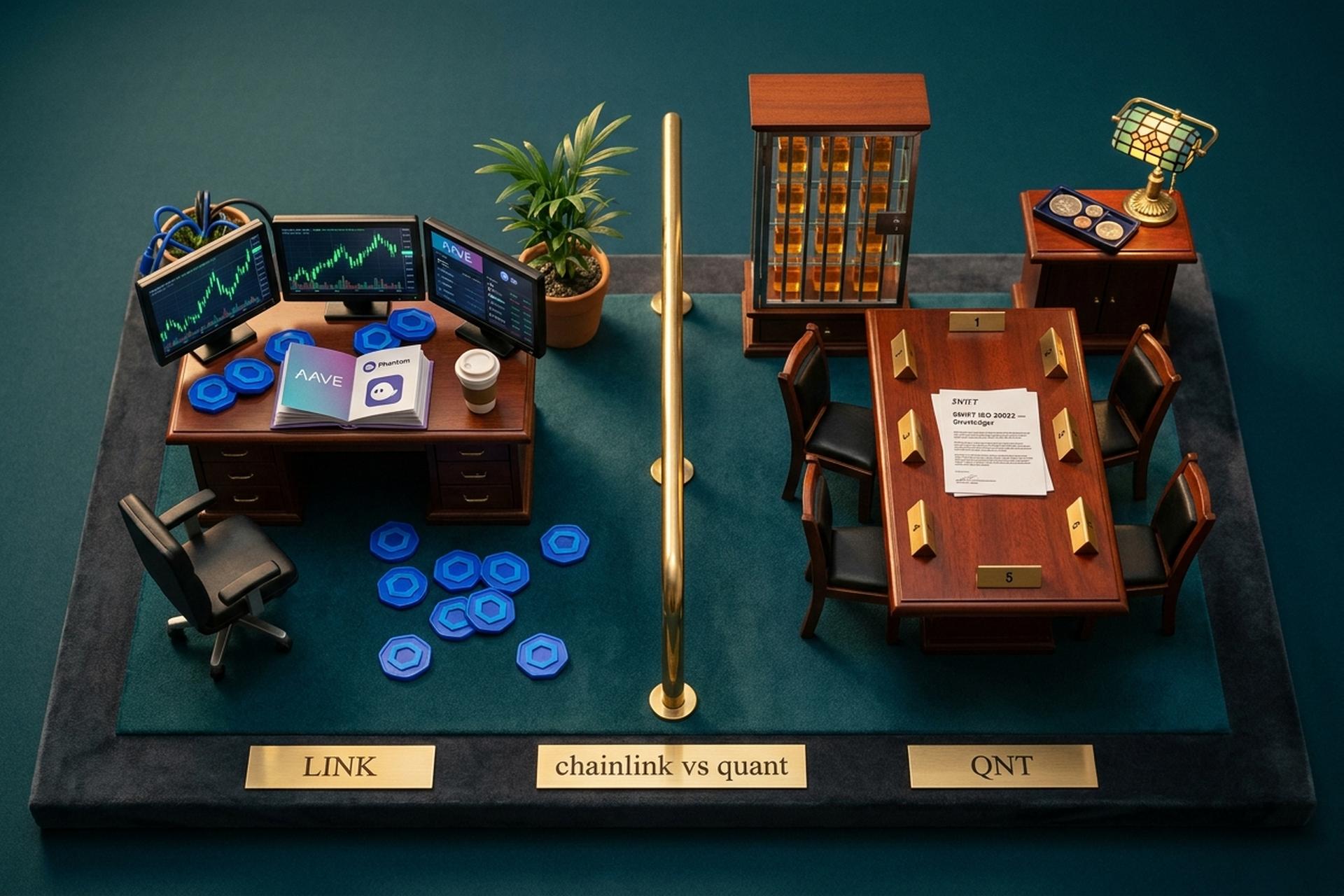
What's the difference between Chainlink and Quant in 2026? Both projects promise to glue traditional financial systems and blockchain technology together, but they tackle the bridge from opposite ends. Chainlink powers data and cross-chain messaging from the public blockchain side. Quant targets the bank side, building software that lets traditional financial systems and blockchain networks talk through a single API. Both have spent April 2026 quietly cashing partnership checks. Chainlink shipped a SOC 2 Type 2 audit by Deloitte on April 21 and got listed on AWS Marketplace three days later. Quant finished SWIFT integration testing for ISO 20022 on April 4 and is now days away from going live with the UK's Tokenised Sterling Deposit network. Two different routes, same destination. So which one belongs in your portfolio, your stack, or both?
This guide breaks down the chainlink vs quant debate the way an analyst would: tokenomics side by side, technology where they really differ, partnership lists with names not adjectives, and the honest risks on each side. By the end you should know whether LINK, QNT, or some mix of the two fits the way you want to bet on the next phase of crypto.
What is Chainlink (LINK)? The oracle network
Before getting into the chainlink vs quant comparison properly, you need a clean picture of each project on its own. Chainlink is a decentralized oracle network, and at its core, Chainlink is a data layer for blockchain networks. It moves real-world data, like the live price of gold or the score of a soccer match, into smart contracts that cannot fetch outside information on their own. Chainlink operates by connecting various blockchains to external data sources. Without an oracle, a smart contract is a calculator with no inputs. With Chainlink, it can react to anything the world does, which is why decentralized finance protocols consume Chainlink services in volume.
The LINK token is what oracle node operators get paid in, and it now also serves as collateral inside Chainlink Staking v0.2, where about 45 million LINK (roughly 6.2% of the circulating supply) is locked to back data feed quality.
The numbers tell the story. According to DefiLlama, Chainlink holds 67-70% of the entire decentralized oracle market. The Q1 2026 quarterly review put cumulative value enabled by Chainlink at $28 trillion, with more than 2,000 active price feeds and over $93 billion in total value secured across the chains it supports. The chainlink network is, by every reasonable measure, the dominant oracle in crypto.
What is Quant (QNT) and Overledger explained
Quant is the opposite shape. Where Chainlink runs as a public, decentralized oracle network, Quant is a UK-incorporated software company, Quant Network Ltd, that licenses an interoperability stack called Overledger to banks, governments and large enterprises.
Overledger is an operating system for distributed ledger technology. It sits above blockchains rather than inside them, exposing a single API that lets a bank read from and write to multiple blockchains without learning each one's plumbing. On top of Overledger, Quant has built QuantNet, which orchestrates programmable settlement across bank money, tokenized deposits and stablecoins. QuantNet launched at Sibos in London in September 2025.
The QNT token works as an access key. Enterprises must lock QNT to run Overledger gateways. The total supply is fixed at about 14.6 million tokens, of which roughly 14.54 million are already circulating per CoinGecko. Quant focuses on the bank side of crypto, and Quant in 2026 is squarely about traditional financial integration. That is the difference between Chainlink and Quant in a single sentence: Chainlink connects data to smart contracts, while Quant lets banks connect to multiple blockchains without rebuilding their stack.
Chainlink vs Quant comparison: at a glance
Before going deeper, here is the head-to-head snapshot. Numbers are from CoinGecko and CoinMarketCap as of April 30, 2026.
| Metric | Chainlink (LINK) | Quant (QNT) |
|---|---|---|
| Price | ~$9.15 | $69-74 |
| Market cap | ~$6.65B | $0.84B-$1.02B |
| Rank | #17 | #62-67 |
| Circulating / max supply | 727M / 1B | 14.54M / 14.6M |
| All-time high | $52.70 (May 2021) | $427.42 (Sep 2021) |
| Down from ATH | -84% | -83.7% |
| Core product | Decentralized oracle network + CCIP | Overledger + QuantNet |
| Token utility | Pay node operators, staking collateral | License lock for Overledger gateways |
| Primary market | DeFi, Web3, RWA tokenization | Banks, central banks, regulated payments |
| Decentralization | High | Low (Quant Ltd is the central operator) |
Two different things. Both currently trade about 84% below their 2021 highs, even though the fundamentals are stronger now than they were back then. If you want to compare Chainlink vs Quant on numbers alone, this is your starting line: compare market cap, volume, supply, and what each token actually buys you.
Architecture: oracles vs Overledger multi-chain
The cleanest way to understand chainlink vs quant is to draw the picture.
Chainlink is a network of independent node operators that fetch external data, sign it, and deliver it to any smart contract that pays them in LINK. There are thousands of nodes, hundreds of node operators, and the trust comes from cryptographic aggregation: if a majority of nodes report the same number, that number is taken as truth and posted on-chain. That is the oracles vs centralized-feed argument in one paragraph.
Quant goes the other direction. Overledger is a closed-source middleware layer running as software inside bank data centers and on enterprise cloud. It does not run a public validator set. It does not produce a token-economic security model the way Ethereum or Chainlink do. Trust comes from the licenses, audits and contracts that Quant Network Ltd signs with each customer. That is more like Visa than Bitcoin.
Two consequences fall out of that:
- Chainlink wins on decentralization and verifiability. Anyone can inspect the nodes, the feeds, the on-chain history.
- Quant wins on regulatory familiarity. A compliance officer at a bank reading "Quant Network Ltd, audited, contracted" understands what they are buying. The same officer reading "decentralized oracle network" needs a translator.
Both run multi-chain. Chainlink connects 60+ blockchains via CCIP. Quant connects to multiple blockchains through Overledger gateways. The promise to connect blockchains without cost or friction is the same. What differs is who you trust to do it. LINK is used to pay nodes; QNT is used to license gateways.
Tokenomics: LINK utility vs QNT scarcity model
Tokenomics is where the chainlink vs quant comparison gets sharp.
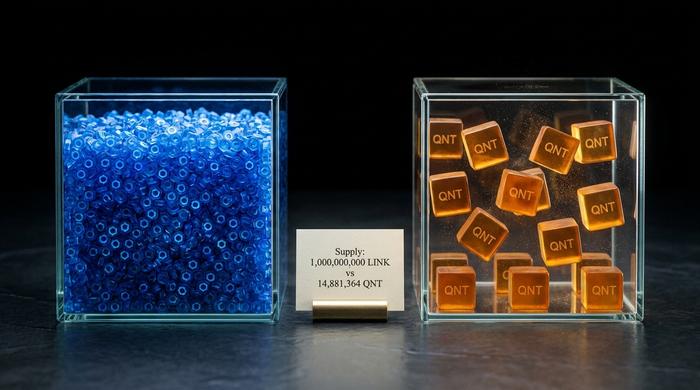
LINK is a utility-driven token. The 1 billion total supply is large, and not all of it is in circulation: 727 million circulate today, with a steady release schedule that critics estimate at roughly 7% of total supply per year. The thesis behind LINK is volume. As more protocols consume Chainlink services, demand for LINK to pay node operators and back staking collateral grows with it. The recent staking program locks about 45 million LINK (6.2% of circulating supply) and pays a community staker APY around 4.32%. Spot LINK ETFs in the US have pulled in roughly $111.5 million since launching this year, per Chainlink's Q1 2026 review.
QNT is a scarcity-driven token. Maximum supply: 14,881,364. That is it. There is no inflation, no new issuance, no validator rewards diluting holders. The thesis behind QNT is that as enterprises must lock QNT to run gateway licenses, the float available to traders shrinks, and price has to absorb new demand against a fixed pool. Quant follows the model more like a prepaid software license: pay once, lock tokens, keep operating.
Both arguments have a problem.
- For LINK, the open question is whether on-chain product traction translates into LINK-denominated revenue at the rate the token's market cap implies.
- For QNT, the open question is how many tokens are actually locked in production Overledger deployments. Quant Ltd does not publish that figure, and recent enterprise materials about QuantNet and ECB-aligned projects often omit QNT entirely.
That is the chainlink vs quant debate at the token level: clearer flywheel on one side, cleaner scarcity story on the other. Neither is settled.
CCIP vs Overledger: cross-chain interoperability
CCIP, the Cross-Chain Interoperability Protocol, is Chainlink's cross-chain product. Overledger is Quant's. They both move messages between blockchains. They are nothing alike under the hood.
CCIP routes value and arbitrary messages across 60+ chains. Weekly CCIP volume hit more than $1.3 billion in late April 2026, up about 260% week-over-week, per Chainlink's Q1 2026 review. CCIP includes a separate Risk Management Network for monitoring, and that is where the "semi-centralization" critique lives. Critics argue the trusted node sets and risk layer make CCIP less than fully trust-minimized. Defenders argue this is the price of regulated-volume readiness. Both are partly right.
Overledger is, again, an enterprise OS. A bank using Overledger does not need to write Solidity or learn each chain. The bank calls a single API, and Overledger handles the routing onto whichever ledger is on the other side. That is the connect-blockchains pitch in product form. The trade-off: Overledger is centralized in a way CCIP is not. If Quant Ltd disappears, the API stops responding. If Chainlink the company disappeared, the oracle network would keep running because the nodes are independently operated.
If you are a DeFi protocol picking an interoperability layer in 2026, you pick CCIP. If you are a regulated bank with compliance requirements that say "named vendor, signed contract, SOC 2," you pick Overledger. Different buyers, different products. That single split is most of the chainlink vs quant comparison on cross-chain.
Use cases: DeFi adoption vs enterprise crypto
The use case lists make the strategic difference obvious.
On the Chainlink side, on-chain:
- Price feeds for DeFi (2,000+ active feeds powering Aave, Compound, Synthetix, GMX and most major protocols).
- VRF (verifiable randomness) for NFT mints and gaming.
- Proof of Reserve for tokenized assets (Crypto Finance, Virtune's $450M+ ETPs, nxtAssets).
- CCIP cross-chain messaging.
- Functions for custom API and compute calls.
- The Automated Compliance Engine, which underpins a 24-institution corporate-actions pilot involving SWIFT, DTCC, UBS, ANZ and others targeting an estimated $58 billion in annual industry inefficiency. The pace of institutional adoption here is the main reason analysts now talk about Chainlink as part of the financial systems plumbing, not just DeFi.
On the Quant side, enterprise:
- Bank settlement infrastructure (the Great British Tokenized Deposit network, JPM Coin integrations, Lloyds GBP wallet work).
- CBDC pilots and tokenized deposit projects.
- ISO 20022 messaging, where Overledger sits between SWIFT messages and blockchain transactions following the April 4, 2026 integration test.
- The PayScript engine for programmable money.
- mDApp, multi-chain applications and Fusion mainnet expansion through 2026.
Two completely different audiences. A DeFi developer in Singapore and a CBDC architect at the Bank of England are not buying the same thing, and that gap is the heart of the chainlink vs quant comparison on use cases.
Adoption and partnership: from Bank of England up
The partnership story is where 2025 and 2026 made both projects look genuinely real to traditional finance.
Chainlink has the broader institutional surface area. SWIFT, DTCC, Euroclear, UBS, ANZ, BNP Paribas and Fidelity International all sit somewhere inside the Chainlink stack. The April 24, 2026 listing on AWS Marketplace lets enterprises procure Chainlink Data Feeds, Data Streams, and Proof of Reserve through standard cloud purchasing. The April 21, 2026 SOC 2 Type 2 audit by Deloitte was, in plain English, the move that flipped a lot of bank procurement teams from "interesting" to "approved."
Quant's reach is narrower but deeper inside its target accounts. The UK Tokenised Sterling Deposit consortium, going live in mid-2026, includes Barclays, HSBC, Lloyds, NatWest, Nationwide and Santander. Six of the largest UK banks running tokenized GBP on a Quant-built network is not a small story. Add Oracle, SIA, Murex and Dentsu, plus the SWIFT ISO 20022 + Overledger testing milestone, and you have an enterprise stack that is genuinely embedded in financial infrastructure.
There is also overlap. Both projects appeared in Bank of England digital pound exploration work, which is part of why "the Bank of England chose Chainlink and Quant" became a meme in 2024. The truth is neither was "chosen" in the way a procurement contract chooses, but both were referenced and tested.
Price and performance: LINK vs QNT in 2026
Live numbers as of April 30, 2026.
| Snapshot | LINK | QNT |
|---|---|---|
| Current price | ~$9.15 | $69-74 |
| Market cap | ~$6.65B | $0.84-1.02B |
| 24h trading volume | ~$250M | ~$8.3M |
| 30-day price change | -40.4% | ~ flat to -3% |
| Year-to-date 2026 | down sharply | down moderately |
| ATH and date | $52.70 (May 2021) | $427.42 (Sep 2021) |
| % below ATH | -84% | -83.7% |
Two takeaways. One: LINK is a far more liquid asset. Daily volume on LINK is roughly 30 times QNT's, which matters if you ever need to exit a serious position. Two: both have spent the last four years grinding sideways and downward despite materially better fundamentals than they had at the 2021 top. That is the crypto market in 2026, full stop. The price movements you see between LINK and QNT track the broader risk-off mood more than they track project-specific news.
The chainlink vs quant comparison on price is unflattering for both. The fundamentals on each side have improved. The market is choosing not to price it. If you want a current price on either, CoinGecko and CoinMarketCap update LINK and QNT crypto data every minute, and the market capitalization figure is the cleanest way to compare crypto market caps directly. The honest read on price and market behavior right now: nothing about either token's chart yet reflects the institutional adoption story behind it.
Key differences in the chainlink and quant ecosystem
If you only remember five things from the chainlink vs quant comparison, make them these.
1. Decentralization model. Chainlink runs on a public node network with growing on-chain transparency. Quant runs as a private vendor with closed-source code and a centralized governance model.
2. Token utility. LINK is paid out and staked inside the network. QNT is locked off-chain as a license. The first is on-chain and visible. The second is contractual and largely opaque.
3. Customer base. Chainlink monetizes through DeFi protocols and now through TradFi institutions paying for CCIP, ACE and Proof of Reserve. Quant monetizes through bank licenses and government-grade infrastructure deals.
4. Scale. Chainlink secures more than $93 billion across crypto. Quant secures named bank deployments without an equivalent on-chain TVS metric. Different scoreboards.
5. Token narrative. LINK is "as crypto adopts, demand for LINK rises." QNT is "as banks adopt, locked QNT supply shrinks." Both can be right at once. They reward different bets.
Risks of Chainlink and Quant tokens
No honest comparison hides the downsides.
Chainlink risks.
- The token-utility critique is real. Many of the biggest TradFi pilots (CCIP integrations, SVR for SmartCons) do not require LINK to be locked at the scale that the token's market cap implies.
- Annual supply unlocks are around 7% of total supply, a steady headwind on price even when adoption grows.
- CCIP has a "semi-centralized" tag from researchers who argue the Risk Management Network and trusted node set fall short of fully decentralized cross-chain messaging.
- Oracle attacks, while not a Chainlink-network failure, remain a category risk. A handful of small DeFi protocols using cheap oracles or thin liquidity have been drained over the years.
Quant risks.
- Centralized governance. There is no DAO, no on-chain proposal system. Quant Ltd controls the roadmap and the codebase.
- Closed-source Overledger means independent security audits cannot be replicated by the public.
- The token-product disconnect is the loudest QNT criticism. Many recent enterprise deliverables (QuantNet, ECB-related work, ISO 20022 integration) describe Overledger and APIs without mentioning QNT at all.
- Small team and key-person concentration. Founder Gilbert Verdian is the public face of nearly every major partnership.
- Liquidity is thin. $8 million daily volume is fine for retail allocations and brutal for any serious position size.
A clear-eyed reader weighs both lists before picking a side, or before deciding to hold a little of both. The chainlink vs quant debate gets a lot less heated once each project's risks are on the table next to its wins.
Quant vs Chainlink: which fits your strategy?
Strategy depends on what you actually believe.
If you believe the next decade of crypto value flows from public, decentralized infrastructure connecting DeFi to real-world data and assets, Chainlink is the bet. Volume, oracle dominance, CCIP traction, ETF inflows and TradFi integrations all point the same direction. The risk is that token utility never quite catches up to product traction.
If you believe central banks, commercial banks and regulated financial systems will quietly run their tokenization programs on a small set of vetted enterprise vendors, Quant is the bet. The UK GBTD project, SWIFT integration and QuantNet make a clean case. The risk is that QNT scarcity stays disconnected from the actual revenue line.
For most diversified crypto portfolios in 2026, the answer is not one or the other. A small allocation to each captures both stories: Chainlink for the broad on-chain growth thesis, Quant for the deep bank-stack thesis. If you only want one, ask yourself which side of the financial system you think gets tokenized first. Your honest answer is your pick.