Who Is Brad Garlinghouse? The Ripple CEO Profile in 2026
If you have followed US crypto policy at all since 2020, you have seen him somewhere — usually in a Senate hearing room, on a Davos panel, or filling a CNBC chair on a slow news day. Brad Garlinghouse runs Ripple, the blockchain payments company behind XRP, and he is the executive who took crypto's most-watched enforcement case all the way to a partial courtroom win, signed off on the $125 million civil penalty, and then steered Ripple into a $50 billion private valuation through five acquisitions in roughly two years.
So who is Brad Garlinghouse, really? The headline version above leaves out almost everything that makes the career interesting. Most of his working life happened nowhere near crypto: two decades inside consumer-internet companies first, including five years at Yahoo where he wrote the famously leaked Peanut Butter Manifesto, two years running consumer applications at AOL, and a CEO seat at Hightail before he had ever heard the word XRP. The Ripple chapter most people now associate with his name did not even open until 2015.
What follows is the rest of the story — who Brad Garlinghouse actually is, how he moved from Topeka to Harvard Business School to the most public CEO seat in crypto, what really went on inside the SEC case, what Ripple is doing in 2026, and where his career sits now that XRP ETFs are live and the IPO conversation refuses to go away.
Who Is Brad Garlinghouse: The Quick Answer
The simplest way to frame him is two decades of consumer-internet jobs first and crypto second. His full legal name is Bradley Kent Garlinghouse, born February 6, 1971 in Topeka, Kansas, and there is a Kansas-farmboy directness to his public manner that rubs against the Harvard MBA polish. He took a BA in economics at the University of Kansas in the early 1990s and finished his MBA at Harvard Business School in 1997, joining the class that fed straight into the dot-com boom.
Today he runs Ripple as CEO, a seat he has held since January 1, 2017 after spending the previous twenty-one months as the company's first Chief Operating Officer. Founder profiles, conference bios and Ripple's own press materials all list the title the same way: CEO of Ripple Labs. Earlier in his career, he served as senior vice president at Yahoo Communications across the Yahoo years.
Outside crypto, his name still travels mostly on the back of a single Yahoo memo from November 2006 — an internal document that leaked the same week and ended up across the front of the Wall Street Journal a few days after that. It became one of the most-quoted corporate dissents of the decade. Inside crypto circles, however, the headline is not the memo but the lawsuit: more than three years of head-to-head fighting with the SEC, a partial courtroom win in July 2023, and the case finally closing in full on May 8, 2025.
From late 2025 forward, the role has not changed. He is still Ripple Labs CEO, and the company has just printed a $50 billion private valuation off a March 2026 buyback. Net worth estimates floating around put him near $10 billion — speculative, but the trajectory makes the figure plausible. For what it is worth, the more interesting number is probably the eight years he has held one CEO seat through the loudest enforcement case in crypto history.
Early Life, Kansas Roots and Harvard MBA
He grew up in Topeka with two sisters, a father named Kent, and a mother named Susan. The "father was a judge" detail floats around lifestyle bios but lacks primary documentation, so it is worth parking. After public schools in Topeka, he stayed in-state for undergrad at the University of Kansas, where he took a Bachelor of Arts in economics.
Then came the East Coast pivot. He earned his MBA from Harvard Business School in 1997, in a class that walked straight into the late-90s internet boom on the way out the door. From there he skipped Wall Street and went West.
His early roles look like the standard pre-Web 2.0 résumé that produced a lot of crypto founders later. He held business-development positions at @Home Network, where SBC Communications was the indirect parent, before sliding into a general-partner seat at @Ventures — the venture arm of CMGI. In 2000 he took his first CEO chair, at Dialpad Communications, an early voice-over-IP startup he ran into 2001. That was long enough to watch one full dot-com unwind from inside the building.
Yahoo Years and the Peanut Butter Manifesto
Yahoo hired him in 2003 as senior vice president. The portfolio: Yahoo Communications, Communities and Front Doors. In product terms — Yahoo Homepage, Flickr after the 2005 deal, Yahoo Mail, Yahoo Messenger. He held the SVP seat from 2003 to 2008. Those five years map almost exactly onto the stretch when Yahoo lost its search lead to Google.
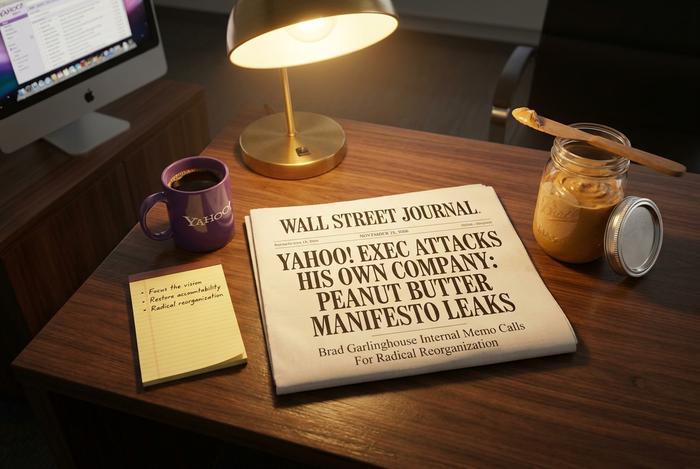
What outlived the run was not a product. It was a memo. Internal Yahoo, dated November 2006, leaked inside a week, fronted on the Wall Street Journal a few days after that. Garlinghouse's pitch was simple — Yahoo's strategy looked like peanut butter spread thin across way too many opportunities. The line that still gets quoted, verbatim: "I've heard our strategy described as spreading peanut butter across the myriad opportunities... a thin layer of investment spread across everything we do and thus we focus on nothing in particular. I hate peanut butter. We all should." Three fixes followed in the same memo: focus the vision; restore accountability and clarity of ownership; execute a radical reorganization.
The memo never saved Yahoo. What it did do was turn Garlinghouse into one of the most-photographed mid-career operators in tech for the rest of his stint there. It also pinned a permanent label on him — the kind of executive who puts awkward arguments on the record. He left Yahoo in 2008. Seven years later, in a 2013 LinkedIn essay titled "What I got wrong in the Peanut Butter Manifesto," he came back to the original and softened his own grade.
AOL, Hightail and the Pre-Ripple Path
After Yahoo, a brief Senior Advisor seat at Silver Lake Partners. Then AOL, September 2009. Title: President of Consumer Applications, formally rendered as President of Internet & Mobile Communications. The portfolio covered Mail, AIM, ICQ and AOL's mobile products, plus a side seat at AOL Ventures' West Coast operations. He stayed through November 2011, watching the same kind of messaging franchise erode that Yahoo had been bleeding a few years earlier.
In 2012 he moved into the CEO chair at Hightail — the file-collaboration platform that used to be YouSendIt. He ran it as CEO and Chairman from 2012 through September 2014, then stepped down over board-level disagreements about strategic direction. Hightail was later picked up by OpenText in February 2018, with deal terms never publicly disclosed. Alongside the operating roles, the board seats stacked up. Animoto from 2012. Ancestry.com 2013 through 2016. Tonic Health 2011 through 2016, where he held executive-level guidance responsibilities on top of the formal directorship.
By early 2015, Garlinghouse had logged fifteen years running consumer-facing internet and messaging businesses. On paper, that CV would not have looked like a natural setup for crypto. And then it became one.
Garlinghouse Joined Ripple as COO in 2015
April 2015 marks the start of the Ripple chapter. Garlinghouse joined Ripple Labs as the financial technology company's first Chief Operating Officer, with a mandate that read simply on paper and proved hard in practice: build the partnerships team, tighten the product, and turn a technology pitch about faster, cheaper cross-border payments using XRP and the underlying ledger into a sales motion that actual banks would say yes to.
He held the COO seat for under two years. In December 2016 the company announced that he would step into the CEO role and replace co-founder Chris Larsen, with the promotion taking effect on January 1, 2017. Larsen moved across into Executive Chairman. With hindsight the timing landed almost exactly on top of the 2017 retail crypto cycle, when XRP went from a relatively obscure altcoin to the third-largest cryptocurrency by market capitalization within roughly twelve months. By January 2018, XRP had hit $3.84 — its long-standing all-time high, a level the 2025 cycle would only push back toward years later.
The COO-to-CEO promotion is a recurring detail in any Brad Garlinghouse profile because of what came next. By becoming Ripple CEO in early 2017, he inherited the bull market, the XRP holders, the partnerships strategy and the regulatory exposure that would dominate the next eight years of the company.
Ripple CEO: Leadership at Ripple from 2017
The Ripple CEO seat has been the same job description since 2017 on paper, and a different role in practice every two years. Looking back, leadership at Ripple under Garlinghouse splits into three loose phases.
Phase one, 2017 through 2019: growth, full stop. Ripple's headcount climbed, banking partnerships stacked, the RippleNet customer pipeline lengthened, and on-demand liquidity (ODL) expanded into new corridors. Garlinghouse held the operational reins and announced new partnerships at close to a monthly cadence. The cap on the period was a $200 million Series C in December 2019 at roughly a $10 billion valuation. RippleNet customers and the broader cryptocurrency space read the round as institutional validation for the company's blockchain solutions in digital currencies.
Phase two, 2020 through 2024: litigation. December 22, 2020. SEC complaint, alleging unregistered XRP sales. From that day, basically every public sentence Garlinghouse uttered for the next three and a half years tied back to the case somewhere. He testified. He sat for long-form interviews. He posted to X almost daily about regulatory clarity in the United States. He clashed publicly with then-Chairman Gary Gensler over the SEC's broader stance on crypto enforcement, and Ripple has kept the regulatory-clarity argument at the centre of its messaging ever since.
Phase three, 2024 onward: institutional buildout. Five acquisitions in two years. A regulated stablecoin. A national trust bank charter. Two new valuations to match. November 2025 — $40 billion off a Fortress-led $500 million round. March 2026 — $50 billion stamped on a $750 million share buyback. Garlinghouse has framed the post-litigation pivot as building what he calls the "internet of value" for institutions, deliberately walking away from the retail XRP narrative that drove the 2017 cycle.
The SEC Case: From Filing to $125M Settlement
The single most-watched event of his career was the SEC v. Ripple case, and the timeline matters because most headlines blur it. Here is the version that actually happened.
| Date | Event |
|---|---|
| December 22, 2020 | SEC files complaint in SDNY against Ripple, Garlinghouse and Larsen, alleging a $1.3B unregistered XRP offering |
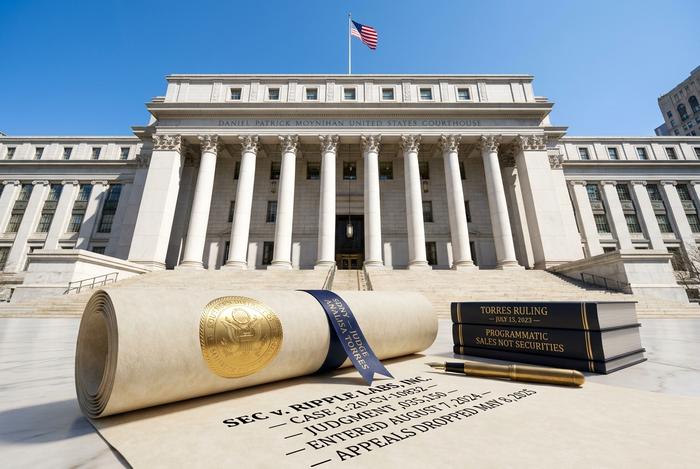
| July 13, 2023 | Judge Analisa Torres rules programmatic XRP sales on exchanges are NOT securities; institutional sales WERE securities. Charges against Garlinghouse and Larsen individually dismissed |
| August 7, 2024 | SDNY enters final judgment: $125,035,150 civil monetary penalty plus permanent injunction |
| May 8, 2025 | Both parties drop appeals; case fully closes |
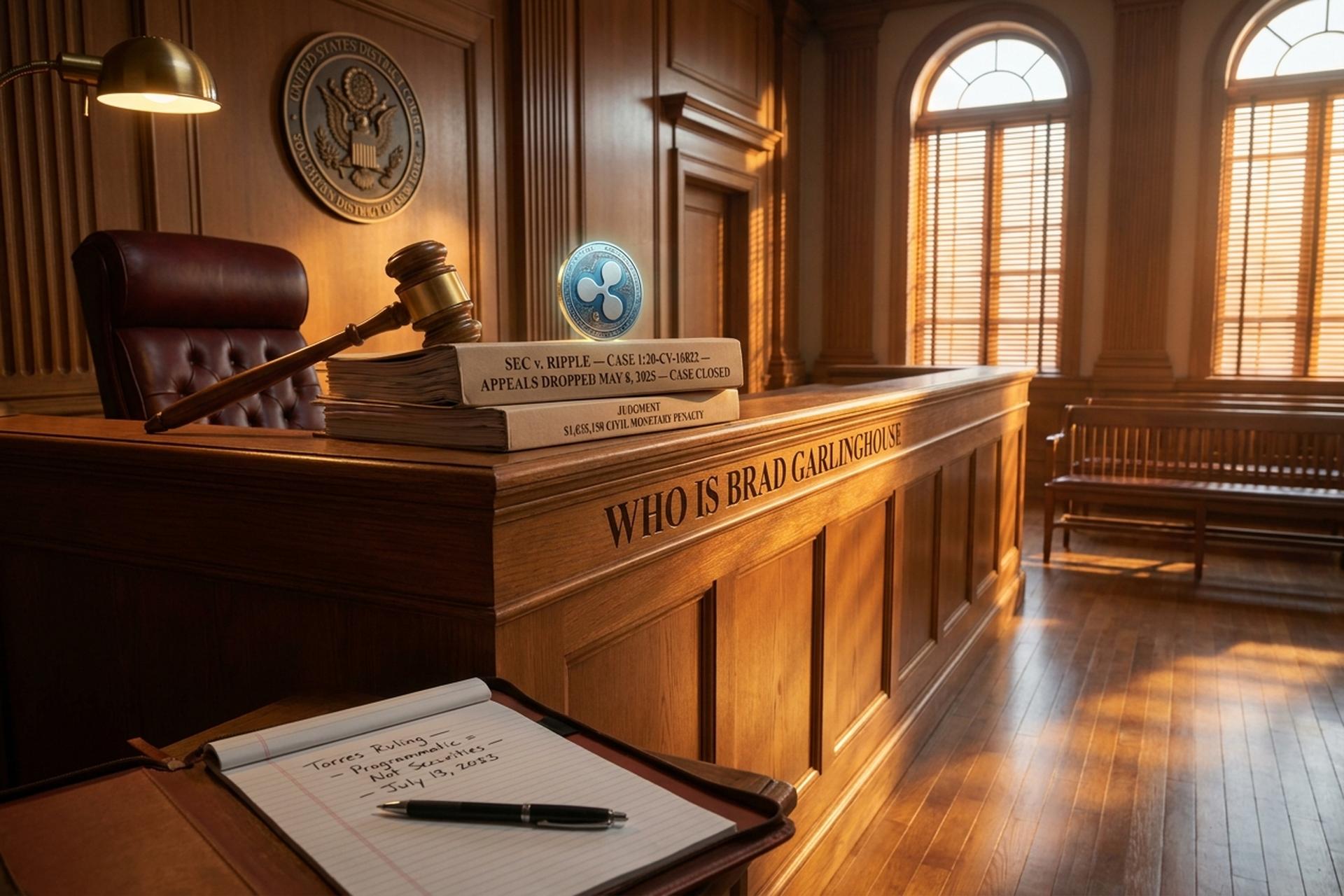
July 13, 2023 was the inflection point. Judge Torres drew a line down the middle of the case, declaring that programmatic sales — XRP that retail buyers picked up on exchanges — were not securities transactions, while institutional sales, where Ripple sold directly to large buyers under written contracts, were ruled securities. The split decision cost Ripple a $125 million civil penalty under the August 7, 2024 final judgment and brought a permanent injunction against future Section 5 violations. The bigger gain was preserving XRP's non-security status in retail markets, which is what kept exchange listings open and made ETF discussions possible later.
May 8, 2025 closed the book. Both Ripple and the SEC dropped their cross-appeals on the same day. The $125 million payment held, and the SEC dismissed any further claims that would allege new violations under the same fact pattern. Garlinghouse personally never paid a fine — the personal claims against him were dismissed in late 2023 — and he came out of the litigation with the kind of credibility most multi-year fights cost executives, plus the legal certainty that exchanges, market-makers and ETF issuers had been waiting on.
Ripple's M&A Spree: Hidden Road, RLUSD Stablecoin
Once the case cleared, Ripple sprinted. Two-year window, five acquisitions, one stablecoin launch. Yahoo-era hires plus ex-Wall Street operators (Pimentel among them) on the leadership bench. Every deal leaned on the same blockchain and cryptocurrency stack Ripple had been building since 2012. The core bet did not change either: blockchain technology will replace chunks of legacy financial plumbing.
First up: Metaco. May 17, 2023. Swiss institutional crypto custody firm. $250 million tag, half cash, half equity. That gave Ripple its first enterprise-grade custody stack. The deal closed before the Torres ruling but was already aimed at the post-litigation institutional thesis.
Standard Custody & Trust. Closed June 11, 2024. NYDFS-chartered trust company. Its CEO, Jack McDonald, slid into the role of Ripple SVP of Stablecoins. In hindsight, that telegraphed what came next.
RLUSD. Launched globally December 17, 2024. Ripple's NYDFS-regulated USD-backed stablecoin. Runs on both the XRP Ledger and Ethereum. Reserve composition: USD deposits, T-bills, cash equivalents. The advisory board reads heavyweight — Sheila Bair, former FDIC Chair, alongside Raghuram Rajan, former Reserve Bank of India Governor. An unusually senior pair of names for a 2024-vintage stablecoin. I keep coming back to that choice. It looks like Ripple wanted regulatory cover stacked in front of any product debate.
Hidden Road was the headliner. Announced April 8, 2025. Closed October 2025. Rebranded as Ripple Prime. Price tag: $1.25 billion. At the time, the largest deal in crypto-industry M&A history. Hidden Road clears more than $3 trillion a year across FX, derivatives, digital assets and fixed income for 300-plus institutional clients. The acquisition dropped Ripple straight into the institutional plumbing of crypto markets as a prime broker overnight.
Rail in August 2025. GTreasury in October 2025. Those two rounded out the run. Garlinghouse himself summarized it on X that October: five major acquisitions in roughly two years, combined headline value north of $2.7 billion. Fairshake, the crypto-policy super-PAC where Ripple is a leading donor, has kept backing pro-crypto candidates in parallel.
The OCC piece arrived on top. Ripple filed a National Trust Bank application on July 3, 2025. Conditional approval landed on December 12, 2025, alongside Circle, Paxos, BitGo and one other applicant. The federal trust bank route quietly replaced the Wyoming SPDI charter angle that some 2024 reporting had floated. It gave Ripple a direct seat at the federal banking table.
XRP Price, ETFs and the IPO Question
XRP has now run through its second full cycle since Garlinghouse took the CEO chair. The 2018 ATH of $3.84 stood untouched for years. The 2025 cycle peak came in around $3.65 on July 18, 2025, in the window right after the SEC settlement. As of May 2026, XRP traded near $1.38 with a market cap around $85.4 billion, holding the number-four slot on CoinMarketCap.
ETF approvals have been the bigger 2025-2026 story for the token. First US spot XRP ETF: Canary Capital, approved November 12, 2025, trading the next day. By March 2026, five spot XRP ETFs were live with cumulative inflows above $1.5 billion. Goldman Sachs disclosed a $153.8 million position across four XRP ETFs in its Q4 2025 13F filing. That kind of institutional adoption is exactly the outcome the post-litigation Ripple thesis was built around.
The IPO question keeps showing up. Ripple is one of the largest privately held companies in crypto. $50 billion valuation as of March 2026. $750 million share buyback running. Garlinghouse and President Monica Long have repeatedly described an IPO as "not a near-term priority," and no confirmed confidential S-1 has surfaced at any reliable source. The signal from Davos 2026, where Garlinghouse shared a panel with Bill Winters and Brian Armstrong, was that Ripple sees more upside in private buybacks than in a public listing under current rates.
Brad Garlinghouse Net Worth, Profile and 2026 Outlook
So how rich is the guy, really? Honestly, most numbers floating around are guesses. The figure that gets recycled most is somewhere around $10 billion, surfacing in March 2025 around Charles Gasparino's reporting on the back of the XRP rally. It has never landed on Forbes' Real-Time Billionaires list. The estimate is derivative — built off a reported 6.3% Ripple stake (itself a 2018 Forbes datapoint) plus undisclosed personal XRP holdings. The current stake, post-buybacks, has not been published. I am not convinced any specific dollar number deserves much confidence here.
The 2025 to 2026 stretch has been the most public period of his entire career. On July 9, 2025 he testified at the Senate Banking Committee in a hearing titled "From Wall Street to Web3". At Davos 2024 he sat with CNBC and called then-SEC Chair Gary Gensler "a political liability for the Democratic Party". At Davos 2026 he was on a panel with Bill Winters and Brian Armstrong, predicting a new XRP all-time high inside twelve months. On April 21, 2026, Harvard Business School handed him its Business Leader of the Year award.
The personal life sits behind a wall, and he keeps it there by design. His first marriage was to Kristen Elizabeth Mautner, with whom he has three children. A second marriage to Tara Millette, a nutritionist, has been reported only by a single Korean crypto outlet, with no mainstream confirmation.
His operational role through 2025 and into 2026 has not budged. He is still Ripple Labs CEO and still the public face of the company. Whether that seat eventually evolves into chairing a public listing, or stays at the helm of the largest privately held crypto firm in the United States, is the open question of the next twelve months.