
Best Mobile Crypto Wallets 2026: Three Architectures Compared
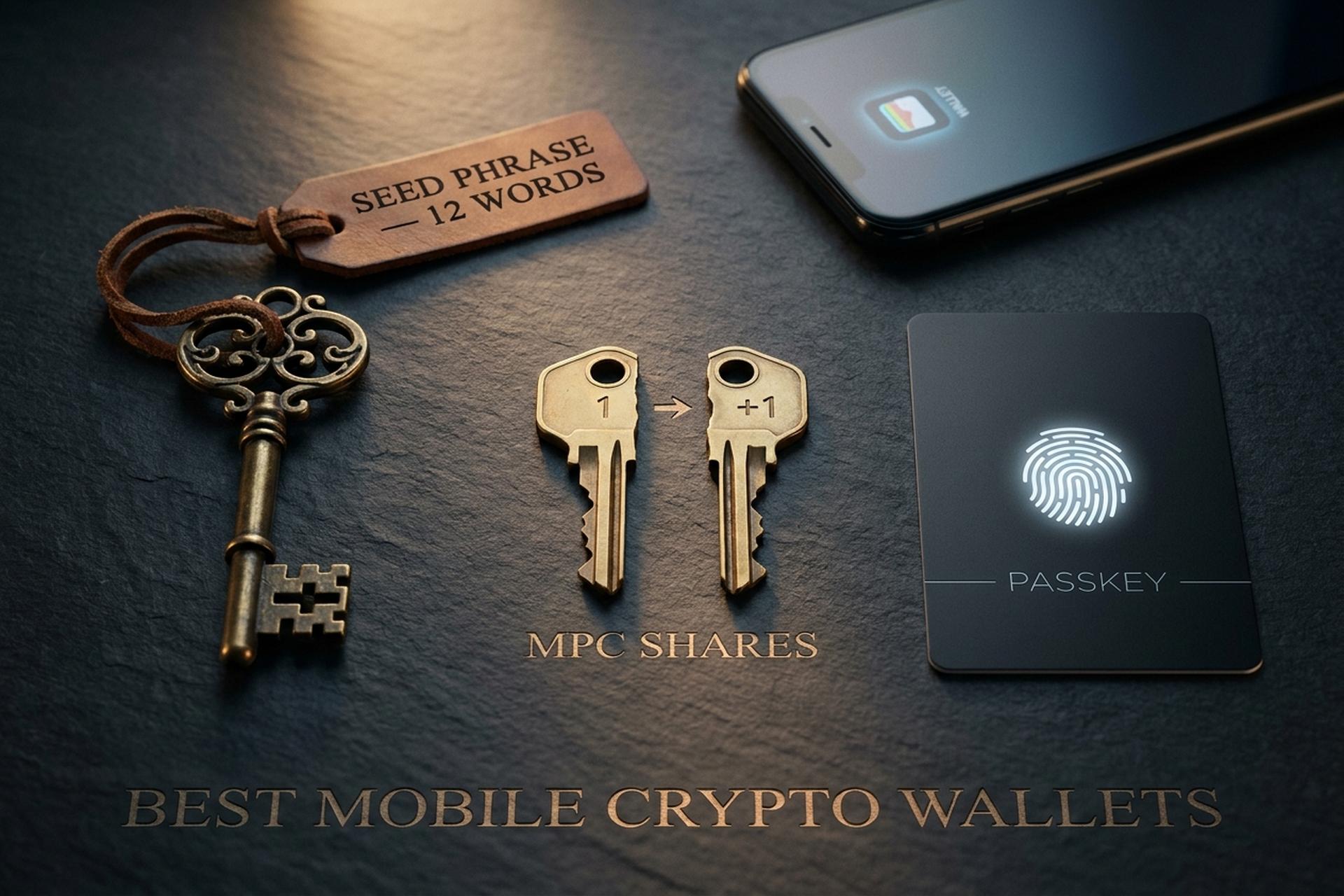
Trust Wallet crossed 220 million users at the end of 2025 and now accounts for 35% of all active hot-wallet sessions on mobile, according to its own year-end report. In the same year, Chainalysis tracked 158,000 personal wallet compromises, 80,000 unique victims and roughly $713 million in stolen funds. Mobile crypto wallets have never been bigger and have never been a bigger target. The best mobile crypto wallet for one person is the worst pick for another, because what really separates 2026 wallets is not "hot vs cold" any more, it is how they store the private key. Pick the architecture first, then pick the brand. This guide walks through the three families that define every serious mobile wallet on the market: the wallets for storing your coins, the ones that let you manage crypto on the go, and the ones with hardware wallet integration. It also compares the top picks across chain support, fees, recovery, and regulatory availability for both new crypto investors and experienced users.
What is a mobile crypto wallet, really?
A crypto wallet does not actually store your bitcoin or your ETH or any other cryptocurrency. Your coins live on a blockchain. The wallet stores the private key (and a derived public key) that lets you sign transactions to spend them. Lose the key, and the digital assets and crypto assets sitting at that address are functionally gone. The type of wallet you choose decides how that key is generated, where it lives, and what happens when your phone falls in a swimming pool. A hot wallet keeps the key on an internet-connected device. A cold wallet keeps it offline, usually on a hardware wallet, either a dedicated bitcoin wallet or a multi-asset device. Today, roughly three-quarters of all hot-wallet activity happens on a mobile app, which is why the choice of crypto mobile wallet matters more than it did in the desktop-only era. Whether you use it only to store crypto, to receive crypto from others, to transfer crypto between friends, or to buy crypto through a linked crypto exchange, the wallet is the layer that turns a passphrase into spendable money.
The three architectures of 2026 mobile wallets
The "hot vs cold" framing covered the field in 2019. It does not in 2026. Three architectural families now define every mobile crypto wallet worth installing, with a fourth bridge category for users who want hardware-grade keys with a phone UX.
Family A — Seed-phrase EOA wallets. This is what most people picture: a wallet app that generates a 12 or 24-word seed phrase, derives a private key from it, and stores that key (encrypted) on your device. MetaMask, Trust Wallet, Phantom, and Exodus all sit here. They are externally owned accounts (EOAs) in Ethereum terminology. You are sovereign. The wallet provider cannot freeze your coins or recover your seed. But if the phrase is lost, stolen, or phished, every coin protected by it is gone. Ledger research suggests roughly one in four users has lost a seed phrase at least once.
Family B — MPC wallets. Multi-party computation wallets decentralize the private key, splitting it into two mathematical shares so that no single device ever holds the full key. The user's phone holds one share, the wallet provider's server holds the other, and signing requires cooperation. ZenGo and Coinbase Wallet are the two best-known mobile MPC wallets. ZenGo reports zero customer wallets hacked since launching in 2018 across more than 2 million users, backed by seven independent audits and an unclaimed $500,000 public hack bounty. Trade-off: recovery is easier (biometric face scan plus cloud), but the user depends on the provider's server staying online and uncompromised.
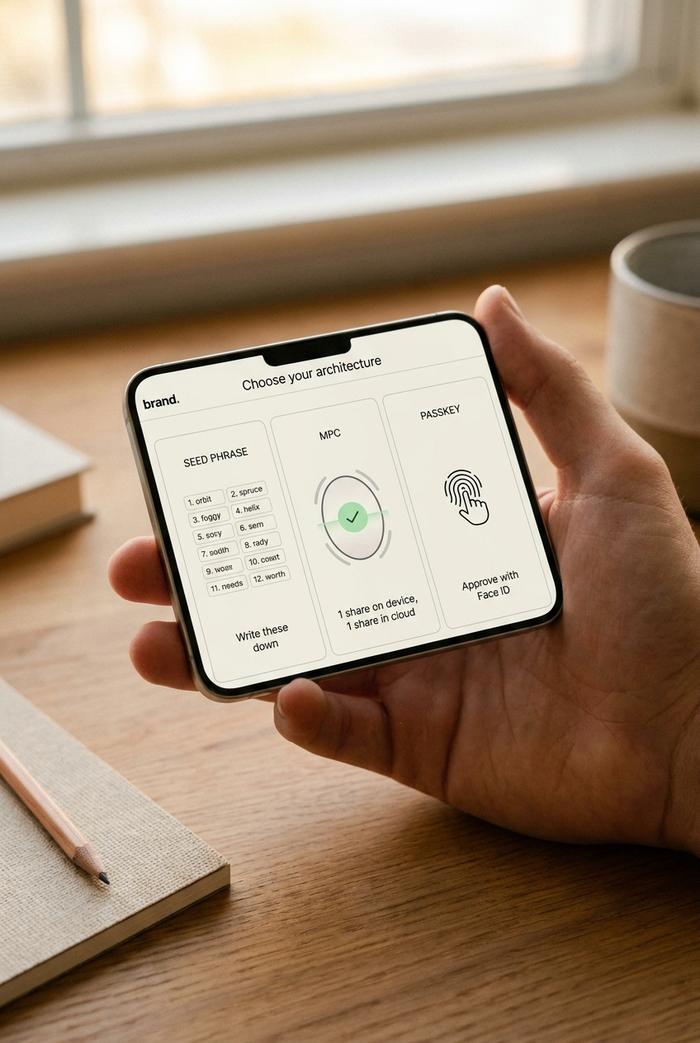
Family C — Passkey and smart-account wallets. The newest family. These wallets do not have a single private key at all. They are smart contracts on-chain (or, after EIP-7702 went live with Ethereum's May 7, 2025 Pectra hard fork, upgraded EOAs) controlled by device passkeys, social guardians, and cloud-backed recovery. Argent, Safe Mobile, Coinbase Smart Wallet, and Cyber are the names to know. BundleBear's live dashboard shows 22.96 million smart accounts active and over 157 million EIP-7702 authorizations as of May 2026. The pitch is no seed phrase, recoverable by friends or iCloud, with gas paid by a paymaster. The catch is maturity. ZeroDev reports 65–70% of early EIP-7702 delegations were tied to phishing or scam activity.
Bridge — Hardware-paired mobile. Ledger Live mobile and Tangem cards keep the key on a secure element chip and use the phone purely as a signing interface. You get cold-wallet key isolation with a touchscreen UX. The fake "Ledger Live" app that drained $9.5 million from over 50 Apple App Store victims in April 2026 is a reminder that the wallet's architecture only matters when you install the real wallet.
| Family | Recovery method | Single point of failure | Typical fee |
|---|---|---|---|
| Seed-phrase EOA | 12/24-word backup, manual | Lost or stolen phrase | 0.85–0.9% swap |
| MPC (2-of-2) | Biometric + cloud share | Provider server compromise | 0% to ~1% |
| Passkey / smart account | Passkey + guardians + cloud | Smart-contract bug or paymaster | Often gasless |
| Hardware-paired | Recovery seed on cold device | Lost device or fake app | Free to use |
How to choose a wallet that fits your habits
A common mistake is to pick a wallet from a "top 10" list and then bend your habits to fit it. The better move is the other direction.
If you are a beginner buying crypto for the first time and you mostly hold, an MPC wallet (ZenGo) or a smart-account wallet (Coinbase Smart Wallet, Argent) removes the single scariest part of self-custody, which is losing a seed phrase. Either works as a software wallet running entirely on your mobile device. If you live in decentralized finance and bridge across chains every day, MetaMask or Trust Wallet still win because their dApp connectors give you access to decentralized apps almost universally. If you trade NFTs on Solana, Phantom is in a category of its own, with about 39.4% of Solana wallet share. If you hold serious Bitcoin, a hardware-paired setup (Ledger Live mobile + a Nano or Stax) is the only honest answer. If you trade across ten chains and prize speed, a multi-chain hot wallet like Trust or OKX Wallet works.
Five practical checks before you install anything: chain coverage matches the assets you actually own; the fee model (swap, bridge, gas) is documented; the recovery method you can realistically execute under stress; the wallet is still available in your country's Apple or Google store under the new app-store rules; and there are recent independent audits on file.
Best mobile crypto wallets 2026 compared
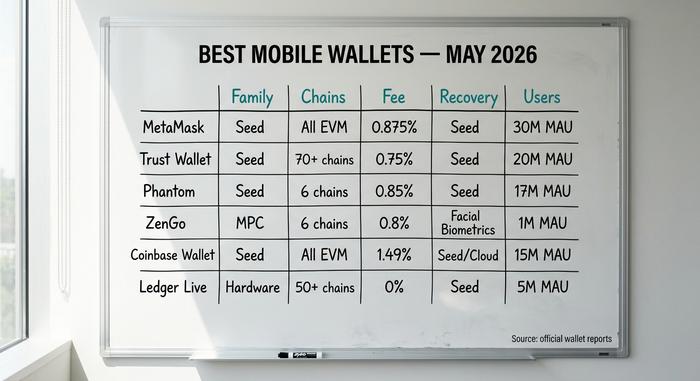
The table below groups eleven of the best crypto wallet apps by architecture, with the figures that matter for a buyer.
| Wallet | Family | Chains | Swap fee | Users | Recovery | iOS + Android | Standout |
|---|---|---|---|---|---|---|---|
| MetaMask | Seed-phrase | 11+ EVM | 0.875% | ~30M MAU | Seed phrase | Yes | Dominant EVM dApp connector |
| Trust Wallet | Seed-phrase | 110+ (+1,000 EVM) | 0% + gas sponsor | 220M+ total | Seed phrase | Yes | Widest chain coverage |
| Phantom | Seed-phrase | 6 mainnets | 0.85% (1.5% gasless) | ~17M MAU | Seed phrase | Yes | Solana-first; $3B valuation |
| Exodus | Seed-phrase | 50+ | 1–3% spread | ~7M est. | Seed phrase | Yes | Built-in Trezor pairing |
| ZenGo | MPC | 70+ | 0.5% | 2M+ | Biometric + cloud | Yes | Zero hacks since 2018 |
| Coinbase Wallet | MPC + self-custody | EVM, Sol, BTC, Base | 1% | ~3.2M MAU | Cloud, passkey | Yes | Tied to Coinbase rails |
| Argent | Smart account | EVM, L2s, Starknet | varies, often gasless | ~700k est. | Guardians + biometric | Yes | Pioneer of social recovery |
| Coinbase Smart Wallet | Passkey AA | EVM + Base | usually gasless | bundled with Coinbase | Passkey + cloud | Yes | No seed phrase ever |
| Ledger Live | Hardware-paired | 5,500+ assets | varies by provider | 8M+ devices | Seed on device | Yes | Cold key, phone UX |
| Tangem | Hardware-paired | 80+ chains | 0% on basic transfers | "millions" of cards | Card + optional seed | Yes | NFC card, no battery |
| Guarda Wallet | Seed-phrase | 400+ assets | 3.5% | ~3M est. | Seed + cloud | Yes | Multi-platform breadth |
MetaMask remains the default for anyone who lives on Ethereum and L2s; the trade-off is no native Bitcoin and a 0.875% swap fee that adds up. Trust Wallet, owned by Binance's ecosystem, is the breadth champion (110+ networks, 1,000+ custom EVM) and prevented $191 million from reaching scam addresses in 2025 by its own count. Phantom is the Solana standard and now stretches across Bitcoin and EVM chains too, with a $20B annual swap volume and a $150M Series C at $3B valuation in January 2025. Exodus's strength is design and the bundled Trezor pairing for users who want to graduate to cold storage.
ZenGo's MPC architecture is the cleanest beginner story in self-custody. No seed phrase, biometric recovery, and a track record that includes a $500K public bounty no attacker has ever claimed. Coinbase Wallet sits between MPC and smart account, with the advantage of tight integration with the Coinbase exchange.
Argent has been doing smart-account self-custody since 2018, well before EIP-7702 made the pattern mainstream. Coinbase Smart Wallet brought the same idea to a much bigger audience in 2024: no seed phrase, passkey-based, recoverable on a new device through your cloud account.
For hardware-paired, Ledger Live mobile is the most-used app in the world for managing cold keys, with 8 million-plus devices sold across 165 countries. Tangem replaces a Nano with an NFC card you tap to your phone. No cable, no battery, no firmware updates to worry about.
Wallet incident map: 2025-2026 in one place
Most wallet losses do not come from the wallet itself. They come from what users sign.
Ledger's December 2023 Connect Kit attack drained roughly $600,000 in under two hours after an attacker phished a former employee's npm credentials and pushed a malicious version of the library every connected dApp loaded. The fix was hours, not minutes; the funds were not recovered. In April 2026, a fake "Ledger Live" iOS app slipped through Apple App Store review and drained $9.5 million from more than fifty victims across BTC, ETH, Solana, Tron and XRP. The wallet's actual security was never breached — the users installed an entirely different app that looked the same.
Address-poisoning attacks deserve their own paragraph. In December 2024, one trader lost $50 million in USDT to a poisoning attack that left a near-identical address in their recent-transactions list. An ArXiv study tracked 252 million poisoning transfers targeting 16 million unique victim addresses in 2025 alone. Phantom was specifically called out by ZachXBT for inadequate spam filtering after a user lost 3.5 wrapped Bitcoin to a clone address.
Chainalysis's 2026 Crypto Crime Report puts the totals in context: $3.4 billion stolen across crypto in 2025 (almost two-thirds attributed to DPRK), of which personal wallet compromises account for $713 million and 158,000 incidents. The lesson is simple. The wallet you pick is one variable. Your signing hygiene is the other, and most attacks live in the second category.
Fees and the hidden cost of "free" crypto wallets
"Free" mobile wallets are not free. They monetize through in-app swaps, bridges, and exchange spreads. MetaMask Swaps charges 0.875% on every trade. Phantom takes 0.85% on most pairs and 1.5% on its gasless Solana mobile flow. Trust Wallet advertises 0% platform fee and sponsors gas for up to four swaps a day, but its routed swap providers still earn a spread. ZenGo takes 0.5% on most swaps. Smart-account wallets backed by a paymaster (Argent, Coinbase Smart Wallet) can offer fully gasless transactions, but the cost is pushed onto the dApp or paymaster funder — usually subsidized in a growth phase and harder to predict later.
Bridges add another layer. A $1,000 USDC bridge from Ethereum to Base through an in-app router can cost $3–$10 in fees plus a 0.05–0.2% spread, depending on the wallet and routing. The "instant swap" inside a wallet app almost always carries a hidden spread on top of the headline fee — something active crypto trading magnifies over time. The smart way to read fees is to do one $100 test trade and compare what you received against the open-market price, then add the gas figure shown on the receipt.
Regulatory state of mobile wallets in 2026
Two app-store policy shifts and one EU regulation define the regulatory floor in 2026. Google's August 13, 2025 Play Store update requires custodial wallet apps to hold an appropriate financial license to remain listed in the US, EU, UK, Canada and Japan, while non-custodial wallets are explicitly carved out. Apple's May 2, 2025 update — driven by US antitrust pressure — finally allows external links to NFT and crypto payments in the US App Store, though in-app crypto purchases, ICOs and on-device mining remain banned.
In the EU, MiCA reaches full enforcement on July 1, 2026. Custodial wallet providers fall under CASP licensing with KYC, asset segregation and operational resilience obligations. Non-custodial wallets are out of scope, but any transfer above €1,000 from a self-hosted wallet into a regulated platform now triggers VASP reporting on the receiving side. The practical effect for retail: more friction at exchange on-ramps, fewer custodial wallets in the EU app stores, and a strong tailwind for self-custody architectures.
How to keep your mobile wallet safe
Six habits cover most of the risk. Turn on device biometrics and a short auto-lock timeout. Back up your seed or MPC recovery share OFF the device — paper or a steel plate in a place the device thief cannot reach. Add every address you transact with to an address book once you have verified it; address poisoning relies on you copying from the recent-transactions list. Read every signing prompt before you tap approve — blind signing is how the largest hot-wallet thefts happen. Install wallet apps only by following the official link from the wallet's website, never from a Google search result (the fake Ledger Live app cost users $9.5 million by exploiting exactly this). Finally, turn on two-factor authentication on any exchange account linked to the wallet — the exchange is usually the weakest entry point, and these six habits together are the practical baseline to keep your crypto safe on a mobile wallet. If your wallet allows you to whitelist withdrawal addresses, do it.
Which mobile wallet should you actually pick?
Five users, five picks — the best wallet depends entirely on what you actually do. A first-time buyer who is new to crypto and wants self-custody without a seed phrase, and a secure mobile wallet that offers a smooth recovery flow: ZenGo or Coinbase Smart Wallet. A DeFi power user bridging across EVM and L2s every day: MetaMask, with a hardware wallet for the long-term bag. A Solana NFT collector or memecoin trader: Phantom, end of story. A Bitcoin holder with serious size: Ledger Live mobile plus a Nano or Stax. A multi-chain trader who wants one app for everything: Trust Wallet, whose wallet offers swap access across 110+ chains in a single tap. None of the best options is universally best — they are best at different jobs.



