What is a seed phrase and why losing it means losing your crypto forever
Your seed phrase is the master key to everything you own in crypto. Twelve or twenty-four words, generated by your wallet when you first set it up, that can restore access to every coin, token, and NFT you hold. Lose it, and there's no customer support to call. No "forgot my password" link. No recovery process. Your crypto is gone, permanently, for anyone, forever.
That's not a scare tactic. Stefan Thomas, an early Bitcoin developer, lost access to 7,002 BTC (worth roughly $480 million at 2026 prices) because he forgot the password to the device holding his keys and couldn't find his recovery phrase. James Howells threw away a hard drive with 8,000 BTC and has spent over a decade trying to excavate a Welsh landfill. Stories like these aren't rare. Chainalysis estimates that about 3.7 million bitcoin are permanently lost, largely because people didn't take their seed phrase seriously enough.
This article explains what a seed phrase is, how it works under the hood, the difference between a seed phrase and a private key, and practical steps to keep yours safe without going crazy.
How a seed phrase works
When you create a new crypto wallet, whether it's MetaMask on your phone, a Ledger hardware device, or Sparrow on your desktop, the software generates a seed phrase. This is a sequence of 12 or 24 simple English words pulled from a standardized list of 2,048 words defined by the BIP39 standard (Bitcoin Improvement Proposal 39).
These words aren't random gibberish. Each one maps to a number, and together they encode a very large random number called entropy. Your wallet takes that entropy and uses it to generate a binary seed, which is then used to derive your private keys, one for each blockchain address you create. Every address, every token, every piece of crypto you'll ever hold in that wallet traces back to those 12 or 24 words.
Here's the practical version: your wallet holds your private keys, which let you sign transactions. Your seed phrase can regenerate all of those private keys. If your phone breaks, your computer dies, or your Ledger gets run over by a car, you buy a new wallet, enter the seed phrase, and everything comes back. Same addresses. Same balances. Same tokens. It's as if nothing happened.
The BIP39 word list was designed with care. All 2,048 words are common English, easy to spell, and distinct from each other. No pair of words shares the same first four letters, which means even a smudged or partially damaged backup can be read. "Abandon" can't be confused with any other word starting with "aban." That level of error correction is built into the standard.
One thing people don't realize: the last word of your seed phrase isn't fully random. It includes a checksum, a mathematical check that verifies the rest of the phrase is valid. If you write down one word wrong, your wallet will catch the error when you try to restore. It won't tell you which word is wrong, but it will refuse to accept an invalid phrase. That's a safety net against transcription mistakes.
| Detail | Explanation |
|---|---|
| Length | 12 or 24 words (12 is standard; 24 offers more entropy) |
| Standard | BIP39 (2,048-word English list) |
| What it encodes | The master seed for all your private keys |
| Compatible wallets | Nearly all: MetaMask, Ledger, Trezor, Trust Wallet, Exodus, etc. |
| Can it be changed? | No. You must create a new wallet to get a new phrase |
| Can it be guessed? | Effectively no. 12 words from 2,048 = 2^128 combinations |
Seed phrase vs private key: what's the difference
People mix these up constantly. They're related but not the same thing.
A private key is a specific string of numbers and letters that controls one blockchain address. Each address has exactly one private key. You need the private key to sign transactions from that address. Anyone who has your private key can spend your crypto from that address.
A seed phrase is the master backup. It can regenerate every private key your wallet has ever produced or will produce. One seed phrase controls potentially unlimited addresses across multiple blockchains. That's why losing the seed phrase is so much worse than losing a single private key. Lose one private key, you lose one address. Lose the seed phrase, you lose everything in the wallet.
Think of it this way: the seed phrase is the master password for your entire building. Each private key is the lock on an individual room. If someone gets the master password, they can open every room. If they get one room key, they get into that room only.
What happens if you lose your seed phrase
If your wallet device is still working and you can access it with your PIN or password, nothing bad happens immediately. You can still use your crypto normally. The danger is if you lose access to the wallet itself (broken phone, dead hardware wallet, forgotten password) and don't have the seed phrase to restore it.
At that point, the crypto is locked in addresses that nobody can access. It still exists on the blockchain. You can see it on a block explorer. But without the keys, nobody can move it. Not you, not the wallet company, not law enforcement. The blockchain doesn't have an admin override.
If you still have wallet access but lost your seed phrase:
1. Don't panic, but act fast
2. Create a new wallet (generates a new seed phrase)
3. Write down the new seed phrase immediately and store it safely
4. Transfer all your assets from the old wallet to the new one
5. Now your crypto is controlled by a seed phrase you actually have
If you lost both the wallet AND the seed phrase:
The crypto is most likely gone. Some specialized recovery services claim to help (like wallet brute-forcing), but they're expensive, slow, and rarely successful unless you remember part of the phrase. For all practical purposes, no seed phrase = no access.
How to store your seed phrase safely
This is where most people either overthink it or dangerously underthink it. Here are the options, ranked from most to least secure:
Metal seed storage (best for long-term)
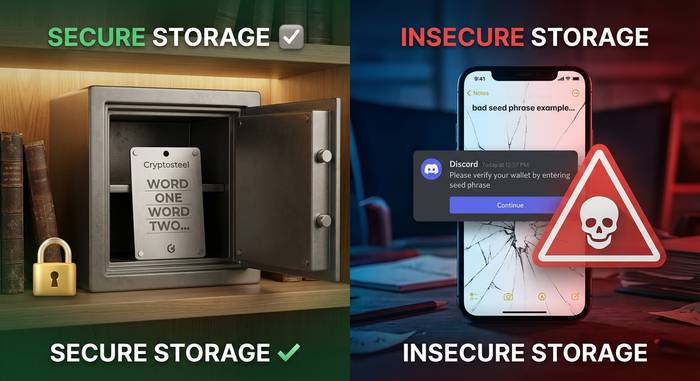
Companies like Cryptosteel, Billfodl, and Blockplate sell metal plates where you stamp or engrave your seed words into steel or titanium. These survive fire (up to 1,500°C), floods, and physical damage that would destroy paper. Cost: $50-150. Worth it for anyone holding more than a few hundred dollars in crypto.
Paper in a secure location
Write the words on paper with a pen (not pencil, not printer). Store the paper in a safe, a locked drawer, or a bank safety deposit box. The main risks: fire, water damage, and someone finding it. Never take a photo of the paper or type it into a notes app.
Split storage
Divide your 24-word phrase into two or three parts and store each in a different physical location. For example, words 1-12 in your home safe, words 13-24 at a family member's house. This way, no single location being compromised exposes the full phrase. The downside: more complexity, and you need to remember where all the parts are.
What NOT to do
Never store your seed phrase digitally. Not in a Google Doc. Not in iCloud Notes. Not in a text file on your desktop. Not in email. Not in a password manager (debatable, but the conservative crypto community says no). A single data breach, malware infection, or cloud hack exposes your seed phrase to the world.
Never share it with anyone. No legitimate wallet, exchange, or crypto service will ever ask for your seed phrase. If someone asks, they're trying to steal your funds. This includes "customer support" on Telegram, Discord, or social media. Scam artists run fake support accounts for every major wallet brand and catch people every day.
Never type it into a website. Phishing sites that look identical to real wallet interfaces ask you to "verify" or "sync" your wallet by entering your seed phrase. The moment you type those words into a website, your crypto is gone within seconds. Bots sweep wallets automatically.
Seedless wallets: the future or a compromise?
The seed phrase model works, but it puts an enormous security burden on individual users. Not everyone is equipped to manage metal plates and split storage. Some newer wallets are trying alternatives.
Multi-party computation (MPC) wallets split the key generation process across multiple devices or parties. No single device ever holds the complete key. If one device is compromised, the attacker can't reconstruct the full key. Coinbase Wallet and some institutional custody solutions use MPC.
Social recovery wallets let you designate trusted contacts (guardians) who can collectively help you recover your wallet if you lose access. Vitalik Buterin has advocated for this model. No guardian alone can access your funds, but a majority of them together can approve a recovery. This is still experimental but gaining traction.
Smart contract wallets like Safe (formerly Gnosis Safe) use multi-signature logic on-chain. Instead of a single seed phrase, a group of keys must sign together to authorize transactions. This is standard for DAOs and protocol treasuries but increasingly accessible for individual users too.
None of these have fully replaced seed phrases yet. The crypto wallet landscape is still built around the BIP39 model, and most users interact with a recovery phrase at some point. But the trend is clear: the industry knows that asking regular people to guard 12 words with their life is a UX problem that limits adoption. The solution will probably be a mix of MPC for casual users and traditional seed phrases for people who want maximum control.
For now, writing down your words on paper or metal and storing them somewhere safe remains the standard. It's low-tech, it works, and it doesn't depend on any company staying in business. The simplicity is actually the point.
Real-world horror stories (and lessons)
These examples aren't meant to scare you into paralysis. They're meant to show that seed phrase management is the single most important skill in self-custody crypto.
Stefan Thomas and 7,002 BTC: Thomas received his bitcoin in 2011 for making an educational video. He stored the keys on an IronKey encrypted USB drive and lost the password. The IronKey wipes itself after 10 failed attempts. As of 2026, he's used 8 of his 10 tries. The bitcoin, worth roughly $480 million, sits untouched on the blockchain. A seed phrase backup would have solved this in 30 seconds.
The Cryptopia hack and no recovery: When New Zealand exchange Cryptopia was hacked in 2019, users who held crypto on the exchange had no seed phrases because the exchange controlled the keys. $24 million was stolen. Users who kept their own wallets with their own seed phrases were unaffected.
Phishing sweeps: In 2023, a mass phishing campaign targeted MetaMask users through fake "wallet sync" websites that ranked in Google ads. Users entered their seed phrases thinking they were connecting to a legitimate service. Bots swept the wallets within seconds of the phrases being entered. Total losses: estimated at tens of millions across thousands of victims. Every single loss was preventable by following one rule: never type your seed phrase into a website.
The pattern in every one of these stories is the same: the blockchain worked exactly as designed. The technology didn't fail. The human layer did. Your seed phrase is the single point of connection between you and your digital assets. Treat it accordingly.