How to Diversify Your Crypto Portfolio: Risk-First Holdings for 2026

Most retail Bitcoin investors who used trading apps between 2015 and 2022 lost money, according to a Bank for International Settlements bulletin published in February 2023. The average loss was roughly $431 per investor, or 47.89 percent of the capital they put in. That finding is the strongest argument for serious crypto portfolio diversification ever produced by a central bank — and it has nothing to do with picking the wrong coin. It has to do with how much, where, and when. Concentration risk is the single largest preventable loss in any cryptocurrency investment, and structured diversification is the only widely tested response.
The crypto market sits at about $2.7 trillion in May 2026, off from its $4 trillion peak in late 2025. Bitcoin dominance is back in the 58–60 percent range, and the CoinMarketCap Altcoin Season Index reads 39 out of 100, firmly in Bitcoin Season territory. Against that backdrop, the case for diversifying a crypto portfolio is not "spread your bets across ten tokens." It is a method: allocation frameworks, sector limits, a stablecoin sleeve, and a rebalancing rule you actually follow. After watching three full crypto cycles, the part that surprises me is how few diversified portfolios I see are actually built from numbers; most are built from vibes.
Why crypto concentration risk is different
Diversification cliches travel poorly into crypto. The mechanics here are sharper. Bitcoin's ten-year annualised volatility runs near 80 percent, while the S&P 500 sits closer to 20 percent. Drawdowns are also more sudden. Correlation across digital assets — even across separate blockchains — tends to spike to 0.75–0.90 during sell-offs, per a 2026 Tandfonline study on post-ETF decoupling. The practical effect: a "ten-altcoin portfolio" often behaves as a single position when stress hits. Stocks and bonds rarely co-move that tightly even in the worst weeks.
Three episodes are worth keeping in mind whenever you set sleeve weights.
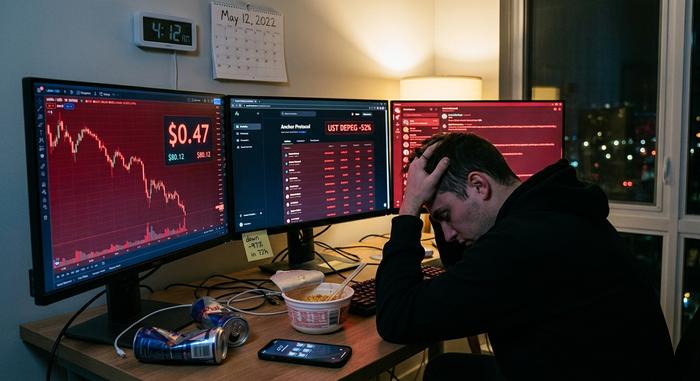
Terra and Luna collapsed in May 2022. LUNA fell from roughly $80 to near zero in three days, while its supply ballooned from one billion tokens to six trillion. The Harvard Law School Forum on Corporate Governance estimated total investor losses at about $40 billion. Anyone who held the bulk of their crypto in the Terra ecosystem (UST, LUNA, Anchor deposits) was wiped, even if it felt diversified across "stablecoin plus yield plus governance token."
FTX failed six months later. Bloomberg's contagion mapping put the destroyed market value near $200 billion. The lesson there was custody concentration: customers who held assets across many tokens, but all of them on one exchange, lost the lot.
The most recent stress was milder but still significant. Q1 2026 took the total market down 20.4 percent in a single quarter, with Bitcoin off 22.0 percent, according to CoinGecko's Q1 2026 industry report. Even the institutional ETF channel could not blunt that drawdown.
| Stress event | Date | Loss (market cap) | Concentration that hurt |
|---|---|---|---|
| Terra/Luna collapse | May 2022 | ~$40B wiped | Single-ecosystem (UST + LUNA + Anchor) |
| FTX bankruptcy | Nov 2022 | ~$200B destroyed | Single-custodian (assets all on one exchange) |
| Q1 2026 market drawdown | Jan–Mar 2026 | −20.4% total cap | BTC-correlated altcoin overweight |
Concentration, not crypto itself, is the variable to manage.
Allocation frameworks compared
Three frameworks dominate professional discussions, and each gives you a specific number to act on, not a vague principle. Pick one and commit; switching mid-cycle is its own form of damage.
The core-satellite approach holds 70–80 percent of your crypto sleeve in Bitcoin and Ethereum (the "core"), with 20–30 percent put into four to six "satellites" spread across sectors. This framework leans into the institutional-ETF dynamic of the past two years. US spot Bitcoin ETFs collectively hold about 1.3 million BTC, roughly 6.2 percent of all the Bitcoin that will ever exist, with $101.4 billion in combined assets as of May 21, 2026 according to Bitbo's tracker. That demand is structurally different from altcoin demand, which is why BTC and ETH increasingly act as a relative-stability anchor inside crypto itself.
A barbell allocation puts roughly 60 percent in low-risk holdings (stablecoins, BTC, staked ETH), 30 percent in higher-conviction altcoins you have researched, and 10 percent in speculative bets. The barbell admits that small high-volatility positions can deliver outsized returns without putting the whole portfolio at risk, and it forces you to size your speculative bets honestly rather than letting them creep up over time.
The risk-parity adaptation weights each asset by the inverse of its volatility, then normalises to 100 percent. Because Bitcoin's volatility is roughly four times the S&P 500's, and altcoins are typically two to three times Bitcoin's, the maths assigns surprisingly small weights to the riskiest tokens. Stablecoins absorb the rest. Most retail investors find this too conservative in bull markets, but it survives drawdowns better than the other two, and drawdowns are what kill long-run compounding.
| Sleeve | Core-satellite | Barbell | Risk-parity |
|---|---|---|---|
| Bitcoin | 45% | 25% | 30% |
| Ethereum | 30% | 10% | 18% |
| Large-cap alts | 10% | 5% | 4% |
| Sector bets (RWA, DeFi, L1s) | 10% | 25% | 6% |
| Stablecoins | 3% | 30% | 35% |
| Yield positions (staked ETH, stables) | 2% | 5% | 7% |
The numbers above are illustrative starting points, not prescriptions. The point is that each framework gives you an answer when an altcoin promoter pings you on Telegram. Without a framework, the answer is always "maybe a small position," and the small positions add up to a concentrated bag.
Sector diversification matters more than coin count
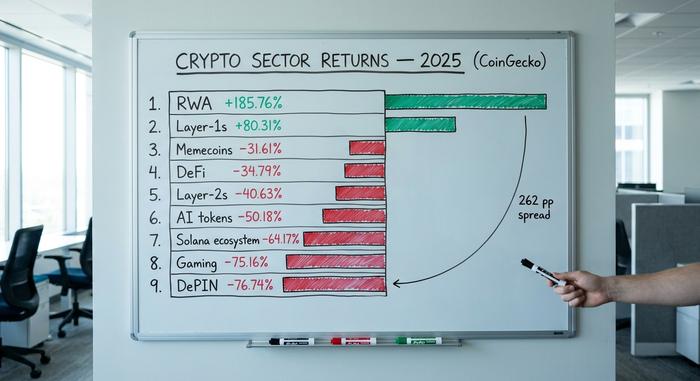
One of the clearest ways to diversify your crypto portfolio correctly is to focus on sectors before tokens — holding twenty altcoins is not diversification if they all belong to the same sector. The 2025 data settles this argument. CoinGecko's annual narratives report tracked the average return for each major sector, and the spread was 262 percentage points top-to-bottom.
| Sector | 2025 average return |
|---|---|
| Real-World Assets (RWA) | +185.76% |
| Layer-1s (excl. ETH) | +80.31% |
| Memecoins | −31.61% |
| DeFi | −34.79% |
| Layer-2s | −40.63% |
| AI tokens | −50.18% |
| Solana ecosystem | −64.17% |
| Gaming | −75.16% |
| DePIN | −76.74% |
A portfolio holding ten "diversified altcoins" picked from L2s, AI, DePIN, and gaming lost between 50 and 77 percent on average in 2025, while the headline crypto market was actually up for most of the year. The lesson is structural — pick your sectors before you pick your tokens, and cap any single narrative at a meaningful percent of the portfolio so a sector blow-up cannot break you.
A workable bucket map for 2026 covers five to six categories. Store-of-value (Bitcoin). Smart-contract Layer-1s (Ethereum and one or two challengers). Stablecoins. RWA tokenization. DeFi or yield positions. And a small narrative-rotation sleeve for memecoins, AI tokens, and gaming — capped aggressively at 5 to 10 percent of the crypto sleeve. The narrative sleeve exists so you stop sneaking those tokens into the rest of your allocation by mistake.
Stablecoins and yield as a portfolio leg
Stablecoins are no longer just a parking lot for trades — they have become a structural allocation choice and a partial hedge inside a cryptocurrency portfolio. The category cleared $320 billion in May 2026, roughly 11.9 percent of total crypto market cap, with USDT at $184 billion and USDC at $77 billion. Together they handle the majority of on-chain settlement and have become the de facto reserve asset inside crypto portfolios. Payment rails like Plisio's, where merchants accept and settle in stablecoins, reinforce that role: the same dollar that pays an invoice can sit on chain as dry powder for the next drawdown.
Yield options give you a third return source that does not depend on price direction. Ethereum's native staking pays about 3.3 percent APY on average, with roughly 28.91 percent of ETH supply staked across some 1.1 million validators (Datawallet, January 2026). Established DeFi stablecoin pools pay 3–8 percent APY; higher-yield products like Ethena's sUSDe have run 10–15 percent, sometimes more, but carry meaningful smart-contract and basis-trade risk. Treat that as a real risk premium, not a free lunch.
A practical guideline: keep 15–30 percent of the crypto sleeve in stablecoins and yield positions combined. That is roughly what allows you to rebalance into drawdowns without selling productive assets at the bottom. The exact number depends on how you view tail risk; investors who lived through 2022 tend to weight this leg heavier, while those who started in the 2024–2025 institutional cycle often underweight it because they have never been forced to use it. Keeping the sleeve real and funded is the cheap insurance no one regrets at the moment they need it.
When and how to rebalance your crypto portfolio
Rebalancing is where most diversified portfolios quietly become concentrated again. A Crypto Research Report study covering 2014 through 2023 ran the numbers on a 2.5 percent Bitcoin allocation inside a traditional portfolio. No rebalancing produced the highest raw return: 178 percent over a rolling three-year window. Monthly rebalancing returned only 97 percent. But monthly also delivered the lowest maximum drawdown. Quarterly came out best on Sharpe ratio.
For a crypto-only portfolio, the practical rule is threshold-based rather than calendar-based: rebalance any sleeve whose actual weight has drifted more than 25 percent from its target, or rebalance the whole portfolio quarterly, whichever comes first. That triggers action when it is actually needed and avoids transaction-tax friction in quiet quarters. Every rebalance is a taxable event in most jurisdictions, so the threshold rule matters financially as well as behaviourally.
The behavioural point matters too. Rebalancing means selling what just outperformed and buying what just underperformed; nobody enjoys it. Having a written rule turns it into mechanical execution rather than a discretionary call you make while watching a chart.
Mistakes that make 'diversified' portfolios fail
Crypto portfolio diversification fails in predictable ways, and the same patterns show up in post-mortems across every cycle.
First, concentration disguised as diversification. Five Ethereum L2 tokens behave as one bet on L2 narrative beta, regardless of how the row of logos looks in your portfolio tracker. Same for five AI tokens or five Solana ecosystem plays.
Second, holding everything on a single chain. Solana ecosystem tokens lost an average 64.17 percent in 2025 even as Bitcoin had a strong year. Chain risk is real, blockchain-specific, and uncorrelated with the broader market.
Third, no stablecoin sleeve. Without dry powder, drawdowns force you to sell something productive to buy something else, which usually means selling Bitcoin at the bottom.
Fourth, emotional rebalancing. Buying more of what just doubled and refusing to touch what just halved is the default human reaction; a rules-based approach beats it.
Fifth, ignoring correlation in stress. Different tokens, similar drawdowns. The 0.75–0.90 correlation spike during sell-offs shows up reliably in every cycle, including the relatively orderly Q1 2026 selloff.
Sixth, custody concentration. FTX showed that token diversification on one exchange is not diversification of risk. Split holdings across at least one self-custody wallet and one or two reputable custodians.
Building a 2026 crypto portfolio step by step
A workable sequence to build the diversified crypto portfolio described above:
1. Decide the crypto sleeve's size as a share of total wealth. Most major advisors, including Charles Schwab's 2025 Modern Wealth Survey, find investors holding around 10 percent in crypto on average; cap based on risk tolerance, not enthusiasm.
2. Pick one allocation framework and stay with it for at least a full year. Core-satellite is the sensible default for new portfolios.
3. Define your sleeves on paper: BTC, ETH, large-cap alts, sector bets, stablecoins, yield positions. Assign target percentages summing to 100.
4. Pick specific assets to fill each sleeve. Use sector limits (no more than two tokens per sector) and chain limits (no more than half the alts on any one chain).
5. Choose a custody mix: a hardware wallet for the core, one or two reputable exchanges for trading and yield. Never one exchange for everything.
6. Write the rebalancing rule down: 25 percent drift trigger, plus a quarterly review. Set a calendar reminder.
7. Review the framework annually. Review the portfolio quarterly. Do not check daily prices unless you enjoy losing money to your own reactions.
Final thoughts on how to diversify your crypto portfolio for 2026
Knowing how to diversify your crypto portfolio comes down to two things: the allocation math behind your token list and the discipline to rebalance back to it. The number of tokens you hold is almost incidental. Concentration is what wrecks most portfolios, and the BIS data shows that has been true throughout crypto's first decade and a half. Pick a framework that fits your risk tolerance, cap each sector, hold a real stablecoin and yield sleeve, and follow a written rebalancing rule you can actually defend in writing. The portfolio that survives the next 70-percent drawdown is the one whose owner already decided what to do before the drawdown started, and stuck to it when the screen was red.