Celestia Blockchain Explained: Modular Data Availability

Most blockchains try to do everything at once. They execute your transaction, agree on the order, settle the result, and store the data so anyone can check it later, all on the same network, all repeated by every node. That design is honest but expensive, and it is the main reason fees spike and throughput stalls when a chain gets popular. The Celestia blockchain made a different bet — do one job, do it well, and let other chains handle the rest. Since its mainnet went live on October 31, 2023, it has been marketed as the first modular blockchain, and the idea has quietly reshaped how new networks get built.
This guide explains what that actually means, how the technology works without the usual hand-waving, and where the project really stands in 2026, including the numbers most explainers skip.
From monolithic to modular: the scaling problem
To understand why the Celestia blockchain exists, you have to understand what it is reacting against.
The blockchain trilemma
Blockchain designers have long talked about a three-way tension between decentralization, security, and scalability. You can usually optimize for two, and the third suffers. Want thousands of transactions per second? Easy, if you let a handful of powerful servers run the network. Want anyone with a laptop to verify the chain? Then you cannot make blocks too big, because every node has to process every byte.
Why monolithic blockchains hit a wall
A monolithic blockchain bundles four jobs into one layer: execution (running the transactions), settlement (resolving disputes), consensus (agreeing on order), and data availability (publishing the data). Bitcoin and, for most of its history, Ethereum work this way; these traditional blockchains are sometimes called full-stack chains, because one blockchain network runs the entire stack. The catch is that throughput is capped by the weakest participant, because decentralization depends on ordinary people being able to run a node. Push block sizes up to gain speed and you slowly price those people out, which is the exact thing that made the network worth using.
The modular alternative
Modular blockchains break that bundle apart and let specialized layers handle each task. Execution can happen on a rollup. Settlement can happen elsewhere. Celestia takes the piece almost everyone underrates: consensus and data availability. It orders data and guarantees it was published, and it deliberately does not run smart contracts itself.
| Job | Monolithic chain | Modular stack |
|---|---|---|
| Execution | Base layer | Rollups / app-chains |
| Settlement | Base layer | Separate settlement layer |
| Consensus | Base layer | Celestia |
| Data availability | Base layer | Celestia |
The pitch is simple. If a chain only has to order data and prove it is available, it can do that cheaply and let a thousand other chains build on top.
Why the Celestia blockchain bets on data availability
Data availability is the least glamorous idea in all of blockchain technology, and also the one the entire modular thesis rests on.
The data-withholding problem
Here is the question data availability answers: has the data behind a block actually been published, so that anyone who wants to can download it and check the math? It sounds trivial until you picture a block producer who posts a valid-looking block header but withholds some of the underlying transaction data. Nobody can prove fraud, because nobody can see the data to recompute the result. For a rollup, this is fatal. Rollups push their execution off-chain and post the raw transaction data somewhere trustworthy so the outside world can reconstruct and challenge their state. If that data is missing, the rollup's security collapses.
Celestia as a data availability layer
Celestia exists to be that trustworthy somewhere. It is a data availability layer: rollups dump their transaction data onto Celestia, and the network guarantees the data was made public. It does not care what the transactions do or whether they are valid in the rollup's logic. Its only promise is that the data is there and anyone can fetch it. That narrow focus is the whole point of the design, and it is what lets Celestia stay lean while the chains above it get complicated.
How Celestia works: data availability sampling
The obvious objection writes itself. If every rollup dumps its data on the Celestia blockchain, doesn't that chain choke on the load it was supposed to escape? The clever answer is that you do not have to download a block to know its data is available.
Erasure coding and light nodes
Celestia expands each block using erasure coding, a technique that adds redundancy so that the original data can be rebuilt even if parts go missing. Roughly, the block data is doubled: if any chunk is withheld, the gap is detectable. This matters because of who gets to check the chain. A full node downloads everything. A light node — the kind you could run on a phone — does not, and that is the whole trick.
Data availability sampling in practice
Instead of downloading a block, a light node performs data availability sampling: it requests a handful of small, random pieces of the block. If all the samples come back, the odds that a meaningful chunk is missing drop fast. After several rounds, a light node reaches roughly 99 percent confidence that the full block was actually published, without ever holding the full block. The more Celestia light nodes sampling in parallel, the more the network can safely raise block size, because verification was never the bottleneck. Anyone running one can verify data availability for themselves rather than trusting a third party. This is the inversion that makes the model work: throughput grows as participation grows, instead of fighting it.
How rollups plug in
Underneath, Celestia uses namespaced data structures so each rollup can fetch only its own slice of a block rather than sifting the whole thing. Validators run the consensus that orders the data, light nodes police availability, and rollups treat Celestia as a shared, neutral notice board. A developer launching a chain writes their transaction data to Celestia and inherits its availability guarantees, rather than building a validator set and a consensus mechanism from scratch. In practice that lets Layer 2s and app-chains launch their own blockchain on top of Celestia far faster, and stay scalable as they grow.
The TIA token: staking, gas, and governance
TIA is the Celestia blockchain's native token, and it is worth being plain about what it does, because it is not a speculative growth story at the moment. It has three plumbing jobs. First, it pays for blobspace, the data slots rollups buy when they post transaction data. Second, it secures the network: validators stake TIA in a proof-of-stake system, and delegators can stake to them. Third, it carries governance weight, so TIA holders vote on parameters and upgrades.
The supply picture, as of June 2026, is a total of 1 billion TIA with about 929 million circulating, per CoinGecko. The network launched with a genesis airdrop of 60 million tokens, around 6 percent of supply, sent to 584,232 addresses. As a digital asset, TIA's value is meant to track demand for Celestia's blobspace, which puts the spotlight squarely on adoption.
What Celestia costs versus Ethereum
This is the number that actually decides whether the Celestia blockchain's modular data availability is more than a nice idea, and oddly few explainers quote it.
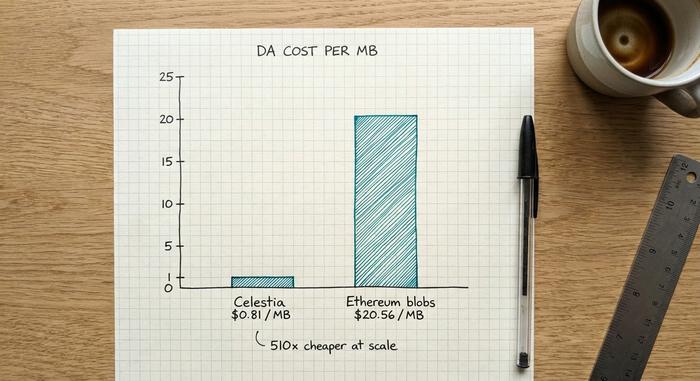
Ethereum opened its own data-availability lane in March 2024 with EIP-4844, which introduced "blobs," a cheaper, temporary place for rollups to post data. Celestia still undercuts it by a wide margin at scale. Independent comparisons put Celestia's data availability at roughly 96 percent cheaper than Ethereum blobs. One detailed breakdown by the rollup team Eclipse found that posting about 115 GB of data cost $12,306 on Celestia versus $502,895 on Ethereum, a 510x per-transaction efficiency gap.
| Data availability cost | Celestia | Ethereum blobs |
|---|---|---|
| Approx. cost per MB | ~$0.81 | ~$20.56 |
| 115 GB posted (Eclipse case) | $12,306 | $502,895 |
| Relative per-tx efficiency | ~510x | 1x |
Why is Celestia so much cheaper? It was built from day one to do nothing but sell data space, so it carries none of the overhead of a chain that also runs a full execution environment and competes for the same blockspace. Ethereum's blobs, by contrast, share a busy general-purpose L1.
The honest caveat is that this gap is a moving target. Ethereum keeps shipping blob upgrades, and each one narrows the distance. Celestia's cost edge is real today; it is not guaranteed forever.

Celestia in 2026: the Matcha upgrade and mainnet today
Most Celestia blockchain explainers froze somewhere in 2024, which is a problem because the network changed the two things people criticized most. On November 24, 2025, the Matcha upgrade raised the maximum block size from 8 MB to 128 MB, a 16x jump in raw throughput, and cut TIA's annual inflation from about 5 percent to 2.5 percent, according to CoinDesk. Any current take on the modular blockchain has to use post-Matcha numbers, or it is describing an older network.
The Celestia mainnet has run continuously since October 2023, secured by a validator set of around 96. On the demand side, the picture is more sober. L2BEAT tracks roughly $180 million of value secured through Celestia across about a dozen projects, and the network is using only about 0.05 percent of its data throughput capacity, per L2BEAT. Put bluntly, Celestia could absorb thousands of times its current load without straining, which is a flattering way of saying almost nobody is touching the headroom yet. The technology scaled; the usage has not caught up.
The risks: adoption, tokenomics, and competition
The Celestia blockchain's technology is impressive. The traction is thin — and I think any useful guide has to say both things in the same breath.
Adoption is concentrated. By mid-2026, a single customer, the Eclipse rollup, accounted for roughly 84 percent of daily blob volume on Celestia. A data availability network whose throughput depends on one chain is not yet the neutral public utility the pitch describes. The raw capacity sits mostly idle, which is great for headroom and bad for the blobspace-demand story TIA's value rests on.
The token reflects that. TIA traded near an all-time high around $19.70 in late 2024 and sits near $0.32 in June 2026, roughly a 98 percent drawdown. The Celestia Foundation raised about $155 million in total, including a $100 million round led by Bain Capital Crypto in September 2024, reported by The Block. The current market cap, near $298 million, sits only modestly above the cash raised, which tells you how much early valuation has unwound.
Then there is competition. Ethereum's own roadmap is the clearest threat. Each planned blob-scaling upgrade raises how many blobs a block can carry and pushes data costs down, and every one of those steps chips at Celestia's main selling point. Celestia keeps a capacity and cost lead after Matcha, but the moat is narrower than it was a year ago, and it closes a little with each Ethereum hard fork.
How to buy and store the TIA token
TIA is listed on most major centralized exchanges, where you can buy it with fiat or stablecoins and, on some, stake it directly. For self-custody, TIA lives in the Cosmos ecosystem, so Cosmos-native wallets like Keplr and Leap support it, and hardware wallets such as Ledger work for cold storage. Holding in a compatible wallet also lets you delegate your TIA to a validator and earn staking rewards, while keeping the keys yourself rather than leaving the token on an exchange.
Where the Celestia blockchain goes from here
Celestia proved a real thing: you can separate data availability from execution, verify huge blocks with light nodes, and post rollup data far more cheaply than on a monolithic chain. That is not marketing; the cost numbers back it up. The open question is not whether the Celestia blockchain works, but whether enough independent rollups show up to use it before Ethereum closes the cost gap. The next year of adoption data, not the next upgrade, will answer it.