
Arbitrum and Optimistic Rollups: L2 Market Share, TVL Data, and Why Arbitrum Leads Ethereum Scaling

Ethereum's gas fees hit $50 per swap during the 2024 bull run. The same swap on Arbitrum cost about a penny. That gap is the entire thesis for Layer 2 scaling, and it explains why Arbitrum has absorbed more value, more users, and more protocols than any other L2 in existence. At its peak, Arbitrum One held $18.8 billion in total value locked and controlled over 40% of all rollup TVL. It had 7.6 million monthly active addresses, more than twice the nearest competitor. And it did all of this running on optimistic rollups, a technology that most of the crypto industry spent 2022-2023 writing off as inferior to zero-knowledge proofs.
I've tracked L2 growth since Arbitrum One launched in August 2021. The data tells a clear story: optimistic rollups won the market even though ZK rollups won the Twitter debate. This article digs into the numbers, compares Arbitrum with its competitors, and explains what makes the optimistic rollup model work well enough that the largest DeFi protocols on Ethereum chose to deploy there first.
How optimistic rollups actually work
Before the data, you need to understand the mechanics. Otherwise the numbers don't mean anything.
An optimistic rollup is a Layer 2 chain that processes transactions off Ethereum's mainnet (Layer 1), batches them together, and posts the results back to Ethereum. The "optimistic" part: the rollup assumes every batch is valid by default. Nobody proves correctness up front. Instead, there's a challenge window, typically 7 days, during which anyone can dispute a batch by submitting a fraud proof. If a batch turns out to be invalid, it gets rolled back and the party that submitted it loses their staked ETH.
Think of it like a classroom where the teacher assumes everyone did their homework correctly. Grades go in the book immediately. But there's a week-long window where any student can challenge another's answers. If someone cheated, the teacher catches it, reverses the grade, and the cheater loses their deposit. Most of the time nobody cheated, so the system runs fast.
The security model relies on what's called the "1-of-N honest assumption." You don't need every validator to be honest. You need just one honest participant watching the chain and willing to submit a fraud proof if something goes wrong. One honest watcher is enough to keep the whole system secure. That's a much lighter security requirement than proof-of-stake (which needs 2/3 honest) or ZK rollups (which need complex mathematical proofs for every single batch).
Here's how Arbitrum's version works step by step. A user submits a transaction on Arbitrum. The sequencer orders it, executes it against the current state, and returns a receipt. The transaction is instantly confirmed from the user's perspective. Meanwhile, the sequencer compresses the transaction data and posts it to Ethereum as calldata (or since EIP-4844, as a blob). Validators on L1 can verify the data. If anyone thinks a state transition was invalid, they initiate a multi-round interactive dispute. Arbitrum's fraud proof system breaks the dispute into smaller and smaller steps until it isolates a single computational step, which gets re-executed on Ethereum. The loser forfeits their stake.
Arbitrum by the numbers: TVL, users, and market dominance
The data on Arbitrum's dominance among L2s is hard to argue with.
| Metric | Arbitrum One | Optimism | Base | zkSync Era |
|---|---|---|---|---|
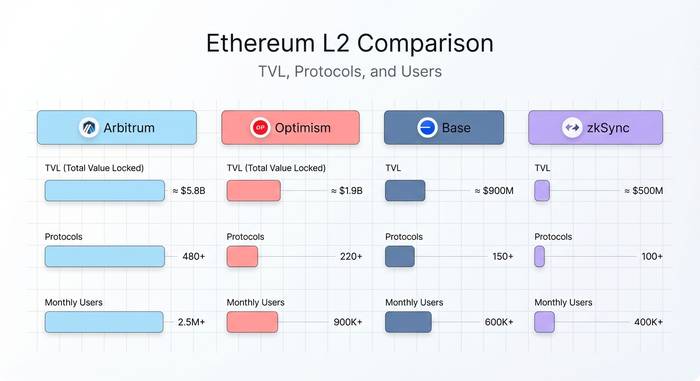
| Peak TVL | $18.8 billion | ~$7 billion | ~$8 billion | ~$1 billion |
| Protocols deployed | 256+ | 119+ | 200+ | 70+ |
| Monthly active addresses (peak) | 7.6 million | ~4 million | ~3.9 million | ~1.5 million |
| L2Beat stage | Stage 1 | Stage 0 | Stage 0 | Stage 0 |
| Fraud/validity proofs | Active (BOLD) | Disabled | N/A (optimistic) | Active (ZK) |
| Transaction cost (post-EIP-4844) | ~$0.01 | ~$0.01 | ~$0.005 | ~$0.02 |
Arbitrum's TVL lead was even more dominant before Base launched in 2023. At one point Arbitrum held 59% of all L2 TVL, which meant it was larger than every other rollup combined. That share has since diluted as Base grew rapidly (powered by Coinbase's user base) and Optimism expanded through its Superchain vision. But Arbitrum still leads in protocol count and peak TVL.
One number that doesn't get enough attention: L2Beat's staging system. Arbitrum is classified as Stage 1, meaning it has a working fraud proof system, a Security Council with known members, and a path toward full decentralization. Optimism is Stage 0, meaning it still runs with training wheels, including disabled fraud proofs and a more centralized governance structure. For anyone who cares about actual decentralization rather than marketing claims, that staging difference is significant.
GMX, the perpetual futures DEX, accounted for nearly 25% of Arbitrum's TVL on its own. Other major protocols on Arbitrum include Aave, Uniswap, Radiant Capital, Camelot DEX, and Pendle. The DeFi ecosystem on Arbitrum is deep enough that you can do essentially everything you'd do on Ethereum mainnet but at a fraction of the cost.
What EIP-4844 changed: the Dencun fee revolution
March 2024 was a turning point. Ethereum's Dencun upgrade introduced EIP-4844 (proto-danksharding), which created a new data type called "blobs." Before blobs, rollups had to post data as calldata on Ethereum, which was expensive. Blobs are temporary data storage that's much cheaper because it gets pruned after about 18 days.
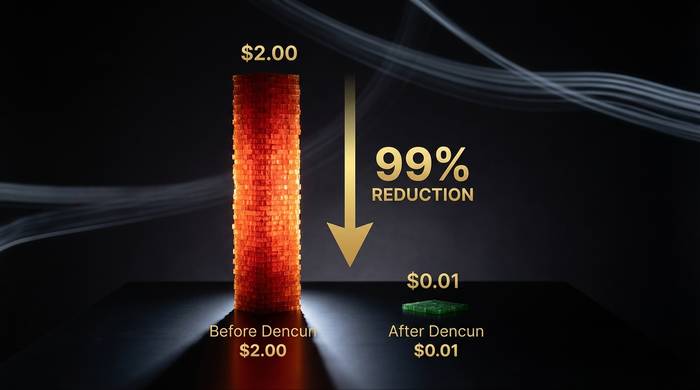
The impact on rollup fees was immediate and dramatic. Arbitrum transaction costs dropped by roughly 99%. A simple ETH transfer went from a few dollars to under a cent. A token swap dropped to about $0.01. The cost reduction was so severe that some analysts questioned whether rollup economics still made sense, since the fees rollups charge users now barely cover their own L1 posting costs.
For users, though, it was pure upside. A swap on Arbitrum became competitive with a swap on Solana in terms of raw cost, except you're still sitting on Ethereum's security model. That matters. The "Ethereum is too expensive" narrative, which had been pushing users toward alternative L1s like Solana and Avalanche for years, lost most of its punch almost overnight. Why spin up a node on a separate L1 when you can use an L2 that inherits Ethereum's security model and costs a penny per transaction? That question reshaped the entire scaling debate going forward.
Arbitrum's architecture: One, Nova, Orbit, and Nitro
Arbitrum isn't a single chain. It's a family of chains with different tradeoffs.
Arbitrum One is the main rollup. Full Ethereum security. All transaction data posted to L1. The chain where GMX, Aave, and Uniswap live. If you've used Arbitrum, this is what you used.
Arbitrum Nova uses a lighter model called AnyTrust. Instead of posting all data to Ethereum, Nova sends data to a Data Availability Committee (a small group of trusted parties). This makes Nova cheaper and faster (6.4 TPS) but less decentralized. Nova is designed for gaming and social applications where throughput matters more than maximum security. Reddit's community points ran on Nova.
Arbitrum Orbit is the framework for launching your own chain using Arbitrum's technology. Think of it as "Arbitrum as a service." Projects can deploy their own L2 or L3 with custom gas tokens, custom throughput settings, and their own governance. Xai (a gaming chain) and several other projects have launched using Orbit. This is Arbitrum's answer to Optimism's Superchain and Polygon's CDK.
Nitro is the tech stack that powers all of these. It replaced Arbitrum's original architecture in August 2022. The "Geth sandwich" structure embeds Go Ethereum at its core for full EVM compatibility, wraps it in ArbOS (Arbitrum's custom operating system that handles calldata compression and L1/L2 messaging), and runs everything compiled to WebAssembly for fast execution. Nitro is what made Arbitrum's transaction confirmation drop to 1-2 seconds and what enabled the interactive fraud proof system.
Optimistic vs ZK rollups: the data behind the debate
The crypto industry has spent years arguing about whether optimistic or ZK rollups will "win." The market has given a fairly clear interim answer, and it favors the optimistic side.
| Metric | Optimistic rollups (Arbitrum, Optimism, Base) | ZK rollups (zkSync, StarkNet, Scroll) |
|---|---|---|
| Combined TVL | ~$25-30 billion | ~$2-3 billion |
| Number of top-100 DeFi protocols deployed | 60%+ | ~15% |
| Transaction confirmation | 1-2 seconds (soft), 7 days (final) | 1-2 seconds (soft), minutes-hours (final) |
| EVM compatibility | Full (runs Geth natively) | Partial to full (via custom VMs) |
| Fraud/validity proofs | Challenge-based, cheaper | Math-based, expensive to generate |
| Developer tooling maturity | High (years of iteration) | Growing (newer ecosystem) |
Optimistic rollups dominate in TVL and protocol count because they were first to market with full EVM compatibility. When Uniswap or Aave wanted to deploy on an L2, they could copy-paste their Ethereum contracts onto Arbitrum with minimal changes. ZK rollups required different compilers, different tooling, and different assumptions. That developer experience gap gave optimistic rollups a multi-year head start that ZK rollups still haven't closed.
The ZK camp argues that validity proofs are mathematically superior because they don't require a 7-day challenge window. That's true. A ZK proof settles in minutes. An optimistic rollup's finality takes a week. But in practice, users don't wait 7 days because liquidity bridges like Across and Hop provide near-instant withdrawals by fronting the capital. The 7-day window is a security parameter, not a user experience bottleneck.
My read: optimistic rollups will keep their TVL lead for at least two to three more years. The head start matters. Every major protocol is already deployed, every integration is already built, and every developer already knows the tooling. ZK rollups will carve out niches where their strengths actually matter: privacy applications, cross-chain messaging infrastructure, and scenarios that genuinely need fast finality without relying on liquidity bridges. But the idea that one rollup type kills the other was always too binary. The market is big enough for both, and the competition between them pushes everyone to build better products.
What's next for Arbitrum: BOLD, Stylus, and decentralization
Arbitrum's roadmap is focused on two things: decentralization and developer expansion.
BOLD (Bounded Liquidity Delay) is the new validation protocol. Launched in 2023, it makes fraud proof submission permissionless. Before BOLD, only 13 whitelisted validators could challenge invalid state transitions. Now anyone can. This is the step that moved Arbitrum from Stage 0 to Stage 1 on L2Beat, and it's the kind of concrete decentralization progress that most L2s haven't matched.
Stylus lets developers write smart contracts in Rust, C, and C++ in addition to Solidity. This opens Arbitrum to a much larger pool of developers. A game developer who writes C++ doesn't need to learn Solidity to deploy on Arbitrum. The contracts run in WASM alongside the EVM, which means Solidity and Rust contracts can coexist on the same chain.
The sequencer remains the elephant in the room and I want to spend a moment on this because it matters more than most Arbitrum advocates admit. The chain still runs a single centralized sequencer operated by Offchain Labs. One entity decides the order of every transaction. One entity can censor. One entity going down means the chain stops. That's exactly what happened in June 2023 when a batch poster outage froze transaction processing.
Offchain Labs says they're building a distributed sequencer committee. No timeline published. No testnet. No spec anyone outside the team has reviewed. This is the single biggest risk to the "Arbitrum is decentralized" narrative and until it's solved, anyone who claims Arbitrum is meaningfully decentralized is skipping the fine print. Stage 1 on L2Beat is real progress. But a centralized sequencer sitting at the center of a $15+ billion ecosystem makes security researchers nervous, and it should make users think twice about how much they leave on the chain at any given time.



