Stimulus Check Boom: How Economic Impact Payments Sparked Crypto
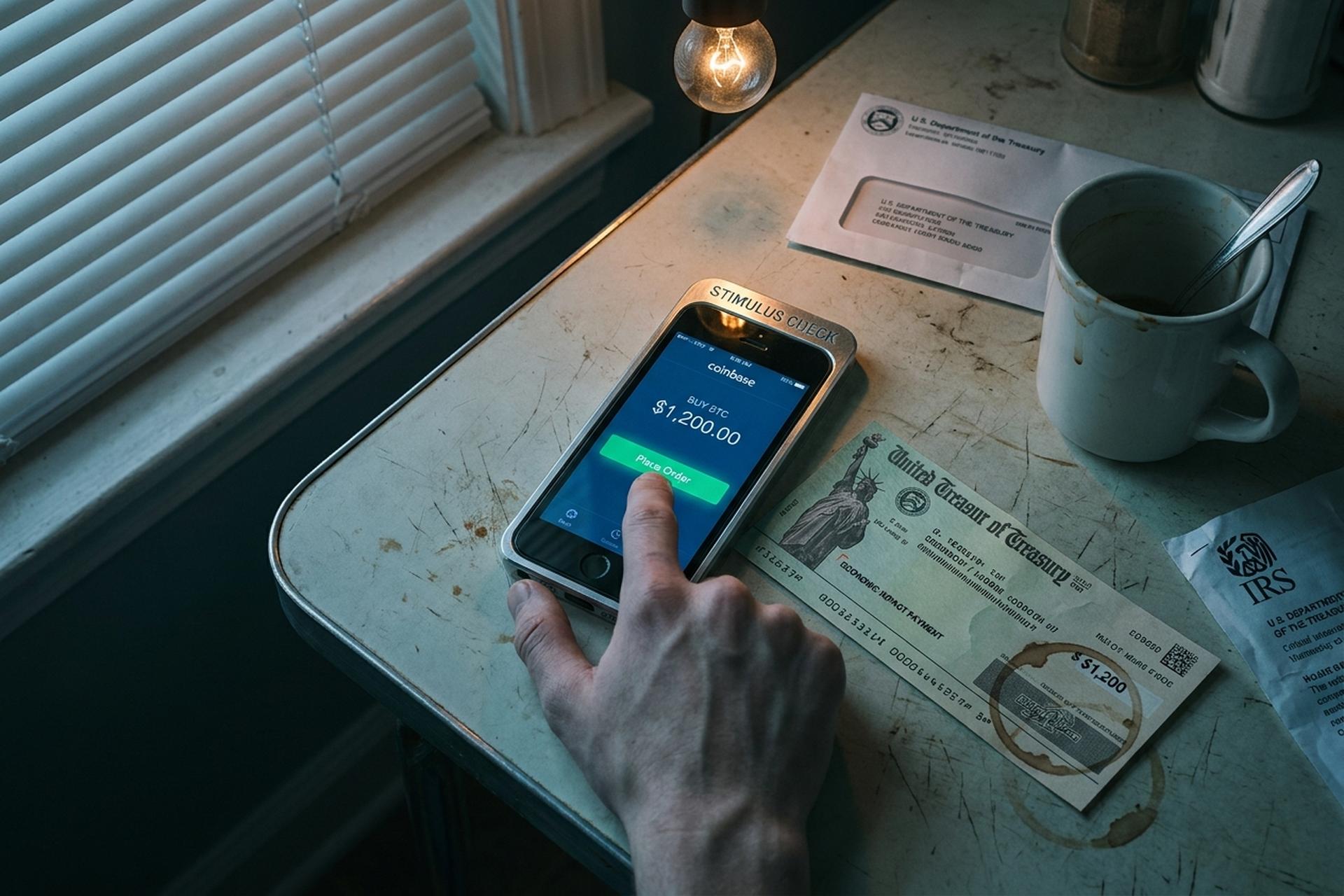
Brian Armstrong, the boss of Coinbase, once posted a chart to Twitter that more or less ended a long-running argument. It tracked buys placed on his exchange and broke out those that came in at exactly $1,200. The line had been sitting near 0.1 percent of total transactions for weeks. Then, in the days after the first U.S. stimulus checks dropped, it shot up to almost 0.4 percent. Four-fold in roughly seven days, with the same oddly round number repeating across thousands of unrelated wallets. After that one tweet in April 2020, anyone still arguing that fiscal stimulus didn't really touch crypto markets was arguing against the receipts.
The receipts kept coming. Across three rounds of Economic Impact Payments the IRS shoved roughly $800 billion through about 472 million transfers, and a meaningful slice of those dollars walked, almost without friction, from a checking account into Bitcoin, Dogecoin, or Ether. Plenty of things drove the 2020-2021 bull market; stimulus was the most visible accelerant, and the on-chain fingerprints it left behind are unusually easy to read.
What follows is a tour of the three stimulus payment rounds, the eligibility rules that decided who got what, the 2020 Recovery Rebate Credit and 2021 Recovery Rebate Credit deadlines, the rails that moved IRS dollars into crypto wallets within hours, and the 2026 picture, in which cash transfers have stopped and spot Bitcoin ETFs have quietly taken their place.
Three Rounds of Stimulus and the IRS Playbook
Writers often treat the three stimulus checks as one giant program, but that framing obscures the mechanics. They were three distinct laws, signed by two administrations, each with its own size, eligibility floor, and political backstory; the gap is why crypto's reaction was so uneven from spring 2020 through late 2021.
The first round was emergency triage. Trump signed the Coronavirus Aid, Relief, and Economic Security Act (CARES Act) on March 27, 2020, throwing $1,200 at every qualifying adult plus $500 per qualifying child. The Treasury Department and Internal Revenue Service started pushing payments the week of April 11; within two weeks press release SM1025 reported 88 million Americans set to receive a payment by April 25. EIP1 totalled around $270 billion on 160 million payments, which at the time felt enormous; nobody knew yet that two more rounds were coming.
Round two was a political compromise. The Consolidated Appropriations Act, signed December 27, 2020 after weeks of failed bargaining between House, Senate, and the outgoing Trump administration, paid $600 per adult plus $600 per qualifying child; it totalled $142 billion on 147 million payments, the smallest round, landing as Bitcoin broke above $20,000.
Round three dwarfed the others. The American Rescue Plan, signed by Biden on March 11, 2021, sent $1,400 per adult and $1,400 per dependent (adult dependents counted this time, pulling college students and elderly parents in). The first wave of third economic impact payments hit accounts on March 17, 2021; by early June the IRS had distributed 163.5 million payments worth almost $390 billion (press release JY0248). Per capita, this third round of economic impact payments was the largest federal cash transfer in U.S. history.
| Round | Law signed | Per adult | Payments | Total disbursed |
|---|---|---|---|---|
| EIP1 | CARES Act, Mar 27, 2020 | $1,200 + $500/child | ~160M | ~$270B |
| EIP2 | Consolidated Approps, Dec 27, 2020 | $600 + $600/child | ~147M | ~$142B |
| EIP3 | American Rescue Plan, Mar 11, 2021 | $1,400 + $1,400/dependent | ~163.5M | ~$390B |
Across the three stimulus rounds, the IRS issued approximately 472 million individual payments worth roughly $800 billion. Direct deposit share climbed from 76 percent in EIP1 to over 85 percent in EIP3. That speed mattered for what came next.

Inside the Economic Impact Payment Program
The Economic Impact Payment program tested the IRS's ability to do something it wasn't built for: cut hundreds of millions of outbound payments in days. It managed by leaning on direct deposit information from prior tax returns and Social Security records.
Recipients on direct deposit got the money first (the IRS will use this information from prior returns to deposit funds directly). Those without bank details got a paper check or a prepaid VISA debit card via MetaBank; paper checks will be mailed to the address on the last return. Non-filers on Supplemental Security Income, Social Security Disability Insurance, and Railroad Retirement were paid automatically via partner financial institutions. The IRS website hosted two portals: "Get My Payment" to check the status of your payment, and a non-filers tool to enter payment information for those who had not filed a 2018 tax or 2019 tax return.
By the end of EIP3, the agency had rolled out plus-up payments for filers underpaid based on 2019 income.
Stimulus Eligibility and the AGI Phase-Outs
Whether you got a check, and how much, depended on the adjusted gross income the IRS happened to have on file, and the result could feel arbitrary. For EIP1, the full $1,200 went to single filers up to $75,000, $112,500 for head of household, $150,000 for those married filing jointly (filing joint); past those points the check shrank by $5 per $100 of extra income, which is why your neighbour earning $90,000 still saw a partial payment while you at $99,000 saw nothing. Round three tightened the screws considerably: the $1,400 per child and per adult vanished at $80,000 single, $120,000 head of household, and $160,000 for married couples, knocking plenty of two-income tech and finance households out who had been eligible to receive a payment the first time.
Beyond income, every eligible individual needed a valid Social Security number, which kept ITIN-only households out of EIP1 and EIP2 until EIP3 partially restored mixed-status families; anyone claimed as a dependent of another taxpayer received nothing in their own name.
The 2020 Recovery Rebate Credit Explained
Say you never got the first or second check, maybe because your 2018 tax address was stale, or you'd moved, or the IRS never had a routing number for you in the first place. There was exactly one way to retrieve that money, and it ran through Form 1040: file a tax return for 2020, drop the missing amount on Line 30, and the IRS would treat it as the 2020 Recovery Rebate Credit. A single filer could in principle claw back up to $1,800 (the $1,200 from EIP1 plus $600 from EIP2 they had never seen), while a married couple filing jointly with one qualifying child stacked the household total up to $3,600.
That window stayed open for three years from the return's original due date, which sounded generous until you realized how quickly time passed. Because the 2020 return had been pushed from April to May 17, 2021 due to the pandemic, the firm deadline to claim the credit was May 17, 2024; miss that, and the money disappeared into the federal general fund. In late 2024 the IRS itself estimated roughly 1.1 million non-filers had let their share lapse entirely, and Treasury was perfectly happy to keep what nobody asked for.
The 2021 Recovery Rebate Credit and Final Deadline
The 2021 Recovery Rebate Credit covered missed EIP3 payments, third economic impact payment amounts, and any plus-up payments you received that weren't fully counted. Filers who never got their $1,400 entered it on Line 30 of the 2021 Form 1040, pulling payment information from the IRS online account that tracked second and third economic impact deposits. By late 2024 the IRS realized something awkward: about 1 million eligible taxpayers had filed but left the line blank, leaving roughly $2.4 billion in payment amounts unclaimed.
In December 2024 the agency announced it would send those payments automatically, using direct deposit information from each filer's most recent return where possible, paper check in the mail otherwise. For non-filers, the agency repeated one cutoff: April 15, 2025. That date came and went; whatever wasn't claimed reverted permanently to the Treasury, and both CBS News and Axios reported close to $1 billion in EIP3 money abandoned.
How the Stimulus Package Fueled the Crypto Boom
Each stimulus package landed in retail accounts the exact moment crypto exchanges had stripped friction down to a one-tap buy. The result showed up in every retail-facing data series.
Coinbase verified users climbed from 43M at end-2020 to 56M by Q1 2021, then 89M by Q1 2022 per its S-1. Robinhood's pre-IPO disclosures were sharper: crypto AUC jumped from $481M in Q1 2020 to $11.6B in Q1 2021, a 24x rise in twelve months. Dogecoin alone made up 34 percent of Robinhood crypto revenue in Q1 2021, then 62 percent in Q2. Funded accounts grew from 12.5M at end-2020 to 22.5M by mid-2021.
Survey data tracked the same wave. A March 2021 Mizuho note by Dan Dolev estimated up to $40B of EIP3 would flow into stocks and Bitcoin, about $25B into Bitcoin alone, enough to lift market cap by 3 percent. A Harris Poll for Yahoo Finance that month found 53 percent of Americans investing their EIP3 chose cryptocurrency, about 7 percent of all recipients. An August 2021 CNBC/Momentive survey found half of Americans 18-34 invested some stimulus money, 11 percent buying crypto directly.
The price chart matched the policy calendar.
| Stimulus event | Date | BTC price before | BTC price after |
|---|---|---|---|
| EIP1 first wave | Apr 13-15, 2020 | ~$6,640 | $7,400 (Apr 30) |
| EIP2 wave | Dec 29, 2020 - Jan 2021 | ~$27,000 | $40,000 (Jan 8) |
| American Rescue Plan signed | Mar 11, 2021 | $57,300 | $61,556 ATH (Mar 13) |
| EIP3 first wave | Mar 17, 2021 | $58,000 | $64,895 ATH (Apr 14) |
| Cycle peak | Nov 10, 2021 | — | $69,044 |
Academic work confirmed the pattern with cleaner numbers. Cleveland Fed Working Paper 2113 by Anantha Divakaruni and Peter Zimmerman (July 2021; later Management Science 2023) measured a 3.8 percent rise in Bitcoin buy-trade volume on the dollar pair after each disbursement, with the modal trade size shifting to exactly $1,200 around EIP1 and $1,400 around EIP3. They calculated a ~7bp price lift per event. Total stimulus flowing into Bitcoin was only ~0.02 percent of EIP dollars, but in a thin retail market that was enough to move price.
From IRS Deposit to Coinbase: The Money Trail
The path from an IRS direct deposit to a Bitcoin position often took less than an hour. ACH same-day rails settled the EIP in 24-48 hours. Plaid, by 2020 ubiquitous on Coinbase, Robinhood, and Cash App, let users link the same checking account in two taps.
Brokerages outside crypto saw the wave too. Schwab reported 3.2 million new accounts in Q1 2021, a record. Robinhood DAUs peaked at 17.7 million; Fidelity logged its largest quarter ever. Glassnode tracked a jump in small-balance "shrimp" wallets through 2020-2021, and Chainalysis flagged deposit clusters of exactly $1,200 and $1,400 at retail exchanges.
Two conditions made it possible: the IRS had direct deposit information on file for most filers, and crypto apps had spent five years on consumer-grade onboarding. When those aligned, the route from federal payment to speculative buy collapsed from days to minutes.
The Inflation Hangover and the End of Cheap Money
The bill arrived later, and it was steep. CPI inflation hit 9.1 percent year over year in June 2022, the worst monthly print since November 1981 (BLS release CPI-07132022). Larry Summers, who had spent most of 2021 warning that the American Rescue Plan was too large for an economy already bouncing back, was vindicated in the most uncomfortable way. New York Fed Staff Report 1050 later pinned several percentage points of the peak on fiscal stimulus interacting with supply-side constraints. The Fed responded by raising the policy rate 525 basis points between March 2022 and July 2023 — closing the zero-rate era that bankrolled both stimulus and the 2021 crypto run.
Will There Be a 2026 Stimulus Package?
Short answer: no. Nothing resembling a federal stimulus payment has been authorized in 2026, and there is no bill close to passing Congress. Two ideas wandered through the political conversation during 2025-2026, and neither survived first contact with arithmetic.
The first was the "DOGE dividend." Hedge fund manager James Fishback floated it in February 2025, Elon Musk amplified it on X, and Trump endorsed it shortly after. The plan would redirect 20 percent of whatever savings the Department of Government Efficiency claimed, paying up to $5,000 per household, restricted to net-income taxpayers, only after DOGE concluded in July 2026. The trouble: DOGE's realized savings came in far below the projections justifying the dividend, and no enabling legislation was ever introduced.
Trump's second pitch, the "tariff dividend," surfaced late in 2025 and proposed a flat $2,000 check to every American, funded by tariff revenue. A November 2025 Tax Foundation analysis put the program cost between $279.8 billion and $606.8 billion, against projected tariff revenue of $158.4 billion in 2025 and $207.5 billion in 2026. The numbers do not add up, and Congress has not moved a bill.
State programs largely wound down. California's Middle Class Tax Refund debit cards expired on April 30, 2026. New York launched its first-ever Inflation Refund Checks in late September 2025, sending $150 to $400 per household to over 8 million residents from surplus sales-tax receipts, modest next to anything federal. Alaska's Permanent Fund Dividend and Colorado's TABOR refunds keep running.

Stimulus Check Scams and Where to Verify Status
Every round of stimulus payments dragged fraud in behind it. FTC numbers: since 2021, over 46,000 people reported losing more than $1 billion to crypto-paid scams, Bitcoin in 70 percent of reports. Stimulus-specific schemes peaked in spring 2021: phishing texts pretending to be the IRS and fake "claim your $1,400 in USDT" landing pages. The agency never asks for personal information via text, email, or social media, and never accepts cryptocurrency. To check your payment status or status of your payment history, the only authoritative source is the IRS Online Account at IRS.gov.
The Last Stimulus-Driven Crypto Cycle and What Replaced It
The 2020-2021 stimulus checks were the largest retail-investor catalyst cryptocurrency has ever seen. The 2024-2026 cycle runs on different fuel: spot Bitcoin ETFs have pulled in about $87 billion since launch, with BlackRock's IBIT alone managing $66.9 billion. The buyer is now an RIA running an allocation model, not a 27-year-old depositing a $1,400 check into Coinbase on a Tuesday afternoon. The mechanism, liquidity chasing scarce digital assets, is the same. The political conditions that produced the stimulus boom are unlikely to repeat soon.