PulseChain (PLS): Richard Heart, Ethereum Fork, Skeptic’s Case
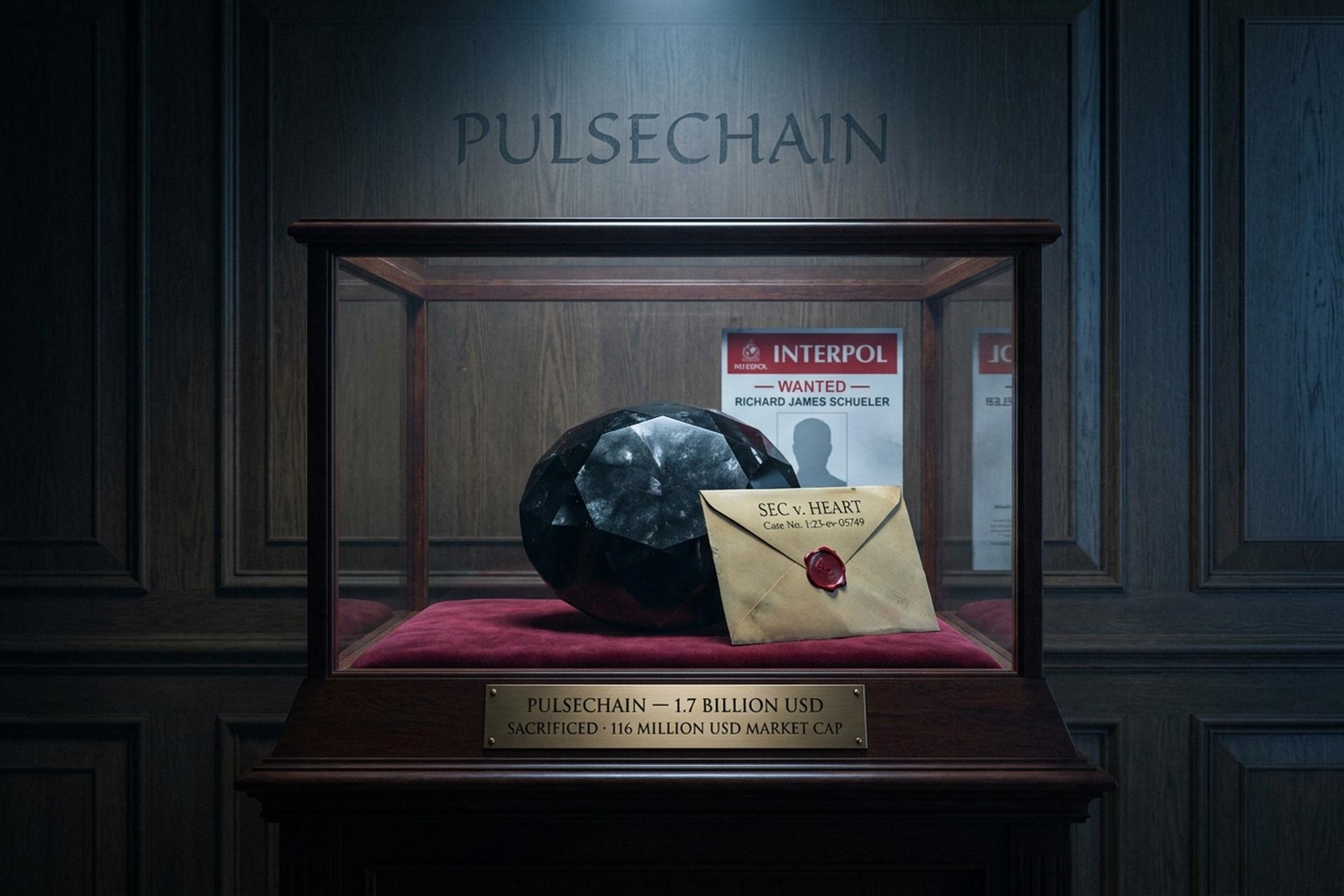
Richard Heart's public-relations posture in 2026 is that he won. A U.S. federal judge dismissed the Securities and Exchange Commission's billion-dollar fraud case against him in February 2025, and Heart's social channels framed the ruling as a total vindication of PulseChain. The harder truth: the dismissal turned on personal jurisdiction, not on whether the offerings were legal. At the same moment Heart was claiming victory in the United States, the Finnish National Bureau of Investigation had him on Europol's Most Wanted list, an Interpol Red Notice was active at Finland's request, and a Finnish court had already remanded him in absentia on suspicion of aggravated tax evasion and aggravated assault of a sixteen-year-old. As of May 2026, his physical location is publicly unknown.
This piece takes a hard look at PulseChain without the spin. It walks through what PulseChain is, who Heart is, how the sacrifice mechanic was designed to dodge securities law, what shipped at mainnet, PLS tokenomics, what the SEC record actually says, the Finnish criminal proceedings, the PulseChain price history, the live PulseChain markets, the on-chain statistics, and the practical note on bridging and buying PLS in 2026.
What PulseChain Is, and Why It Was Built
PulseChain is a full-state hard fork of Ethereum — a Layer 1 chain that copies its parent's entire state. PulseChain operates with a delegated proof of stake validator set, shorter block times of about three seconds, and a native token called PLS. At launch on May 13, 2023, it duplicated the entire Ethereum state from a snapshot at block 17,233,000, so every Ethereum-based token and NFT was cloned as a "p-prefixed" cousin: holders of 1 ETH at the snapshot block received 1 pETH on PulseChain, and holders of HEX received a 1:1 pHEX airdrop of those tokens and NFTs.
The marketing pitch was straightforward: cheaper fees and lower transaction fees than Ethereum mainnet, faster confirmation, an environmentally friendly proof of stake consensus mechanism, and free copies of every Ethereum-based asset for existing holders. That is genuinely what shipped. What did not ship is anything technically novel. PulseChain has no new consensus algorithm, no new virtual machine, no new cryptography. It is an Ethereum clone with a 75/25 fee split and an unusual cloned-state airdrop. In a year when Base, Arbitrum and Optimism were offering even cheaper fees with a fraction of the controversy, that has been a hard sell for the broader cryptocurrency market.

Richard Heart: From "Spam King" to PulseChain Crypto
The creator of PulseChain crypto operates under the stage name Richard Heart. His legal name is Richard James Schueler — the SEC's litigation release LR-25794 captions him "Richard J. Schueler a/k/a Richard Heart." His pre-crypto reputational record is unusually well-documented. In 2002, anti-spam site Peacefire.org sued Schueler under Washington State's anti-spam statute (RCW 19.190) and won, earning him the "Spam King" label that has followed him for two decades. A 2007 Google Groups post by Panamanian civil rights lawyer Miguel Antonio Bernal named Schueler among foreign nationals he accused of exploiting Panama's weak legal protections, though no Panamanian conviction was ever entered. He spent the next decade selling SEO products before relocating to Helsinki, Finland.
Heart launched HEX on December 2, 2019 — an ERC-20 "blockchain certificate of deposit" pitched with advertised yields up to 38 percent annually. PulseChain followed in 2021 as the planned host for a forked, lower-fee version of HEX. PulseX completed the trinity in 2022. The three projects together raised more than $1.7 billion in cryptocurrency from contributors who were told, on the sign-up page, that they were not investors.
The Sacrifice Phase and the PulseChain Token
The most carefully lawyered part of the enterprise was the way contributors paid in. The PulseChain token allocation, like the PulseX allocation before it, was not sold. It was given away after participants made what Heart's lawyers called a "sacrifice." Contributors sent ETH, BTC, ERC-20s, or fiat to designated wallets and self-attested they were not U.S. persons, were not buying anything, and had no expectation of receiving a token in return. Any PLS or PLSX they later received was framed as a discretionary post-launch reward, not a contractual deliverable — a structure designed to fail the Howey test for an investment contract.
The PulseChain sacrifice opened July 15, 2021 and ran through August 22, 2021. Community totals put the take at more than $700 million in thirteen days. The SEC's 2023 complaint pleads roughly $354 million, valuing each contribution at receipt rather than at peak quote. The PulseX sacrifice opened mid-December 2021 and closed January 10, 2022, drawing approximately $1.06 billion under the same mechanic.
| Sacrifice phase | Window | Reported raise (community) | SEC-pleaded figure |
|---|---|---|---|
| HEX origination | Dec 2019 – Nov 2020 | n/a (Ethereum-native) | $678M |
| PulseChain sacrifice | Jul 15 – Aug 22, 2021 | >$700M (13 days) | $354M |
| PulseX sacrifice | Mid-Dec 2021 – Jan 10, 2022 | ~$1.06B | $676M |
Contributions used a declining-bonus curve, so earlier sacrificers received more points per dollar than late ones. That is a standard early-bird ICO mechanic in a structure that was explicitly not an ICO.
PulseChain Mainnet, Block 17,233,000, and the Bridge
When PulseChain mainnet went live on May 13, 2023, the chain took a snapshot of Ethereum at block 17,233,000 (mined three days earlier on May 10). Every ETH balance, every ERC-20 holding, every NFT was duplicated to PulseChain as a "p-prefixed" copy. Within twelve hours the network was processing ~130 transactions per block, almost all arbitrage and farming, not organic dApp usage.
A bridge to PulseChain was opened the same week — cross-chain rails branded PulseBridge. The bridge does the only thing that actually matters for moving value: it lets users bridge assets like USDT, USDC or WBTC across into the PulseChain ecosystem in lockup form so they can be traded on PulseX with real backing. The free-airdrop clones, by contrast, have no upstream backing. A pUNI token on PulseChain trades at fractions of a cent because the real UNI value remains on Ethereum, where the actual Uniswap protocol operates. The clones were always a marketing trick, not an economic one.
Tokenomics: PLS Supply, PoS, and the 75/25 Burn
PLS is the native gas token of PulseChain. Max supply is ~135 trillion PLS, of which ~14.8 trillion is circulating as of May 2026. Initial distribution ran through three channels: a 1:1 airdrop to every Ethereum address holding ETH at the snapshot block, a 1:1 airdrop to existing HEX holders, and sacrifice allocations based on each contributor's points balance. New PLS issuance afterward comes from validator rewards.
The fee-burning mechanism is the most-cited tokenomics feature. Every base fee, paid in PLS, is split: 75 percent to validators producing the block, 25 percent permanently removed from circulation. The structure echoes Ethereum's EIP-1559 with the burn ratio inverted — Ethereum burns 100 percent of base-fee ETH; PulseChain burns only 25 percent.
In steady state with sufficient volume, the 25 percent burn could outpace new validator issuance and make the network deflationary. Current volume falls far short. Day-to-day, PulseChain's net PLS supply continues to grow. The deflationary claim repeated in marketing is conditional on transaction volume the network has not yet produced.
A second design choice is the absence of a meaningful unlock schedule. Most of the circulating supply was distributed at launch, so no large investor cliff is waiting to hit the market — genuinely better than most 2021-vintage launches. The market-pressure problem on PulseChain is not future unlocks; it is the absence of buyers.

SEC v. Heart: PulseChain, and the 2025 Dismissal
The SEC filed SEC v. Richard Heart a/k/a Richard James Schueler, Hex, PulseChain, and PulseX in the U.S. District Court for the Eastern District of New York on July 31, 2023 (Case No. 1:23-cv-05749, Press Release SEC 2023-143). The complaint pleaded three core claims: unregistered securities offerings under Section 5 of the Securities Act of 1933 against all four defendants; antifraud violations under Section 17(a), Section 10(b), and Rule 10b-5 against Heart and PulseChain; and misappropriation of investor funds.
The dollar figures are specific. The SEC alleged Hex raised more than $678 million between December 2019 and November 2020, collected as more than 2.3 million ETH. The PulseChain sacrifice raised approximately $354 million on the SEC's valuation method. PulseX raised approximately $676 million. The combined figure across the three offerings exceeded $1 billion. Of that, the complaint alleged Heart diverted at least $12.1 million to luxury goods including sports cars, watches, and a 555.55-carat black diamond known as "The Enigma," purchased at Sotheby's London on February 9, 2022 for £4.3 million (~$4.28 million) in cryptocurrency. The Enigma is a Guinness record-holder.
The case ended without a merits ruling. On February 28, 2025, Judge Carol Bagley Amon (E.D.N.Y.) granted dismissal in full on personal-jurisdiction grounds. The court held the SEC had failed to plead conduct expressly directed at the United States — globally available internet content was an insufficient nexus. In April 2025 the SEC declined to amend, ending the case.
Heart's PR framed the outcome as a total victory. That framing erases two facts. First, no finding that the offerings were lawful or that the misappropriation allegations were false. The dismissal was procedural. Second, the Finnish criminal proceedings against Schueler are entirely independent of the U.S. case and remain active.
Finland's Indictment and the Interpol Red Notice
Yle, Finland's public broadcaster, broke the Finnish criminal story in September 2024. The Finnish National Bureau of Investigation (Keskusrikospoliisi) is investigating Schueler on two suspected offenses. The first is aggravated tax evasion: prosecutors allege Schueler failed to file Finnish business tax returns and omitted income from personal pre-filled returns between June 2020 and April 2024, with unpaid taxes "counted in hundreds of millions of euros." The figure is a prosecution estimate, not a court-adjudicated assessment.
The second is aggravated assault. A Finnish court has been told Schueler allegedly knocked a sixteen-year-old victim to the ground and repeatedly punched the victim on February 16 and 17, 2021. On September 13, 2024, the court remanded Schueler in absentia. On December 18, 2024, Europol added him to its Most Wanted list, and an Interpol Red Notice was issued the same period. As of May 2026 there has been no arrest, no trial, no conviction. Schueler's location is publicly unknown.
PulseChain Price History and the 97% Drawdown
The PulseChain price history is the cleanest data point in the whole story. PLS hit an all-time high of $0.0003206 on May 22, 2023, nine days after mainnet, according to CoinGecko, CoinMarketCap and CoinPaprika. The token then fell more than 95 percent within six months, reaching the low-$0.00001 range by late 2023 and never sustaining a meaningful recovery. As of May 16, 2026, PLS trades at roughly $0.00000753 with a market capitalization near $116 million, a sustained drawdown of approximately 97.7 percent from the all-time high.
For context, the project raised more than $1.7 billion combined across the PulseChain and PulseX sacrifices. The current PLS market cap is roughly 7 percent of the capital sacrificed. That gap is the single most important number in any honest discussion of the project.
PulseChain Markets and Live PulseChain Price Today (USD)
The live PulseChain markets snapshot and the PulseChain price today in USD, as of mid-May 2026, look like this:
| PulseChain market metric | Value (May 16, 2026) |
|---|---|
| PLS price | ~$0.00000753 USD |
| Market capitalization | ~$116 million |
| Rank | ~#5,070 on CoinMarketCap |
| Circulating supply | 14.8 trillion PLS |
| Max supply | ~135 trillion PLS |
| Fully diluted valuation | ~$994 million |
| Primary venues | NonKYC.io, SafeTrade (small low-regulation venues; no Kraken listing) |
| 24-hour trading volume | modest, concentrated in last 24 hours on NonKYC |
| Market cap of PulseChain | ~$116M |
The PLS price chart is essentially a long flat-line below the May 2023 spike, with small relief bounces failing to reclaim earlier levels. The live price of pulsechain and the broader marketcap have stayed in this band for over a year. Trading volume across all cryptocurrencies that track PLS is concentrated on a handful of small venues, not on major exchanges, and PLS price action does not show up on Kraken or Coinbase order books.
PulseChain Statistics: TVL and On-Chain Reality
The PulseChain statistics underneath the price are equally bleak. Network-wide TVL, per DefiLlama, sits near $66 million in mid-May 2026, down sharply from a March 2024 peak above $465 million. PulseX accounts for the majority of remaining liquidity. Daily DEX transactions hover around 45,000 per Bitget Academy reporting, the upper bound of meaningful activity. The ecosystem dApps are all close to Heart: LiquidLoans (a Liquity-style CDP clone), Phiat/Phamous (Aave/GMX clones), Powercity, Internet Money. No major external dApp has chosen to deploy on PulseChain — no Aave, no Curve, no Uniswap V3, no Maker, no Lido. The clone tokens from the airdrop sit essentially worthless because all upstream value remains on Ethereum.
How to Bridge to PulseChain and Buy PulseChain
Buying PulseChain in 2026 requires two steps. The first step is adding the PulseChain network to a wallet such as MetaMask via a custom RPC, then using the bridge to PulseChain (PulseBridge) to move an Ethereum-based asset like USDC or USDT across — a cross-chain transfer that lets users bridge assets without leveraging custodial intermediaries. The second step is swapping the bridged asset to PLS on PulseX, the in-house DEX where the deepest native liquidity sits.
Tier-one exchanges are not an option. Coinbase displays a PulseChain price page with a converter and calculator, but PLS is not tradable on Coinbase. Kraken's page explicitly states PulseChain is not available on Kraken. Binance and Binance.US have likewise never listed PLS for trading. The confirmed spot venues are NonKYC.io and SafeTrade. Gate.io, MEXC, KuCoin, Bybit and Bitget all show price pages, but actual spot trading availability is worth confirming directly on each exchange before sending funds; price-tracker pages routinely mislead.
The Steelman Case and the 2026 Verdict on PulseChain
The strongest pro-PulseChain case is genuine. The SEC case was dismissed, fees on the network are genuinely a fraction of a cent, the Hexican community provides organic demand most ghost-chain forks would envy, and the 25 percent burn is structurally deflationary at high enough volume. No court has ruled on the merits of the misappropriation allegations. All of that is true. The numbers around it are also true: TVL down 86 percent from peak, no external dApp adoption, a 97.7 percent drawdown sustained for three years, and a founder whose physical location is unknown to Interpol.