CEP Stock: What Happened to Cantor Equity Partners
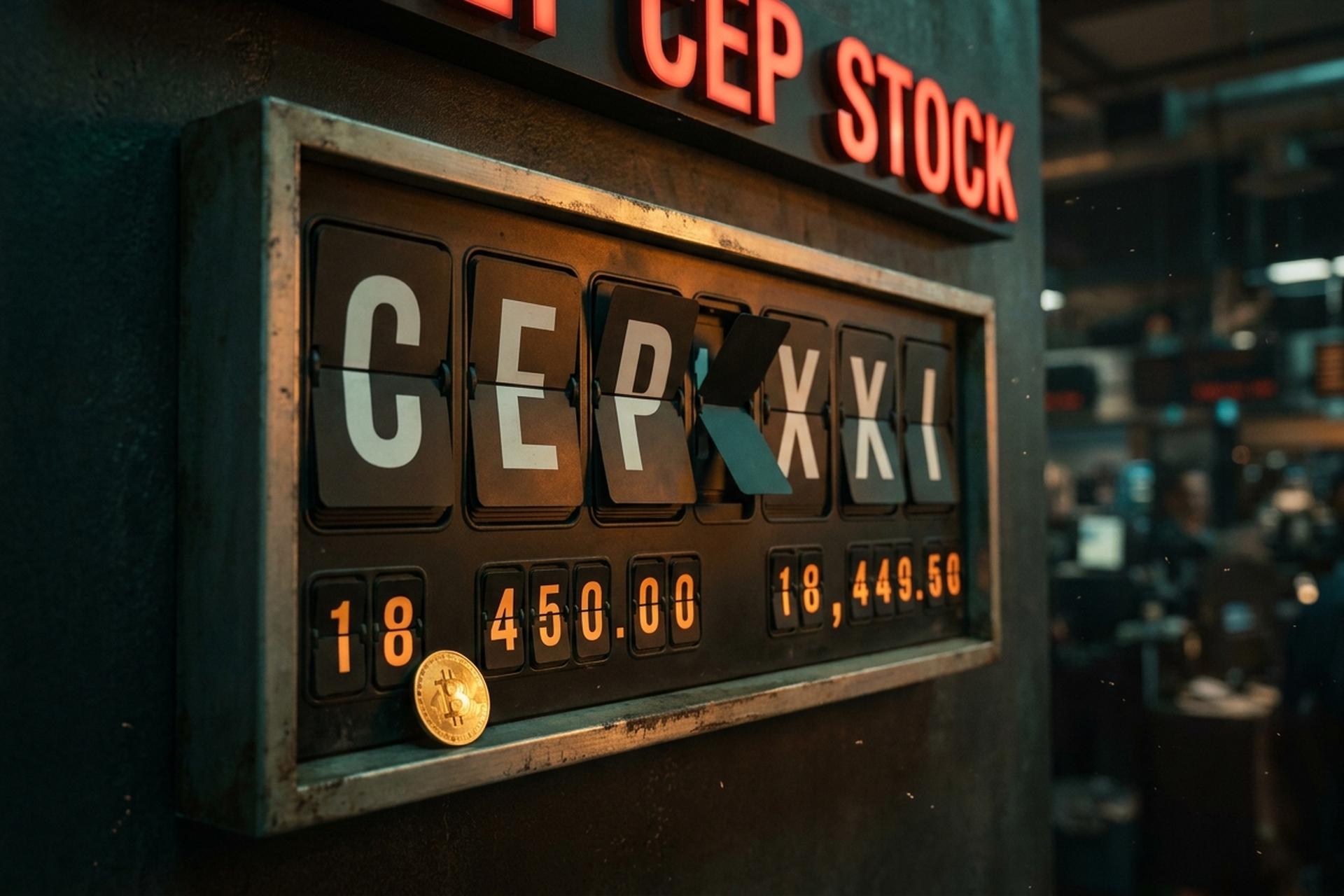
If you went looking for CEP stock recently and found the ticker gone, you did not miss a collapse. CEP, the symbol for Cantor Equity Partners, simply stopped existing in December 2025, when the company changed both its name and its entire reason for being. What was once an empty shell hunting for a deal is now Twenty One Capital, a Bitcoin holding company that trades on the New York Stock Exchange under the ticker XXI.
That switch is the whole story behind CEP stock, and it is more interesting than the usual ticker change. It involves a Cantor Fitzgerald blank-check vehicle, a $3.6 billion Bitcoin bet, a price that briefly spiked 130%, and a finish where the stock now trades at a steep discount to the very Bitcoin it holds. This article walks through what happened, what you actually own if you hold it today, and how it compares to the other ways of buying Bitcoin through the stock market.
What actually happened to CEP stock
Cantor Equity Partners was never an operating business. It was a special purpose acquisition company, a SPAC, sometimes called a blank check company — and understanding that structure is the key to understanding why CEP stock behaved the way it did. Its only job was to raise money, sit on it, and find a private company to merge with so that company could go public without a traditional IPO. In SPAC terms that merger is a reorganization: the shell legally becomes the operating company, keeps the listing, and usually adopts a new name and ticker.
The Cantor Equity Partners SPAC
CEP went public on the Nasdaq in August 2024 at the standard SPAC price of $10 a share, raising roughly $100 million that sat in a trust earning interest. The sponsor was an affiliate of Cantor Fitzgerald, the Wall Street firm then chaired by the Lutnick family. For months the stock did what SPACs do before they announce a deal: almost nothing, drifting close to that $10 trust value because that is what each share was worth if the SPAC found nothing and handed the cash back. A SPAC is essentially a blind pool with a deadline. Investors hand a sponsor money and trust it to find a target before the clock runs out, and until it does, the shares are little more than a parking spot for cash with a lottery ticket attached.
The Twenty One Capital deal
The quiet ended in April 2025. Cantor announced that CEP would merge with Twenty One Capital, a newly formed Bitcoin-native company backed by the stablecoin giant Tether, its sister exchange Bitfinex, and Japan's SoftBank, with Strike founder Jack Mallers as chief executive. The deal valued the combined business at about $3.6 billion, with Bitcoin priced near $84,863 at the time. The pitch was simple and aggressive: build a public company whose entire purpose is to accumulate Bitcoin and grow the amount of it backing each share — a Bitcoin-per-share machine, not a business in the ordinary sense.
From CEP to XXI
Shareholders approved the merger on December 3, 2025, and the combination closed on December 8. The next day, December 9, 2025, the company began trading as Twenty One Capital under the ticker XXI on the NYSE. CEP was retired. Anyone still searching for CEP stock is really searching for XXI now, and the two are the same lineage with very different stakes. Notably, almost no CEP holders cashed out: near-zero redemptions meant the trust money stayed in, a rare show of confidence for a SPAC. CEP was also only the first of a series. Cantor has since run the same playbook with other shells, steering Cantor Equity Partners II toward a merger with the tokenization firm Securitize and a third vehicle into its own deal, but those are separate tickers and should not be confused with the original CEP.
The CEP stock price spike and crash
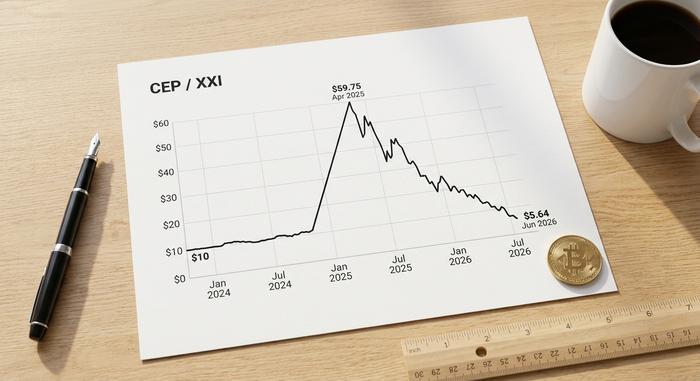
The CEP chart is a textbook lesson in how SPAC prices behave around a deal. For most of its life the stock sat near its $10 trust value because there was nothing else to price. Then the Twenty One announcement hit, and the stock jumped roughly 55% in a single day and about 130% over two sessions, briefly touching a 52-week high near $59.75, a world away from its 52-week low around $10.25. Traders were not paying for earnings. They were paying for the anticipation of a Bitcoin treasury and the celebrity backers attached to it.
| CEP / XXI price timeline | Event | Approx. price |
|---|---|---|
| August 2024 | SPAC IPO | $10.00 |
| April 2025 | Twenty One deal announced | spiked toward $59.75 |
| December 9, 2025 | Converts to XXI on NYSE | ~$10.50 debut |
| June 2026 | Trading as XXI | ~$5.64 |
From that peak it was a long slide, and the CEP stock chart from mid-2025 onward is essentially a Bitcoin sentiment gauge with extra leverage applied. Reality set in: a treasury company is worth what its Bitcoin is worth, plus or minus whatever premium the market grants, and as Bitcoin cooled through late 2025 the premium evaporated. By the time the merger closed, the stock had drifted back toward $14, and XXI opened its first NYSE session near $10.50, down about 25% on the day and right around the $10 price its PIPE investors had paid. Through the first half of 2026, with Bitcoin sliding and enthusiasm fading, XXI fell further to around $5.64. From the spike high to mid-2026, that is a drop of roughly 90%. The lesson is old and keeps repeating: the SPAC pop is anticipation, and anticipation is not a balance sheet.
What you own now: Twenty One Capital stock
Strip away the SPAC wrapper and what remains is straightforward. Twenty One Capital is a Bitcoin holding company. It owns Bitcoin, it intends to own more, and almost everything about the stock traces back to that single asset.
A Bitcoin-native treasury company
As of June 2026, Twenty One holds about 43,514 BTC, worth roughly $2.8 billion, bought at an average cost near $84,865 per coin for a total outlay around $3.69 billion. With Bitcoin trading near $63,000 in mid-2026, that cost basis left the treasury well underwater, a reminder that buying at the top hurts just as much inside a stock as it does in a wallet. To assemble the stack, the company raised more than $800 million around the deal, roughly $486 million in convertible notes plus a few hundred million in a PIPE equity placement, money that also expanded the share count. That makes it one of the larger corporate Bitcoin holders in the world, though it is dwarfed by the company that invented the playbook. The model is openly borrowed from MicroStrategy: raise money through equity and debt, convert it into Bitcoin, and measure success by Bitcoin per share rather than by revenue or profit.
The backers: Tether, SoftBank, Bitfinex, Cantor
The cap table is where Twenty One gets unusual. It launched controlled by Tether and Bitfinex, with SoftBank as a large minority and Cantor as the sponsor. Then, in May 2026, Tether bought out SoftBank's roughly 26% stake, an implied price near $679 million, leaving Tether as the unchallenged controlling owner. After the SPAC dilution, public shareholders, the people who actually buy XXI on the open market, own only about 2.7% of the combined company. You are a small minority passenger in a vehicle that Tether drives.
Jack Mallers and the Bitcoin-per-share pitch
Jack Mallers, known for the Bitcoin payments app Strike, is the public face and chief executive. His message is that Twenty One is not a software firm with a Bitcoin sideline but a pure expression of Bitcoin conviction. In April 2026 the company proposed a three-way merger with Strike and a firm called Elektron, a sign that Tether wants to weave Twenty One deeper into its broader ecosystem. No financial terms were disclosed.
CEP/XXI vs MSTR vs a Bitcoin ETF
If XXI is just a way to own Bitcoin through a stock, the fair question is why own it at all instead of the original or the cheapest alternative. The honest answer, in mid-2026, is that the math does not obviously favor it.
| What you are buying | Twenty One (XXI) | Strategy (MSTR) | Spot Bitcoin ETF |
|---|---|---|---|
| Bitcoin held | 43,514 BTC | 843,706 BTC | holds BTC directly |
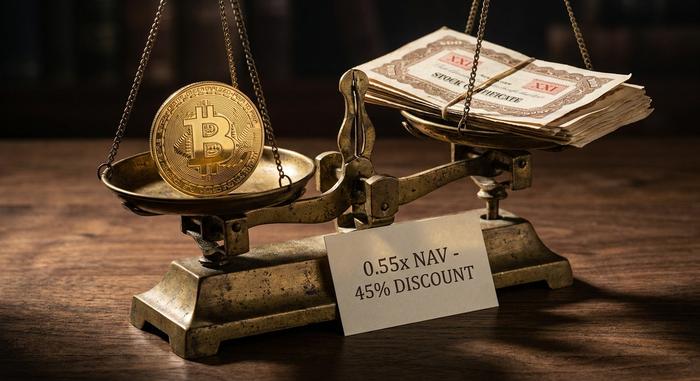
| mNAV (price vs BTC value) | 0.55x (45% discount) | 1.03x (near parity) | ~1.0x (tracks BTC) |
| Average cost per BTC | $84,865 | $66,384 | n/a |
| Control | Tether-controlled | widely held, Saylor-led | fund issuer |
| Ongoing fee | none, but dilution | none, but dilution | ~0.25% per year |
XXI versus Strategy
Strategy, the former MicroStrategy, holds about 843,706 BTC, nearly twenty times what Twenty One owns, at a much lower average cost of $66,384. Just as telling, Strategy traded around an mNAV of 1.03 in June 2026, meaning the market valued it at roughly the worth of its Bitcoin. Twenty One traded at an mNAV of about 0.55, a 45% discount to its own Bitcoin: a market cap near $1.96 billion against a Bitcoin pile worth $2.8 billion. In plain terms, that market capitalization implied investors paying 55 cents for every dollar of Bitcoin sitting inside XXI.
Why a treasury stock over a spot ETF
A spot Bitcoin ETF like BlackRock's IBIT tracks the coin closely for a fee of about 0.25% a year, with no premium, no discount, and no controlling shareholder. For most people who simply want Bitcoin exposure inside a brokerage account, that is the clean answer. A treasury stock only makes sense if you believe it can grow Bitcoin per share faster than it dilutes you, and if you are comfortable with the corporate risk stacked on top.
The discount you are buying
That 45% discount cuts both ways. A cynic sees a market that does not trust the structure, the control, or the dilution. An optimist sees a dollar of Bitcoin on sale for 55 cents, on the bet that the discount eventually closes. I lean toward the cynic here, because discounts on controlled, single-asset vehicles tend to persist for a reason rather than snap shut on schedule.
The risks behind CEP/XXI stock
A SPAC-born, sponsor-controlled, single-asset company carries stacked risks, and XXI — the direct successor to CEP stock — shows most of them at once. The first is the one already on the chart: the premium that lifted CEP can keep draining, and a stock that trades below its Bitcoin can stay there. The second is control. With Tether holding the company and public investors owning about 2.7%, minority shareholders have almost no say and simply ride along with whatever Tether decides.
Then there is the Tether question itself. Tether is the largest stablecoin issuer in the world and a perennial subject of regulatory and reserve scrutiny, and that scrutiny now bleeds directly into XXI. Add the obvious one, a pure dependence on the Bitcoin price, with an average cost above $84,000 that sat underwater through mid-2026, plus warrants and convertible notes that can dilute holders further. There is little independent analyst coverage to lean on — one of the few public ratings on the stock was a Weiss "Sell" in May 2026. Investors are largely flying on the company's own disclosures, with the next real checkpoint a Q2 2026 earnings report due in mid-June. None of this means the company fails. It means the ways to lose outnumber the ways to win.
Is CEP stock (now XXI) worth buying?
The easy money in CEP stock is long gone. That money was the SPAC trade, buying near $10 and riding the deal-announcement pop, and it ended the day the merger closed. What is left is a leveraged, Tether-controlled bet on Bitcoin trading at a discount to its own coins, with a proposed three-way merger with Strike and Elektron still hanging over the structure and no terms yet disclosed. If you are convinced Bitcoin heads much higher and that the discount narrows, XXI offers more upside than the coin itself. If either assumption fails, you hold a diluted minority slice of someone else's Bitcoin fund. For most investors, a spot ETF answers the same craving with far fewer moving parts.
What CEP stock means for investors now
CEP is gone in name only. What replaced it is a concentrated, sponsor-driven Bitcoin treasury company with more ways to go wrong than the asset it holds. The ticker change from CEP to XXI was not cosmetic; it swapped a simple cash-in-trust SPAC for a complicated, discounted, Tether-controlled equity. Before you treat CEP stock as a backdoor into Bitcoin, I would ask the simpler question first: do you want Bitcoin, or do you want Tether's version of it? Those are not the same purchase.