VOO vs Bitcoin ETF (IBIT): The 2026 Investor’s Comparison
A Bitcoin ETF that did not legally exist three years ago is now collecting more new dollars per trading week than the largest S&P 500 fund did in its first six years on the market. That single fact, more than any forecast or thesis, frames the choice retail investors actually face in 2026.
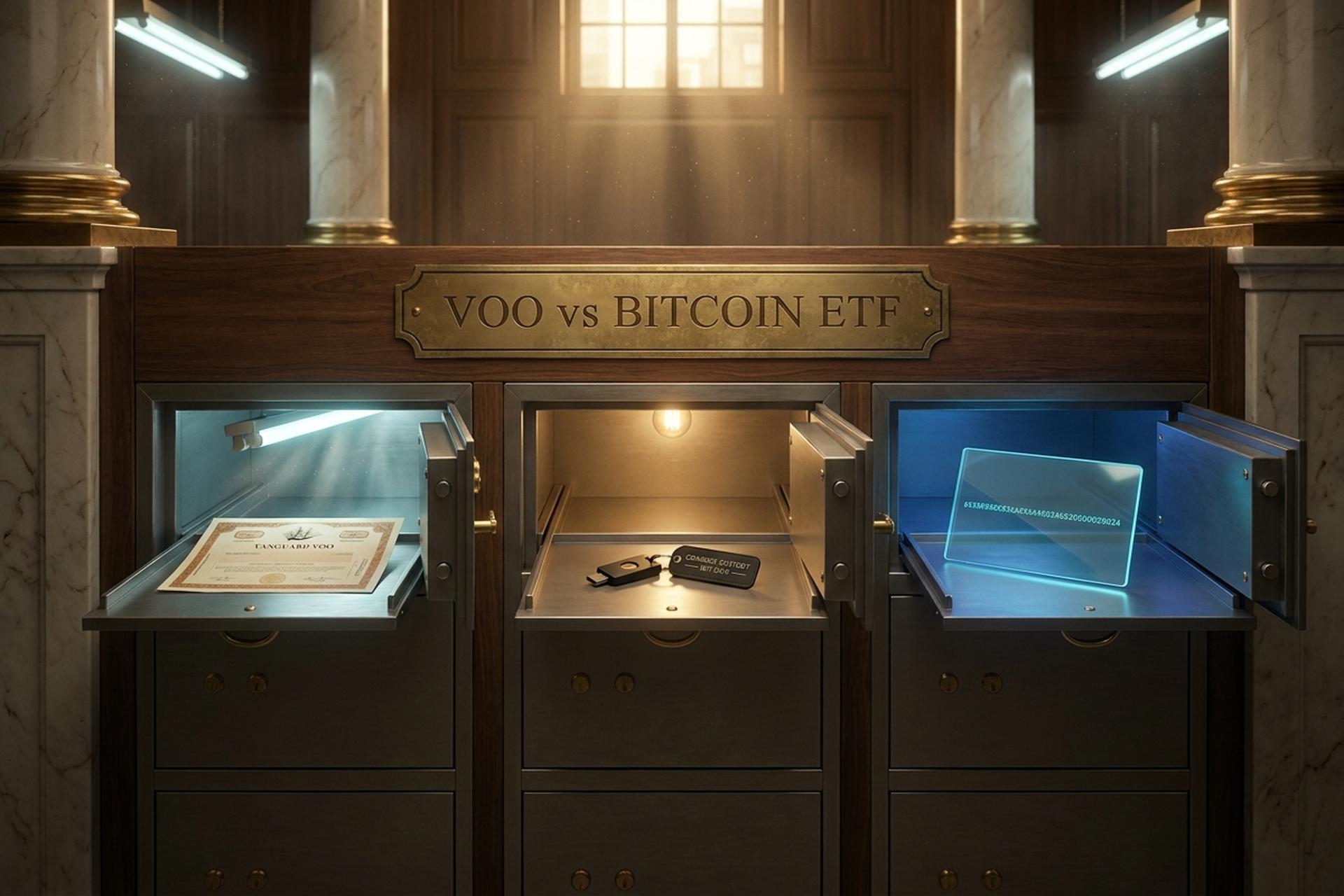
Three vehicles claim to offer broad market exposure, and they are not interchangeable. Vanguard's VOO routes your money through a registered open-end fund. BlackRock's IBIT and its ten spot Bitcoin ETF peers route it through a grantor trust that holds the underlying coin at a single custodian. The newer tokenized S&P 500 wrappers, like Backed's bCSPX or Securitize-issued products, route it through a Swiss bank, a smart contract, and a legal certificate that does not really exist in US securities law. Each is a different bet, even when the headline exposure looks the same. This ETF comparison walks through how the three actually differ for investors trying to diversify across equities and cryptocurrency.
Why VOO Became the Benchmark Every Portfolio Trusts
VOO did not win on cleverness. It won on arithmetic. The fund charges an expense ratio of 0.03%, which works out to thirty cents on every thousand dollars invested per year. Compound that fee gap against actively managed alternatives over a decade and the result stops being marginal. By the end of April 2026, VOO held roughly $1.60 trillion in assets, having quietly passed SPY around mid-2025 to become the largest S&P 500 ETF in the world.
The fund's top ten holdings tell you almost everything about the modern US market. Nvidia sits at 7.84% on the back of AI-driven earnings, Apple at 6.44%, Microsoft at 4.89%, Amazon at 4.19%, both Alphabet share classes together near 6.5%. The top ten collectively represent more than forty percent of the index. Index purists may grumble about concentration risk, but VOO is a passive vehicle. It owns what the S&P 500 committee says it should own, in the weights the committee says.
Performance, the metric that gets most of the marketing attention, has been steady rather than spectacular. The Vanguard S&P 500 ETF's annualized return over the past 10 years sits around 15.68%, with a five-year CAGR closer to 13.92%, solid long-term average numbers by US large-cap standards. Annual returns over the past six calendar years have been 18.29%, 28.78%, then a 2022 drawdown of 18.19%, followed by 26.32%, 24.98%, and 17.82% in 2025. That sequence includes one bad year, which is the point. The worst recent drawdown, peak to trough, was 33.99% in March 2020, recovered in 97 trading sessions. For retirement accounts targeting S&P 500 index exposure, the average return profile is hard to beat.
Structurally, VOO is a '40 Act registered open-end ETF. State Street holds the underlying basket as custodian, and authorized participants across multiple market makers handle creation and redemption in-kind, which is the reason VOO's premium and discount to NAV is almost never visible in normal conditions. The dividend yield runs about 1.05% trailing twelve months, paid quarterly. For long-horizon investors, VOO is the easiest piece of the asset-allocation puzzle to defend at a kitchen table.
How Bitcoin ETFs Cracked Wall Street: IBIT's Rise
The standard story about spot Bitcoin ETFs is that the SEC eventually came around. The real story is that a federal court told the SEC it could not keep refusing with a straight face. In August 2023, the D.C. Circuit unanimously vacated the agency's denial of Grayscale's conversion application, calling the reasoning "arbitrary and capricious." Five months later, on January 10, 2024, the Commission approved eleven spot Bitcoin ETPs in a 3-2 vote. Chair Gary Gensler joined the majority but issued an unusual concurring statement clarifying that the approval was "not an endorsement of bitcoin."
The eleven approved funds were ARKB, BITB, FBTC, EZBC, GBTC, DEFI, BTCO, IBIT, BRRR, HODL, and BTCW. Expense ratios at launch ran between 0.12% (IBIT during its waiver window) and 1.50% (the legacy Grayscale trust). Most launched with fee waivers that have since expired. The category quickly consolidated. By May 2026, BlackRock's IBIT held approximately $66.9 billion in assets and 777,872 bitcoin, capturing roughly 66% of the entire spot Bitcoin ETF segment. Fidelity's FBTC sat second at about $12.7 billion, with Ark/21Shares' ARKB and Bitwise's BITB filling out the visible tier.
The growth curve is what made the financial press lose composure. IBIT crossed the $100 billion mark in 636 trading days. VOO took roughly 2,900. At its current 0.25% expense ratio (the introductory fee waiver expired on January 11, 2025), IBIT generates an estimated $250 million in annual revenue for BlackRock, on assets that did not exist on the firm's balance sheet two years ago.
Underneath the marketing, the structure is not what most investors assume. Spot Bitcoin ETFs are not '40 Act funds. They are commodity-based trusts registered under the '33 Act, organized as grantor trusts with a single trustee and no board of directors fulfilling fiduciary duties to shareholders the way a mutual fund board does. Creation and redemption is cash-only. The original SEC approval explicitly refused the in-kind model that traditional ETFs use, though staff have since signaled openness for select issuers. Custody concentration is the other quiet risk. IBIT holds 100% of its bitcoin at Coinbase Custody Trust. FBTC self-custodies through Fidelity Digital Assets, which is the rare case where the fund manager and the custodian sit under one roof. The rest sit somewhere in between.
VOO vs Bitcoin ETF: Returns, Volatility, Correlation
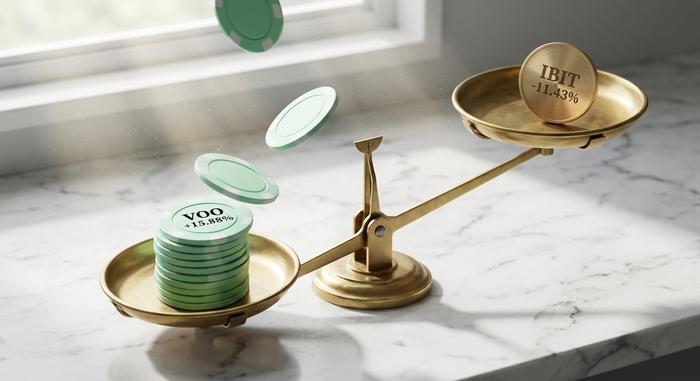
Anyone framing the VOO vs Bitcoin ETF comparison as "which has done better" is asking a dishonest question, because the answer depends entirely on the window you pick. Through the first five months of 2026, VOO returned roughly 15.88%. IBIT returned negative 11.43%. If the cherry-picker rewinds to January 2024, IBIT has roughly doubled, and VOO has gained around 50%. Bitcoin won the decade. The S&P won the year. A portfolio held by a real person has to live through both.
Volatility is where the two diverge most cleanly. VOO's realized annualized volatility sits around 15%. Bitcoin's, depending on the window, runs between 50% and 60%. That gap shows up in the worst-case numbers. VOO's deepest recent drawdown was 34% during COVID, recovered in less than five months. Bitcoin's deepest historical drawdown is closer to 80%, and even the relatively mild Q1 2026 episode saw spot prices fall 25% in roughly ten weeks.
Correlation is the metric the marketing decks tend to skip. For years, Bitcoin was sold as a low-correlation diversifier, and the long-run daily correlation to the S&P 500 since 2014 has been a modest 0.20. The recent picture is different. The 30-day rolling correlation peaked at 0.74 in March 2026, with intraday r² hitting 0.94 in certain windows. On a rolling basis over the last 5 years, the relationship has climbed every cycle. CME Group's 2025 research framed the shift bluntly: post-ETF approval, Bitcoin trades increasingly as a risk-on macro asset, not an uncorrelated alternative. Any chart of historical performance against the Nasdaq makes the point: the 1-year correlation between the two assets now sits stubbornly above 0.5. Past performance has not guaranteed future results, as the past year confirms.
| Metric | VOO | IBIT | FBTC | bCSPX |
|---|---|---|---|---|
| AUM (May 2026) | ~$1.60T | ~$66.9B | ~$12.7B | ~$5M |
| Expense ratio | 0.03% | 0.25% | 0.25% | 0.20% |
| 5Y CAGR | 13.92% | n/a (BTC ~+200%) | n/a | n/a |
| Annualized vol | ~15% | ~50-60% | ~50-60% | ~15% (CSPX) |
| Max drawdown | -33.99% (2020) | BTC -25% (Q1 2026) | same | tracks CSPX |
| Custodian | State Street | Coinbase Custody | Fidelity Digital Assets | Swiss bank |
| Structure | '40 Act open-end | '33 Act grantor trust | '33 Act grantor trust | Swiss DLT cert |
The Sharpe ratios sit roughly where intuition would put them. VOO's trailing twelve-month Sharpe is around 1.07. Bitcoin's peaked at 2.42 in mid-2025, then collapsed to negative by January 2026.
Tokenized S&P 500: Stock Market Exposure On-Chain
The third option almost nobody is writing about is a Swiss-issued token that holds the iShares Core S&P 500 UCITS ETF (ticker CSPX) in a bank vault in Zurich and lets the token trade on Uniswap at three a.m. on a Sunday. Backed Finance's bCSPX is licensed by S&P Global, deployed as an ERC-20 on Ethereum, Avalanche, Base, Gnosis Chain, and BNB Smart Chain, with Chainlink CCIP handling cross-chain transfers. The wrapper is a Swiss DLT Act tracker certificate: a bankruptcy-remote book-entry security under Swiss law, one-to-one collateralized by the underlying CSPX shares.
AUM is, frankly, tiny. About $5 million at last count. But the broader tokenized real-world-asset segment is no longer marginal. BlackRock's BUIDL fund, tokenized by Securitize, holds roughly $1.7 to $2.3 billion and is now accepted as collateral on Binance. Franklin Templeton's BENJI (FOBXX), the first US-registered mutual fund to use a public blockchain as its system of record, passed $1.98 billion in April 2026, with cumulative peer-to-peer volume above $211 million since retail P2P opened. Ondo's OUSG holds around $692 million in tokenized short-term Treasuries, and Ondo Global Markets announced tokenized US stocks and ETFs on Solana in early 2026.
The total tokenized RWA market sits at roughly $20 billion under the narrow definition, $36 to $50 billion when private credit and commodities are included. Citi and BCG project $16 trillion by 2030 in the bull case. Whether that forecast lands or not, the structural feature these wrappers offer is real. Tokenized S&P exposure settles 24/7. Conventional ETFs do not. Weekend macro news that moves European or Asian markets is, at the moment, only tradeable through tokenized proxies. Spreads are wide because liquidity is thin, but the rail exists.
The catch for US investors is meaningful. Most tokenized equity products are restricted to non-US persons under Regulation S, with KYC required at primary issuance under Swiss FinSA or EU MiFID. Secondary trading on a decentralized exchange is technically permissionless, but doing so as a US resident sits in an unsettled tax and legal posture.
Custody and Legal Wrappers: How These Funds Compare
The instinct to treat the VOO vs Bitcoin ETF choice, or its tokenized cousin, as "the same exposure, just packaged differently" is what gets investors hurt in the rare cases where things break. The wrappers are not equivalent.
VOO is a '40 Act open-end fund. State Street holds the underlying basket. Shareholders have the standard set of fund-board fiduciary protections, diversification rules, and a creation-redemption mechanism distributed across dozens of authorized participants. SIPC does not insure ETF holdings directly, but the brokerage account where shares sit is covered for the usual $500,000.
IBIT and FBTC are '33 Act grantor trusts. They are technically commodity-based ETPs, not investment companies, and the legal protections that come with the '40 Act simply do not apply. The trust holds bitcoin; you hold shares of the trust. IBIT delegates 100% of bitcoin custody to Coinbase Custody Trust, a real concentration risk that few comparison articles acknowledge. FBTC's choice to self-custody via Fidelity Digital Assets is, by most institutional reckonings, the structural advantage that does not yet show in the AUM numbers.
| Vehicle | Wrapper | Custodian | Key recourse |
|---|---|---|---|
| VOO | '40 Act open-end ETF | State Street | Fund board fiduciary duties |
| IBIT | '33 Act grantor trust | Coinbase Custody | Trustee only; no diversification rules |
| FBTC | '33 Act grantor trust | Fidelity Digital Assets | Same as IBIT, single custodian under one roof |
| bCSPX | Swiss DLT-Act certificate | Swiss bank | Bankruptcy-remote book-entry; smart-contract risk on top |
| BUIDL | Reg D fund | Bank of New York Mellon | Qualified purchasers only |
BlackRock's BUIDL is structured as a Regulation D fund restricted to qualified purchasers, broadly the $5 million-and-up institutional tier. The token is on-chain, but the protections are weaker than what an IBIT retail shareholder gets, a counterintuitive result that reflects how Reg D is built.
Building a Three-ETF Portfolio: Strategy and Comparison
Most retail investors do not need exposure to all three vehicles. A working three-layer model exists for U.S. investors weighing investment decisions across the three, and it has practical wrinkles the basic asset-allocation literature has not caught up with.
A common practitioner investment approach is something like 85 to 90 percent VOO (or VTI, which is broader), 3 to 5 percent IBIT or FBTC for the regulated Bitcoin sleeve, and zero to 2 percent in tokenized exposure for investors who can legally access it. DCA strategies work well for the Bitcoin slice because volatility punishes lump-sum entries. The S&P slice can go either way; the statistics on lump-sum versus DCA at the index level are roughly a wash. A comparison tool like portfoliovisualizer.com answers most allocation questions fast. The diversification benefit of holding two assets with imperfect correlation has been the central retirement-planning argument for a small crypto sleeve, even after the recent upshift. That broader trend toward mainstream crypto allocation is what surfaced this debate.
The funding mechanics get awkward at the edges. Moving fiat into the crypto leg of a portfolio is straightforward through Coinbase, Kraken, or a Bitcoin ETF in a regular brokerage account. Moving the other direction, out of a self-custodied crypto position into bank-rail dollars or euros, is where merchants and platforms increasingly use gateways like Plisio to handle USDT-to-fiat settlement without burning a centralized exchange. That is a niche concern for most VOO-and-chill investors, but a real one for anyone running on-chain positions alongside a traditional brokerage account.
Tax-wise, VOO and IBIT both fall under standard long-term capital gains treatment. Tokenized offshore products may trigger PFIC reporting (Form 8621), which is a footnote most US holders should clear with tax counsel before buying.
Risks and Regulation: What 2026 Changed for ETFs
The regulatory machine moved meaningfully in 2025 and 2026, but it moved sideways, not toward full integration. In December 2025, the SEC's Division of Trading and Markets issued a no-action letter to DTC permitting a tokenization-services pilot on approved permissionless blockchains, with a three-year sunset. A month later, on January 28, 2026, a joint Corp Fin / Investment Management / Trading and Markets staff statement laid out the agency's emerging taxonomy for tokenized securities. The EU's MiCA framework took full effect December 30, 2024, but tokenized equity sits outside MiCA; it falls under MiFID II and the DLT Pilot Regime. FINRA's 2025 Annual Regulatory Oversight Report devoted a dedicated "Member Firms' Nexus to Crypto" section, signaling examination focus through 2026.
Bottom Line: Picking the Right ETF Wrapper for You
Not "the future is bright." The future is forked. VOO will keep collecting another trillion because compound math does not care about narratives. Bitcoin ETFs will keep collecting money because Wall Street figured out how to charge a fee on something it does not control. Tokenized S&P 500 is the wild card: small, legally awkward, and the only vehicle that lets you trade the index on a Sunday afternoon. Pick the wrapper that matches the bet you are actually making, not the one with the most marketing behind it. The VOO vs Bitcoin ETF question is really about which legal stack you trust.