What Is Hedera Hashgraph? HBAR and Distributed Ledger Explained

Forget blocks. Forget miners burning electricity to win the right to add the next one. Hedera throws all of that out and runs on a hashgraph instead, a completely different way for thousands of computers to agree on what happened and in what order. It is quick, too; a payment settles in the time it takes to read this paragraph. Three names get tangled up here, so pin them down now. Hedera is the network. Hashgraph is the consensus method under it. HBAR is the coin that pays the bills. From there, this piece digs into how that consensus really works, where Hedera Hashgraph beats a blockchain, where the marketing gets ahead of reality, and whether HBAR is worth holding.
What Is Hedera Hashgraph? The Basics of HBAR
Strip away the jargon and Hedera is a shared record of transactions that no single company owns. That makes it a public distributed ledger, a form of distributed ledger technology (DLT). The goal is the same one Bitcoin and Ethereum chase, letting strangers move value without a bank sitting in the middle. What is different sits entirely under the hood, in how the network decides whose transaction came first.
Hedera, hashgraph, and HBAR are three different things
Mixing these three up is the single most common mistake newcomers make. So, briefly: the hashgraph is the algorithm, a recipe for ordering events. Hedera is the live public network that actually runs that recipe. HBAR is the native cryptocurrency you spend on fees and stake to help secure the network. You could study hashgraph as pure computer science and never say the word Hedera. In the real world, though, Hedera is the one network running it at any serious scale.
Who built it
A computer scientist named Leemon Baird worked out the hashgraph math, then teamed up with Mance Harmon to commercialize it through their company Swirlds back in 2016. Hedera came later, as the public network built on top of that work. One number is worth tattooing on your brain: HBAR has a hard cap of 50 billion coins, fixed from day one, no exceptions. The network also handles smart contracts and a separate service for timestamping data. Hold onto that 50 billion figure, because it decides the answer when people ask whether HBAR can ever hit a dollar.
What you can build on it
Hedera does more than move money. It offers three main services. The Hedera Token Service lets anyone create their own fungible and non-fungible tokens without writing a smart contract. The Consensus Service provides a tamper-proof, ordered log that decentralized applications use for audit trails and messaging. And for developers who want full programmability, Hedera runs smart contracts compatible with the Ethereum Virtual Machine (EVM), so existing Solidity code can be ported over with little change. That mix is aimed squarely at businesses rather than hobbyists.
How Hashgraph Consensus Actually Works
Almost every explainer drops the phrases "gossip about gossip" and "asynchronous Byzantine Fault Tolerance" and then moves on without explaining either. They are not as complicated as they sound.
Gossip about gossip
Imagine an office where news spreads by people telling each other. In a normal network, you would tell two coworkers a piece of news. In hashgraph, you tell them the news and also who told you, and who told them, and when. Each node randomly shares everything it knows with another node, including the full history of who shared what. This is the gossip about gossip. Very quickly, every computer ends up holding the same detailed map of how information spread across the whole network.
Virtual voting and aBFT
Here is the clever part. Once every node has that shared map, they do not need to send votes back and forth to agree on the order of transactions. Each one can look at the map and calculate how everyone else would vote, because they all see the same history. They run the vote in their own memory. Nodes reach agreement without the heavy back-and-forth messaging that slows older systems down. This gives hashgraph asynchronous Byzantine Fault Tolerance, or aBFT, the strongest known security category. It means the network stays correct even if up to a third of the nodes are dishonest or messages are delayed, without assuming the internet behaves nicely.
Why it is a graph, not a chain
A blockchain bundles transactions into blocks and links them in a single line. A hashgraph does not. Each event records two parents, the last thing the node saw from itself and from whoever gossiped to it, forming a directed acyclic graph that branches and weaves instead of marching in one line. There are no blocks to fill, no leader to pick, and no wasted "orphan" blocks from two miners finding a solution at once. The math behind this is laid out in Leemon Baird's 2016 Swirlds hashgraph paper, the original source for the consensus algorithm.
One underrated result of this design is fair ordering. On many blockchains the validator who builds a block can reorder or insert transactions to profit, a practice known as maximal extractable value, or MEV. Because hashgraph timestamps each transaction by the median time that nodes first saw it, no single party gets to pick the order. For uses like trading and auctions, that fairness is a concrete advantage rather than a slogan.
Hashgraph vs. Blockchain: An Honest Comparison
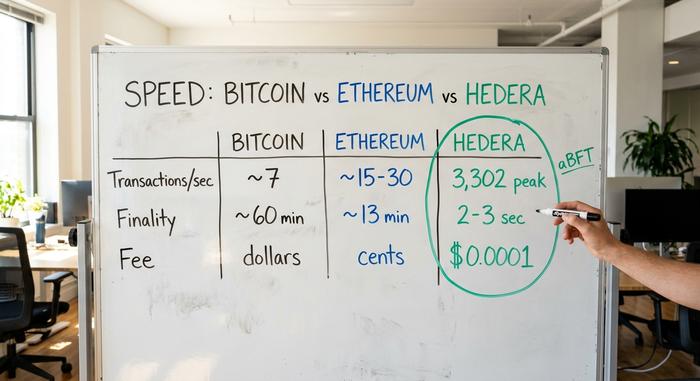
On paper, hashgraph is faster and cheaper. The honest version of Hedera Hashgraph performance separates what the network is marketed to do from what it has actually been measured doing. Hedera advertises more than 10,000 transactions per second, but that is a theoretical ceiling under ideal settings. The highest throughput observed on the live network is closer to 3,302 transactions per second, according to performance tracker Chainspect as of June 2026, and on a quiet day actual load is a tiny fraction of that. Even the measured figure dwarfs Bitcoin, Ethereum, and most other cryptocurrencies.
| Metric | Bitcoin | Ethereum | Hedera Hashgraph |
|---|---|---|---|
| Throughput (real) | ~7 TPS | ~15-30 TPS | 3,302 TPS peak (10,000 claimed) |
| Time to finality | ~60 min | ~13 min | 2-3 seconds |
| Typical fee | dollars | cents to dollars | $0.0001 |
| Data structure | Chain of blocks | Chain of blocks | Directed acyclic graph |
| Consensus | Proof of work | Proof of stake | Hashgraph aBFT |
The standout is finality, the moment a transaction is truly settled and cannot be reversed. Hedera reaches it in two to three seconds, while Bitcoin asks you to wait for confirmations that can take an hour. That speed, plus a fixed fee of a hundredth of a cent, is the real pitch.
There is a catch worth naming. Part of why hashgraph settles so fast is that its consensus nodes are known and limited, which makes coordination easier than herding thousands of anonymous miners. Speed and a small, identified node set are linked, not independent. That is the same design choice that fuels the centralization debate further down this guide.
The HBAR Token: Tokenomics and Price
HBAR does two jobs. It pays the network's tiny transaction fees, and holders can stake it to help secure the network. That sounds healthy until you notice a tension. If every transaction costs a hundredth of a cent, even heavy usage barely creates demand for the digital asset. The link between the network being busy and HBAR being valuable is weaker than fans admit, and it is the part of the story I find hardest to square.
| HBAR stat | Value (as of June 2026) |
|---|---|
| Price | ~$0.085 |
| Market capitalization | ~$3.7 billion |
| Market rank | around #24 |
| Circulating supply | 43.37 billion |
| Maximum supply | 50 billion (fixed) |
| Main uses | network fees, staking |
Those figures come from CoinMarketCap, as of June 2026. With roughly 43 of the 50 billion coins already circulating, there is no large hidden inflation ahead, which some investors like. Whether the price goes anywhere depends far more on adoption than on the token mechanics themselves.
Staking is worth understanding here. When you stake HBAR you are not locking it away; you point it at a node to add weight behind honest validation, and you can earn modest rewards while keeping the coins liquid. It is lower-risk than staking on many networks, but the rewards are correspondingly small.
The Hedera Council and the 2024 Hiero Move
Here is where Hedera is genuinely unusual, and where the honest criticism lives. Most public networks are secured by thousands of anonymous validators. Hedera Hashgraph takes a different path: it is a permissioned public network, run by a council of named corporations rather than an open validator market. That deliberate choice shapes everything from governance to who gets a seat at the table.
Who actually runs Hedera
So who actually runs the thing? A council. The Hedera Governing Council holds up to 39 seats and sits at roughly 31 members today, a roster that reads like a Fortune 500 guest list: Google, IBM, Boeing, Deutsche Telekom, FedEx, McLaren. Each member is capped at two three-year terms, and none of them can steer the network alone. Fans call this enterprise-grade stability, the kind of setup where no founder vanishes overnight with the treasury. Skeptics call it centralization in a nicer suit, since a small club of corporations still writes the rules. Honestly, both are right. Which one bothers you comes down to what you believe a public network is supposed to be.
The Hiero move to the Linux Foundation
In 2024 the decentralization story actually moved. On September 16, Hedera handed its core network software to the Linux Foundation under the open-source Apache 2.0 license and rebranded it Hiero, per the Hedera Governing Council, a transfer detailed by Linux Foundation Decentralized Trust. The node software now lives in neutral, community-governed hands, which is a genuine improvement. But read the small print. Swirlds still owns the underlying hashgraph patents, so "open source" here means the code anyone can run, not a wide-open, permissionless validator set. Call it real progress toward decentralization, not the finish line.

The Hedera Ecosystem: Real-World Adoption
Skip the generic "supply chains and NFTs" list every article recites and look at what is actually deployed. Hedera leans hard into enterprise tokenization, the practice of putting real-world assets on a ledger. There are stablecoin and central-bank pilots, including AUDD, an Australian-dollar stablecoin issued on the network. In decentralized finance, the exchange SaucerSwap accounts for roughly two-thirds of activity. Carbon-credit projects such as DOVU use it, and large institutions including Lloyds Banking Group have run foreign-exchange pilots on it. Across its life the network has processed more than 71 billion transactions, which is a serious number. Much of that volume is not payments at all but Consensus Service messages, used for supply-chain provenance and verifiable audit logs, where a cheap, ordered, tamper-proof record is the whole point. Carbon-registry and enterprise-data projects lean on exactly this. It is a less glamorous use than DeFi, but it plays to Hedera's strengths better than chasing trading volume does.
The honest counterweight is that decentralized finance on Hedera is still small. Total value locked, the money sitting in its DeFi apps, peaked around $113 million in 2025 and sat lower than that by year end. For a network with Fortune 500 backers, that is modest, and it shows the gap between enterprise pilots and live, money-moving usage.
Risks and Criticisms of Hedera Hashgraph
The bear case is short and worth hearing. The council puts a handful of corporations in the gatekeeper seat, which sits awkwardly next to the word decentralized; the Hiero move softens that, it does not erase it. The token has a built-in weakness, because fees this tiny mean a busy network barely tugs on HBAR demand. DeFi activity is still thin. And the competition is brutal. Solana, Avalanche, and newer chains like Sui and Aptos all pitch similar speed, and most of them have bigger developer crowds. None of this makes the technology bad. It just means the investment case rests on faith in enterprise adoption rather than on-chain numbers you can point at today.
Is Hedera Hashgraph Worth Watching in 2026?
The technology is the real thing. Hashgraph is a genuinely different approach to consensus, and the speed and fixed micro-fees are not marketing fiction. What remains unproven is the bridge from impressive engineering to a token people need. Enterprise pilots are plentiful; deep, daily usage that pulls value into HBAR is not, at least not yet. So the question to sit with is simple: do you think the Hedera Hashgraph model — named-corporation governance and a slow march toward openness — will win the trust that turns pilots into permanent infrastructure? Your answer to that is really your answer on HBAR.