Cryptocurrency with Lowest Transaction Fees: 2026 Guide

Try this experiment. Open your wallet and send $50 in Bitcoin. You will pay somewhere around $0.44 in fees as of April 2026. Now send that same $50 in Nano. The fee is zero. Literally $0.00. Send it on Stellar and you pay $0.000004. Four ten-thousandths of a cent.
Why the gap? Because every blockchain has its own rules about what it costs to move money. Some charge you per byte of data. Others charge per unit of computation. A few charge nothing at all. And when networks get congested, like Bitcoin during the April 2026 halving when fees hit $128.45, those costs can spike by orders of magnitude overnight.
This is the guide to finding which cryptocurrency with lowest transaction fees actually earns that title in 2026. We cover every major chain, break down how the fee structure works under the hood, and show you how to stop overpaying when you trade on a crypto exchange or send token transfers from wallet to another.
Understanding Crypto Transaction Fee Structure
No two blockchains charge you the same way. That trips people up. You really need to grasp three different models before any fee comparison makes sense.
Model one: the auction. Bitcoin does this. Your fee is denominated in satoshis per virtual byte. Each sat equals 0.00000001 BTC. The more complex your transaction (more inputs, more outputs), the more bytes it takes, the more you pay. You set the rate yourself. Low bid? Maybe your transaction sits in the mempool for six hours. High bid? Confirmed in the next block. On a slow Tuesday in April 2026 you might pay $0.44. During the halving a week earlier, people paid $128.45. Supply and demand, pure and simple.
Model two: gas metering. Ethereum does this. Each computational step costs gas units. A basic send: 21,000 units. A complex DeFi swap: maybe 200,000. The price per unit is set in gwei (0.000000001 ETH) and fluctuates with congestion. After EIP-1559, the base fee portion gets burned and a priority tip goes to stakers who prioritize their transactions. When nobody is using the network, gas costs are fractions of a penny. When a popular NFT drops, you can watch gas spike in real-time.
Model three: flat or zero. Solana charges 5,000 lamports per transaction, around $0.00025, no matter what you do. Stellar charges 0.00001 XLM per operation. Nano charges nothing because its block-lattice design has no miners or validators to pay at all. TRON uses a bandwidth and energy system where you stake TRX for free daily transactions. Hedera pegs fees to USD at $0.0001 per transaction, so you always know the cost upfront regardless of token price swings.
The consensus mechanism underneath explains most of the gap. Proof-of-Work chains (BTC, LTC) burn real electricity, and someone pays for it. PoS chains (ETH, SOL, ADA) run on staked capital instead of kilowatts, which costs less.
| Fee model | Used by | How it works |
|---|---|---|
| Satoshis per byte | Bitcoin, Litecoin | Fee scales with transaction data size |
| Gas units x gas price | Ethereum, Polygon, Avalanche | Fee scales with computational complexity |
| Flat fee per transaction | Solana, Stellar, Ripple | Fixed cost regardless of complexity |
| Zero fee | Nano, IOTA | No transaction fee by design |
| Bandwidth/energy model | TRON | Stake TRX for free transactions |
Why Bitcoin and Ethereum Network Fees Stay High
Bitcoin and Ethereum are the two largest cryptocurrencies by market cap, and both have historically struggled with high transaction fees. Understanding why helps explain the appeal of lower fee alternatives.
BTC can process seven transactions per second on a good day. Three on a bad one. One block every ten minutes, 4 MB max. When demand exceeds that, you get a bidding war. Halving day April 2024: $128.45 average fee. Everyone was minting Runes. Nobody could get a transaction through without paying a premium that would make a bank wire look cheap.
Fast forward to April 2026 and the situation could not be more different. BTC average fee: $0.44. March 2026 saw miner fee revenue drop to a 30-day average of 2.5 BTC per day, which ycharts flagged as a 13-year low. The chain is quiet. Almost eerily so.
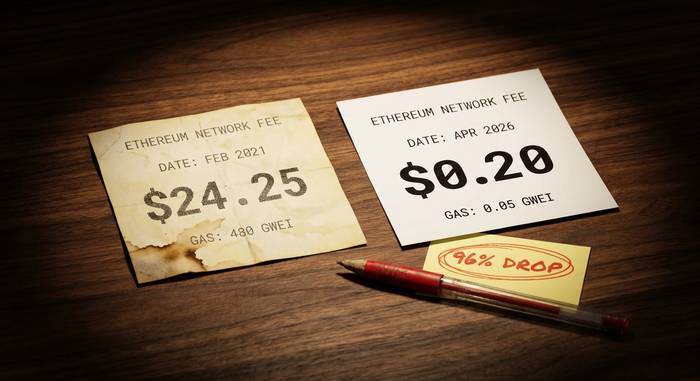
ETH has changed even more. I pulled the numbers and they still surprise me. February 2021: $24.25 average transaction. February 2026: about $0.20. That is a 96% drop. Gas is at 0.05 gwei, when it peaked at 480 gwei back in September 2020. What changed? Layers 2s absorbed the traffic. They now carry 95% of all Ethereum transactions. The Dencun upgrade in March 2024 introduced blob data, and overnight the cost of posting to L1 from Base, Arbitrum, and Optimism collapsed. Network congestion on ETH mainnet in April 2026 is at 0.12%.
So why were fees ever high? Limited throughput plus heavy demand. That is really all it is. BTC has 4 MB blocks and 10-minute intervals. ETH had 15 TPS before L2s. When those pipes filled up, higher fees were the inevitable result. The chains in the next section solved the problem by building wider pipes, running cheaper consensus, or removing fees entirely.
For context, here is what you would pay today for a simple transfer on each network:
| Network | Avg transfer fee (Apr 2026) | Confirmation time | TPS |
|---|---|---|---|
| Bitcoin (mainnet) | $0.44 | 10-60 min | ~3-7 |
| Ethereum (mainnet) | $0.16-0.22 | 12-15 sec | ~15-25 |
| Bitcoin Lightning | ~$0.001 | Near-instant | ~1M+ |
| Ethereum L2 (Base) | < $0.01 | 2 sec | ~112 |
Ethereum fees by year tell the story of a network that has gotten radically cheaper:
| Year (February avg) | Ethereum avg tx fee |
|---|---|
| 2021 | $24.25 |
| 2023 | $2-4 |
| 2025 | $0.76 |
| 2026 | ~$0.20 |
Cryptocurrencies with the Lowest Fees in 2026
Now the actual list. Every chain below costs a fraction of a cent to use, or nothing at all.
Nano. Zero. $0.00. I keep saying "zero" and people think I mean "rounds down to zero." No. The protocol has no fee mechanism. You send XNO, the recipient gets exactly what you sent. Confirmation takes under one second. Nano runs a block-lattice design where each wallet has its own chain, confirmed by delegated voting. The cost of this simplicity: no smart contracts, no DeFi, and a 2021 spam attack that clogged the network for weeks. You trade ecosystem for speed and zero cost.
IOTA also runs feeless, using a DAG called the Tangle. Your transaction validates two previous ones. Built for IoT micropayments. Interesting tech, small ecosystem.
XLM on Stellar costs $0.000004 per transaction. Four millionths of a cent. Practically indistinguishable from zero, but technically not. MoneyGram uses Stellar. Franklin Templeton tokenized a money market fund on it. Several central banks are testing CBDCs on the network. For cross-border money movement, Stellar hits a sweet spot: near-zero fees, 3-5 second finality, and institutional adoption that most low-fee chains lack.
XRP (Ripple) charges about $0.0002. The fee gets burned, which is unusual. 1,500 TPS, finality under 4 seconds. The partial SEC court win gave Ripple legitimacy it had been fighting years for.
Algorand runs a flat 0.001 ALGO per transaction (roughly $0.0002). It does smart contracts, DeFi, tokenized assets. 1,200 TPS with near-instant finality. Think of it as the low-fee chain that can do everything Ethereum can, just with far fewer users.
Solana. About $0.00025 per transaction at the base fee level. Actual throughput around 4,000 TPS with a theoretical max over 65,000. Full DeFi, NFT, and gaming stack. The knock on Solana is reliability: multiple outages between 2022 and 2024 raised real questions. Those have gotten less frequent, but the reputation lingers.
TRON runs on bandwidth and energy rather than direct fees. Stake TRX and basic transfers are free (1,500 bandwidth points daily). Without staking, a transfer costs about $0.001. The real TRON story is USDT. The network handles 67% of all Tether transfers globally, roughly $20 billion every day. In August 2025, Proposal #104 cut energy costs 60%, dropping a USDT send from $2.47 to about $0.72.
AVAX (Avalanche) costs $0.003-0.02 depending on the sub-chain. X-Chain has a flat fee. C-Chain (EVM-compatible, where most DeFi sits) works like a cheaper version of Ethereum. High throughput, near-instant finality.
Cardano sits at $0.15-0.30 per transaction. More expensive than everything above, but still cheaper than like Bitcoin or ETH mainnet. The Ouroboros protocol is peer-reviewed and deliberately slow to change. Cardano fans consider that a feature.
| Cryptocurrency | Avg fee | Confirmation | Smart contracts | Best for |
|---|---|---|---|---|
| Nano (XNO) | $0.00 | < 1 sec | No | Micropayments, P2P |
| IOTA | $0.00 | Seconds | Limited | IoT, M2M payments |
| Stellar (XLM) | $0.000004 | 3-5 sec | Yes | Remittances, CBDC |
| Ripple (XRP) | $0.00003 | 3-4 sec | Limited | Institutional settlements |
| Algorand (ALGO) | $0.0002 | ~4 sec | Yes | DeFi, tokenization |
| Solana (SOL) | $0.00025 | ~0.4 sec | Yes | DeFi, NFTs, gaming |
| TRON (TRX) | Near $0 | ~3 sec | Yes | USDT transfers |
| Cardano (ADA) | $0.15-0.30 | 20 sec | Yes | Peer-reviewed DeFi |
Low-Fee Blockchains and Layer 2s: Polygon, BTC, ETH
You do not have to leave Bitcoin or Ethereum behind just because their base layers cost more. L2 networks do the heavy lifting off-chain, then post a summary back to the main chain. You get mainnet security at a fraction of the cost.
The lightning network is how BTC gets cheap. Open a payment channel (one on-chain tx), then route as many payments as you want for near-zero fees. Strike and El Salvador's Chivo wallet run daily BTC payments through Lightning. Median routing fee: about 0.0029% of the transfer amount. For $100, that is less than a third of a penny.
Ethereum L2s got radically cheap after the Dencun upgrade. Base (built by Coinbase) does swaps for about $0.001. Arbitrum and Optimism sit at $0.008-0.012. zkSync Era runs $0.05-0.20 but gives you ZK proof security guarantees. All of them are EVM-compatible, so every smart contract and DeFi protocol that works on mainnet works on these too. That is the key: same ecosystem, 100x to 1000x lower fees.
Polygon is its own animal. Part sidechain, part L2 ecosystem. Transfers cost under a cent in POL (the token formerly known as MATIC). Nike, Starbucks, and Reddit have all built on Polygon. For users who want Ethereum compatibility without Ethereum prices, it is probably the most battle-tested option.
| Layer 2 / Sidechain | Avg fee | Parent chain | Technology |
|---|---|---|---|
| Lightning Network | ~$0.001 | Bitcoin | Payment channels |
| Base | ~$0.001 | Ethereum | Optimistic rollup |
| Arbitrum | ~$0.008 | Ethereum | Optimistic rollup |
| Optimism | ~$0.012 | Ethereum | Optimistic rollup |
| zkSync Era | $0.05-0.20 | Ethereum | ZK rollup |
| Polygon | < $0.01 | Ethereum | Sidechain + ZK |
Stablecoin transfers deserve special attention because they are the single biggest real-world use case for finding the cryptocurrency with lowest transaction fees. Sending $1,000 in USDT on Ethereum mainnet can cost $0.50 to $5.00 depending on congestion. The same transfer on Solana costs less than $0.01. On TRON it costs about $0.72. On Base it is under $0.01. USDC transfers show a similar pattern across blockchains. TRON alone processes roughly $20 billion in daily USDT transfers, according to TRON network data from May 2025. For remittances, where the World Bank estimates average fees at 6.2% of a $200 transfer, even TRON's $0.72 fee represents a massive saving. Stablecoins on low-fee chains have quietly become the cheapest way to move money internationally.
Crypto Exchange Fees vs Blockchain Network Fees
People confuse these all the time, so here is the split. When you buy and sell cryptocurrencies, you deal with two completely separate cost layers.
Network fees (blockchain network fees, gas fees, whatever you want to call them) go to the miners or validators who run the chain. They exist no matter where you trade. Use Coinbase, use MetaMask, use a decentralized exchange: you still pay the chain. These fees depend on congestion and how complex your transaction is.
Exchange fees are what the platform charges you. Trading fees (percentage of each buy or sell order), withdrawal fees (often inflated above the real network fee), deposit fees (credit cards typically cost 2.5-3.99%, bank transfers are sometimes free), and spread (the gap between buy and sell price, which is a hidden cost that can eat 2-3% without you noticing).
Here is a real example. You put $1,000 into crypto through Coinbase with a card. That costs roughly $54.80 in combined fees: 3.99% card fee + 1.49% trading fee. Same trade on Binance via bank transfer: $6-11 total. That is a 5x to 9x difference for moving the same amount of bitcoin.
MEXC has 0% maker fees on spot. Coinbase Advanced charges 0.40% maker, far less than standard Coinbase's 1.49%. DEX trading runs about 0.3% in trading fees, plus whatever the blockchain charges. On Solana or Base, that network piece is under a cent, which keeps total costs almost invisible.
The formula: deposit fee + trading fee + spread + withdrawal + network fee = your actual cost. Most people only look at the first two. The final amount, after all processing fees, is what matters for an accurate cost calculation.
How to Cut Your Crypto Fees and Save on Gas
These actually work. Not theory. Things you can do today.
Pick the right network. Sending USDT? Use TRON or Solana, not Ethereum mainnet. TRON costs $0.72 for a USDT transfer. Ethereum can cost $5. Same coin, same dollar value, ten times the fee for sending it on the wrong chain.
Time it. Ethereum gas costs drop on weekends and late at night US time. Check real-time prices on Etherscan before you hit send. Timing alone can cut gas costs in half.
Use Layer 2s. The lightning network for BTC, Base or Arbitrum for ETH. Moving $100 in ETH on Base: about $0.001. On mainnet: maybe $0.50. Same ETH. Different rails.
Batch your withdrawals. One $500 withdrawal costs the same network fee as one $50 withdrawal. Five $100 transfers cost five times the fee. Do the math.
Use limit orders. Maker fees (limit orders) are almost always lower than taker fees (market orders). On Binance, the difference is roughly 50%. On Coinbase Advanced, makers pay 0.40% versus 0.60% for takers.
Read the fine print. Some platforms advertise zero trading fees but inflate the exchange rate by 2-3%. Others mark up withdrawal fees by 10x the actual network cost. A transparent fee with no hidden charges beats a fake "free" offer every time. Always check what the final amount looks like after all processing fees before confirming.