OnlyFans Stock 2026: Why It Isn’t Publicly Traded
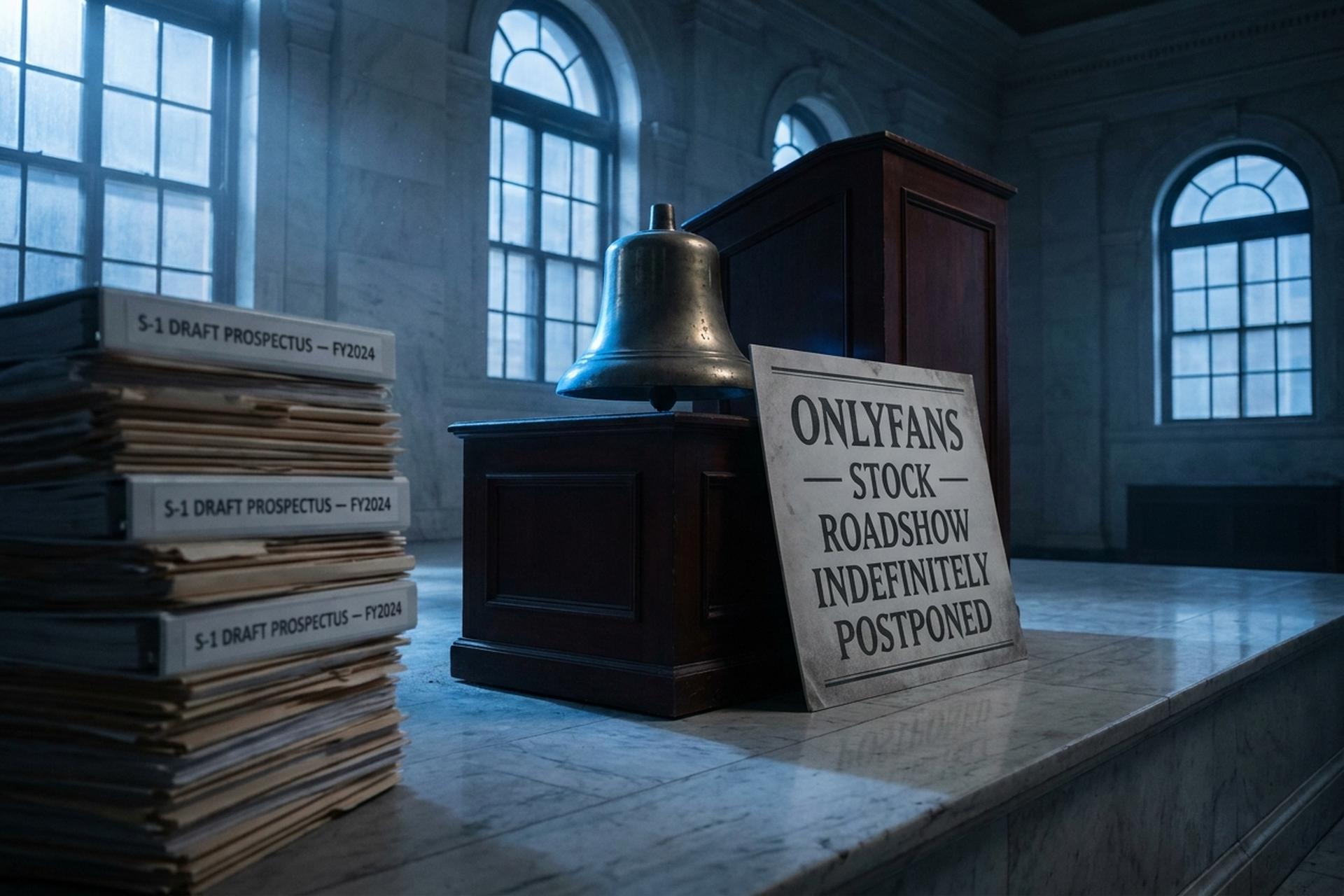
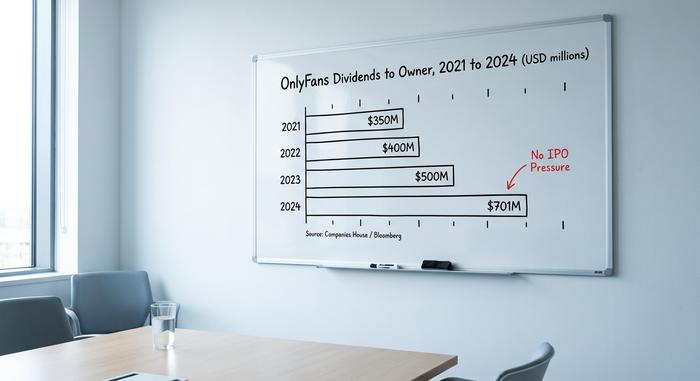
There is no OnlyFans stock, and the reason is not the one the headlines repeat. The cleanest explanation sits in a single line of Companies House filings: Leonid Radvinsky, who owns 75% of the platform through Fenix International Limited, paid himself a $701 million dividend out of fiscal-year 2024 earnings. Public shareholders would never tolerate that much cash leaving a business each year. Radvinsky has no commercial reason to give it up. Around that one fact, three structural blockers explain why OnlyFans remains privately held and stays one of the most profitable companies in the creator economy that nobody can buy into: owner extraction, payment-processor risk, and a stubborn investor stigma. The same blockers also explain why the creators on top of it are quietly moving their money onto crypto rails.
Can you buy OnlyFans stock today?
The short answer is no. OnlyFans has no ticker symbol on the major US stock markets, neither NYSE nor Nasdaq, and no listing on the London Stock Exchange either. There is no SPAC vehicle alive, no S-1 on file, and no broker-dealer offering the company as a tradable security. When PortfolioPilot's AI screener is asked for "OnlyFans stocks", it returns 5,527 unrelated tickers (Alphabet, Tesla, Dell among the top picks), because the actual company is not in the universe of publicly traded equities at all.
The only legitimate exposure runs through private-market platforms such as Forge Global, Hiive, and UpMarket, and that route is gated. US rules limit pre-IPO secondary trades to accredited investors, meaning a $1 million net worth excluding primary residence, or sustained income above $200,000. Even there, you cannot freely buy and sell OnlyFans shares the way you can a listed equity: minimums on UpMarket sit around $50,000, with no liquidity guarantee on exit. For most retail readers searching "buy OnlyFans stock", the answer ends here. The rest of this article explains why that is unlikely to change soon.
What OnlyFans actually is, briefly
OnlyFans is a subscription-based content platform founded in 2016 by Tim Stokely, who reportedly borrowed £10,000 from his father to launch it. In 2018, Stokely sold 75% of the parent company, Fenix International Limited, to Leonid Radvinsky, a Florida-based entrepreneur who has remained the controlling shareholder since. The platform keeps a 20% commission on creator earnings and pays out the rest. As of mid-2025, it hosted roughly four million creators and 220 million registered users, and employed around one thousand staff. Adult content remains the dominant category, although fitness, music, and cooking creators are growing in absolute terms.
OnlyFans revenue and valuation in 2026
The financials are the part that frustrates retail investors most. They are exactly the kind of numbers a market would normally reward with a listing. Fenix International's accounts filed with Companies House in August 2025 reported gross payments volume of $7.22 billion for the fiscal year ending November 2024, up 9% year-on-year. Creators received $5.80 billion of that, close to the platform's 80% revenue-share promise, leaving roughly $1.44 billion in net revenue and somewhere between $520 million and $683 million in pre-tax profit depending on which line you read. The business held $808 million in cash and carried no external debt.
| Fiscal year (end Nov) | GPV | Net revenue | Net profit | Creator payouts | Marker valuation |
|---|---|---|---|---|---|
| FY2022 | $5.55B | $1.10B | ~$650M | $4.43B | $18.0B (BBC est.) |
| FY2023 | $6.63B | $1.30B | ~$658M | $5.30B | ~$8.0B (Reuters sources) |
| FY2024 | $7.22B | $1.44B | $520M | $5.80B | $5.46B (UpMarket) / $5.5B (Architect proposal) |
What stands out, sitting beside an income statement like that, is why demand for OnlyFans stock, if it ever existed, would collide with a valuation that has drifted down even as the cash flows have grown. UpMarket's February 2026 estimate of $5.46 billion is lower than the $8 billion Reuters source-reported in May 2025, and well below the $18 billion the BBC cited in 2022. The market is not re-rating the business on its margins. It is re-rating it on the risk that the margins ever reach a public shareholder.
Why no OnlyFans IPO: three structural blockers
Most competitor write-ups stop at "the company says it isn't planning to go public". That is true, but it is the symptom, not the cause. Three concrete issues sit underneath that statement. Any analyst pricing OnlyFans as a hypothetical S-1 candidate has to work through all three.
The first is the dividend pattern. Bloomberg reported on August 22, 2025 that Radvinsky drew a $701 million dividend on the FY2024 results, the largest single-year payout on record, after roughly $1.1 billion in cumulative dividends across 2021–2023 according to Companies House. That cash extraction works because Radvinsky owns the equity outright. Inside a public company, the same pattern would face a shareholder revolt over capital allocation. Prospectus disclosure would frame those dividends as lost reinvestment: audits, compliance staffing, age-verification infrastructure, or international expansion. The owner's preferred yield, in effect, does not fit a public float.
The second is payment-processor exposure. Mastercard's April 2021 rules on adult-content merchants set the precedent. In October 2021, OnlyFans tried to ban explicit content and walked it back within a week after a creator backlash. That single episode showed how thin its negotiating room actually was. The OCC's preliminary debanking report from December 11, 2025 named nine US banks for cutting off adult-industry accounts. The list reads like the top of the US banking system: JPMorgan, Bank of America, Citi, Wells Fargo, PNC, TD, BMO, Capital One, and Truist. An S-1 risk-factor section would have to flag each one as a single point of failure. No underwriter wants to write that paragraph.
The third is investor stigma, which is harder to quantify and arguably the most binding. Previous funding rounds reportedly stalled. Institutional LPs declined the exposure on reputational grounds. CEO Keily Blair told Reuters in May 2024 that "an IPO is not on the company's roadmap"; the phrasing in subsequent interviews has not changed. A New York roadshow with adult-content disclosure has no real precedent. Playboy's 2021 SPAC, the closest comparable, traded at a fraction of its listing price within two years and was taken private again by 2024. Index funds bound by ESG screens would almost certainly exclude any OnlyFans listing on day one, narrowing the available demand pool before the bell even rings.
I am not convinced that any one of those blockers is permanent. Card-network policy could soften; the dividend pattern could be restructured ahead of a roadshow; ESG screening could evolve. But the three are correlated, not independent, and they tend to fail together rather than apart. That is the part the "OnlyFans IPO soon" speculation usually misses.
The private sale path: Forest Road and Architect Capital
A liquidity event for Radvinsky is plausible. A traditional IPO is not the most likely vehicle. Reuters reported on May 22, 2025 that a Forest Road-led investor group was in talks at roughly an $8 billion valuation. The deal cooled through summer 2025. The disagreements were on adult-content scope and earn-out structure. UpMarket's February 2026 commentary cited a separate Architect Capital proposal: 60% of the company at $5.5 billion. The discount has widened, and the buyer pool has shifted away from media-adjacent funds. The new bidders are specialised credit and structured-equity shops that live with payment-rail risk every day.
For retail, a private sale would matter only briefly. Secondary trading on UpMarket and Forge Global would likely open small windows around the close, but the shares stay illiquid in practice: minimums in the $25,000–$50,000 range, accredited gating intact, and only institutional investors clearing the full due-diligence packet. Anyone hoping a sale unlocks a public ticker should read it the other way around: the existence of a private path is part of why a public one keeps slipping further off the calendar.
If you can't buy OnlyFans, what can you buy?
Almost every "alternatives" list pushes the same five names. Most of those names do not actually track OnlyFans exposure; they track the broader subscription and creator-economy thesis, which is related but not identical. The honest version of the comparison is in the table below.
| Ticker | Market cap (May 2026) | Why it shows up in OF proxy lists | What it actually misses |
|---|---|---|---|
| META | ~$1.6T | Creator monetisation; Stripe-USDC payouts launched April 2026 | No adult-content revenue exposure |
| RDDT | ~$30.3B | Post-IPO creator gold and contributor revenue model | Heavily ad-funded, not subscription-led |
| BMBL | ~$1.5B | Subscription, female-led platform thesis | No content-creator economics |
| MTCH | ~$8.5B | Subscription dating, recurring revenue | Mature growth, not creator-driven |
| RBLX | ~$70B | Paid creators $923M in FY2024 | Gaming UGC, not adult content |
None of these is a substitute. They are partial overlaps on individual axes (subscription, creator payouts, network effects) that together approximate maybe a third of what OnlyFans actually is. Treating them as proxies is reasonable for diversified exposure to the creator economy. Treating them as a way to "buy OnlyFans indirectly" is not.
The payments crack: why creators are moving to crypto
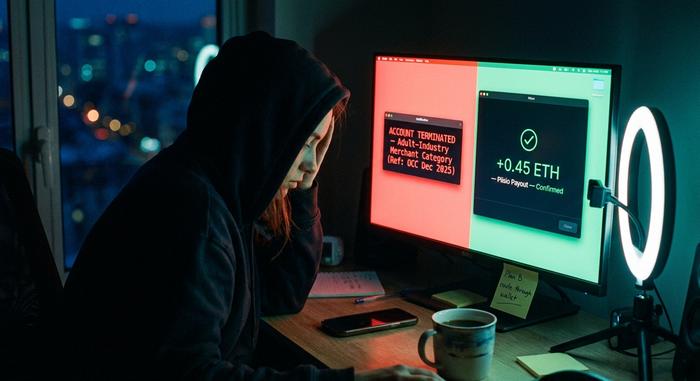
The same banking friction that keeps the equity private is reshaping how the platform's creators actually receive money, and that secondary effect is more investable than the primary one. The OCC's December 2025 report named card networks and the nine banks above as the immediate source of debanking. The American Bankers Association's January 2026 follow-up flagged the pattern as category-wide, not firm-specific. Mastercard and Visa retained their NSFW restrictions through 2025, with PinkNews reporting in August that policy reviews under shareholder pressure had stalled inside both networks' compliance committees.
Stablecoin rails became the practical workaround. Meta launched USDC creator payouts through Stripe on April 29, 2026, across Polygon and Solana, targeting more than 160 countries. That was the first time a hyperscaler treated stablecoins as production payment infrastructure rather than experiment. The signal was meaningful because it normalised a route that adult-platform creators had been quietly using for two years.
For OnlyFans creators specifically, the operational story is simpler. Cryptocurrency payment processors such as Plisio settle subscriptions and tips in BTC, ETH, USDT, and a dozen other assets. Funds go to the creator's preferred wallet, and the card networks are out of the loop. Settlement runs in minutes. A US bank can hold a flagged adult-industry payout for seven to fourteen days. Fees sit around 0.5%, with no chargebacks since on-chain transactions are final. The catch is the creator now sits on volatility exposure unless funds are routed straight into a stablecoin, which is why USDT-denominated flows have grown faster than BTC ones across the segment. OnlyFans itself has held an Ethereum treasury position since at least 2022, when Companies House filings first disclosed crypto holdings.
Risks even if OnlyFans stock ever trades
Suppose all three structural blockers softened and an S-1 actually printed. The risk-factor section would still run long. Radvinsky's 75% stake would create a permanent controlled-company designation, limiting governance protections. Card-network policy risk would remain disclosed at the top of the risks. Age-verification regulation has tightened sharply. 25 US states had enacted laws by early 2026 after the Supreme Court upheld Texas HB 1181 in 2025, the UK Online Safety Act levied a £1.05 million Ofcom fine on Fenix International in March 2025, and the EU Digital Services Act remains the active enforcement front. Any one of those lines is enough to compress a public multiple by a turn or two.
What the absent ticker actually tells you
The absence of OnlyFans stock from any exchange is not a gap waiting to be filled. It is information. It tells you which capital structures the US public market can absorb in 2026 and which it cannot, and which payment rails the legacy financial system is willing to underwrite versus which it has quietly placed off-limits. The question worth holding onto is not "when does OnlyFans IPO". The more useful one is whether the same structural blockers that close that door are opening a different one for the rails its creators actually use. A second question follows. The brokerages and trading platforms now listing pre-IPO private shares may eventually push that boundary further into retail hands. So far, they have not.