OnlyFans Leaks: Creator Protection, DMCA, and Crypto Fallback

In fiscal year 2024 (ended Nov 30, 2024), OnlyFans paid $5.80 billion to 4.634 million OnlyFans creators. Gross revenue was $7.22 billion. The creator base grew 13% year-on-year. By October 2025, CEO Keily Blair told Bloomberg that total payouts since onlyfans.com launched in 2016 had crossed $25 billion. Big numbers. The leaked onlyfans content ecosystem is the shadow side. Removing leaked onlyfans content is now its own industry.
This article is a defensive guide for content creators on OnlyFans (and adjacent platforms like Fansly). It does not name leak sites or link to scraper tools. It is not a tour of the underground. It walks through how leaks circulate. It maps the 2026 legal toolkit after the federal TAKE IT DOWN Act. It covers the takedown services and free hash databases creators rely on. It looks at the watermark feature options worth using. It maps the debanking problem that pushes adult content workers toward crypto rails. It ends with a practical protect-your-content checklist.
The framing throughout: no single tool stops leaks. Layered content protection cuts both the volume of unauthorized sharing and the reputational damage. The layers: copyright registration, watermarks, takedown services, hash databases, banking backup. That is what the rest of this guide covers.
Why OnlyFans leaks happen and what is actually circulating
Leaks reach the public through a known stack. Private Telegram channels, paid and free, package content by creator. Discord servers and invite-only forums host smaller bundles. Dedicated mirror sites sit on bulletproof hosting outside major Western jurisdictions. Cyberlockers and file hosts act as the warehouses behind those mirrors. Search-result spam and SEO-poisoned pages target high-traffic creator names. Torrent and pirate forums sit at the bottom of the stack. The anti-piracy service BranditScan markets coverage of "500+ known pirate domains," which is a reasonable directional density indicator.
The historic high-water mark is still the 2020 incident reported by BleepingComputer and BuzzFeed News. Roughly 1.6 terabytes. One bundle. One Google Drive folder contained material from 279 creators. Smaller dumps surface routinely, but the 2020 event remains the reference for how badly things can scale.
Less obvious, and worth understanding before going anywhere near a search-engine result for "OnlyFans leak," is the fake-leak scam ecosystem. These sites traffic in fake unreleased material and exclusive material that does not exist, often pretending to host exclusive OnlyFans bundles to lure clicks. Many sites that advertise free leaked content are not really hosting leaks at all. They are phishing pages, malware-delivery vehicles, or scareware funnels. Security firm eSentire documented 2024 campaigns delivering DcRAT through fake OnlyFans pages. HackRead reported on fake "OnlyFans checker" tools that infected the operator with the Lummac information stealer. Daily Security Review tracked fake-CAPTCHA campaigns built around adult-content lures. Identity theft is also routine. Scammers download Instagram or TikTok content from any creator, repackage it as a fake OnlyFans page, and resell access. Most people typing "OnlyFans leaks" into a search bar end up at one of these traps. From a defensive view, that is a useful fact about the ecosystem on its own. Once images and videos are shared on social media without your permission, regaining control takes months, not days. Sharing content without permission is also a copyright matter, not just a moral one.
The legal toolkit: DMCA, NCII laws, and the TAKE IT DOWN Act
US copyright law is automatic. An OnlyFans creator owns the copyright in their original content from the moment of creation. Registration is not required for protection. But it is required to claim statutory damages of up to $150,000 per work in an infringement lawsuit. Plus attorney's fees. Registering your intellectual property before posting (or within three months of first publication) is the single highest-leverage legal move a creator can make. The Copyright Act gives independent creators serious leverage when they document things properly.
The Digital Millennium Copyright Act is the workhorse takedown tool. A valid DMCA notice under 17 U.S.C. §512(c)(3) needs six elements. A physical or electronic signature. The copyrighted work named. The infringing material named, with enough detail "reasonably sufficient to locate" it (in practice, specific URLs on third party websites). The sender's contact info. A good-faith-belief statement that the use is unauthorized. And a statement under penalty of perjury that the information is accurate and the sender is authorized to act. Section 512(f) creates liability for knowing false claims in a takedown notice. That clause matters when bad-faith counter-notices appear. Filing DMCA takedown notices at scale is what creators end up doing routinely.
The legislative landscape has tightened considerably since 2018. The table below covers the milestones a creator needs to know.
| Date | Law | Scope |
|---|---|---|
| Apr 11, 2018 | FOSTA-SESTA | Section 230 carve-out for sex-trade content |
| Mar 2022 | VAWA Reauthorization 2022 | Federal civil cause of action for NCII victims |
| May 14, 2024 | EU Directive 2024/1385 | EU NCII, cyberstalking, deepfake harms |
| May 2025 | South Carolina NCII law | Brings US state coverage to 50/50 plus DC |
| May 19, 2025 | TAKE IT DOWN Act (US federal) | Criminalizes nonconsensual intimate imagery and AI deepfakes; 48-hour platform takedown |
| May 19, 2026 | TAKE IT DOWN Act platform compliance | Covered platforms must operate the 48-hour takedown system |
| Jun 14, 2027 | EU 2024/1385 transposition | Deadline for member states to implement |
The TAKE IT DOWN Act passed the House 409-2 and the Senate by unanimous consent. Its criminal provisions took effect immediately. Platform-takedown obligations come into force exactly one year after signing, on May 19, 2026. That window gives covered platforms a year to operationalize a 48-hour notice-and-removal system for intimate images. The policy framing of intimate-image abuse has also shifted. The academic and legal term is now Image-Based Sexual Abuse (IBSA) rather than "revenge porn." "Revenge" implies victim-blaming logic. The term excludes commercial leaks, hacked content, AI deepfakes, and pornography distributed without your permission. Many leaks also violate state revenge-porn statutes. For creators considering legal action, talking to a copyright legal team early matters. Cease and desist letters are routine pre-litigation tools. Defamation claims for false attribution are common too.
The takedown infrastructure: how it actually works
OnlyFans operates an in-house Trust & Safety team. It files DMCA notices on behalf of verified creators at no charge through the "Reporting Stolen Content" channel in support. The Lumen Database at lumendatabase.org logs more than 20,000 takedown notices per week from Google and other search engine partners. That is the infrastructure scale most creators are interacting with whether they realize it or not. Google Search Console provides a copyright removal flow that delists URLs from search results without removing the underlying content from origin servers. It is the right tool when a host will not cooperate.
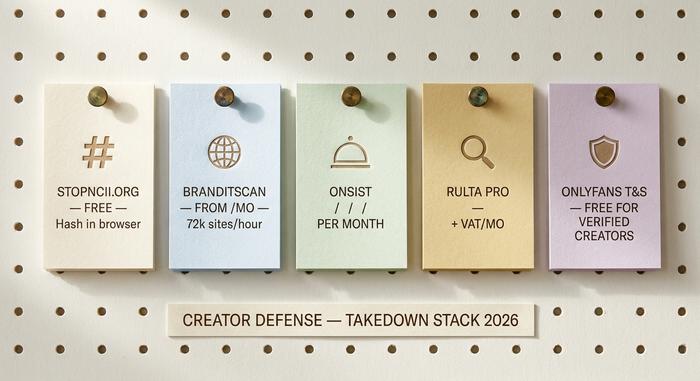
For volume, third-party services do most of the work. The pricing landscape in 2025-26 looks like this. A short tour.
| Service | Pricing | Notes |
|---|---|---|
| StopNCII.org | Free | Non-profit; hash generated in-browser; partners include Meta, TikTok, Reddit, Snap, Bumble, OnlyFans, Pornhub, Google |
| BranditScan | From $69/month | 72,000+ sites scanned hourly; AI face/image match; Google Trusted Copyright Removal Program partner |
| Onsist | $199 / $249 / $399 per month | Three tiers; covers search, social, cyberlockers, dark web; 20% annual discount |
| Rulta | $324 + VAT/month (Pro) | Manual takedowns + Telegram coverage |
| Takedowns AI | Variable | AI-first newer entrant |
| Ceartas, Privly, CopyrightShark | Variable | Mid-tier creator-focused |
| PhotoDNA | Free for qualifying platforms | Microsoft 2009; perceptual hash; not facial recognition; primarily CSAM use |
StopNCII.org is the single most important free option. It was built by SWGfL's Revenge Porn Helpline in the UK. It generates an image hash entirely in the user's browser. The original photo never leaves the device. The hash is shared with participating platforms, which then match it against their content stores. Subjects must be 18+ in the image (under-18 cases route through NCMEC's Take It Down service). PhotoDNA was built by Microsoft and Dartmouth in 2009. It is the main hash tech behind much of this work. It survives crop, resize, and color shifts. But it only matches known hashes. It does not detect new content.
Watermarking and prevention tech
Visible per-fan watermarks burn the fan's username or session ID into each image and video. A leaker can crop or blur them. But they work as a deterrent. They are first-line attribution evidence too. The honest pitch: visible marks raise the friction floor. They do not stop a motivated re-uploader. They will not stop someone who shares your content without permission.
Invisible or forensic watermarks embed a hidden payload. Typically a per-session, per-subscriber unique ID. The payload survives common transforms such as cropping and re-encoding at lower quality. It degrades against aggressive re-encoding, downscaling, and screen recording. But each surviving frame can identify the subscriber whose viewing session produced the leak. Vendors include Digimarc (which in July 2025 launched audio watermarking that detects clips as short as one second), MASV, DoveRunner, and Privly. Forensic watermarking is best treated as attribution evidence. The payload tells you whose viewing session produced the leak. That enables a subscriber ban. And, where statutory damages and registration line up, a lawsuit. It is rarely a prevention tool on its own.
OnlyFans offers a DRM setting in Privacy & Safety. It disables screen recording on supported devices when the creator turns it on. The setup is imperfect. Different OS and browser combos vary in how well they comply. But it is free and worth turning on. The defensible posture is layered. Visible watermark plus hidden forensic mark plus DRM plus subscriber due-diligence. Block bulk-buy patterns. Throttle PPV access for newly created accounts. These steps protect content creators against most of the casual unauthorized sharing that drives the bulk of leaked material.
The debanking problem and the crypto fallback
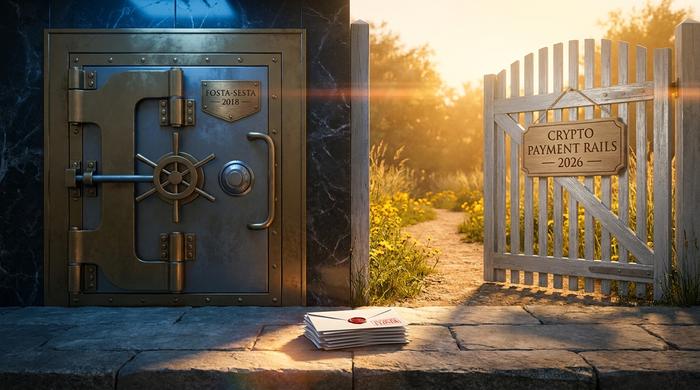
The financial-services side of the leak story is its less-publicized half. FOSTA-SESTA was signed on April 11, 2018. It amended Section 230. Platforms became liable for user content related to "promotion or facilitation of prostitution." Hacking//Hustling's research found a stark figure. Around 90% of sex workers whose accounts closed under post-FOSTA-SESTA pressure reported income decline. The Free Speech Coalition's surveys put the figure at 63% of adult-industry workers having lost a bank account because of their work. About half have been rejected for loans on the same grounds.
Card-network moves have repeatedly reshaped the industry. In December 2020, after a New York Times piece, Visa, Mastercard, and Discover blocked purchases on Pornhub. Pornhub responded by deleting roughly 10 million videos from non-verified uploaders. It pivoted toward crypto-only payments and payouts. The platform now supports more than thirteen cryptocurrencies, including Monero. On April 8, 2021, Mastercard announced new adult-content merchant standards. They took effect October 15, 2021. The rules required pre-publication content review, age and ID verification, banned-search-term enforcement, and a complaints process. On August 19, 2021, OnlyFans announced it would ban explicit content to comply. On August 25, six days later, it suspended the ban after creator and public backlash. Mastercard reaffirmed the standards in August 2022, and the underlying card-network risk has not gone away.
The 2023-2025 cycle added a new chapter. Operation Chokepoint 2.0. FOIA-released FDIC "pause" letters to banks went public. The House Financial Services Committee published a 50-page report on debanking in 2025. The Office of the Comptroller of the Currency issued preliminary findings in 2025. They confirmed that banks restricted some sectors based on "values," with adult entertainment among restricted categories. JPMorgan disclosed in 2025 that it was facing a federal probe over its debanking practices.
The practical effect is straightforward. For a working adult creator, bank access is unstable in a way it is not for almost any other line of work. Crypto payment gateways like Plisio give creators a banking-resistant payout and checkout option. Non-custodial, multi-asset (BTC, ETH, USDT, USDC, LTC, TRX, DOGE). Not subject to the same correspondent-banking fragility that has produced the closures documented above. Plisio is not a substitute for OnlyFans's own creator payouts. It is a tool for creators selling subscriptions or merchandise off-platform. Or for receiving fan payments outside of card-network channels.
A practical creator protection checklist
A pragmatic order of steps to protect your content and online reputation:
1. Register copyright on your most valuable original content before posting. Three months is the safe window. Earlier is better. That registration unlocks statutory damages later.
2. Watermark every piece. Visibly (subscriber username) and invisibly (forensic per-session payload).
3. Enable OnlyFans DRM in Privacy & Safety so screen-recording attempts are blocked on supported devices.
4. Subscriber due-diligence. Monitor for bulk-buy patterns. Throttle PPV access for fresh accounts. The economic incentive of most leakers is recouping the subscription cost by reselling access to digital content they did not create.
5. Document evidence. URLs, profile names, timestamps, screenshots. Build a paper trail before you need it.
6. Submit your hashes to StopNCII.org. It is free. The hash never leaves your device.
7. Subscribe to a takedown service if your scale needs it. BranditScan from $69/month is a sensible entry point. Onsist or Rulta for higher-volume creators with broader content removal needs.
8. Use OnlyFans's in-house DMCA team for the bulk of routine takedowns of online content. It is free.
9. Diversify payment rails. If banking access gets unstable, a crypto gateway like Plisio is a known industry fallback.
10. Look after the mental-health side. Sharing content without consent causes real emotional distress. There are dedicated digital rights help lines. The Cyber Civil Rights Initiative runs a 24/7 crisis line in the US. The Revenge Porn Helpline (UK) operates alongside StopNCII. SWOP-USA is the national sex-worker advocacy network. Independent creators also have the right to assert their digital rights and regain control over how their work is distributed.
The honest verdict on creator defense in 2026
No single tool stops leaks. Watermarks slow casual leakers, not motivated ones. Takedown services scrub URLs. They cannot make content un-public. The TAKE IT DOWN Act adds federal teeth as of May 2025. Its full platform-compliance window opens on May 19, 2026. What works is layering: registered copyright, layered watermarking, hash submission, takedown service, banking redundancy, and mental-health support.
The question every working creator should ask, in 2026, is which of those layers is missing from their stack right now. Whichever one it is, that is the next thing to add.