Mantle Network (MNT): 2026 Guide to Mass Adoption On-Chain
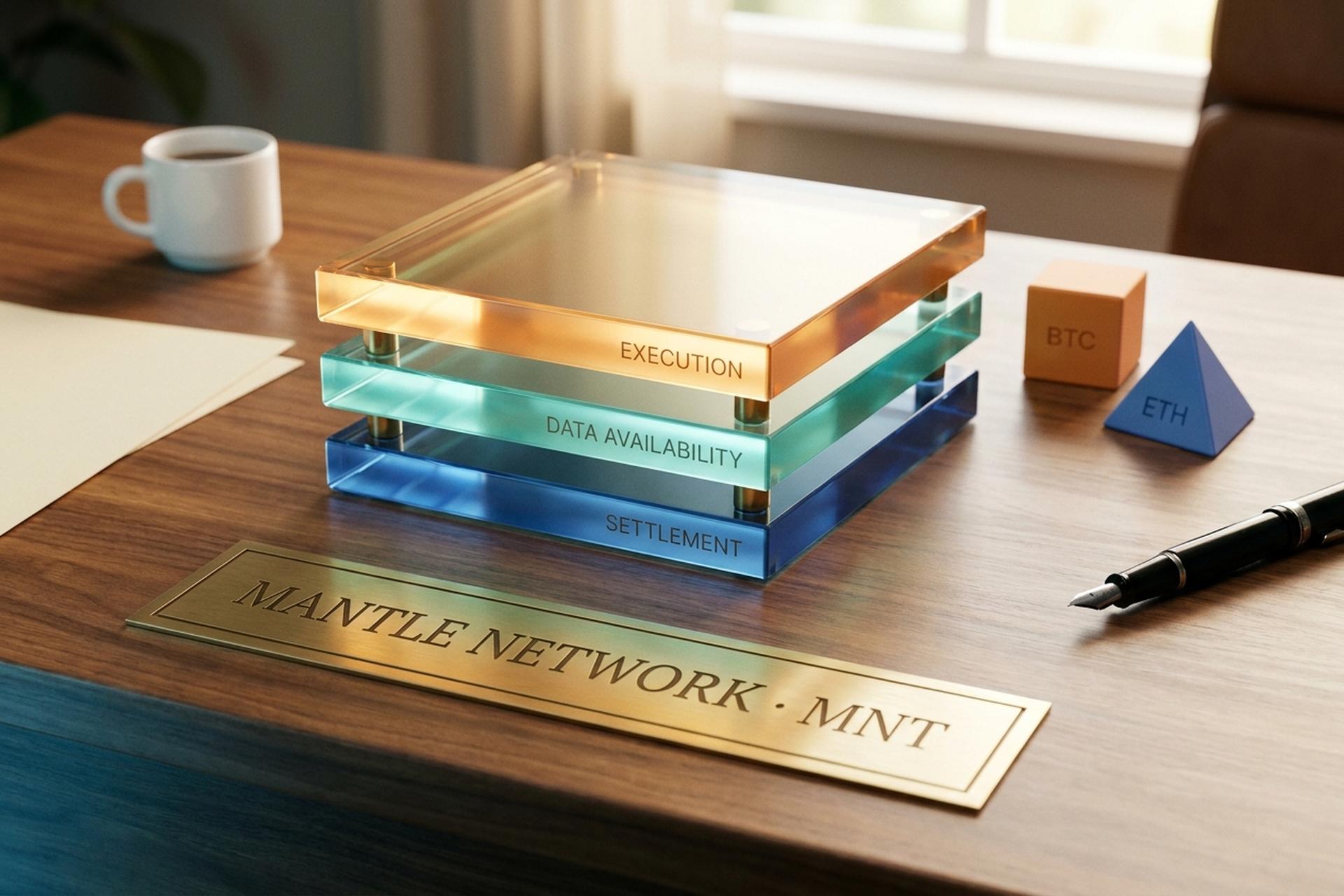
Mantle's DeFi total value locked crossed $1 billion for the first time on 10 March 2026, the same day the chain's stablecoin market cap reached $980 million. Three years after BitDAO's treasury was voted into a rebrand, Mantle has gone from a treasury-backed experiment to a top-five Ethereum Layer 2 by total value secured. The architecture is also new. In September 2025 Mantle finished its move from an optimistic rollup with EigenDA to a ZK validity-proof system built on Succinct's SP1 zkVM, dropping the withdrawal window from seven days to six hours.
This guide covers what Mantle Network is, how the chain works in 2026, the MNT token and its governance role, the projects that actually drive its ecosystem, the institutional pivot represented by the MI4 fund, and a sober look at where Mantle sits among the other major L2s.
What is Mantle Network and the MNT token?
Mantle Network is an Ethereum Layer 2 built on the OP Stack with a ZK validity-proof system. The chain executes EVM-compatible transactions in its own environment, posts data to Ethereum's blob space, and settles back to Ethereum mainnet through cryptographic proofs generated by Succinct's SP1 zkVM. MNT is the network's native token, used for gas, governance, and ecosystem coordination.
Mantle did not start as a network. It started as the treasury of BitDAO, the DAO that grew out of Bybit's early grant programmes. In May 2023 BitDAO members approved BIP-21, the proposal to convert BitDAO into Mantle and swap BIT tokens 1:1 for MNT. The merged entity carried a treasury valued around $2.5 billion at the time. Mantle mainnet alpha launched on 17 July 2023 with more than fifty dApps live on day one and a $200 million ecosystem fund attached.
The on-chain governance has remained DAO-led. There is no centralised company that holds the chain. For merchants and businesses that want to accept MNT or other tokens on Mantle without managing a wallet directly, payment gateways such as Plisio handle the conversion to fiat. That part of the stack sits at the edge of the network, not inside it.
How Mantle works — the ZK rollup architecture
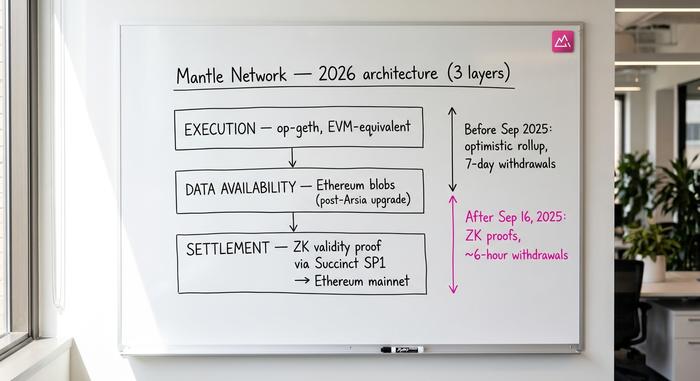
Mantle's 2026 architecture is a different blockchain design from what most older guides describe. Three layers do the work, and the split between them is what gives the chain its scalability profile.
The execution layer is an EVM-equivalent chain running op-geth, the OP Stack's Ethereum client. Any contract written for Ethereum runs on Mantle without modification. Developers use the same tooling — Hardhat, Foundry, Solidity — and deploy through the same workflows.
The data availability layer is where the most visible change happened. Mantle originally posted transaction data to EigenDA, the third-party data-availability network from EigenLayer. The Arsia upgrade migrated data availability to Ethereum's own blob space (introduced by Ethereum's Dencun upgrade in March 2024). Posting to Ethereum blobs is more expensive than EigenDA but it ends one of the trust assumptions that critics of the earlier setup raised: the chain now inherits Ethereum's data-availability guarantees directly.
The settlement layer changed too. Until September 2025 Mantle ran as an optimistic rollup, meaning withdrawals to Ethereum had to wait through a seven-day challenge window in case anybody submitted a fraud proof. The OP-Succinct upgrade that went live on 16 September 2025 replaced that model with a ZK validity proof generated by Succinct's SP1 zkVM. Every batch of transactions ships with a succinct cryptographic proof that Ethereum's verifier contract can check directly. Result: the withdrawal window dropped from seven days to roughly six hours, and the chain stopped depending on optimistic-rollup assumptions.
Throughput tracks the architecture's design points. Nansen recorded average daily transactions in the 80,000-85,000 range across Q4 2025, with single-day peaks above 120,000. None of this rivals high-throughput L1s like Solana on raw transactions per second, but it sits comfortably above Ethereum mainnet's effective capacity and roughly in line with the other major OP Stack chains.
The OP Stack composition — op-geth for execution, op-batcher for bundling transactions, op-proposer for posting state commitments, op-node for chain derivation — is modular by design. That modularity is part of why Mantle could swap data-availability layers and proof systems without rebuilding the whole chain. It also means the chain inherits whatever issues exist upstream in the OP Stack code.
The practical upshot for users: anything you do on Mantle settles back to Ethereum with cryptographic security and shorter finality times than the optimistic rollups that still dominate the L2 landscape. The cost is paying for Ethereum blob space, which is real but currently small at typical transaction volumes. For developers, the change is invisible — the same Solidity contracts compile and run as before.
MNT token — supply, utility, governance
MNT entered circulation through the 1:1 swap from BIT after BIP-21 passed in May 2023, with more than 235 million BIT voting in favour. Maximum supply is set at 6.219 billion tokens. As of May 2026 roughly 3.3 billion are circulating, around 53% of the cap. The Mantle Treasury holds the remainder. Messari's February 2026 report on Mantle put treasury value at around $4.2 billion, making it one of the largest single-protocol treasuries in crypto.
The token does four things on the network. First, it pays gas fees. Unlike most Ethereum L2s, which use ETH for transaction fees, Mantle uses MNT — a deliberate design choice that ties token demand to chain activity. Second, MNT is the governance token. Holders vote on Mantle Improvement Proposals (MIPs) through the on-chain DAO process, and the resulting decisions cover everything from treasury allocations to protocol upgrades. Third, MNT can be staked into network-security and ecosystem-incentive programmes that distribute additional MNT, mETH, or other tokens. Fourth, the token serves as the unit of account inside the BitDAO-to-Mantle ecosystem coordination process: grant proposals, ecosystem-fund allocations, and bond programmes all denominate in MNT.
Practically speaking, MNT token holders determine the strategic direction of the Mantle ecosystem through the proposal-and-vote cycle, and the treasury size means even minority votes carry real economic weight. The downside is that on-chain governance participation is, like most DAO governance in 2026, dominated by a small number of large holders. Anyone holding a meaningful position should expect to follow MIP discussions on the Mantle governance forum rather than rely on the token doing the work passively.
Mantle vs the top Ethereum L2s — a 2026 snapshot
| L2 | Native token | TVL (May 2026) | Withdrawal time | Notable feature |
|---|---|---|---|---|
| Arbitrum One | ARB | ~$16.9B | 7 days (optimistic) | Largest L2 by TVL |
| Base | — (uses ETH) | ~$12.8B | 7 days (optimistic) | Coinbase-incubated, fastest growth 2024-25 |
| Optimism | OP | ~$1.91B | 7 days (optimistic) | OP Stack originator |
| Mantle | MNT | ~$1.43B TVS / $1B+ DeFi TVL | ~6 hours (ZK SP1) | Treasury-backed, ZK validity proofs |
| zkSync Era | — (uses ETH) | varies | hours (ZK) | Custom zkEVM stack |
Mantle is the fourth-largest L2 by total value, and the gap between #2 (Base) and #4 (Mantle) is roughly ten times. The treasury cushion explains part of why Mantle keeps appearing in the conversation despite the gap.
The Mantle ecosystem — DeFi, staking, institutional
Mantle's ecosystem story has two halves. One is conventional DeFi, the other is a deliberate institutional push that most other L2s have not made.
On the DeFi side, the lending market reset the chain's traction in 2024. Aave V3 deployed on Mantle and crossed $1 billion in total market size within nineteen days of going live. INIT Capital, Merchant Moe (the dominant on-chain AMM), and Agni Finance round out the lending and exchange stack. The chain has its own liquid-staking protocol — mETH — which launched on 16 January 2024 and hit a peak TVL of $2.19 billion in late 2024. mETH's TVL has cooled since: DeFiLlama recorded roughly $480 million in May 2026, a meaningful drawdown that tracks the broader liquid-staking pullback. cmETH extends the same primitive into liquid restaking, layering EigenLayer-style yield on top of staked ETH exposure.
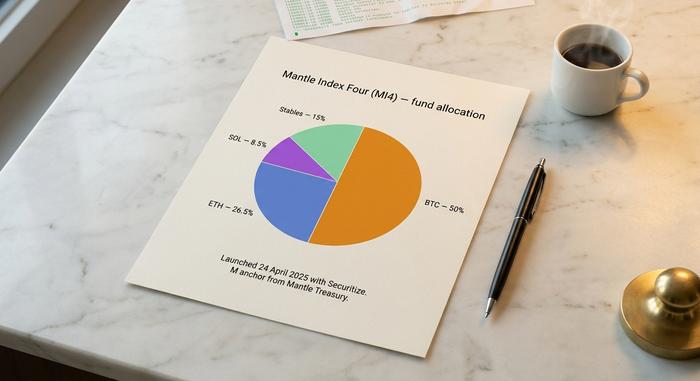
The institutional half is the unusual move. On 24 April 2025 Mantle launched the Mantle Index Four (MI4) fund with Securitize as the tokenisation partner, anchored by a $400 million commitment from the Mantle Treasury itself. MI4 is a tokenised index product holding roughly 50% Bitcoin, 26.5% Ethereum, 8.5% Solana, and 15% stablecoins, designed to give institutional and on-chain investors a single ticker that tracks the broad crypto market. Most L2s focus narrowly on attracting DeFi developers; Mantle is one of the few that is also packaging tokenised institutional-grade products on top of its own chain.
The supporting stack has grown alongside. UR provides a banking-style fiat-crypto account for users moving in and out of the chain. USDY brings tokenised US Treasury-bill yield on-chain as a digital asset for institutional and retail wallets alike. Stablecoin market cap on Mantle reached $980 million on 10 March 2026, the same day overall DeFi TVL crossed the $1 billion mark. The mix — DeFi primitives, liquid staking, tokenised institutional products, and Web3-native banking rails — is what Mantle's roadmap calls "on-chain finance".
Risks and limitations of Mantle Network
The honest part. L2BEAT classifies Mantle as Stage 0, the most cautious of its three decentralisation stages. The block-list reason is upgrade authority: the Mantle team can push instant upgrades to the chain, which is faster for fixing bugs but breaks one of the conditions for Stage 1 promotion. Anyone running serious balances on Mantle should track L2BEAT's classification, because Stage promotion correlates with reduced trust assumptions over time.
The sequencer remains centralised, which is true for almost every major L2 in 2026 and not unique to Mantle. Canonical bridge withdrawals take roughly six hours; faster routes through third-party liquidity providers like Stargate or Across exist but carry their own trust assumptions and fee profiles.
Market position is the other honest point. Mantle is fourth in L2 TVL behind Arbitrum, Base, and Optimism. The treasury advantage has kept the chain growing and the MI4 launch broke open an institutional niche, but Mantle does not have the developer mindshare of Arbitrum or the consumer-flow tailwind of Base. The mETH TVL contraction of roughly 78% from its Q3 2025 peak is a reminder that ecosystem traction can reverse.
How to use Mantle — bridge, wallets, getting MNT
The practical flow is short. Add Mantle to MetaMask (or any wallet that supports custom EVM networks) using the official RPC at rpc.mantle.xyz and chain ID 5000. Once the network appears in the wallet, bridge in either ETH or USDC from Ethereum mainnet through the official Mantle Bridge at bridge.mantle.xyz, or use a third-party route such as Stargate or Across for faster movement. Keep a small MNT balance on hand for gas, because unlike most L2s, Mantle pays fees in MNT rather than ETH.
MNT itself is available on the major centralised exchanges. Bybit listed MNT first and has the deepest liquidity (Mantle was incubated through Bybit's early-stage ecosystem programmes). MEXC, OKX, KuCoin, and Kraken added MNT pairs in the months that followed. On-chain, the Merchant Moe and Agni AMMs hold the main MNT liquidity pools.
For businesses on the merchant side — accepting MNT or other Mantle-native tokens as payment — third-party gateways like Plisio handle the on/off-ramp and accounting so the business does not need to run its own wallet infrastructure. That removes the operational overhead of self-custody while leaving the user-facing payment experience on-chain.