What is a crypto Layer 2 and why do blockchains need scaling solutions
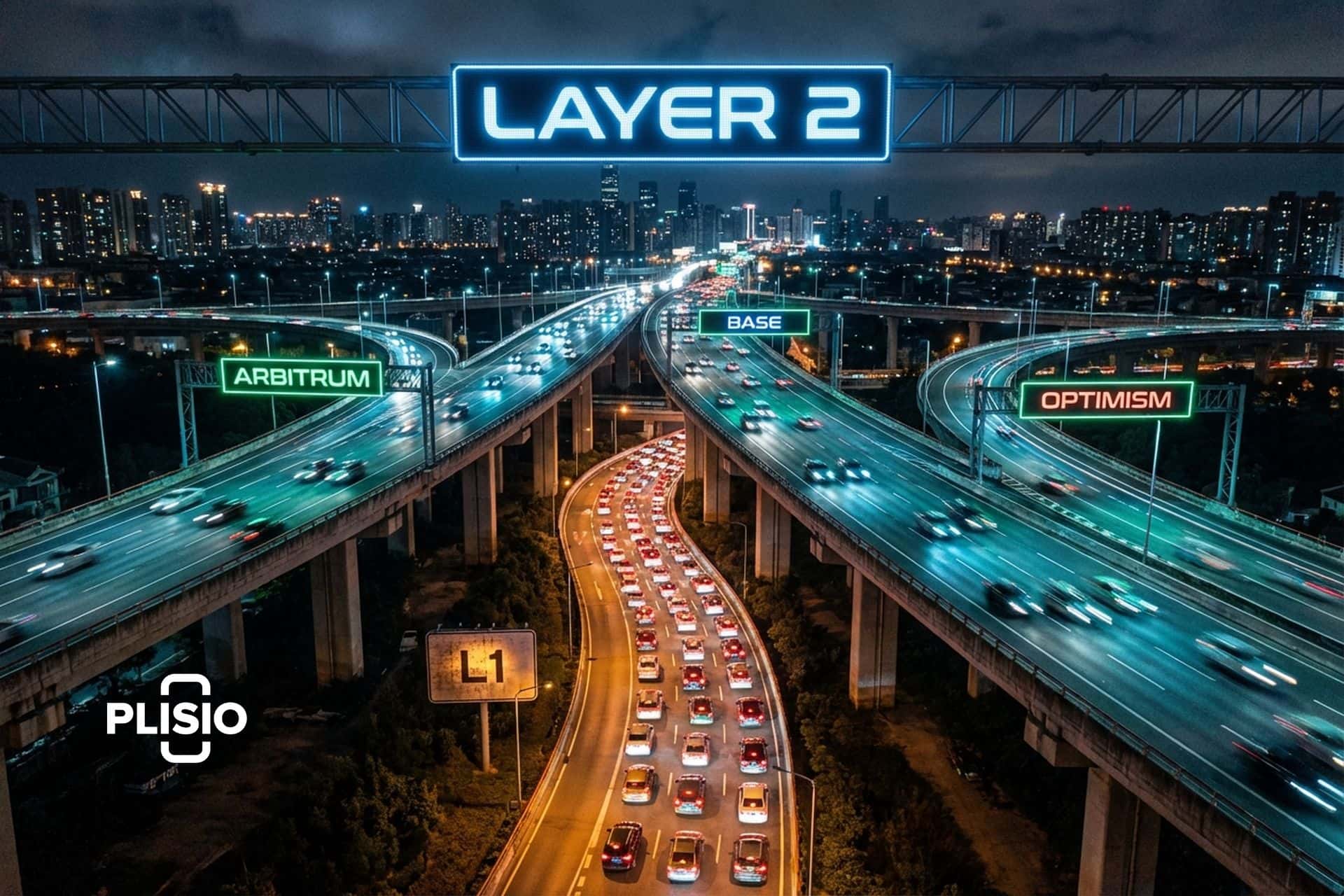
Ethereum can process about 15-30 transactions per second on its main network. Bitcoin manages 7. For context, Visa handles roughly 65,000. That gap is why a simple token swap on Ethereum cost $50-200 in gas fees during peak periods in 2021, and why Bitcoin transactions sometimes sat unconfirmed for hours during busy stretches.
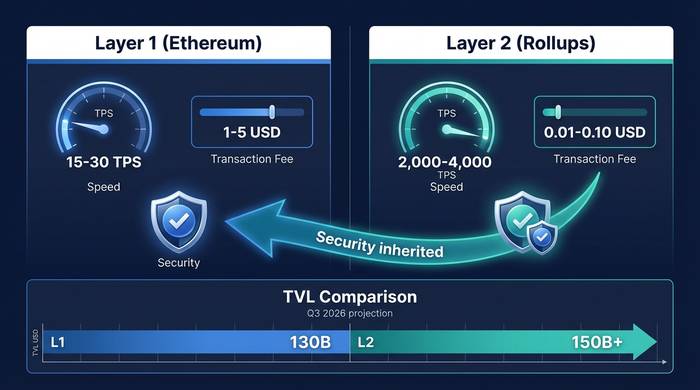
Layer 2 networks exist to fix that. They're separate systems that process transactions off the main blockchain (Layer 1), then post compressed results back to it. You get the speed and low fees of the Layer 2 with the security backing of the underlying Layer 1. As of 2026, Layer 2 solutions on Ethereum alone hold over $30 billion in TVL, and by Q3 2026, L2 TVL is projected to exceed Ethereum mainnet DeFi TVL for the first time.
If you use any crypto application today, there's a decent chance you're already on a Layer 2 without realizing it. Coinbase routes users to Base. Many DeFi protocols default to Arbitrum. The Lightning Network handles Bitcoin payments in the background. Understanding how these scaling solutions work helps you pick the right network, avoid unnecessary fees, and make sense of where crypto infrastructure is heading.
Layer 1 vs Layer 2: what's the difference
Layer 1 is the base blockchain itself. Bitcoin's blockchain is a Layer 1. Ethereum's mainnet is a Layer 1. Solana, Cardano, Avalanche, all Layer 1 blockchains. They run their own consensus mechanisms, maintain their own security, and process transactions directly on their own ledger.
The problem with most Layer 1 blockchains is a trade-off called the blockchain trilemma: you can optimize for security, decentralization, or scalability, but improving one usually comes at the expense of another. Ethereum chose security and decentralization. That makes it trustworthy but slow. Bitcoin chose security above all else. That makes it robust but limited in throughput.
Layer 2 solutions sit on top of a Layer 1 and handle the heavy lifting. They process transactions off-chain, bundle them, and periodically submit proof of those transactions back to the main blockchain. The Layer 1 verifies that proof and considers those transactions settled. You get scalability without sacrificing the security of the base layer.
Think of it like this: Layer 1 is the courthouse that keeps the official records. Layer 2 is the office building next door where all the actual work gets done. The office sends paperwork to the courthouse at the end of the day to make everything official.
| Feature | Layer 1 (Ethereum mainnet) | Layer 2 (Arbitrum, Base, etc.) |
|---|---|---|
| Transaction speed | 15-30 TPS | 2,000-4,000+ TPS |
| Average fee (2026) | $0.50-5.00 | $0.01-0.10 |
| Security source | Own validators (900,000+) | Inherits from Layer 1 |
| Decentralization | High | Varies (improving) |
| Settlement finality | ~12 minutes | Seconds on L2, hours/days for L1 finality |
| TVL (2026) | ~$130 billion | $150+ billion (projected Q3 2026) |
How Layer 2 scaling solutions actually work
Not all Layer 2s use the same technology. The two dominant approaches are optimistic rollups and zero-knowledge rollups. They solve the same problem (more transactions, lower fees) but use very different methods.
Optimistic rollups
Optimistic rollups assume transactions are valid unless someone proves otherwise. That's the "optimistic" part. They batch hundreds or thousands of transactions together, execute them on the Layer 2, and post the compressed results to Ethereum. If nobody challenges the results within a dispute window (usually 7 days), they're considered final.
The advantage: they're simpler to build and they support the same smart contracts that run on Ethereum. Developers can port their apps with minimal changes. The disadvantage: that 7-day challenge window means withdrawing funds from an optimistic rollup back to Ethereum takes a week if you go through the official bridge.
Major optimistic rollups in 2026:
- Arbitrum -- largest L2 by TVL ($16.6 billion), most DeFi activity
- Optimism -- powers the OP Stack used by Base and other chains
- Base -- Coinbase's L2, fastest-growing, now handles 60%+ of all L2 transactions
Zero-knowledge (ZK) rollups
ZK rollups take a different approach. Instead of assuming transactions are valid and waiting for challenges, they generate a mathematical proof (called a validity proof) that the transactions are correct. This proof gets posted to Ethereum along with the batch, and the Layer 1 can verify it instantly without re-executing every transaction.
The advantage: faster finality (no 7-day wait for withdrawals) and stronger security guarantees. The disadvantage: ZK proofs are computationally expensive to generate, and building EVM-compatible ZK rollups is technically harder. This is why optimistic rollups got to market first and still dominate in TVL.
Major ZK rollups in 2026:
- zkSync Era -- general-purpose zkEVM, growing ecosystem
- Starknet -- uses STARK proofs instead of SNARKs, designed for high throughput
- Polygon zkEVM -- part of Polygon's AggLayer vision
- Linea -- built by Consensys (the company behind MetaMask)
- Scroll -- community-driven zkEVM
Other scaling approaches
State channels (like Bitcoin's Lightning Network) allow two parties to open a direct payment channel, transact off-chain as many times as they want, and only settle the final balance on Layer 1. They're great for frequent small payments between the same parties but don't support complex smart contracts.
Sidechains (like Polygon PoS) run their own consensus and post checkpoints to Ethereum but don't technically inherit Ethereum's security the way rollups do. They're faster and cheaper but carry their own security assumptions. Whether sidechains count as "real" Layer 2 solutions depends on who you ask. Purists say no because they have their own validator set. Pragmatists point to Polygon's billions in TVL and say the label doesn't matter.
Validiums store data off-chain entirely, using validity proofs like ZK rollups but without posting transaction data to the Layer 1. They're even cheaper than rollups but sacrifice data availability guarantees.
The Layer 2 landscape in 2026: who's winning
The market has consolidated fast. Three networks control nearly everything.
| L2 Network | Type | TVL (late 2025) | DeFi TVL share | Key fact |
|---|---|---|---|---|
| Arbitrum | Optimistic rollup | $16.6B | 30.86% | Largest L2 by TVL |
| Base | Optimistic rollup | $10B+ | 46.58% | 60% of all L2 transactions |
| Optimism | Optimistic rollup | $6B | ~10% | OP Stack powers Base and 20+ chains |
| zkSync Era | ZK rollup | ~$1.5B | ~3% | Leading general-purpose zkEVM |
| Starknet | ZK rollup | ~$500M | ~2% | STARK-based, own VM |
A few things stand out. First, Base came from nowhere. Coinbase launched it in August 2023, and by 2026 it processes more daily transactions than any other L2. Having Coinbase funnel its 100+ million users to Base is an unfair distribution advantage that other L2s simply can't match.
Second, optimistic rollups dominate in practice even though ZK rollups are technically superior on paper. The reason is simple: optimistic rollups shipped first, attracted developers who built real apps, and those apps attracted users and liquidity. By the time ZK rollups became production-ready, the optimistic rollup ecosystem had a two-year head start. Network effects are hard to overcome. That said, ZK technology is catching up fast, and several major L2 teams believe ZK will eventually replace optimistic approaches entirely. The timeline for that switch keeps getting pushed back, though.
Third, according to 21Shares research, most of the 100+ Ethereum L2s may not survive 2026. The top three networks are pulling away, and smaller rollups without meaningful user bases or unique value propositions face extinction. It's a winner-take-most dynamic.

How Layer 2 fees work (and why they're so cheap)
When you transact on a Layer 2, you pay two things: an execution fee (the L2's cost to process your transaction) and a data posting fee (the cost to post compressed data to Ethereum Layer 1).
Before March 2024, L2s had to post data as regular Ethereum calldata, which was expensive. Then EIP-4844 ("proto-danksharding") introduced blob space, a special area on Ethereum blocks designed specifically for rollup data at much lower cost. This single upgrade cut Layer 2 fees by 90-95%.
In practice: a token swap on Arbitrum or Base costs $0.01-0.05 in April 2026. The same swap on Ethereum mainnet costs $1-5. For users, this means you can use DeFi, mint NFTs, and trade tokens on L2s for essentially nothing.
The fee model creates an interesting dynamic. Layer 2 networks pay Ethereum for security (through blob fees), and Ethereum benefits from L2 activity even if users never touch the mainnet directly. It's symbiotic: L2s need Ethereum's security, and Ethereum needs L2 fees to sustain its economic model.
How to use a Layer 2 network
Getting onto a Layer 2 takes about two minutes:
Option 1: Bridge from Ethereum. If you have ETH on mainnet, use the official bridge for your target L2 (bridge.arbitrum.io, app.optimism.io/bridge, etc.). You send ETH on mainnet, and it appears on the L2 within a few minutes. Bridging back from an optimistic rollup takes 7 days through the native bridge, though third-party bridges like Across and Stargate do it in minutes for a small fee.
Option 2: Buy directly on L2. Many exchanges now support direct withdrawals to Layer 2 networks. Coinbase withdrawals default to Base. Binance supports Arbitrum and Optimism withdrawals. This is the cheapest route because you skip the bridging fee entirely.
Option 3: Use a multi-chain wallet. MetaMask, Rainbow, and Rabby automatically detect L2 networks and let you switch between them. Add the network (Arbitrum, Base, Optimism) and your wallet works the same way it does on Ethereum mainnet.
Once you're on a Layer 2, the experience is almost identical to using Ethereum mainnet. The same dApps run on L2s: Uniswap, Aave, Curve, Lido, and hundreds of others have deployed across Arbitrum, Base, and Optimism. Your wallet address is the same. Your tokens show up the same way. The only visible difference is the fee: what costs $3 on mainnet costs $0.03 on the L2. For most people, that alone is reason enough to move everything to a Layer 2 and never interact with Ethereum directly.
I switched my own daily crypto activity to Arbitrum and Base about a year ago and haven't made a single Ethereum mainnet transaction since. The only time I touch L1 is for large staking operations or governance votes. Everything else, swaps, bridges, lending, happens on L2 for a fraction of a cent. Once you try it, going back to mainnet fees feels absurd.
Risks and trade-offs of Layer 2 solutions
L2s are not without issues:
Centralized sequencers. Most rollups currently have a single entity (the sequencer) that orders and batches transactions. If the sequencer goes down, the L2 halts. If the sequencer censors transactions, users have to wait for the escape hatch to force transactions through the Layer 1. Decentralizing sequencers is on every L2's roadmap but hasn't shipped at scale yet.
Bridge risk. Moving assets between L1 and L2 (or between different L2s) involves bridge smart contracts. Bridges have been the target of some of the largest hacks in crypto history. The Ronin bridge lost $624 million. The Wormhole bridge lost $320 million. Using official, audited bridges reduces but doesn't eliminate this risk.
Fragmented liquidity. With 100+ L2s, liquidity is spread thin. A token might have deep pools on Arbitrum but almost no liquidity on Starknet. This fragmentation is why aggregators and cross-chain protocols are becoming increasingly important.
Withdrawal delays. Optimistic rollup native bridges enforce a 7-day withdrawal period. Third-party bridges offer instant exits but charge a fee and carry their own smart contract risk.
Evolving security. Many L2s are still in early stages of decentralization. L2Beat tracks the security status of every Ethereum rollup, and the picture is sobering: most L2s still have emergency multisigs controlled by their development teams. In theory, these teams could upgrade the rollup contract and access user funds. In practice, no major L2 has abused this power, but the trust assumption exists. Arbitrum and Optimism are furthest along in removing these training wheels. Newer rollups may take years to fully decentralize. Check L2Beat before depositing significant funds, and prefer L2s that have progressed furthest on their decentralization roadmap.
The meta question: are there too many L2s? As of 2026, over 100 rollups and app-chains have launched on Ethereum. Most have negligible users. According to 21Shares research, many won't survive the year. The useful ones, the ones with real user bases and DeFi ecosystems, will consolidate further. For you as a user, stick with the top three to five networks unless you have a specific reason to use a smaller one.