What Is Solidity? A Smart Contract Programming Language
One careless line of Solidity once handed an attacker 3.6 million ETH. The code did exactly what it was told. That is the unsettling part. Solidity moves money. Its source usually sits in plain view. And once a contract is live, there is no quiet patch — the bug stays, the funds stay exposed, and the whole world can read both. It is the dominant programming language for writing smart contracts on Ethereum and every EVM blockchain beside it. Strip away the jargon and most of DeFi and NFTs is Solidity underneath. Powerful. Also unforgiving. Here is what it is, how the code actually runs, what a first contract looks like, and why security never leaves the room.
What Is Solidity as a Programming Language
Every guide says the same thing: Solidity is a high-level language for smart contracts. Fine. That barely helps you. What kind of language, though? Statically typed. Object-oriented. Curly braces and semicolons, syntax borrowed from JavaScript, C++, and Python. If you have shipped code in any of those, a `.sol` file reads familiar in about ten minutes.
Gavin Wood sketched it in 2014, helped by a small Ethereum team that included Christian Reitwiessner. The aim was blunt: let people write smart contracts for a public blockchain. Its core unit is the `contract`. Think of it as a `class` that happens to live on a chain — it holds state, exposes functions, inherits from others. The twist is where the thing runs. Compile it to bytecode, and the same contract executes identically on every node across a decentralized network, all of them checking each other. That single demand explains why Solidity feels so boxed in.
| Solidity at a glance | |
|---|---|
| First released | 2014 |
| Lead designer | Gavin Wood (Ethereum) |
| Paradigm | Object-oriented, contract-oriented |
| Typing | Static |
| Compiles to | EVM bytecode |
| Latest compiler | v0.8.35 (Apr 2026) |
| File extension | .sol |
How Solidity Works: From Code to the EVM
The interesting part of Solidity is not the syntax. It is the pipeline. Readable code becomes something thousands of machines agree to run the same way. Determinism is the whole point. If two nodes ran the same contract and got different answers, the network could not agree on anyone's balance. That single requirement explains a lot of the language's odd limits: no fetching a random number, no calling an outside web API mid-execution. Everything has to be reproducible from the chain itself.
The compiler and bytecode
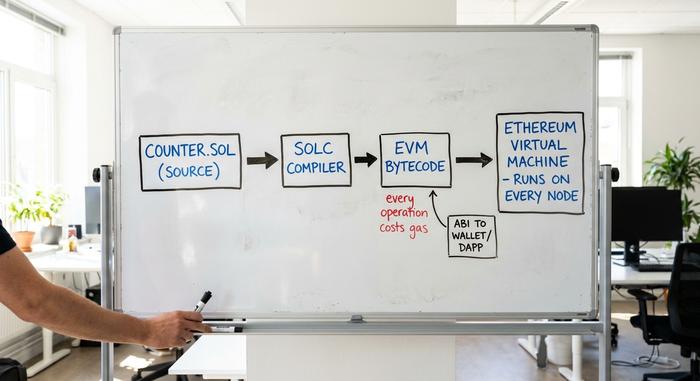
You write a `.sol` file, human-readable and high-level. The Solidity compiler, `solc`, turns it into EVM bytecode, a long string of low-level operations, plus an ABI that lists the contract's functions. The bytecode is what lands on chain. Nobody reads it by hand. It is the machine target, the way C ends up as assembly.
The EVM and gas
The Ethereum Virtual Machine runs that bytecode. Every Ethereum node has one. Every operation it performs costs gas, a fee paid in ETH. Gas is not a side detail. It is how the network prices computation and defends itself: a runaway loop does not freeze the chain — it just burns through the sender's gas and reverts. Good Solidity keeps gas low.
The ABI
The ABI, or Application Binary Interface, is the JSON map of how to talk to a deployed contract. A wallet like MetaMask, or a front-end dApp, uses it to encode a function call into the format the EVM expects, then decode whatever comes back. Think of the ABI as the bridge between the interface a user sees and the contract sitting at an address on the blockchain.

Writing Your First Solidity Smart Contract
Enough theory. The fastest way to understand Solidity is to read a small contract and recognize its parts.
Anatomy of a contract
```solidity
// SPDX-License-Identifier: MIT
pragma solidity ^0.8.20;
contract Counter {
uint256 public count;
event Incremented(uint256 newCount);
function increment() public {
count += 1;
emit Incremented(count);
}
}
```
A few pieces carry the whole thing. The `pragma` line pins the compiler version, so an incompatible release cannot silently recompile your code. `contract Counter` opens the contract, like opening a class. `count` is a state variable, stored on chain, permanently. `increment()` is a public function anyone can call. `event Incremented` logs each change so off-chain apps can react. Object-oriented code, with a blockchain underneath.
The tools you actually use
You install nothing to start. Remix is a browser IDE: write, compile, and deploy Solidity in a few clicks, which makes it the standard place to learn Solidity. Real projects move to local frameworks. Hardhat and Foundry handle compiling, testing, and deployment properly. And almost everyone leans on OpenZeppelin, a library of audited, reusable contracts for tokens and access control, rather than reinventing risky code from scratch.
From code to a live address
Deploying means sending the compiled bytecode in a transaction. Test on a free testnet first. Sepolia is the usual pick in 2026. Connect a wallet such as MetaMask. Push to mainnet only when the contract behaves. Deployment costs gas too, paid in real ETH. And here is the line worth tattooing on your wrist: once deployed, the code is immutable. You cannot edit a live contract. That single fact — more than any syntax quirk — is why the next section exists.
Which Blockchains Support Solidity
Solidity stopped being "Ethereum's language" years ago. So many networks adopted the EVM to reuse Ethereum's tooling that Solidity became the shared tongue of a whole chain family. ChainList tracks more than 385 EVM-compatible blockchains in 2026. The big names all qualify: Polygon, BNB Chain, Arbitrum, Base, and Avalanche, all running the same bytecode your `.sol` file compiles to.
Ethereum is still the center of gravity. It holds about $45 billion in total value locked, more than half of all DeFi, according to DeFiLlama. And activity is climbing: roughly 8.7 million new smart contract deployments in the fourth quarter of 2025 alone, by Token Terminal's count. For a developer, that reach is the real reason to pick Solidity over a language welded to one chain.
So what gets built with it? Almost every category of decentralized applications you have heard of. DeFi lending and trading protocols. The ERC-20 contracts behind most tokens, the ERC-721 contracts behind NFTs. DAOs encode their voting rules in Solidity. Stablecoins manage supply with it. On-chain games keep their logic there. When a project says it is "on Ethereum," someone almost certainly wrote and deployed Solidity.
Why Solidity Smart Contract Security Is Hard
The properties that make Solidity powerful are the same ones that make its bugs so expensive. The code holds money. The source is often public. It cannot be patched. An attacker reads your contract at leisure, and the funds are right there at the address. This is not a language for moving fast and breaking things. I have never worked with software where the gap between "it compiles" and "it is safe" runs this wide.
Reentrancy and the DAO hack
The textbook Solidity vulnerability is reentrancy. A contract sends ETH to an external address before it updates its own internal balance, and the receiving contract calls back in to withdraw again, and again, before the first call finishes. In June 2016 this exact flaw drained about 3.6 million ETH, worth roughly $60 million at the time, from The DAO. The fallout split Ethereum into ETH and Ethereum Classic, a chain that still trades today. And the fix? Almost insultingly small. Update your state first, send the money last. The pattern even has a name: checks-effects-interactions.
Integer overflow and SafeMath
Before Solidity 0.8, arithmetic could silently wrap around. Add 1 to the maximum value of a `uint256` and it rolled over to zero, which attackers exploited to mint absurd token balances, as in the BeautyChain (BEC) incident in 2018. For years developers guarded against this with a library called SafeMath, for a while one of the most-imported files in all of Solidity. Then version 0.8 built overflow and underflow checks into the language itself. The most common arithmetic bug now reverts by default, no extra library required.
Audits and what they cost
Because mistakes are permanent, serious projects pay for review. They build on OpenZeppelin's audited components and then hire firms to audit the whole system. A professional smart contract audit typically runs from $25,000 to over $100,000 for a DeFi protocol, according to market data from Sherlock, and Solidity audits tend to be 25 to 40 percent cheaper than equivalent Rust audits simply because the talent pool is larger. Good firms book out, too. A mid-size protocol can wait weeks for a slot, then weeks more for the report. None of this is fast, and none of it is optional.
| Vulnerability | What goes wrong | Famous case | Fix |
|---|---|---|---|
| Reentrancy | External call re-enters before state updates | The DAO, 2016 | Checks-effects-interactions |
| Integer overflow | Arithmetic wraps past its limit | BeautyChain (BEC), 2018 | Built-in checks (Solidity 0.8+) |
| Access control | Anyone can call a privileged function | Various | `onlyOwner` / role guards |
| Unchecked external calls | Failed call ignored, logic continues | Various | Validate return values |
The good news is that the carnage is shrinking. Cryptocurrency losses from DeFi-specific exploits fell to about $680 million in 2025, down roughly 74 percent from the $2.62 billion peak in 2022, according to Immunefi. Better tooling and the security checks now baked into the compiler are part of why.
Solidity vs Other Smart Contract Languages
Solidity has rivals. It is not even the safest of them. Vyper is minimal and Python-like, stripped down on purpose to cut the ways you can blow off your own foot; Curve runs on it. Rust powers contracts on Solana and NEAR, safer in some respects, but harder to learn and costlier to audit. So why does Solidity still win? Not language design. Network effects. The deepest tooling, the most audited libraries, a whole EVM ecosystem of chains and wallets, all of it already speaks Solidity.
| Language | Chains | Syntax base | Best for | Trade-off |
|---|---|---|---|---|
| Solidity | Ethereum + all EVM | JavaScript/C++ | Maximum reach, mature tooling | Easy to write unsafe code |
| Vyper | EVM | Python | Safety-critical, simple contracts | Fewer features, smaller community |
| Rust | Solana, NEAR | Rust | High performance, strong safety | Steep curve, costlier audits |
If you want to ship where the users and the money already are, Solidity is the pragmatic default, even when a rival is technically safer.
Should You Learn Solidity Programming in 2026?
The speculative hype around crypto cooled, but the demand for people who can write correct Solidity did not. Ethereum added about 16,181 new developers between January and September 2025, by Electric Capital's count, and roughly 74 percent of all multi-chain developers work on EVM chains. That is where the paying work and the reusable libraries are.
A sane path to learn Solidity programming: start in Remix, read the official Solidity docs, then work through OpenZeppelin's contracts so you see how professionals structure tokens and access control. Deploy small projects to a testnet until the security patterns feel automatic rather than memorized. The scarce skill is not writing Solidity that compiles; plenty of people can do that. What a Solidity developer actually gets paid for is writing code that survives contact with an adversary — someone who has read your contract and has money on the line.
Why Solidity Remains the Default Language
Solidity is the default for a concrete reason, not hype. It reaches every EVM chain. It carries the richest tooling. It sits under most of DeFi and NFTs. But the first thing to absorb is not the syntax. It is this: on a blockchain, deployed code is law, and bugs are forever. Learn the language and the security patterns together, because the two are not separable here. The honest next step is small and free. Open Remix, write a ten-line contract, and deploy it to a testnet this week.