
Smart contracts on the blockchain: how they work and why they replaced the middleman

In 2016, a group of people pooled $150 million into a smart contract called The DAO. It was supposed to be a decentralized venture fund. No managers, no board, just code deciding where the money went. Six weeks later, a hacker found a flaw in that code and drained $60 million. The contract executed exactly as written. The problem was that what was written wasn't what the creators intended.
That story captures everything about smart contracts in one shot: the power, the risk, and the reality that "code is law" sounds great until the code has a bug. Despite that early disaster, smart contracts went on to create a $100+ billion industry. DeFi, NFTs, DAOs, stablecoins, token launches, all built on the same idea that Nick Szabo sketched out on paper in 1994.
This article explains what smart contracts actually are, how they work under the hood, where they're used today, and what can go wrong.
What is a smart contract
A smart contract is a program stored on a blockchain that runs automatically when preset conditions are met. No human needs to press a button. No lawyer needs to review it. No bank needs to approve it. The contract checks whether the conditions are satisfied, and if they are, it executes.
The simplest way to think about it: a vending machine. You put in $2, press the button, and the machine gives you a soda. The transaction is automatic, trustless, and final. Nobody at Coca-Cola personally hands you the can. Smart contracts do the same thing, but for financial transactions, ownership transfers, voting, insurance payouts, and thousands of other use cases.
Nick Szabo, a computer scientist and legal scholar, came up with the concept in 1994. But the technology to make it work didn't exist until Ethereum launched in 2015. Bitcoin has a basic scripting language that can handle simple conditions, but Ethereum introduced a Turing-complete programming language (Solidity) that lets developers write complex logic directly on the blockchain.
When someone says a smart contract is "deployed on Ethereum," they mean the code has been permanently written to the Ethereum blockchain. Every node on the Ethereum network stores a copy. Every node can execute it. The code is open for anyone to inspect. And once deployed, the code can't be changed (with some exceptions for upgradeable contract patterns, which add their own trust assumptions).
Here's a concrete example: you and I make a bet on whether Bitcoin will be above $80,000 on December 31, 2026. We each send 1 ETH to a smart contract. The contract is programmed to check the BTC price on that date (using an oracle like Chainlink) and automatically send 2 ETH to the winner. No bookie. No trust required between us. The contract holds the money and executes the payout with zero human involvement.
How smart contracts work on the blockchain
Every smart contract lives at a specific address on a blockchain network, just like a wallet. But instead of holding a person's funds, it holds code and state (data).
When you interact with a smart contract, you send a transaction to its address with instructions: "I want to swap 1 ETH for USDC" or "I want to deposit collateral and borrow against it." The contract receives your transaction, runs its internal logic, and produces an output, all within the same block.
The execution costs gas (on Ethereum). More complex operations consume more gas. A simple token transfer might cost 21,000 gas units. A multi-step DeFi interaction could cost 300,000+. You pay gas fees in the network's native currency (ETH on Ethereum, for example) to compensate validators for running the computation.
The role of the Ethereum Virtual Machine
The Ethereum Virtual Machine (EVM) is the runtime environment where smart contracts execute. Think of it as a global computer. Every Ethereum node runs the EVM, and every node independently executes the same smart contract code to reach the same result. This redundancy is what makes smart contracts trustless: no single node can fake the output because every other node will catch the discrepancy.
Smart contracts are written in high-level languages like Solidity (the most popular) or Vyper, then compiled into bytecode that the EVM understands. Other blockchains have their own virtual machines: TRON uses the TVM (compatible with EVM), Solana uses its own runtime, and Cardano uses Plutus.
The oracle problem
Smart contracts can only see data that exists on the blockchain. They can't browse the internet, check a stock price, or read a weather report. If a contract needs external data (like the BTC price for our bet example), it relies on an oracle, a service that feeds real-world data into the blockchain.
Chainlink is the dominant oracle network, supplying price feeds, randomness, and external API data to smart contracts across dozens of blockchains. The accuracy and reliability of oracles is critical: a corrupted price feed could cause millions in incorrect liquidations or payouts. Oracle manipulation has been the attack vector for several major DeFi exploits.
Smart contract use cases in 2026
The early pitch for smart contracts was that they would replace lawyers, banks, and notaries for everything from real estate to insurance. The reality in 2026 is more focused but still massive:
Decentralized finance (DeFi)
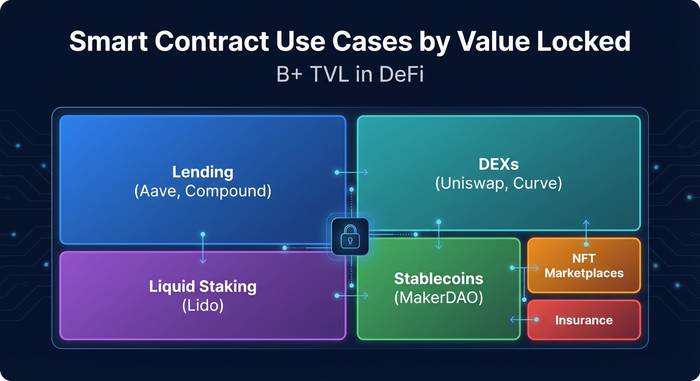
DeFi is the biggest smart contract use case by far. The entire category, worth over $100 billion in TVL, runs on smart contracts.
| DeFi category | What the smart contract does | Example protocols |
|---|---|---|
| Lending/borrowing | Holds collateral, calculates interest, triggers liquidations | Aave, Compound, MakerDAO |
| Decentralized exchanges | Manages liquidity pools, executes token swaps, distributes fees | Uniswap, Curve, SushiSwap |
| Stablecoins | Maintains peg through collateral management and algorithmic rules | DAI, FRAX, LUSD |
| Derivatives | Manages margin, settles futures contracts, handles payouts | dYdX, GMX, Synthetix |
| Yield aggregators | Automatically moves funds between protocols to maximize returns | Yearn Finance, Beefy |
Every time you swap tokens on Uniswap, a smart contract calculates the price from the liquidity pool ratio, deducts a 0.3% fee, and transfers the tokens to your wallet. No order book. No matching engine. No exchange employee. Just code running on thousands of computers simultaneously.
What makes DeFi smart contracts particularly interesting is composability. Contracts can call other contracts. A single transaction can borrow from Aave, swap on Uniswap, and deposit into a yield farm, all atomically. If any step fails, the entire transaction reverts. This Lego-like building approach is what people mean when they talk about "money Legos." It's powerful, but it also means that a bug in one widely-used contract can cascade through the entire ecosystem.
NFTs and digital ownership
Every NFT is a smart contract. The ERC-721 standard defines how unique tokens are created, transferred, and verified on Ethereum. When you buy an NFT on OpenSea, a smart contract handles the transfer of ownership and the payment in a single atomic transaction: either both happen or neither does. No escrow needed.
DAOs and governance
Decentralized Autonomous Organizations use smart contracts to manage voting, treasury funds, and proposal execution. When a DAO votes to allocate 500 ETH to a development grant, the smart contract automatically releases the funds once the vote passes the required threshold. No board member writes a check.
Supply chain and verification
Brands use smart contracts to track products from factory to consumer. Each step in the supply chain is recorded on the blockchain, creating a tamper-proof record. This is more common in enterprise blockchain deployments than in public crypto, but companies like Walmart and Maersk have run supply chain pilots on blockchain networks.
Insurance
Parametric insurance contracts trigger payouts automatically based on measurable events. A crop insurance smart contract could automatically pay a farmer if rainfall data (supplied by an oracle) drops below a threshold. No claims process. No adjusters. No waiting weeks for approval.
Risks and limitations of smart contracts
Bugs and exploits
Smart contract code is immutable once deployed. If there's a bug, it can't be patched like a regular app. Hackers have stolen billions by exploiting coding errors. The DAO hack ($60M in 2016), the Wormhole bridge exploit ($320M in 2022), and the Euler Finance hack ($197M in 2023) all resulted from smart contract vulnerabilities. Code audits help but don't guarantee safety. Even audited contracts have been exploited.
Gas costs and network congestion
Complex smart contract interactions on Ethereum mainnet can cost $5-50 in gas during busy periods. Layer-2 networks reduce this to cents, but the cost barrier still exists on L1. Some operations (like deploying a new contract or interacting with multi-step DeFi strategies) can consume hundreds of thousands of gas units.
Immutability cuts both ways
The fact that smart contracts can't be changed is a feature (nobody can tamper with the rules) and a bug (nobody can fix mistakes). Some contracts use "proxy patterns" that allow upgrades, but these introduce trust: who controls the upgrade? If a team can change the contract, they could theoretically change it in their favor. True immutability means living with the code as-is, bugs included.
Legal gray area
Smart contracts aren't "contracts" in the legal sense in most countries. A traditional contract requires offer, acceptance, consideration, and mutual assent. A smart contract is just code that executes when triggered. If it malfunctions and you lose money, who is liable? The developer? The protocol's DAO? The auditor who missed the bug? Courts are still working through these questions.
Some jurisdictions are further along than others. The US state of Tennessee passed a law in 2018 recognizing smart contracts as legally enforceable. Wyoming has similar legislation. The UK Law Commission published a report in 2021 concluding that existing English contract law can accommodate smart contracts. But global consensus doesn't exist yet, and cross-border disputes involving smart contracts are a legal nightmare.
For practical purposes: don't treat a smart contract as a replacement for a legal agreement if real stakes are involved. Use it as an execution layer, and pair it with a traditional legal framework if you need enforceability in court.
They're only as good as their inputs
A perfectly written smart contract that relies on a bad oracle produces bad results. Garbage in, garbage out. If Chainlink's price feed delivers a wrong ETH price for even one block, a lending protocol could liquidate millions in user positions incorrectly. The "smart" in smart contract refers to self-execution, not intelligence.
Which blockchains support smart contracts
Not all blockchains can run smart contracts. Bitcoin's scripting language is intentionally limited. Here's where smart contracts live:
| Blockchain | Smart contract language | Notable feature |
|---|---|---|
| Ethereum | Solidity, Vyper | Largest ecosystem, most DeFi |
| Solana | Rust | High throughput, low fees |
| Avalanche | Solidity (EVM compatible) | Subnet architecture |
| Cardano | Plutus, Marlowe | Formal verification focus |
| TRON | Solidity (EVM compatible) | Stablecoin transfers |
| Polkadot | ink! (Rust-based) | Cross-chain interoperability |
| Arbitrum, Base, Optimism | Solidity (EVM L2s) | Cheap Ethereum smart contracts |
Ethereum remains the center of gravity. According to Electric Capital's developer report, Ethereum has more active smart contract developers than all other blockchains combined. EVM compatibility has become the default standard for the industry. If a new blockchain wants developers, it almost always supports Solidity. That's why chains like Avalanche, Polygon, Arbitrum, and TRON all run EVM-compatible virtual machines.
The exception is Solana, which uses Rust instead of Solidity. This gives it performance advantages (Solana programs run closer to the metal) but means developers need to learn a different stack. Cardano took yet another approach with Haskell-based smart contracts focused on formal verification, the idea being that mathematically proven code has fewer bugs. In practice, Cardano's DeFi ecosystem has grown more slowly than Ethereum's, partly because of the steeper developer learning curve.



