
What Is an EVM Wallet? Best EVM Wallets and Security Guide
Open MetaMask in May 2026 and you face a choice that did not exist a year ago. The same browser extension can run as an old-fashioned externally owned account, a fully programmable smart wallet built on ERC-4337, or a hybrid "smart EOA" enabled by EIP-7702 since the Pectra upgrade in May 2025. The wallet looks identical. The security and recovery model behind it is now three different things.
That is the real story of an EVM wallet in 2026, not "MetaMask is the most popular one." This guide walks through what an EVM wallet actually is, the six wallets worth considering for a serious web3 user, the threat landscape after a year of EIP-7702, and how to set up your first wallet without losing it inside a month. The EVM wallet you pick is the gateway to every decentralized service in the ecosystem, so picking the wrong one is expensive.
What is an EVM wallet and how does it differ?
Ignore the app icon. Whatever logo sits on your phone, the actual EVM wallet is doing one boring job. It guards a 256-bit number. The wallet derives a 42-character public address from that number, starting with `0x`, via ECDSA on the secp256k1 curve and a Keccak-256 hash at the end. The address can sit on a billboard. The 256-bit number cannot leave the device.
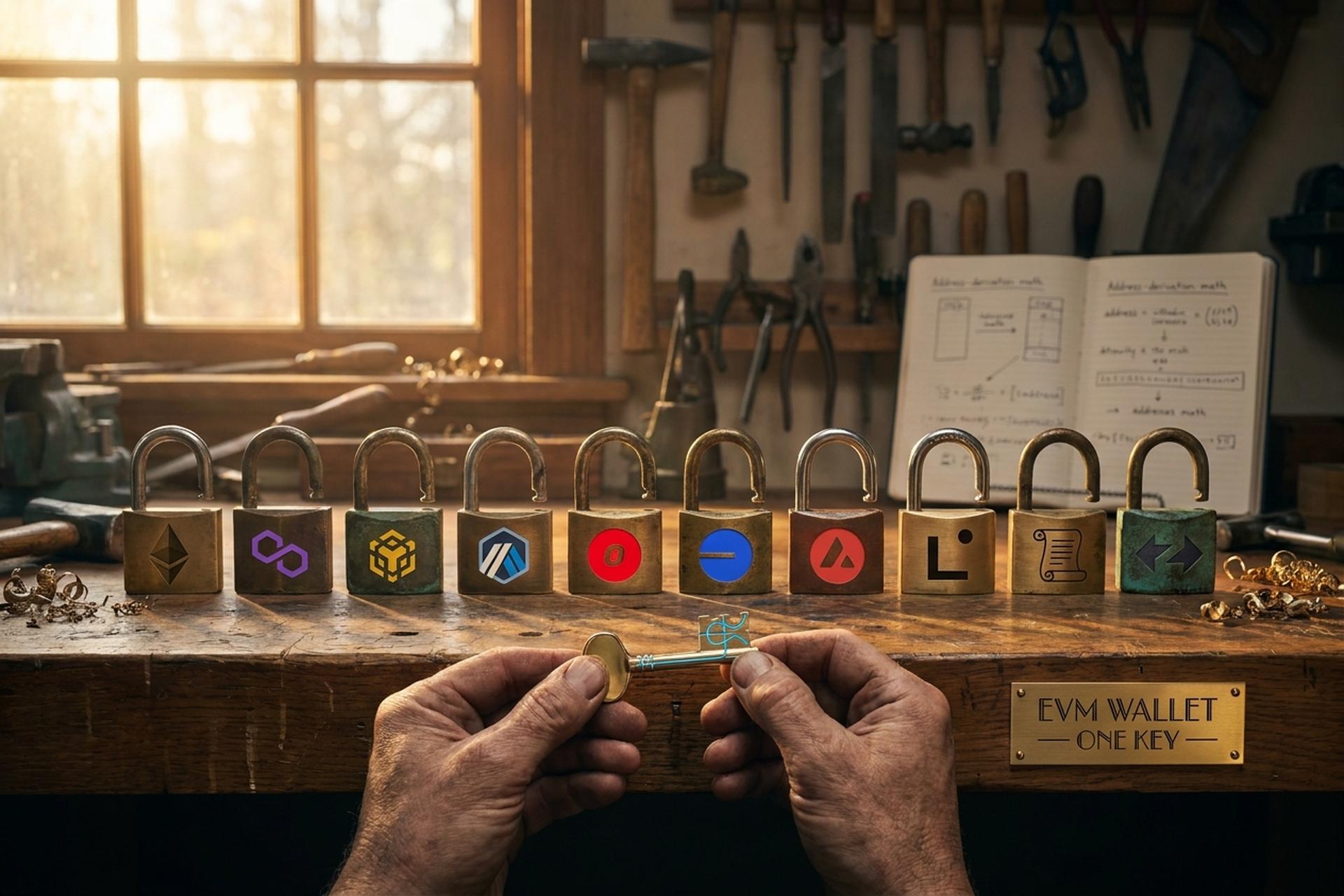
Here is the bit that trips up almost everyone the first week. The wallet does not store any ETH or USDC. It signs messages. The chains hold the balances. Your `0x` address shows up on Ethereum mainnet, Polygon, BNB Chain, Arbitrum, Optimism, Base, Avalanche, Linea, Scroll, zkSync, and dozens of smaller chains nobody talks about until something rugs. Every network keeps its own ledger of who owes what to that one address. One key. Sixty-plus ledgers. All tied together by a shared bytecode spec called the Ethereum Virtual Machine.
Lose the key, you lose all of it. Not on one chain. On all of them, at the same time. That is why the first hour with an EVM wallet matters more than the next two years of picking which one has the nicer dark mode.
How EVM wallets work: the Ethereum Virtual Machine layer
The Ethereum Virtual Machine is a stack-based state machine. It runs smart contract bytecode. Every EVM chain (Polygon, BNB Chain, Base, Arbitrum, the rest) executes identical opcodes against an identical address-space convention. One decentralized wallet talks to all of them because, from the wallet's perspective, every chain is the same machine running in a different room.
Press "send" and four things happen, in this order. The wallet drafts a transaction: recipient, amount, gas price, nonce. It signs that draft locally; your key never leaves the device. The signed bytes get pushed to an RPC node, typically Infura, Alchemy, or a public endpoint someone is graciously running for free. Validators pick it up, include it in the next block, and the EVM mutates the chain's state. A few seconds on Base. Twelve seconds on Ethereum. Sometimes longer if gas is tight.
A dapp connection is the same loop, just kicked off from a website. The application sees your address. Nothing else. When the dapp wants a token swap, an NFT mint, a vote, anything at all, it asks the wallet to sign. You read the prompt. You sign or you don't. If you don't read the prompt, that is when expensive mistakes happen. Every wallet on the market (MetaMask, Rabby, Trust, Phantom, Coinbase, OKX) runs this same loop. The differences are interface, chain coverage, security warnings, and how the wallet handles recovery. A user-friendly EVM wallet is one that makes the signing prompt readable instead of cryptic.
Types of EVM wallets: hot, hardware, and smart
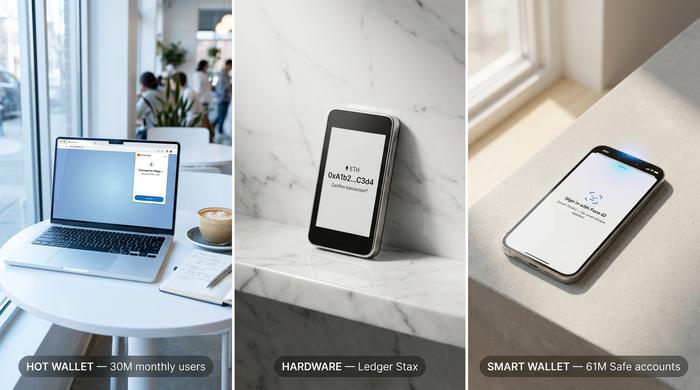
Three real categories in 2026, plus a hybrid that arrived with Pectra.
| Type | Examples | Pros | Cons | Best for |
|---|---|---|---|---|
| Hot (browser/mobile) | MetaMask, Rabby, Phantom, Trust, Coinbase, OKX | Free, fast, dapp-native | Private key in software, drainer risk | Daily DeFi, small balances |
| Hardware | Ledger Stax, Trezor Safe 7, CoolWallet | Key in chip, immune to malware | Cost, slower signing, supply-chain risk | Balances above $10K |
| Smart wallet (ERC-4337) | Safe, Coinbase Smart Wallet, Argent | Multi-sig, passkey login, social recovery | Deployment gas, contract risk | New users, treasuries |
| Smart EOA (EIP-7702) | MetaMask, Ambire | Keep your address, get smart features | New attack surface | Power users post-Pectra |
Numbers first. MetaMask hovers near 30 million MAU on the Blockworks 2024 baseline and has not really grown in two years. Trust Wallet boasts about 220 million installs, but a chunk are clearly dormant. Phantom comes in at 15 to 17 million MAU after rolling out EVM support, OKX shows roughly 50 million downloads across 100-plus chains, and Rabby (which DeBank picked up for the simulation-first design) reports 4.2 million installs as of last year. The interesting feature is what they share. None of these companies can move your funds. They ship the interface; you keep the key.
What about the cold side? Ledger refreshed its lineup in October 2025 with a Nano Gen5 at $179, a Flex at $249, and a touchscreen Stax at $399, then booked $181.5 million of 2025 revenue, up 31% year on year. Trezor came back with the Safe 7 the same month, marketed as quantum-ready and IP67-rated. Pick one and the trade-off is the same as it has always been: signing is slower, the device costs money, you have to plug it in. In return your private key spends its life inside a chip that has never touched the open internet, which is the only durable answer to malware.
The smart-wallet category is moving the fastest of the three. Cumulative ERC-4337 accounts crossed 40 million in early 2026, and Safe alone secured $35.25 billion across 61.11 million accounts in Q1 2026, roughly a third of all EVM DeFi total value locked. Coinbase Smart Wallet reached 1 million users in August 2025 by killing the seed phrase entirely and using a device passkey on iOS and Android. To me that one design move matters more than the rest of the smart-wallet roadmap combined, because people lose folded paper. They tend not to lose Face ID.
Best EVM wallets in 2026 by category and use case
| Wallet | Type | Standout feature | Hardware support |
|---|---|---|---|
| MetaMask | Hot + Smart EOA | Snaps + EIP-7702 Smart Account | Yes |
| Rabby | Hot | Pre-tx simulation, risk alerts | Yes |
| Coinbase Wallet | Smart Wallet | Passkey login, no seed phrase | Yes |
| OKX Wallet | Hot multichain | 100+ chains, swap aggregator | Yes |
| Phantom | Hot multichain | Solana + EVM + Bitcoin | Yes |
| Ledger Stax | Hardware | E-ink touchscreen, $399 | n/a |
| Safe | Smart Wallet | Multi-sig for treasuries | Yes |
MetaMask is the default starting point for a reason: every dapp expects it, the Snaps ecosystem extends it to non-EVM chains, and the May 2025 Smart Account rollout lets users upgrade an existing address to EIP-7702 batched transactions in one click. The downside is also predictable: it is the most-targeted phishing surface in crypto.
Rabby is the wallet I now recommend for anyone making more than a few DeFi transactions a week. Its pre-transaction simulator shows what each signature will actually do, flagging permit2 traps and approval drains before you click. The DeBank team acquired it, which means continued funding rather than maintenance mode.
Coinbase Wallet ships with the cleanest Smart Wallet experience for new users. You sign up with a passkey on a phone, no seed phrase to lose, no gas to manage on Base. The trade-off is that Coinbase controls the recovery infrastructure, so you trade absolute self-custody for usability.
OKX Wallet is the cross-chain workhorse. Built-in swap aggregation across more than 100 chains, an integrated NFT marketplace, and one of the better account-abstraction implementations outside the pure ERC-4337 stack.
Phantom moved from Solana-only to multichain in 2024 and now supports EVM and Bitcoin. The mobile UX remains the best in the category; users who want one wallet for Solana memecoins and EVM blue chips usually end up here.
Hardware is non-negotiable above a five-figure balance. Ledger Stax with the e-ink screen and Trezor Safe 7 are the current flagships; the cheaper Nano Gen5 and Trezor Safe 5 do the same job for less money. Pair them with a software EVM wallet like MetaMask or Rabby for everyday signing.
Safe is the answer when balances or governance require more than one signature. Multi-sig with configurable thresholds, modular extensions for spending limits and automation, and the largest auditing footprint of any smart-contract wallet on Ethereum.
EVM wallet security: drainer attacks and ERC-7702
This is where most EVM wallet guides hand-wave. Get specific.
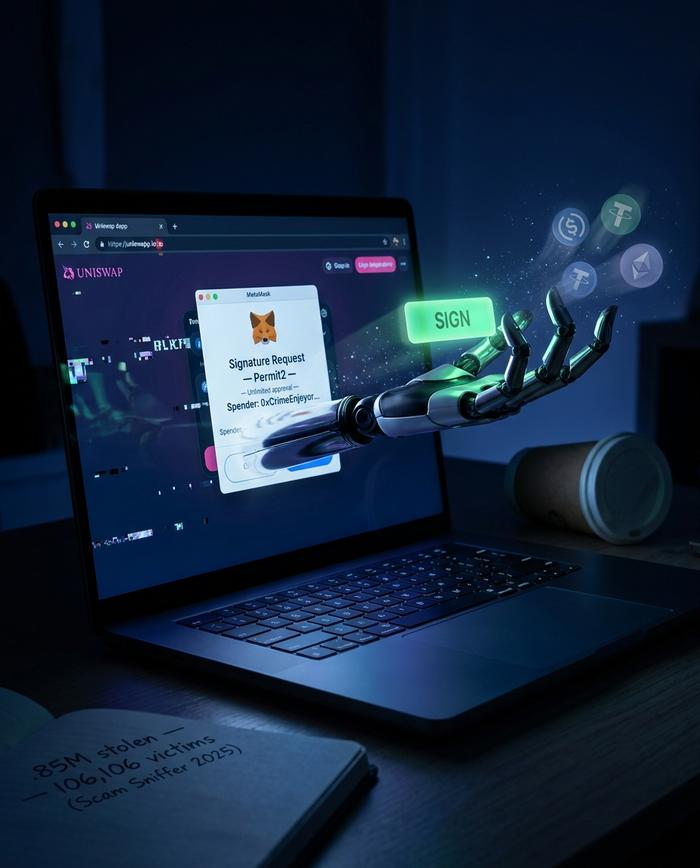
Wallet drainers had a brutal but improving year. Scam Sniffer recorded $83.85 million stolen from 106,106 victims in 2025, down roughly 83% in dollars and 68% in victim count from 2024's $494 million / 332,000 victims. The biggest single phishing loss was a $6.5 million theft via a malicious Permit signature in September 2025 (Scam Sniffer). The decline is real but the absolute number is still nine figures, and it landed on users who clicked the wrong "Confirm" button on what looked like a routine signature prompt. Most of those prompts arrived through fake decentralized finance dashboards and airdrop claim pages.
The mechanics matter. Most drainer kits, including Inferno Drainer, Pink Drainer, and Angel Drainer, rely on three specific tricks. The first is `eth_sign` blind signatures, where the wallet shows a hash and the user has no way to read what they are signing. The second is ERC-20 `permit` and Uniswap's `Permit2`, which let an attacker drain tokens without an on-chain approval transaction. The third is malicious dapp websites that mimic legitimate ones; Etherscan's phishing-address registry has been the canonical defense.
Then came EIP-7702. Pectra activated on May 7, 2025, and added the ability for any EOA to delegate execution to a smart-contract template. The good version: your MetaMask address gets gas sponsorship, batched approvals, and session keys. The bad version arrived inside weeks. Wintermute reported in mid-2025 that more than 97% of EIP-7702 delegations on mainnet pointed to identical sweeper contracts that researchers nicknamed "CrimeEnjoyor" — automated drainers waiting for any incoming asset to be re-delegated to them. One confirmed phishing loss reached $1.54 million from a single compromised address.
Supply-chain attacks are the other wallet-security wildcard. The Ledger Connect Kit incident in December 2023, with about $610,000 drained after a former employee's NPM token was compromised and patched within roughly 40 minutes, remains the canonical example. Chainalysis put the broader 2025 figure at $3.4 billion stolen across the crypto ecosystem, dominated by the $1.5 billion Bybit hack and $2.02 billion attributed to DPRK operators, though personal-wallet theft fell to $713 million from $1.5 billion the year before.
A separate phishing technique that grew through 2025 is address poisoning: an attacker sends a zero-value transaction from a lookalike address that shares the first and last four characters of an address you recently used, hoping you will paste it from your history. Coinbase and MetaMask both added in-wallet warnings for this in late 2024, but the attack still works on users who copy from a block-explorer screen. Periodic approval cleanup at Revoke.cash or Etherscan's token approval tool removes another whole category of dormant attack surface.
Three rules cover most of the risk for any EVM wallet user. Verify the contract address before any approval. Use a wallet that simulates transactions: Rabby, MetaMask's recent updates, and most hardware wallets now do this. And keep significant balances on a hardware device that requires physical confirmation; software wallets are for spending money.
How to set up your first EVM wallet
Setting up an EVM wallet is the moment your money leaves the bank's perimeter. Nobody but the keyholder can move funds again. No bank can freeze the account. The catch is operational: from now on you are the bank, the customer service desk, and the security team for that account. Plan for one hour, not five minutes.
Working steps. Download the wallet only from the official website or its app-store listing. Skip the search-engine ad on top; the sponsored result is often a phishing clone. Write the 12 or 24-word recovery phrase on paper, then store two copies in two physical locations. Never photograph the phrase. Inside the wallet, add only the chain you actually plan to use first (Base or Arbitrum for low fees, Ethereum mainnet for high-value transfers), and confirm the chain ID against chainlist.org so you do not accidentally add a spoofed network. Move a small test transaction next, five or ten dollars, before sending anything meaningful. When you pair a hardware device later, set both a PIN and a passphrase. The passphrase opens a second hidden wallet that still works even if the paper seed leaks.
Now the opinion. Anyone holding more than a couple of thousand dollars on-chain in 2026 should already be using a hardware wallet. Anyone opening a fresh address this year should at least try a passkey smart wallet before defaulting to MetaMask. The seed-phrase model came from a time when crypto was a hobby; it does not survive contact with how non-technical people actually use their phones. Whether smart-wallet UX can make self-custody feel as routine as opening a banking app, without giving up the part that made self-custody worth the trouble, is the question that decides the next year of EVM wallet design.



