
Utility Tokens vs Security Tokens in Crypto: 2026 Guide
Most people who own a "utility token" could not tell you, in legal terms, what they actually own. They know the token gets them cheaper trading fees, a vote in a protocol, or access to a game. What they do not know is whether a US regulator could one day flip it into an unregistered security, which would force exchanges to delist it overnight. That distinction is what this guide is about. It covers what a utility token is, where it differs from a security token, what the most-used examples actually do on-chain in 2026, and why the regulatory line has quietly shifted in the past 18 months. By the end, you should be able to look at any token and decide whether it has real utility, real risk, or only the appearance of both.
What is a utility token in crypto?
The utility token definition is narrow but precise. It is a type of token built to provide access to specific services or a specific function inside a blockchain ecosystem. Nothing more. Utility tokens provide a way for users to interact with a decentralized product, and they grant holders access to whatever that platform offers. Some writers still call them "utility coins". The technical term is token, because they ride on a host blockchain platform rather than running their own chain.
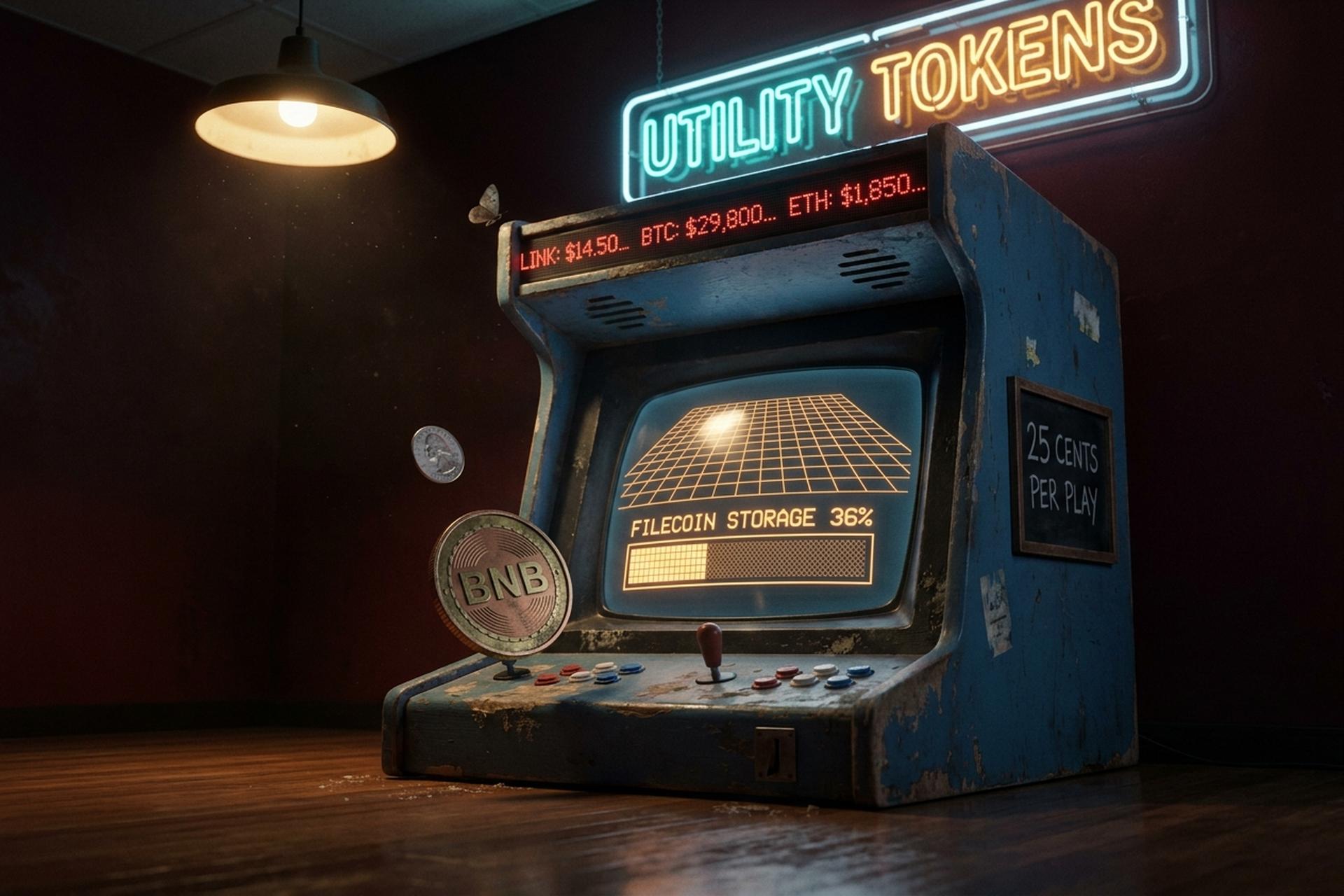
A simpler way to picture it: a utility token is closer to an arcade chip than to a stock certificate. The chip works inside one machine. Outside, it does almost nothing. Take BAT, the Basic Attention Token. Inside the Brave browser, users earn it for watching ads and creators get tipped with it. Outside Brave, BAT is just a tradeable digital asset on Ethereum.
Almost every utility token in circulation sits on top of an existing blockchain network rather than running its own. On Ethereum that means ERC-20. On BNB Chain, BEP-20. On Solana, SPL. Each standard sets out how the token contract handles balances and transfers, which is why any wallet that supports the standard supports the token.
How utility tokens work: smart contracts and the ERC-20 standard
The mechanism is less mysterious than crypto marketing suggests. A utility token is an entry in a smart contract: a piece of code that lives on a blockchain and tracks who owns how many units. Send the token, and the contract updates two balances. Spend it inside a dApp, and a function in that dApp consumes the tokens.
ERC-20, proposed by Fabian Vogelsteller in November 2015, is the reason this works across wallets and exchanges. The standard sets out six required functions every utility token contract has to expose: `transfer`, `balanceOf`, `approve`, and three others. Token issuance through these standards is what makes the system interoperable. By April 2026, Etherscan was indexing over 500,000 deployed ERC-20 contracts on Ethereum alone. BNB Chain hosts roughly 4.7 million BEP-20 tokens. Solana's SPL program minted around 18 million tokens in the past year, mostly through the Pump.fun launchpad. Most of those are dead, speculative, or both — but they all share the plumbing.
A detail that trips up beginners. Gas fees are not paid in the utility token itself; they are paid in the host chain's native asset. To spend BAT on Ethereum you also need a bit of ETH. To trade a BEP-20 token on BNB Chain, you need BNB. That is why ETH, BNB, and SOL are themselves utility tokens of a different category, paying for the operation of the network underneath.
| Standard | Host chain | Use |
|---|---|---|
| ERC-20 | Ethereum | Fungible utility tokens |
| BEP-20 | BNB Chain | Fungible utility tokens |
| SPL | Solana | Fungible utility tokens |
| TRC-20 | Tron | Fungible utility tokens, USDT-heavy |
Key differences between utility tokens and security tokens
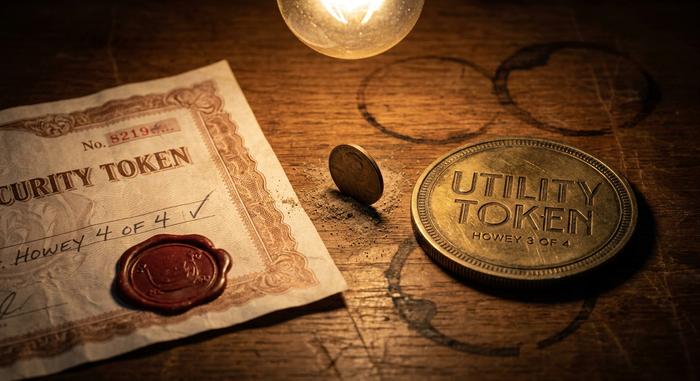
The legal split is not a marketing choice. It is decided by the Howey test, a 1946 US Supreme Court doctrine that asks four questions about any asset offered for sale: was there an investment of money, into a common enterprise, with an expectation of profit, derived from the efforts of others? If all four are met, the asset is a security. If only some are met, it may not be. Utility tokens are designed, in principle, to fail the fourth prong — the value of utility tokens should depend on user activity, not on the founding team's continued promotion. Security tokens represent ownership in an underlying asset or enterprise, which is why they fall under existing securities regulations. The choice between utility tokens or security tokens, then, is largely a question of who the token is sold to and what claim it carries.
In practice, that line has been argued in court for years. The Telegram case in 2020 produced a $1.7 billion settlement with the SEC over its GRAM tokens, the early benchmark for what the agency saw as a security disguised as a utility. Ripple is the more important precedent now. Judge Analisa Torres ruled in 2023 that programmatic XRP sales on exchanges were not securities, even though institutional sales were. The SEC and Ripple dropped their cross-appeals in August 2025, with Ripple paying a $125 million civil penalty.
Then the US position pivoted. Under new leadership, the SEC dismissed its lawsuits against Coinbase on February 27, 2025, Uniswap on February 25, and Binance on May 29. President Trump signed the GENIUS Act on July 18, 2025, the first federal framework for payment stablecoins, explicitly carving them out of the "security" and "commodity" categories. None of this means utility tokens are now legal everywhere by default — only that the most aggressive enforcement campaign in crypto history was halted.
In Europe, MiCA went fully live on December 30, 2024 and treats utility tokens as a separate category from asset-referenced tokens and e-money tokens. By mid-2025, ESMA reported more than €540 million in MiCA-related penalties and over 40 issued CASP licenses. The transition window for existing tokens closes on July 1, 2026.
| Feature | Utility tokens | Security tokens |
|---|---|---|
| Primary purpose | Access to a service | Investment / ownership |
| US legal test | Generally fails Howey | Meets Howey |
| Typical examples | BNB, LINK, BAT, FIL | Tokenized equity, debt, real estate |
| EU regulation | MiCA Title II | MiFID II / Prospectus Regulation |
| Profit expectation | From use, not promotion | From issuer's efforts |
Examples of utility tokens: BNB, LINK, BAT, FIL, SAND
Five tokens cover most of what the category does in practice. Their 2026 numbers tell very different stories.
Start with BNB, often pitched as the top utility token by market cap. It pays for gas on BNB Chain and discounts trading fees on Binance. Market cap sits somewhere between $87 and $106 billion in May 2026, depending which feed you trust; daily volume swings between $700 million and $2.7 billion across CoinGecko and CoinMarketCap. About 45% of the original supply has been burned through quarterly burns linked to platform revenue — the closest thing crypto has to a share-buyback.
Chainlink (LINK) sits in a different lane. Node operators get paid in LINK to push external data into smart contracts, and the oracle network's Total Value Secured peaked above $100 billion on DeFiLlama in September 2025. By April 2026 that number had compressed to roughly $40 to $42 billion. Not a loss of integrations; just the broader DeFi pullback.
BAT is the outlier on user count. Brave browser passed 100 million monthly active users in 2025, and more than a million verified creators receive BAT tips. Most layer-1 chains do not have that kind of reach.
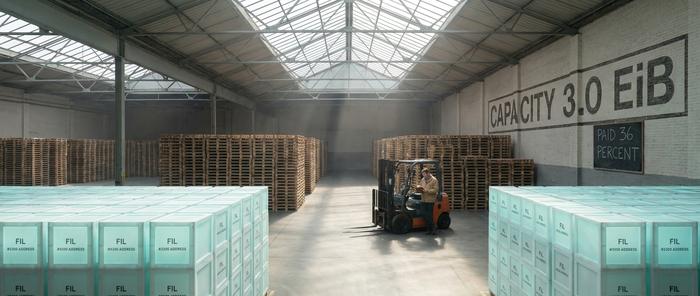
Filecoin (FIL) pays for decentralized storage. Messari's Q3 2025 report shows committed capacity of 3.0 exbibytes, down about 10% quarter on quarter, while paid utilization rose from 32% to 36%. The headline shrank. The share of storage someone is actually paying for grew.
And then there is The Sandbox, the cautionary one. SAND trades around $0.079 in May 2026, roughly 99% below its November 2021 peak of $8.40 per CoinMarketCap. Content still ships. The early metaverse demand never came back.
| Token | Function | 2026 metric | Source |
|---|---|---|---|
| BNB | Exchange fee discount, gas on BNB Chain | $87–106B market cap | CoinMarketCap, May 2026 |
| LINK | Oracle service payment | $40–42B value secured | DeFiLlama, April 2026 |
| BAT | Browser ad rewards | 100M MAU on Brave | Brave, 2025 |
| FIL | Decentralized storage | 36% paid utilization | Messari, Q3 2025 |
| SAND | Metaverse access | -99% from ATH | CoinMarketCap, May 2026 |
Utility token use cases in 2026
After more than a decade of experimentation, the working use cases reduce to a short list. Almost every successful utility token does one of five things, and the failed ones usually do none.
The first is fee payment and discount. BNB on Binance, KuCoin's KCS, GMX's GMX — holders pay reduced trading fees, and the platform burns a share of revenue to support price. The second is paying for a real-world service. FIL for storage, LINK for oracle calls, AR for permanent file storage, RENDER for GPU compute. These tokens have something close to a price floor because someone needs them to run a job, not as an investment. The third is gating access. SAND and MANA used to buy virtual land; ApeCoin to access Otherside; many DePIN networks require their token to register a device. The fourth is governance-lite voting, where governance tokens are used to incentivize participation: holders vote on protocol parameters, treasury, or fees. UNI is the most-cited example, though governance participation in major DeFi protocols rarely exceeds 5% of supply. The fifth is staking for security and yield: tokens locked into a protocol earn a share of fees or new emissions. ETH, AVAX, and many layer-1 native tokens fit this pattern, and so do liquid-staking derivatives like Lido's stETH.
A working utility token usually combines two or three of these. BNB pays gas on BNB Chain, discounts fees on Binance, and can be staked. LINK pays oracle nodes and can be staked into Chainlink's CCIP service. The failures usually had only the appearance of utility — a "governance" vote that decided nothing material, or "access" to features anyone could use without holding the token. The user count is the test. By a16z's 2025 State of Crypto report, 40 to 70 million people transact on-chain monthly out of about 716 million crypto holders globally. Real utility tokens draw from that 40–70 million, not the larger passive holder base.
Issuing utility tokens: ICOs, airdrops, and what changed
The way utility tokens get distributed has shifted twice in the last eight years. The first wave, the ICO era of 2017–2018, peaked near $11.4 billion in 2018 before collapsing under SEC enforcement and scams. Most ICO tokens are worth less than 1% of their peak today.
The second wave is the airdrop and points-programme era. Projects launch the product first, attract users, and distribute the token retroactively. Uniswap's UNI airdrop in September 2020 paid 400 UNI (about $1,200 then) to every wallet that had used the protocol; many of those grew to $25,000 or more. Blur, Friend.tech, Hyperliquid, EigenLayer, and Jupiter followed variants of the same model in 2023–2024. The legal logic mirrors Ripple's programmatic-sales argument: without a public fundraising round, the Howey "investment of money" prong is harder to satisfy.
A third pattern, locked vesting with cliffs, runs alongside both. Team and investor allocations unlock over two to four years, which limits early sell pressure but creates predictable supply overhangs the market prices in advance.
Investing in utility tokens: what to evaluate, what to skip
Utility tokens are volatile in price by nature, and a utility token's price reflects two things: token demand from token holders who actually use the product, and the token supply schedule. Most failed tokens collapsed because the supply schedule was real and the demand was not.
Three checks settle most decisions. Active addresses measure whether anyone is using the underlying product. A token whose addresses are flat but whose price is rising is usually being moved between exchanges, not used. Fee revenue captured by the token measures whether holders share in the protocol's economics. Protocols like Aave, MakerDAO, and GMX redistribute a portion of fees; many "governance" tokens redistribute nothing. Insider unlock schedules drive the supply side and are publicly viewable on dashboards such as TokenUnlocks and CryptoRank; if 40% of supply unlocks to a single venture investor in the next 12 months, that is the dominant variable in price, not anything the team announces.
The textbook example is FTT, the FTX exchange token. CoinGecko Research documented FTT falling from $22.14 to $3.15 in the hours after CoinDesk's November 2, 2022 leaked-balance-sheet report, vaporizing more than $2.6 billion in market cap. The token had a "utility" — fee discounts on FTX — but its value was tied to the solvency of the parent exchange. When the exchange failed, the utility evaporated, and holders of utility tokens issued by centralized companies were left carrying counterparty risk that was invisible until the day it mattered.
Risks and regulatory uncertainty
Regulatory risk has eased in the US. The EU framework is now structured. The operational risks have not changed at all. Chainalysis's 2026 Crypto Crime Report logged $154 billion in illicit cryptocurrency flows in 2025, a 162% year-over-year jump. Roughly $3.4 billion of that came from hacks, with the Bybit incident in February 2025 alone draining $1.5 billion — the largest single crypto theft on record. Stablecoins, not utility tokens, accounted for 84% of that illicit volume. The smart-contract bugs that enable these thefts hit any token deployed in DeFi all the same.
The other big risk is ecosystem dependency. A utility token only works if its host application keeps working. If a layer-1 chain loses developers, or a DeFi protocol gets drained, or a metaverse never finds users, the token collapses regardless of legal classification. The crypto utility on offer disappears with it. Terra is the cleanest example. In May 2022, roughly $40 billion in market value across LUNA and UST evaporated in three days, and many tokens used inside the Terra ecosystem went to zero alongside it. For holders of utility tokens in crypto, counterparty and protocol risk dominate the exposure far above the residual risk of a security reclassification.
Conclusion: utility tokens in crypto, in practice
Utility tokens are a real product category, but the label tells you almost nothing on its own. The question that matters is whether anyone is using the underlying product, and whether holders of the token capture some of the economics. Real demand inside a working application is the only durable source of value. Everything else, from regulatory classification to marketing narrative to the price chart, sits downstream of that single variable.



