Basescan in 2026 : How to Use the Base Explorer and Query the API
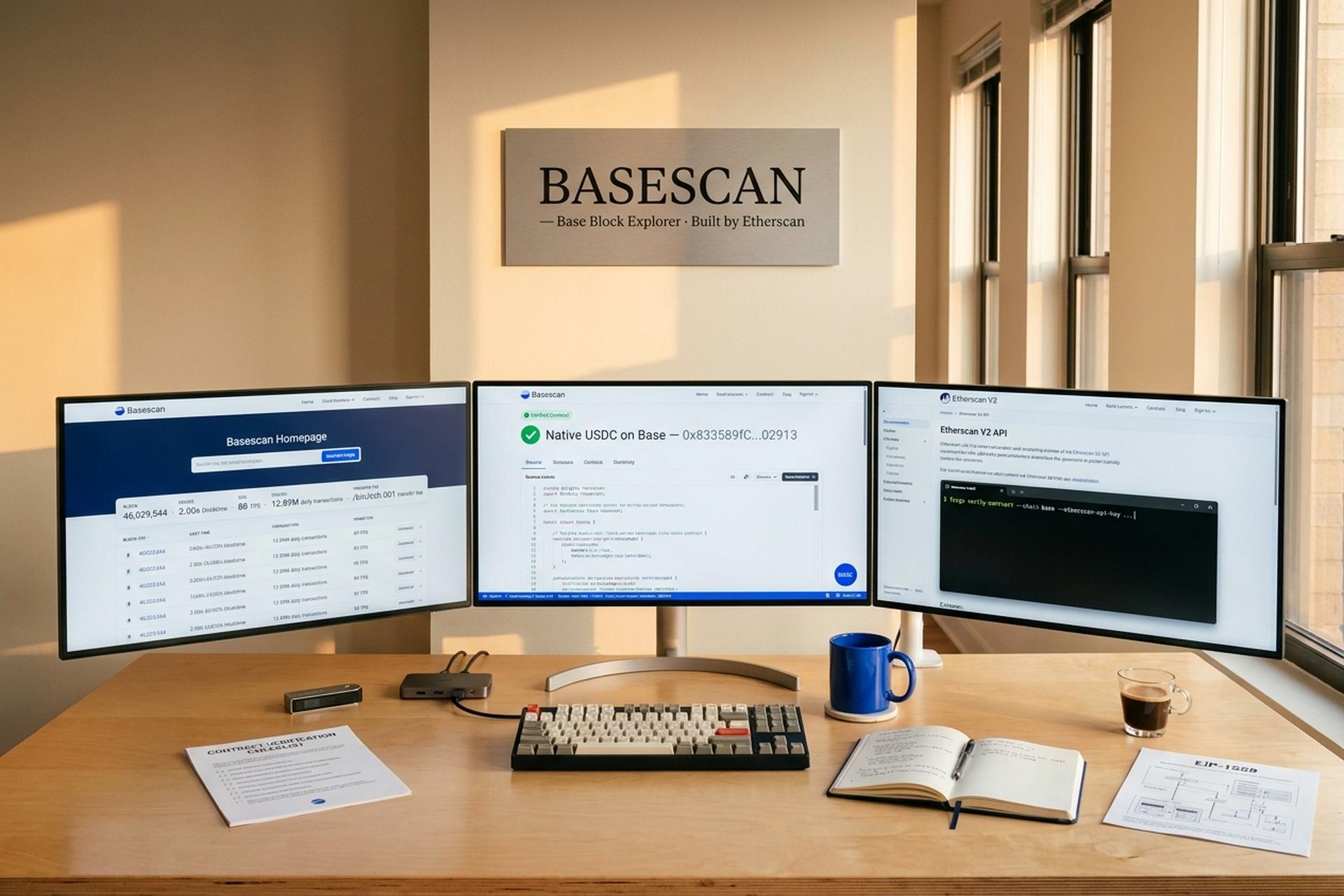
Base processed roughly 12.89 million transactions a day on average through the first half of 2026, with about 382,500 daily active addresses, $7.8 billion in total value locked, and a network throughput hovering around 88 transactions per second. The explorer that shows you all of that — the Etherscan-team-built site at basescan.org — is the canonical way to read what is actually happening on the chain. Most Base users, builders, and merchants will encounter Basescan within hours of touching the network.
This rewrite covers what Basescan is, how the data behind the dashboard gets there, every feature worth knowing in 2026 (token tracker, gas tracker, contract verification, approval checker, AA transactions, EIP-7702 authorizations), the Etherscan V2 API that replaced the old version in May 2025, and how merchants on Plisio can use the explorer to reconcile incoming USDC payments. The article is for readers who want more than the brochure pitch. If you have used Etherscan already, most of this will read as familiar, with a handful of Base-specific quirks that matter operationally.
What Basescan Is and Who Operates It
Basescan is the block explorer for Base. Coinbase's Layer 2, Optimism-based, lives on Ethereum, and the explorer that reads it launched on the same day Base mainnet opened to the public: August 9, 2023. The team behind Basescan is the Etherscan team, same group that runs Etherscan.io and the EVM-explorer family covering BNB Chain (BscScan), Arbitrum (Arbiscan), Polygon (PolygonScan), and a handful more. The codebase is shared. So is the UI. So is the URL structure. If you've used Etherscan, you already know how to use Basescan.
What is the explorer actually doing under the hood? It runs full nodes on Base. It indexes every block, transaction, address, contract, token transfer, and event log into a queryable database. It exposes the result through a web interface and a paid/free API. The data flow goes Base node → RPC stream → indexer → relational storage → web/API surface. Latency on new blocks is sub-second.
A Snapshot of Base Network in May 2026
The numbers below are what Basescan's homepage shows alongside the live block ticker on a typical May 2026 day.
| Metric | Value (May 2026) | Source |
|---|---|---|
| Block time | ~2.00 seconds | Basescan / Base docs |
| Daily transactions | ~12.89M | RootData |
| Daily active addresses | ~382,500+ | Blockscout stats |
| Cumulative transactions | ~6.39B | Basescan home |
| Throughput | ~88 TPS | Basescan home |
| Minimum base fee | 0.005 gwei | Basescan gas tracker |
| Typical ERC-20 transfer cost | ~$0.001 | Basescan gas tracker |
| Typical swap cost | ~$0.002 | Basescan gas tracker |
| TVL | ~$7.8B (peak ~$10.7B 2026) | DefiLlama via RootData |
Base TVL has roughly quintupled over the eighteen months from October 2024 ($2.1B) into early 2026. The chain hit a peak of around $10.7 billion before settling near $7.8B in March 2026 amid sector-wide TVL compression. None of that, importantly, dented daily transaction or address counts, which suggests the on-chain activity is broadening rather than concentrating in a small set of yield protocols.
The dominant DeFi protocol on Base is Aerodrome, which processed roughly $13.3 billion in 30-day spot volume as of May 2026 and generated approximately $99.3 million in annualized fees, per DefiLlama. Aerodrome's TVL has compressed from its $1B+ December 2025 peak to around $384 million following the January 2026 announcement that Dromos Labs is merging Aerodrome (Base) with Velodrome (Optimism) into a unified DEX called Aero, expanding to Ethereum and Circle's Arc chain in Q2 2026. The Basescan address book has Aerodrome's main contracts pre-labeled, which makes tracing liquidity flows on the protocol trivial.
Core Features: What You Can Actually Do on Basescan
In order of how often people actually use them:
Transaction lookup. Paste the 0x-prefixed transaction hash into the search bar at basescan.org. The page returns the full record — status, block number, timestamp, sender, recipient, gas used, gas fee in both ETH and USD, every token transfer inside the transaction, and decoded function-call data if the destination contract has been verified. This is the most common entry point.
Address lookup. Drop any wallet or contract address into the same search bar. Back come balances (ETH plus every ERC-20 the address has ever touched), the paginated transaction history, all token transfers, NFTs held, internal calls, and a colored tag if the address is a known entity in Basescan's label cloud.
Contract page. Verified contracts are where Basescan gets interesting. Source code is on display — Solidity or Vyper. The ABI sits beside it. Two interactive panels matter: Read Contract for free in-browser view-function calls (handy for sanity-checking a token's totalSupply or a vault's pricePerShare without writing a script) and Write Contract, where users connect a wallet — MetaMask, Coinbase Wallet, Rabby — and submit live transactions from the explorer UI.
Token tracker. The Token Tracker section indexes every ERC-20, ERC-721, and ERC-1155 token deployed on Base. Each token has a page showing holders, transfers, contract code, and market data when available. Native USDC on Base, for example, lives at `0x833589fCD6eDb6E08f4c7C32D4f71b54bdA02913`, the Circle FiatTokenProxy with six decimals. The legacy bridged USDbC at `0xd9aAEc86B65D86f6A7B5B1b0c42FFA531710b6CA` is being phased out and merchants should standardize on the native contract. USDC adoption on Base has grown rapidly: daily active USDC users hit roughly 83,400 in November 2025, up 233 percent year over year from 25,100 in November 2024, per RootData.
Gas tracker. Live at basescan.org/gastracker. Shows the current base fee (typically 0.005 gwei), priority fee, and three example transaction costs in USD — a simple ETH transfer, an ERC-20 transfer, and a Uniswap-style swap. EIP-1559 on Base uses an elasticity multiplier of 6 and a base-fee-change denominator of 125, capping per-block base-fee moves at about 4 percent.
Contract Verification: Hardhat, Foundry, and the JSON Path
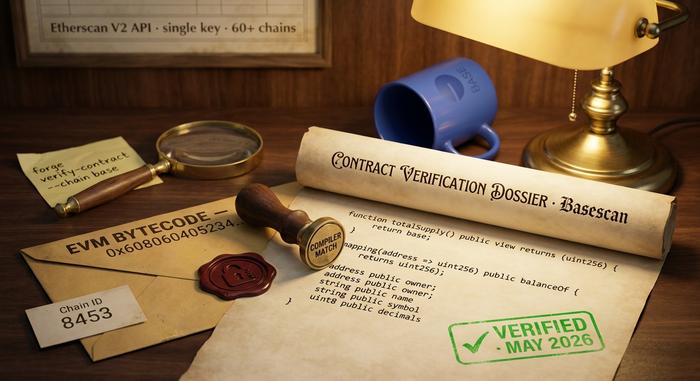
Verification is the step that turns a deployed contract from opaque bytecode into readable source. Without it, the explorer can show you what address holds a balance and what transactions touched it, but nothing about what the code actually does. Three workflows get you there.
The web UI path goes to basescan.org/verifyContract. Paste the address. Pick compiler version. Pick optimization settings. Upload your flattened source — or, for multi-file projects, the JSON input the compiler emits. Submit. A server-side check recompiles your source and matches the bytecode. If it matches, green check, source goes public.
The Hardhat path runs through the `@nomicfoundation/hardhat-verify` plugin. Drop your Etherscan V2 API key into `hardhat.config.ts` — same key for Base as for Ethereum mainnet, with Base on chain ID 8453 — and run `npx hardhat verify --network base
[constructor args]`. Flattening, multi-file uploads, JSON-input submissions all happen automatically.
The Foundry path is `forge verify-contract
: --verifier etherscan --etherscan-api-key --chain base`. Since the V2 API arrived, that key is multi-chain by default.
Once verified, the contract page wakes up. Read/Write Contract panels activate. Wallets, aggregators, debuggers, audit tools start treating the address as a known quantity.
The Etherscan V2 API: One Key for 60+ Chains
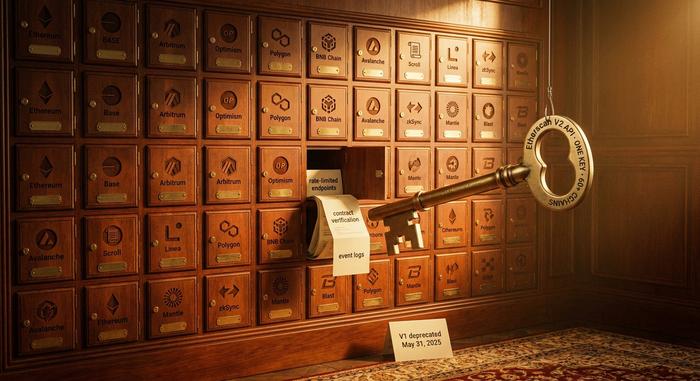
The big developer-facing change of 2024-2025 in the Etherscan ecosystem was the V2 API. Beta announcement: October 25, 2024. V1 deprecation: May 31, 2025. Full sunset: August 15, 2025. After that date, one API key covers more than sixty EVM chains. Base is one of them, reached via the `chainid` query parameter set to 8453.
What didn't change is the endpoint surface. Account balances, transactions, token transfers, contract source and ABI, block range queries, the gas oracle, event log filtering — all the same endpoints, all the same response shapes. What did change is that a developer building cross-chain tooling now keeps one key instead of juggling five.
Pricing tiers, applied uniformly across all Etherscan-family explorers:
| Tier | Price | Rate limit |
|---|---|---|
| Free | $0 | 3 calls/sec, 100,000/day |
| Lite | $49/mo | 5 calls/sec |
| Standard | $199/mo | 10 calls/sec |
| Advanced | $299/mo | 25 calls/sec |
| Professional | $399/mo | 50 calls/sec |
| Pro Plus | $899/mo | 100 calls/sec + dedicated support |
The free tier is enough for most hobbyist tooling, indie wallets, and small dashboards. The Standard tier and above unlock the throughput needed for serious on-chain analytics or merchant-side payment monitoring at scale.
Power-User Features: Approvals, AA Transactions, EIP-7702
A handful of newer Basescan tabs are worth knowing if you spend any time on Base.
Token Approvals Checker. Live at basescan.org/tokenapprovalchecker. Paste a wallet address and Basescan lists every active token approval the wallet has granted to dApps and contracts across ERC-20, ERC-721, and ERC-1155, with one-click revoke. This is the same problem Revoke.cash solves at the Ethereum mainnet layer, and the explorer-native version is the lowest-friction way to audit a Base wallet that has interacted with multiple DEXs and lending protocols.
Account Abstraction (AA) transactions. A dedicated tab in beta surfaces ERC-4337 user-operation transactions separately from regular EOA-signed transactions. Useful when debugging smart-wallet flows or auditing paymaster behavior.
EIP-7702 Authorizations. Following EIP-7702's mainnet activation, Basescan now indexes the authorization tuples that let EOAs delegate code execution to contracts for a single transaction. The Authorizations tab makes those delegations queryable per address, which matters for tracing newer smart-account designs.
L1 ↔ L2 message tracking. Native panels show both deposit transactions (L1 Ethereum to Base) and withdrawal transactions (Base to L1) with the seven-day challenge clock state. Anyone bridging significant value through bridge.base.org should use this view to confirm finalization status rather than waiting in the dark.
Address book and labels. Basescan maintains a curated label cloud for known contracts and named entities — exchange hot wallets, major DEX routers, token contracts, MEV bots, and protocol treasuries. Searching `Coinbase: Hot Wallet` or `Aerodrome: Router` returns the labeled address pages directly, which is faster than copying hex strings. Logged-in users can also maintain a private watchlist of addresses with email alerts for incoming transfers above a threshold, which is the lowest-friction way to monitor a treasury or operational hot wallet without standing up custom infrastructure.
Basescan vs Blockscout vs Routescan
Three legitimate alternatives exist, each with a use case.
Blockscout Base at base.blockscout.com is open-source under GPLv3 and self-hostable. The API surface is broader (REST v2, GraphQL, WebSocket, plus an Etherscan-compatible endpoint) and free without a key. Native OP Stack depth is better than Basescan for L2-specific tracing. If you need an indexer you control or you want GraphQL queries, Blockscout is the answer.
Routescan is a multi-chain aggregator covering 160+ EVM chains, including Base, behind an Etherscan-compatible API. Single key across all chains. Useful for developers shipping cross-chain tooling who do not want either an Etherscan or a Blockscout dependency.
OnchainKit from Coinbase is not an explorer at all. It is a React component library that surfaces on-chain data inside dApps and links out to a configured explorer — Basescan by default. Listed here because it shows up in searches; it is complementary to Basescan, not an alternative.
For most readers, Basescan is the right default. It is the highest-traffic explorer for Base by a wide margin, every wallet links to it, and the Etherscan family's UI patterns are universally familiar.
Plisio Merchants and Basescan: A Practical Workflow
The natural Plisio connection is reconciliation. Plisio accepts USDC alongside more than thirty other cryptocurrencies for merchant payments, with a flat 0.5 percent fee and non-custodial settlement. The June 2025 Coinbase, Stripe, and Shopify announcement about merchants accepting USDC on Base across 34 countries highlights the same rail.
For any merchant accepting USDC paid in over Base, the verification workflow is short:
1. Plisio reports a payment with a transaction hash.
2. Paste the hash into basescan.org's search bar.
3. Confirm sender address, amount, token contract (the Circle native USDC at `0x833589fC...02913`, not the legacy USDbC), and finalization status.
4. For periodic auditing, point a sheet at the Etherscan V2 API with the wallet address and pull the latest token transfers programmatically. Free-tier rate limits handle several thousand reconciliations per day at no cost.
The same workflow works for any incoming token transfer, not just USDC, and replaces the more cumbersome step of asking the customer for proof of payment.