Is HIVE Stock a Buy? Bitcoin Mining, AI Pivot 2026
HIVE stock is one of the few tickers wired to two of the loudest trades on the market at the same time: Bitcoin and artificial-intelligence compute. The trouble is that, right now, those two trades are pulling in opposite directions. Bitcoin has fallen hard from its 2025 peak, while demand for AI computing power keeps climbing. HIVE Digital Technologies, listed as HIVE on both the Nasdaq and the Toronto Stock Exchange, sits squarely in the middle of that tension.
Here is the puzzle that frames the whole stock. In its 2026 fiscal year, HIVE's revenue nearly tripled, yet the company still reported a net loss and the shares trade in the middle of their range rather than near the highs. That gap is not an accounting glitch. The market is no longer pricing HIVE as a quarter-to-quarter Bitcoin miner. It is pricing a transition. This article explains what HIVE actually does, what moves the share price, the AI pivot that has become the real story, and the risks worth weighing before anyone treats it as a buy.
What is HIVE Digital Technologies?
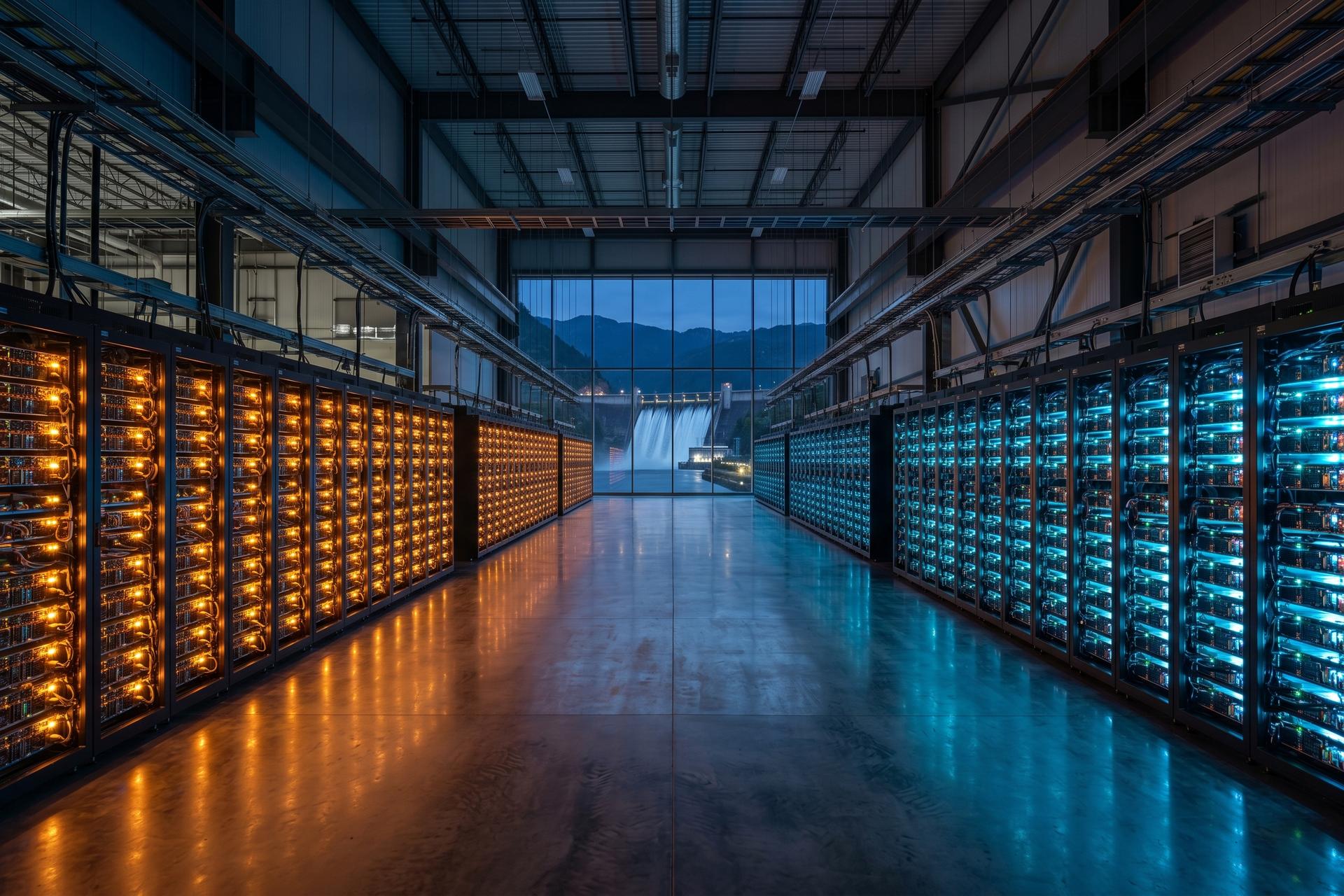
HIVE is a Canada-based digital-infrastructure company. In plain terms, it owns and runs large warehouses full of specialized computers, and it earns money two ways: by mining Bitcoin and, increasingly, by renting out graphics-processing power to companies that need it for AI work. Its facilities sit in Canada, Sweden, and Paraguay, chosen mostly for access to cheap, low-carbon hydroelectric and renewable energy, which is the single biggest cost in this business.
The company has been around longer than most of its peers. It started with roots in Genesis Mining and, back in 2017, became the first crypto miner to list on a major stock exchange, then under the name HIVE Blockchain. The 2023 rename to HIVE Digital Technologies was not cosmetic. It signaled the ambition to be a broad data-center operator, not just a coin producer. In 2026 the company up-listed to the main Toronto Stock Exchange board alongside its Nasdaq listing.
Why should a reader outside crypto care? Because HIVE is one way to get stock-market exposure to both Bitcoin mining and AI infrastructure without personally holding any coins or buying any GPUs. That convenience is also the catch, as we will see, because it bundles two very different risk profiles into a single share price.
What actually drives HIVE stock?
Four forces move this stock, and it helps to take them in order.
The first is the Bitcoin price, and the link is unusually direct. Unlike some rivals that hoard the coins they mine, HIVE keeps almost no Bitcoin on its books, roughly 150 BTC, worth only about $10.8 million at the close of its fiscal year. It sells most of what it mines to fund operations and growth. The practical effect is that HIVE's mining revenue tracks the Bitcoin price in close to real time, which makes the stock behave like a high-beta proxy for Bitcoin: when the coin rises, HIVE tends to rise faster, and when it falls, HIVE usually falls harder.
The second force is hashrate, the industry's word for how much mining power a company runs, measured in exahashes per second (EH/s). More hashrate means a bigger share of the daily Bitcoin issued to miners. HIVE grew its installed hashrate roughly fourfold in a single year, from about 6.5 EH/s to 25.1 EH/s, and management has set a target above 35 EH/s. That kind of expansion is the clearest reason revenue climbed so fast.
The third force is the AI and high-performance-computing story, which we will come back to, because it is the part of the business the market is most excited about even though it is still small.
The fourth force is dilution. To fund all this growth, HIVE regularly issues new shares. Each new share means existing holders own a slightly smaller slice of the company, so even when the business grows, the per-share value can lag. It is a recurring drag worth keeping in view.
Underneath all of this sits mining economics. The 2024 Bitcoin halving cut the reward miners earn per block in half, so efficiency, cheap power, and scale now decide who stays profitable. The table below summarizes where the stock stood in early June 2026.
| HIVE stock snapshot | Figure (as of June 4-5, 2026) |
|---|---|
| Share price | ~$4.37 |
| Market capitalization | ~$1.17 billion |
| 52-week range | $1.60 - $7.84 |
| Shares outstanding | ~253-267 million (rising) |
| Analyst consensus | "Strong Buy" |
| Average analyst target | ~$5.80 |
| Listings | Nasdaq and Toronto Stock Exchange |
Reading HIVE's FY2026 earnings
The headline is genuinely strong. For the fiscal year ended March 31, 2026, HIVE reported total revenue of $297.8 million, up 158% year over year, according to the company's FY2026 results. Tripling revenue in twelve months is rare, and it came from that fourfold hashrate increase and the Paraguay build-out.
But the split inside that number tells the real story. Bitcoin mining brought in $278.3 million, or 93.4% of revenue. The AI and high-performance-computing side contributed $19.5 million, just 6.6%. In two figures, that is the entire investment debate: HIVE talks like an AI company but still earns its keep almost entirely as a Bitcoin miner.
Profitability needs a careful read, because the headline loss can mislead. HIVE produced a gross operating margin of $107.9 million (36.2%) and adjusted EBITDA, a rough proxy for operating cash generation, of $72.9 million. Yet it reported a net loss of $148.4 million. The difference is mostly accounting: roughly $221 million of non-cash items, such as the changing book value of equipment and digital assets, ran through the income statement. So the business generated real operating cash even as the formal bottom line showed a loss. For a non-finance reader, the lesson is simple: a reported "net loss" here does not automatically mean the company is bleeding cash on its core operations.
| FY2026 (year ended March 31, 2026) | Amount | YoY |
|---|---|---|
| Total revenue | $297.8M | +158% |
| Bitcoin mining revenue | $278.3M (93.4%) | +164% |
| AI / HPC hosting revenue | $19.5M (6.6%) | +94% |
| Gross operating margin | $107.9M (36.2%) | - |
| Adjusted EBITDA | $72.9M | - |
| Net loss | -$148.4M (incl. ~$221M non-cash) | - |
| Bitcoin mined | 2,885 BTC | +104% |
| Bitcoin held | 150 BTC (~$10.8M) | - |
One operational detail rounds out the picture. HIVE mined 2,885 BTC during the year, and its fleet ran at about 16.5 joules per terahash (J/TH), a measure of how much electricity it burns per unit of mining work. Lower is better, and HIVE's figure is competitive, which matters more than ever after the halving squeezed the reward side of the equation.
The real story: from Bitcoin mining to AI
The reason HIVE trades on more than its mining output is a subsidiary called BUZZ HPC. This is the company's bet that the same skills it uses to run mining warehouses, securing cheap power, cooling dense racks of hardware, operating around the clock, can be redirected to the far larger and steadier market for AI computing.
Where does BUZZ stand today? It runs roughly 5,500 GPUs, a mix of Nvidia H200 and newer Blackwell B200 chips, and it closed the fiscal year with about $35 million in contracted annual recurring revenue, or ARR, the predictable, subscription-style income a business can count on each year. That figure followed the activation of its first B200 cluster at a Bell Canada AI facility in May 2026. Earlier in the year, BUZZ had signed $30 million in AI cloud contracts with partners including Dell and Bell Canada.
Then comes the ambition. Management has set a target of $660 million in ARR by the end of 2028. Against today's $35 million, that is roughly a nineteenfold increase, and it is fair to call it a bet rather than a result. The build-out behind it is real: continued expansion of cheap hydro capacity in Paraguay, and a planned "Gigafactory" in the Greater Toronto Area sized at 320 megawatts with room for more than 100,000 GPUs.
Why pivot at all? Because AI compute pays differently from mining. Mining income swings with the Bitcoin price and the halving cycle, while AI hosting can be sold on multi-year contracts at fixed rates. For a company whose revenue currently lurches with one volatile asset, contracted income is attractive. The strategic logic is sound. The honest caveat is just as clear: AI is about 7% of revenue today, yet the share price already carries expectations that assume it becomes much more.
How HIVE stacks up in the miner-to-AI race
HIVE is not making this move in isolation. Across 2025 and 2026, much of the Bitcoin-mining sector pivoted toward AI as the same data-center footprint became valuable to a new set of customers. Some peers have struck deals on a scale HIVE has not yet approached. Core Scientific reportedly signed a roughly $10.2 billion, multi-year agreement with CoreWeave, and IREN reportedly agreed to a deal worth about $9.7 billion with Microsoft. Larger miners such as Riot Platforms and MARA Holdings are building in the same direction.
Two things follow from that context. First, HIVE's contracts remain pilot-scale next to those headline numbers, so size is a genuine disadvantage. Second, everyone is now competing for the same scarce Nvidia GPUs and the same megawatts of power, which means execution and energy access, not ambition, will separate winners from losers. HIVE's edge is its early start and its low-cost hydroelectric power; its handicap is a smaller balance sheet than the giants it is racing.

The risks every HIVE investor should weigh
Start with Bitcoin, because it still drives most of the revenue. The coin traded near $62,875 on June 5, 2026, roughly 50% below its October 2025 all-time high of about $128,000. Because HIVE holds almost no Bitcoin in reserve, it has little cushion when the price falls; weak Bitcoin flows straight into weaker mining revenue.
Dilution is the second risk, and it is structural rather than occasional. HIVE funds growth partly by selling new shares through an at-the-market, or ATM, program, in one recent quarter it issued close to 15 million shares, and in April 2026 it raised $115 million through 0% exchangeable notes that can convert into stock at around $2.57 per share. Because that conversion price sits below the current share price, conversion would add yet more shares. None of this is hidden; the full structure is laid out in the company's annual report filed with the SEC. But it does cap how much each existing share can gain even as the company grows.
Third is execution risk. The $660 million ARR goal depends on procuring scarce hardware, delivering data centers on time, and winning enterprise customers, all at once, and all in a market where deep-pocketed rivals want the same chips. Any slip pushes the payoff further out.
Finally, there is the ordinary stuff that still matters: electricity priced at volatile spot rates in Sweden, cross-border operations exposed to several regulators, and no dividend. HIVE reinvests everything into growth, so a shareholder's return depends entirely on the share price rising.
So, is HIVE stock worth watching?
It is worth watching, with both eyes open. The bull case is straightforward: a miner that is profitable at the operating level, sitting on some of the cheapest clean power in the industry, building a credible AI compute arm while the shares trade mid-range and analysts lean constructive. The bear case is just as plain: a company that still earns 93% of its money from Bitcoin, dilutes its holders to grow, and is targeting an AI business nineteen times its current size while Bitcoin sits in a deep drawdown.
The honest framing is that HIVE is a leveraged bet on two things going right at the same time, Bitcoin steadying and the AI pivot landing. If both happen, the mid-range price could look cheap in hindsight. If either stumbles, the same leverage cuts the other way. Position size and risk tolerance, not enthusiasm, should decide whether HIVE stock belongs in a portfolio. None of this is investment advice.
FAQ
What is HIVE stock's ticker and where does it trade?
It trades under the ticker HIVE on the Nasdaq in the United States and on the Toronto Stock Exchange in Canada.
Does HIVE pay a dividend?
No. Like most Bitcoin miners, HIVE reinvests its cash into hashrate, GPUs, and data-center expansion, so returns come only from share-price movement, not from a dividend.
What is HIVE's market cap?
Around $1.17 billion as of early June 2026, with the share price near $4.37, though both move quickly with Bitcoin.
Is HIVE a Bitcoin mining company or an AI company?
Both, but mostly mining today. In FY2026, about 93% of revenue came from Bitcoin mining and roughly 7% from AI and high-performance-computing hosting through its BUZZ HPC unit.
Why is HIVE stock so volatile?
Because it behaves like a leveraged bet on Bitcoin. HIVE keeps almost no Bitcoin in reserve, so revenue tracks the coin's price closely, and ongoing share issuance adds further swings.
What is BUZZ HPC?
BUZZ HPC is HIVE's AI and high-performance-computing subsidiary. It rents out Nvidia GPU capacity to AI customers, closed FY2026 with about $35 million in contracted annual recurring revenue, and is targeting $660 million by the end of 2028.