CLSK Stock: Is CleanSpark Inc a Smart Nasdaq Buy?
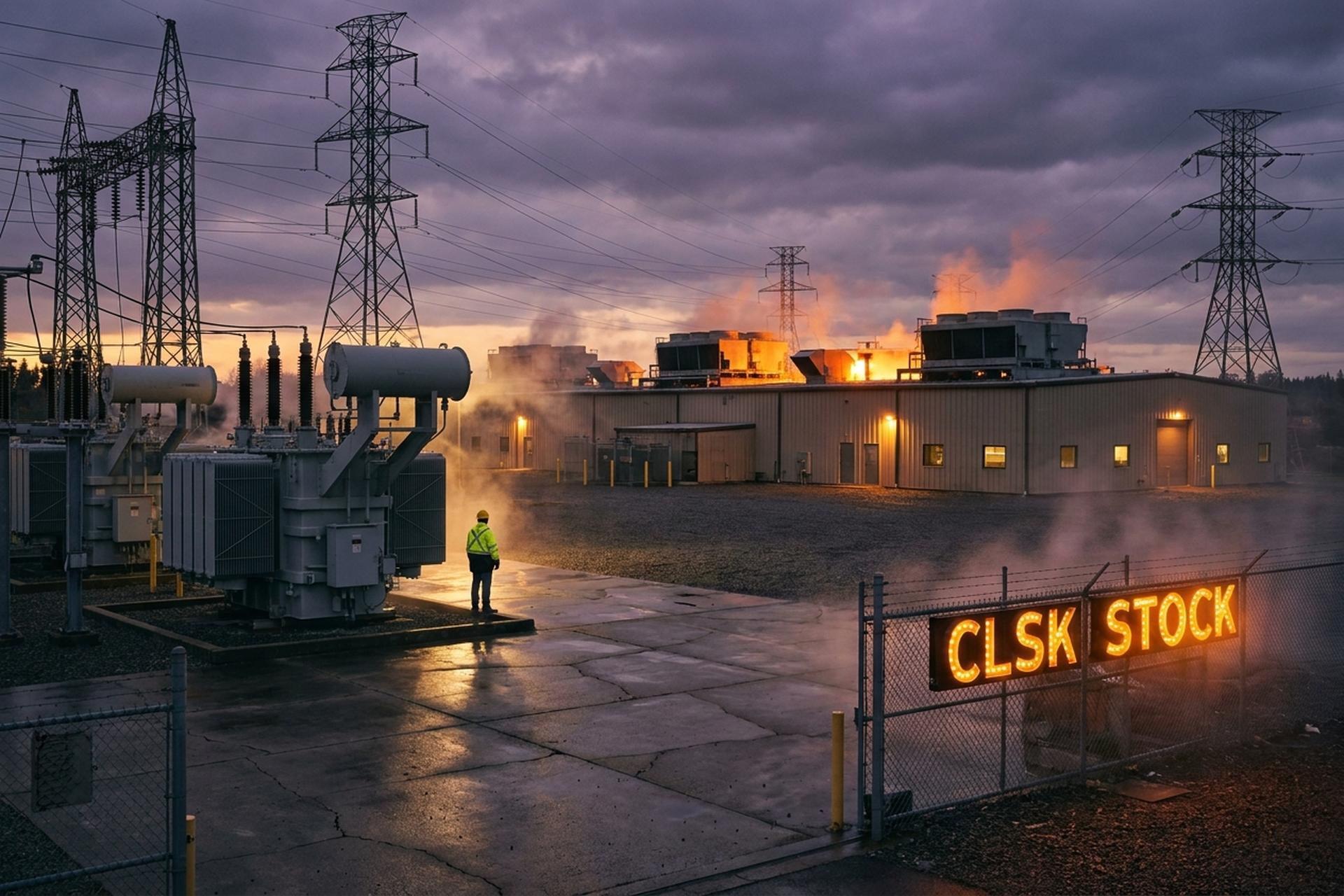
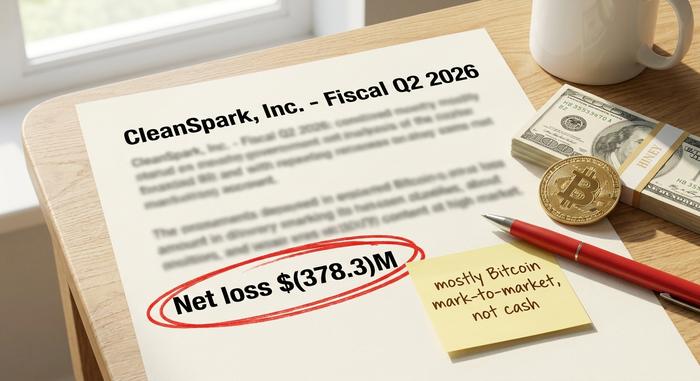
CleanSpark just told investors it lost $378 million in a single quarter. The stock went up. That contradiction is the most useful thing to understand about CLSK stock before you buy a single share. CleanSpark, Inc. trades on the Nasdaq as a Bitcoin miner, but the number on the bottom line and the number in the bank are telling two different stories. One is an accounting headline. The other is the business. If you can hold both in your head at once, the rest of the analysis gets a lot easier.
This is a company in motion: still mining Bitcoin at industrial scale, while quietly buying the land and power it needs to become something closer to a data center operator. Whether that pivot pays off is the real question behind the share price.
What CleanSpark (CLSK) actually does as a company
On paper CleanSpark is a Bitcoin mining company. In practice it is a bet on cheap power and what you can do with it. The mining is the cash engine today; the pivot is where management is pointing the headlights.
The Bitcoin mining engine
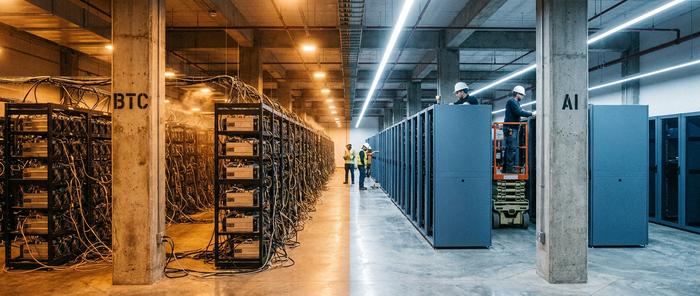
CleanSpark runs warehouses full of specialized computers that compete to validate Bitcoin transactions and earn freshly minted coins. By May 2026, per CleanSpark's operational update, the fleet hit a peak hashrate of 50 exahashes per second, with 224,473 active miners drawing 808 megawatts across sites concentrated in the US Southeast and at its Henderson, NV base. Hashrate is just a measure of how much computing muscle a miner points at the network. More muscle means a bigger slice of the daily Bitcoin reward, so when people watch CleanSpark, they watch that exahash number climb. The whole network adjusts difficulty roughly every two weeks to keep block times steady, which means a miner has to keep adding machines just to hold its share. Standing still is the same as falling behind, and that treadmill is why miners raise capital so often. With around 310 employees running this much hardware, CleanSpark is closer to an industrial power company than a tech startup.
The AI and HPC pivot
Here is the part the stock quote pages miss. CleanSpark has 1.8 gigawatts of power under contract but only uses about 808 megawatts of it today. That gap is deliberate. The company outbid Microsoft for a 100-megawatt site in Cheyenne, Wyoming, and picked up a 271-acre campus outside Houston rated for roughly 285 megawatts. Power and land at that scale are exactly what artificial intelligence data centers fight over. Training and running large AI models eats electricity, and the bottleneck for the whole industry right now is not chips but megawatts and the grid connections to feed them. CleanSpark already controls both. So the company is positioning to rent compute capacity to AI tenants, not just mine digital coins. The infrastructure it owns is the asset; Bitcoin is one way to monetize it, and high-performance computing could be another — at far higher margins. The catch is that mining and AI hosting need different hardware and different buildings, so the pivot is a real construction project, not a flip of a switch. That distinction is the heart of the CLSK investment case.
CLSK stock price and key market stats today
CLSK stock is not a quiet holding. It moves with Bitcoin, often harder than Bitcoin itself, and the market data shows why. The stock carries a five-year beta of 3.72, meaning it tends to swing more than three times as much as the broad market on a typical day. Roughly a third of its tradable shares are sold short, so every piece of good news can force a scramble to cover.
Here is the snapshot most investors care about, as of June 4, 2026 via Yahoo Finance:
| Metric | Value (as of Jun 4, 2026) |
|---|---|
| Share price | $16.78 |
| Market cap | $4.31 billion |
| 52-week range | $8.00 – $23.61 |
| Year-to-date return | +65.8% |
| Beta (5-year) | 3.72 |
| Short interest | ~33% of float |
| Average daily volume | ~18–23 million shares |
Read that table as a risk profile — not a scorecard. A 52-week range that runs from $8 to nearly $24 tells you the chart whips around. The year-to-date gain looks great until you remember the same volatility cuts both ways.
Inside CleanSpark earnings and financials
This is where most quick takes on CLSK stock go wrong. The earnings reporting looks alarming if you only read the last line.
Why the giant net loss is misleading
For its fiscal second quarter of 2026, CleanSpark reported revenue of $136.4 million, down about 25% from a year earlier, and a net loss of $378.3 million, or roughly $1.52 per share, according to its SEC 8-K filing. A loss that big against that little revenue should be a red flag. Except most of it is not a cash loss at all. Under current accounting rules, companies mark their Bitcoin holdings to fair value every quarter, and that swing runs straight through the income statement. When Bitcoin's price dips, CleanSpark books a paper loss on coins it still owns. Zoom out and the operating picture is healthier: full-year fiscal 2025 revenue came in at $766.3 million, more than double the prior year. The mining business is generating real money; the GAAP headline is mostly Bitcoin's mood. The quarterly revenue dip is partly seasonal and partly the halving working through the numbers, since each mined coin is now worth the same in dollars but harder to earn. None of this means the loss is fake. It means the income statement is the wrong place to judge a miner. Cash flow and the value of the assets being built tell you more than the net loss line ever will.
Balance sheet, debt and dilution
The balance sheet is the part worth a careful look. CleanSpark held about $260 million in cash, but carried a debt-to-equity ratio near 181%. It raised $1.15 billion through a zero-percent convertible note and arranged a $400 million credit facility backed by its Bitcoin. A zero-percent convertible sounds free, but it is not; lenders accept no interest because they expect to convert the note into stock later, which quietly enlarges the share count. That financing funds the expansion, yet it comes with a cost shareholders feel directly: more shares outstanding and more debt against the business. EBITDA stays negative while the heavy buildout continues, so this is not a company you value on current profit. You value it on the capacity it is assembling and on whether that capacity gets filled with paying demand. With total assets near $2.9 billion against roughly $1.9 billion in liabilities, the equity cushion is real but thinner than the market cap alone suggests.
Hashrate, BTC treasury and compute capacity
CleanSpark's treasury strategy separates it from some louder peers. The company held roughly 13,470 Bitcoin, but it is close to treasury-neutral in practice: in May 2026 it mined 671 coins and sold 654 of them at an average price near $79,934. In other words, it funds operations by selling most of what it mines rather than hoarding coins and hoping. That makes CLSK stock less of a pure Bitcoin proxy than a miner like MARA, which leans on holding its stack.
| Operational metric (May 2026) | Value |
|---|---|
| Peak hashrate | 50.0 EH/s |
| Bitcoin held in treasury | ~13,470 BTC |
| Bitcoin mined / sold (month) | 671 / 654 |
| Fleet efficiency | 16.07 J/TH |
| Marginal cost to mine 1 BTC | ~$34,000–$43,000 |
Efficiency matters more than size after the April 2024 halving, which cut the Bitcoin reward in half overnight and roughly doubled the cost to produce each coin. Joules per terahash is simply how much electricity a machine burns for a unit of work, and lower is better. At about 16 joules per terahash, CleanSpark runs a relatively modern fleet, and a marginal cost in the mid-$30,000s leaves breathing room while Bitcoin trades well above that. Squeeze that margin, though, and the whole model tightens fast. This is why the treasury-light approach is defensible: by selling most of its coins near production, CleanSpark turns mining into a steadier cash business and avoids betting the company on where Bitcoin trades next quarter. The trade-off is that it gives up the explosive upside a big held stack would deliver in a bull run.
CLSK vs other Bitcoin mining stocks to trade
No miner trades in a vacuum, and the peer group sets expectations for CLSK stock just as much as for any rival. On raw hashrate, on early-2026 figures, CleanSpark sits mid-pack, behind MARA but ahead of or even with the rest of the field. Where it differs is the lighter Bitcoin treasury and the harder push into power infrastructure.
| Company | Hashrate (EH/s) | Profile |
|---|---|---|
| MARA Holdings | 72.2 | Largest fleet, big BTC HODL |
| CleanSpark (CLSK) | 46.2 | Efficient fleet, treasury-light, AI pivot |
| Riot Platforms | 36.4 | Texas power focus |
| IREN | 36.0 | Mining plus AI cloud |
The takeaway for anyone building a mining portfolio: these stocks are not interchangeable. MARA is the leveraged Bitcoin bet, Riot is the power-and-Texas story, IREN already rents AI compute, and CleanSpark is trying to straddle mining and infrastructure at once. Your view on Bitcoin and on AI demand should decide which one you trade.
Analyst rating and price forecast for CLSK
Wall Street likes CLSK stock, but the word "consensus" oversells it. Across roughly 15 analysts the average rating lands on a "Moderate Buy," with a mean price target near $20.40 according to MarketBeat, implying about 21% upside from recent levels. The spread is the real signal. The most bullish target sits at $27 from firms like Macquarie and HC Wainwright, while JPMorgan anchors the low end near $14. That is not a rounding error; it is a genuine disagreement about whether the AI pivot becomes revenue. When the forecast range is that wide, the analysts are really arguing about the story, not the spreadsheet. Treat any single price target as one opinion, not a destination.
Bull vs bear case before you invest in CLSK
Strip away the noise and the CLSK stock investment case comes down to two bets stacked on top of each other.
The bull case: CleanSpark has a 2.2x expansion runway already under contract, an efficient fleet that survives a tougher Bitcoin market, and a free option on AI tenancy that the share price barely credits. If Bitcoin holds up and even one large high-performance computing lease gets signed, the company grows into its power footprint and the math changes quickly.
The bear case is just as concrete. The stock is a leveraged play on Bitcoin's price, so a deep crypto drawdown hits revenue and the treasury at the same time. The expansion is funded by dilution and debt, which chips away at what each share owns; the share count today is far larger than it was two years ago, and that trend is unlikely to stop while the buildout runs. Short interest near a third of the float signals how many investors expect trouble, and a crowded short can cut both ways in a stock this volatile. And the AI thesis, the whole reason for the premium, rests on tenancy deals that had not been signed as of the latest reporting. You are paying today for a call option that may or may not land. Neither side is obviously right — which is exactly why the analyst targets are scattered from $14 to $27.
What CLSK stock comes down to for investors
CLSK stock is a volatility instrument, not a buy-and-forget holding. The cash engine underneath it is real, and the GAAP loss that scares headline readers is mostly Bitcoin accounting rather than a business falling apart. What you are actually buying is power capacity — and a management team racing to fill it before Bitcoin margins tighten. The two numbers to watch are not the quarterly loss; they are the price of Bitcoin and the date of the first signed AI lease. Until that lease exists, the AI premium is a hope. After it exists, the conversation changes entirely.