Iron Condor Strategy: A Complete Options Trading Guide

The iron condor strategy wins about seven times out of ten. That is the line that sells it, and it is broadly true. It is also the most misleading sentence in options trading, because it leaves out the part that actually matters: when an iron condor loses, it usually loses more than it ever made.
That tension is the whole story. The iron condor is the most popular neutral options strategy on the market, a defined-risk way to bet that a stock or index goes basically nowhere. Done with discipline, it has a real statistical edge. Done carelessly, it is a slow way to give back a year of small wins in a single bad week. This guide covers all of it: the four legs, the payoff math with a worked example, how to set one up, how to manage it, the risks nobody advertises, how it changes in crypto, and whether it is actually any good.
What Is an Iron Condor? The Four Legs
Strip away the bird name and an iron condor is two boring trades stapled together. Two credit spreads, one above the price and one below, both betting the market stays calm.
The two spreads, four legs
An iron condor has four option legs, all expiring on the same day. Below the current price, you build a bull put spread: sell an out-of-the-money put, then buy a further out-of-the-money put underneath it for protection. Above the price, you build a bear call spread: sell an out-of-the-money call, then buy a further out-of-the-money call above it. You collect more from the two options you sell than you pay for the two you buy, so the trade opens for a net credit. That credit is the most you can make. The two long options are your wings, and they cap the most you can lose. It is a market-neutral, defined-risk position.
Where the profit comes from
You are not betting on direction. You are betting on stillness. As long as the price stays between your two short strikes through expiration, all four options expire worthless and you keep the entire credit. The engine is theta, the slow daily bleed of time decay that erodes every option as expiration approaches. You sold that decay to someone else. Every quiet day, you win a little. The flip side matters just as much — you only win if the price cooperates by staying put. An iron condor is a bet against a big move in either direction. If the stock rips higher or craters, the strategy that loves boredom suddenly hates your position.
Iron condor vs iron butterfly vs short strangle
Three cousins get confused constantly. An iron butterfly sells both short strikes right at the current price, so it collects a fatter credit but needs the stock to pin a much tighter range. A short strangle is the same neutral bet with no protective wings at all, which means a bigger credit and undefined, potentially huge risk. The iron condor sits in between: think of it as a short strangle with insurance bolted on. You give up some credit to cap the downside. For most traders, that trade is worth making.
| Strategy | Short strikes | Risk | Credit | Profit zone |
|---|---|---|---|---|
| Iron condor | OTM, spread apart | Defined (capped) | Moderate | Wide |
| Iron butterfly | At the money | Defined (capped) | Larger | Narrow |
| Short strangle | OTM, spread apart | Undefined | Larger | Wide |
The Payoff: Max Profit, Max Loss, Breakevens
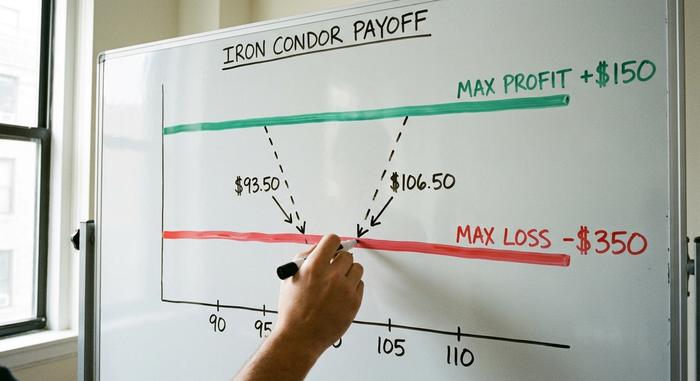
Three formulas run the entire trade. Learn them once and nothing about the position will surprise you. Max profit is the net credit you collect. Max loss is the width of one spread minus that credit. The breakevens are the short call strike plus the credit on the top, and the short put strike minus the credit on the bottom.
Here is a clean example. A stock trades at $100. You sell the $95 put and buy the $90 put. You sell the $105 call and buy the $110 call. For that, the market pays you about $1.50 per share, or $150 for one contract.
| Leg | Action | Strike |
|---|---|---|
| Put wing | Buy | $90 |
| Short put | Sell | $95 |
| Short call | Sell | $105 |
| Call wing | Buy | $110 |
| Net credit | Collect | $150 |
Each spread is $5 wide, so $500. Your max loss is $500 minus the $150 credit, which is $350. Your max profit is the $150. The breakevens land at $93.50 and $106.50. As long as the stock stays within those two breakeven numbers at expiration, you make money. Notice the imbalance already: you are risking $350 to make $150. Hold that thought. That asymmetry is not a quirk of this one example — it is baked into nearly every iron condor. Because the short strikes sit out of the money, the credit you collect is always smaller than the width you are protecting. You are trading a high chance of a small win for a low chance of a bigger loss.
How to Set Up an Iron Condor Trade
Setting up this option trade is a chain of trade-offs between probability and profit potential, and there is no free lunch hiding in the chain. Move your strikes further out and you win more often but collect less. Move them in and you collect more but get tagged more often.
Picking the strikes with delta
Most traders choose the short strike price by delta, the options metric that doubles as a rough probability. A 16-delta short strike sits about one standard deviation away from the price, which implies roughly an 84% chance it expires out of the money. Selling your short put and short call around 16 delta is a common, balanced starting point; many traders work in the 15 to 30 delta range depending on how aggressive they want to be. Keep the wings an equal width on both sides, and as a rough guide, aim to collect about one-third of that width in credit.
Choosing the expiration
Time frame matters as much as strikes. The classic window is 30 to 45 days to expiration. That is long enough for time decay to do real work, but short enough that you are not exposed to weeks of headline risk. Shorter is not always better. The explosion of zero-days-to-expiration options has made same-day condors popular, but they trade gamma risk for speed, and gamma near expiration is where accounts get hurt.
When to use it
The ideal backdrop is a calm, range-bound market where you also expect volatility to fall. High implied volatility is your friend at entry, because it fattens the premium you collect. If you sell that rich premium and the market then settles down, the options deflate and you win twice, once from time and once from the volatility crush. There is a tidy way to spot the setup. Traders watch implied volatility rank — a measure of where current volatility sits relative to the past year. A high IV rank means options are expensive, which is exactly when a seller wants to sell. Selling cheap premium into an already quiet market is how condors bleed out slowly.
Managing the Trade: Profit Targets and Adjustments
If you remember one habit from this guide, make it this one: take profits early. Do not hold an iron condor to expiration hoping to see all options expire worthless and squeeze the last few dollars. Close it when you have captured about half of the maximum profit.
This is not a hunch. A study of 71,417 SPY iron condors from 2007 to 2017 found that managing trades at 50% of max profit lifted the win rate to around 70%, versus roughly 60% for trades held all the way to expiration, and it did so with smaller drawdowns. Taking money off the table works because the last bit of profit carries the most risk for the least reward. A second common rule is to exit by 21 days to expiration regardless, to sidestep that late gamma. If one side gets tested, some traders roll the untested side closer to the price to collect extra credit. And when a trade goes wrong, cut it before it reaches max loss rather than praying. Adjustments are a rabbit hole, though — every roll adds commissions, complexity, and a fresh way to be wrong. Chasing a losing trade with more trades is how a small loss quietly becomes a big one. Sometimes the cleanest adjustment is simply to close the position and walk away.
The Risks: Why the Math Is Asymmetric
Now the part the win-rate crowd skips. Go back to the example. You risked $350 to make $150. That ratio is the iron condor's defining flaw, and it never goes away. A high win rate hides it, but the arithmetic is brutal: a single max loss can erase three or four winning trades. Win rate is seductive. Expectancy, the average outcome over many trades, is what actually pays you.
The old trader's phrase for this is picking up pennies in front of a steamroller. Most months you collect the pennies. Then a surprise earnings move, a gap down, or an overnight shock blows clean through a short strike and you eat the full loss. There is more. Options on US stocks are American-style, so a short leg that goes in the money can be assigned early, leaving you with a stock position you did not want. And four legs mean four commissions and four bid-ask spreads to cross, every time you open and close. On thinly traded names that friction is worse — a wide bid-ask quietly eats your edge before the trade even starts. None of this makes the iron condor a bad trade. It makes it a trade you must respect.

Iron Condors in Crypto: Higher IV, Wider Wings
The same strategy shows up in crypto, just dialed to eleven. Bitcoin and Ether options trade mostly on Deribit, and crypto volatility is a different animal. Deribit's DVOL index, its version of the VIX, often sits between 40 and 80, while equity's VIX usually lives between 12 and 25.
That cuts both ways. The fat implied volatility means the premium you collect on a crypto condor is far richer. But you have to place your strikes much wider to stay safe, and crypto never closes, so a 3am move can gap straight through your wing with no opening bell to wait for. The market is big enough to trade: Deribit cleared roughly $1.875 trillion in options volume in 2025, and Bitcoin options open interest reached about $26.9 billion in early 2026. The iron condor works in crypto. The steamroller just moves faster.
Is the Iron Condor a Good Strategy?
For the right trader, yes. For the wrong one, it is a trap. Among neutral option strategies, the iron condor stands out for one reason: defined risk. You always know your worst case before you enter. It suits a patient, neutral trader who sells premium when volatility is high, manages winners at 50%, and accepts the occasional full loss without flinching. It punishes the person who treats a 70% win rate as free income and holds every trade to the bitter end. Options trading is bigger than ever, with a record 15.2 billion US contracts traded in 2025 and same-day options now most of the action, so the tools are everywhere. The discipline is the rare part. None of this is financial advice.
The Bottom Line on the Iron Condor
The iron condor is a clean, defined-risk way to bet that a market goes nowhere. The mechanics are simple once you see them as two credit spreads, and the management edge is real and measurable, as long as you take profits early and never forget that you are risking more than you can make. The strategy does not fail people. People fail the strategy, usually by falling in love with the win rate and ignoring the loss. So before you sell your first condor, ask yourself the honest question: can you take the occasional steamroller without it wrecking you?