Delta Exchange India: Bitcoin & Ether Crypto Options Futures

India is the largest crypto market on earth by user count, but until a few years ago its traders had almost no regulated way to trade crypto derivatives in their own currency. Spot was easy. Futures and options were a passport away. Delta Exchange India is the derivatives exchange in India that broke that pattern, and it is the one most retail Indians now use when they want to trade Bitcoin and Ether options without leaving the rupee economy.
This guide explains what Delta Exchange India actually is in 2026, how its fees and products work, where it sits in the new Indian crypto tax regime, and how it stacks up against domestic peers like Pi42 and CoinDCX as well as global venues like Deribit. If you have never traded a perpetual or an option, the regulation and product sections will get you oriented. If you trade crypto regularly, the comparison and risk sections are where the value is.
Why Delta Exchange Is a Leading Crypto Derivatives Venue
Delta Exchange started in 2018 as an offshore crypto derivatives platform headquartered in St. Vincent and the Grenadines. Its India-specific arm, registered with the Financial Intelligence Unit (FIU-IND) under PMLA, launched in 2024 with INR settlement and a fully Indian KYC and tax workflow. By May 2025, CEO Pankaj Balani told Analytics Insight the platform was processing about $2.5 billion in daily trading volume, with a peak of roughly $4 billion on April 28, 2025 according to AInvest reporting.
For context, India ranked first globally in Chainalysis's 2025 Geography of Crypto report for the third year running, with around 119 million active users and $338 billion in on-chain transaction value over the year ending June 2025. Most of that activity was spot. Crypto futures and options, until recently, were a side trade done on offshore exchanges that withheld no Indian tax and offered no recourse if something went wrong. A regulated derivatives exchange in India with INR settlement is the missing piece, and Delta Exchange India has built a real chunk of that piece, positioning itself among the top cryptocurrency derivatives venues serving the country.
The INR Settlement Edge for Indian Crypto Traders
INR settlement sounds boring. It is the most important feature on the platform.
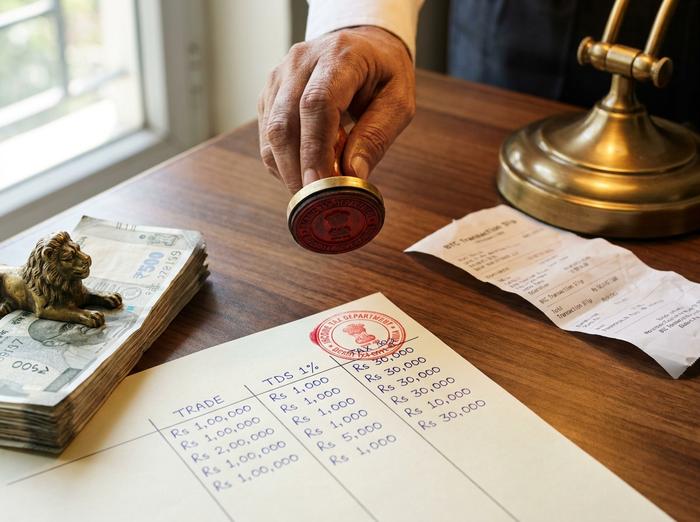
Most crypto derivatives elsewhere are quoted and settled in USDT or USDC. To trade them as an Indian resident, you have to convert rupees to a stablecoin, pay 1% TDS on the on-ramp, accept FX and slippage costs, then reverse the whole pipeline to take profits home. Delta Exchange India lets you deposit rupees by UPI or bank transfer, post INR margin, settle profit and loss in INR, and withdraw to your Indian bank account directly.
For a trader who wants to express a view on Bitcoin or Ether and walk away with rupees in their account, that single change of cutting out the stablecoin layer removes a meaningful drag on returns. The platform also supports lot sizes starting at INR 100, which means a beginner can size a real position for the cost of a coffee. That is a different experience from Deribit, where contract sizes and dollar funding requirements push out most retail Indian traders before they can begin. The benefits of INR settlement go beyond convenience: the entire tax and reporting trail stays inside the Indian banking system, which is exactly what the government's new VDA reporting rules now demand.
Products on Delta Exchange: Futures, Options, Perpetuals
The product surface is wider than most users realize. Delta Exchange India offers four core categories:
- ETH call and put options plus the same on Bitcoin, with daily, weekly, and monthly expiries. Strikes are spaced narrowly enough to express directional and volatility views without paying for far-OTM noise. The full crypto futures and options suite sits inside a single trading interface rather than scattered across separate apps.
- Option spread contracts like straddles, strangles, and condors, listed as single instruments so you can enter a multi-leg view in one click instead of legging in.
- Perpetual futures on BTC, ETH and a curated list of altcoins, with leverage up to 100x on the main pairs and as much as 200x on select option contracts. Perpetual futures can be traded around the clock with funding settled every eight hours.
- Spot markets for BTC, ETH, SOL, XRP, USDC and the platform's DETO token, paired against USDT. Spot is intentionally limited. Delta is a derivatives house, not a spot supermarket, but the wide range of cryptocurrencies in the perpetuals book offsets that.
The strategy builder and basket orders tools let you draft a position visually, see margin and Greeks before submitting, and modify legs as a unit. A rich set of analytics around implied volatility, Greeks, and open interest sits a tab away from the order ticket. For active option traders that combination is what keeps them on the platform versus the alternatives.
Fees, Real-Time Liquidity and Crypto Trading Conditions
Fees on the official rate card (April 2026) are straightforward, but the GST line matters more than people remember:
| Product | Maker | Taker | Notes |
|---|---|---|---|
| Crypto futures (BTC/ETH perps and dated) | 0.02% | 0.05% | + 18% GST on the fee itself |
| Vanilla options | 0.010% | 0.03% | Capped at 3.5% of option premium; + 18% GST |
| Spot buy | 0.00% | 0.00% | Free buys; rare among Indian venues |
| Spot sell | 0.10% | 0.10% | + 18% GST |
| Settlement at expiry | Taker rate | Taker rate | Charged on notional |
The 18% GST is a real cost. A 0.05% taker fee on a futures trade becomes about 0.059% all-in once GST hits the fee. Multiply across an active day and the difference between Delta Exchange India and a peer with a "lower" headline fee can flip in either direction.
Real-time liquidity on the BTC and ETH books is the deepest of any FIU-registered Indian venue, but it is still thin compared with Binance or Deribit on the same pairs. Spreads on weekly ATM options are usually a few rupees wide on the highly traded strikes, much wider on far-OTM and on the longer-dated monthlies. If you trade size, scale orders or use the API rather than firing market orders into a quiet book.
Bitcoin and Ethereum Options: Strikes, Expiries, Execution
Options are where Delta Exchange India differentiates itself. The platform lists a wide range of strikes around the spot price for Bitcoin and Ethereum, with daily, weekly, and monthly expiries running in parallel. You can trade a call for a same-session view or write a monthly straddle for the carry. Options on Bitcoin are the most active by far, with ETH call and put options the second-deepest book; the chain density is higher than what Indian competitors offer, and the order ticket integrates Greeks, implied volatility, and real-time bid-ask depth.
To execute a multi-leg structure cleanly, the strategy builder sends all legs as a single batch. That matters when you are putting on a put spread in a fast market: you do not want to pay the bid-ask twice, and you do not want one leg to fill while the other slips. Delta also offers an analytics module that displays IV by strike and expiry, so you can spot a skew dislocation rather than trade blind.
The catch: BTC and ETH options on Delta Exchange India sit inside a global market dominated by Deribit, which Kaiko Research estimated holds roughly 85% of crypto-native options volume, with Bitcoin options open interest at about $42.5 billion in May 2025. Implied volatility on Delta tracks Deribit closely on the front weeklies but can diverge on longer expiries when local flow is one-sided. For most directional trades that gap is invisible. For volatility arbitrage it is your edge or your loss.
BTC and ETH Perpetual Futures: Leverage and Funding
The perpetual futures book on Delta Exchange India is busier than the options book in absolute volume terms. Funding payments occur every eight hours, and the funding rate is displayed on the order ticket so you know the cost of holding a position into the next funding window. Long bias in the market pushes funding positive, meaning longs pay shorts.
Leverage tops out at 100x on the headline BTC and ETH perps. That is high and best treated as theoretical. A 10x position liquidates on a 10% adverse move; at 100x you can lose the entire margin on a 1% wick. Most consistent traders on the platform run 2x to 5x effective leverage and rely on stop-loss orders sized to the daily volatility of the underlying.
Margin is cross or isolated, your choice. Cross margin uses your full account balance as backstop and gives you the most flexibility but also the most damage if a single position blows up. Isolated margin caps the loss to the assigned amount and is the right default for anyone still learning how funding, liquidation, and adverse selection actually feel.
Indian Crypto Regulation: TDS, 30% Tax and FIU Rules
The Indian crypto tax framework is the single biggest factor in deciding where to trade, especially for crypto futures and options trading where ticket sizes and turnover stack up fast. Three rules govern almost everything, with the flat tax on gains being the most punishing:
| Rule | Detail | Source |
|---|---|---|
| Flat 30% tax on VDA gains | Section 115BBH of the Income Tax Act; no offset against other income; only cost of acquisition deductible | ClearTax / Koinly |
| 1% TDS on transfers | Section 194S; effective from 1 July 2022; withheld by the exchange on each transaction above INR 10,000 (or INR 50,000 for specified persons) | Income Tax Department |
| Schedule VDA in ITR | Mandatory from FY 2025-26; every gain, transfer, and TDS credit must be itemised | Income Tax Department |
The Union Budget 2026, presented in February, kept the 30% tax and 1% TDS unchanged but added Section 446 of the new Income Tax Act 2025: a penalty of INR 200 per day on platforms that fail to furnish transaction statements, and INR 50,000 for inaccurate reporting. In practice that pushes more compliance burden onto exchanges, which is why FIU-registered platforms now produce a downloadable annual statement that maps cleanly into Schedule VDA.
The FIU-IND registry itself, as of FY 2024-25, lists 49 Virtual Digital Asset Service Providers (45 domestic and 4 offshore) according to Business Standard. Twenty-five offshore platforms received non-compliance notices from FIU in late 2024; Binance was one of them, paid a $2.2 million penalty, and is now on the registered list. The Department of Economic Affairs' long-promised crypto discussion paper, which was supposed to clarify the broader legal framework, has been delayed again. CryptoTimes reported in April 2026 that RBI continues to block its release.
Delta Exchange vs Pi42, CoinDCX and Global Venues
The Indian derivatives field is small and getting more interesting. Here is how the major venues compare for an Indian trader in 2026:
| Platform | Products | Futures fees (Maker/Taker) | INR Settlement | FIU-IND | Notable in 2025 |
|---|---|---|---|---|---|
| Delta Exchange India | BTC/ETH options + perps + spot | 0.02% / 0.05% (+18% GST) | Yes | Yes | $2.5B daily volume, May 2025 |
| Pi42 | Crypto-INR perpetual futures only | 0.05% / 0.10% (+18% GST) | Yes (INR-native) | Yes | Markets 0% TDS, 0% VDA tax stance, untested in court |
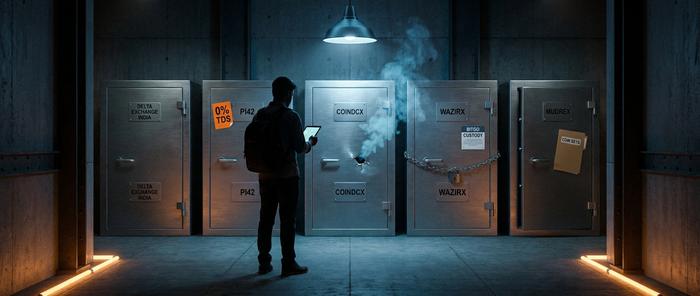
| CoinDCX | Spot + USDT-margined futures | Variable, low | Hybrid | Yes | $44M operational-wallet hack, July 2025; Coinbase took minority stake at $2.45B valuation in Dec 2025 |
| WazirX | Spot only (relaunched Oct 2025) | n/a | Yes | Yes | Resumed trading after $230M Lazarus Group hack of July 2024, with BitGo custody |
| Mudrex | Spot, futures, "Coin Sets" managed baskets | Variable | Yes | Yes | Pivoting toward investment-platform positioning |
| Deribit | BTC/ETH options + perps + futures | 0.00%-0.05% | No | No | ~85% of global crypto options market share (Kaiko) |
| Binance | Full derivatives suite | 0.02% / 0.05% | No | Yes (post-penalty) | Re-registered after $2.2M FIU penalty |
Pi42 is the most pointed competitor. Its CEO Avinash Shekhar argues that crypto-INR perpetuals are not "Virtual Digital Assets" under Section 2(47A) of the Income Tax Act and therefore exempt from the 1% TDS and 30% tax. Coingape and the platform's own materials make this case openly. It is a genuine legal interpretation, but it has not been tested by CBDT clarification or in court. Treat the savings as conditional on a future ruling, not as settled tax planning.
CoinDCX and WazirX are spot-first venues that came back from real damage. CoinDCX kept user funds segregated in cold storage during its July 2025 incident and covered the $44 million loss from reserves. WazirX needed sixteen months and BitGo custody to come back from its $230 million hack; trading resumed October 24, 2025 with thirty days of zero fees as a goodwill gesture. The history matters when you decide where to keep meaningful balances.
Algo Trading, API Copilot and Bots for Active Traders
Delta Exchange India's REST and WebSocket APIs are documented in detail and used heavily. The platform recently shipped a built-in API Copilot that helps you write a connection script in minutes rather than hours, and it accepts external signal feeds so you can run a strategy designed in TradingView or a custom backtester without re-implementing the order logic. Greater margin efficiency, courtesy of portfolio margin across correlated positions, makes complex spread structures cheaper to hold than the same legs would be on a venue without it.
You can attach a trading bot to connect external signals, build basket orders, or run a simple market-making script on a quiet altcoin perp. Latency is acceptable for retail strategies but not competitive with the lowest-latency venues. If you are running a sub-second arbitrage system, Delta is not the right venue. If you are running a swing-bias strategy on hourly or daily candles, it works well and the algo discount in fees applies once volume thresholds are crossed.
For traders who want automation without code, Delta offers Robo Strategies. These are packaged momentum, arbitrage, and AMM-style flows that allocate within set risk parameters. They are best treated as managed exposure rather than as a free path to profit. Read the strategy logic before you put real capital in.
Risk Management: Liquidations and Safe Exit Planning
Two specific failure modes account for most of the losses in retail derivatives trading. The first is leverage that is too high for the position's volatility budget. The second is a missing or wrongly placed exit: no stop at all, or a stop tucked just inside the noise band where it gets swept on every spike.
Practical rules that hold up under fire:
- Cap position-level loss at 1% to 2% of total trading capital. If you are wrong, the next trade is still possible.
- Run isolated margin until you have a year of consistent track record. Cross margin destroys careless accounts faster than you can react.
- Place the stop where the thesis is wrong, not where the loss feels tolerable. If your thesis breaks at $58,000, that is the stop, not $59,500 because you cannot stomach the bigger loss.
- Watch the funding rate on perps. Persistent positive funding means longs are paying shorts. Sometimes that is worth holding through, but more often it signals crowded positioning.
- Use the testnet. Delta runs a testnet that mirrors the live terminal. Practice every order type there before risking rupees on it.
The exit plan is the trade. Everything else is a story you tell about why you entered.
How to Open an Account and Trade Bitcoin Safely
The onboarding flow on this trusted platform is the same shape as every other FIU-registered Indian venue but with a few quirks worth knowing. Mobile trading via the iOS and Android apps mirrors the desktop terminal, so you can step through the same screens on the device you actually carry:
1. Sign up with email and mobile, set a strong password and enable two-factor authentication using an authenticator app, not SMS. SMS 2FA is vulnerable to SIM-swap attacks and there have been documented Indian cases.
2. Complete KYC with your PAN card, Aadhaar, and a selfie. Approval is usually within hours during business days but can stretch to two days when volume is high.
3. Deposit INR via UPI, IMPS or NEFT. UPI is instant up to your bank's daily limit. There is no deposit fee.
4. Whitelist withdrawal addresses before you deposit any crypto and set the anti-phishing code so you can spot fake platform emails immediately.
5. Start small on the testnet or with a single options contract priced under INR 500. The platform's lot sizes are small enough that you can learn the order ticket without risking real capital.
6. Download your transaction statement quarterly and reconcile it against your bank account. The Schedule VDA filing in your ITR will require this and you do not want to do it under deadline pressure in July.
To trade Bitcoin specifically: the BTC perpetual is the most liquid contract on the platform; weekly call and put options are the most active by lot count. To trade BTC for the first time on Delta Exchange India, sizing a single ATM weekly call to risk no more than 1% of the account is the most forgiving entry point.