
Troy Coin in 2026: Price, Status, Delisting, Verdict
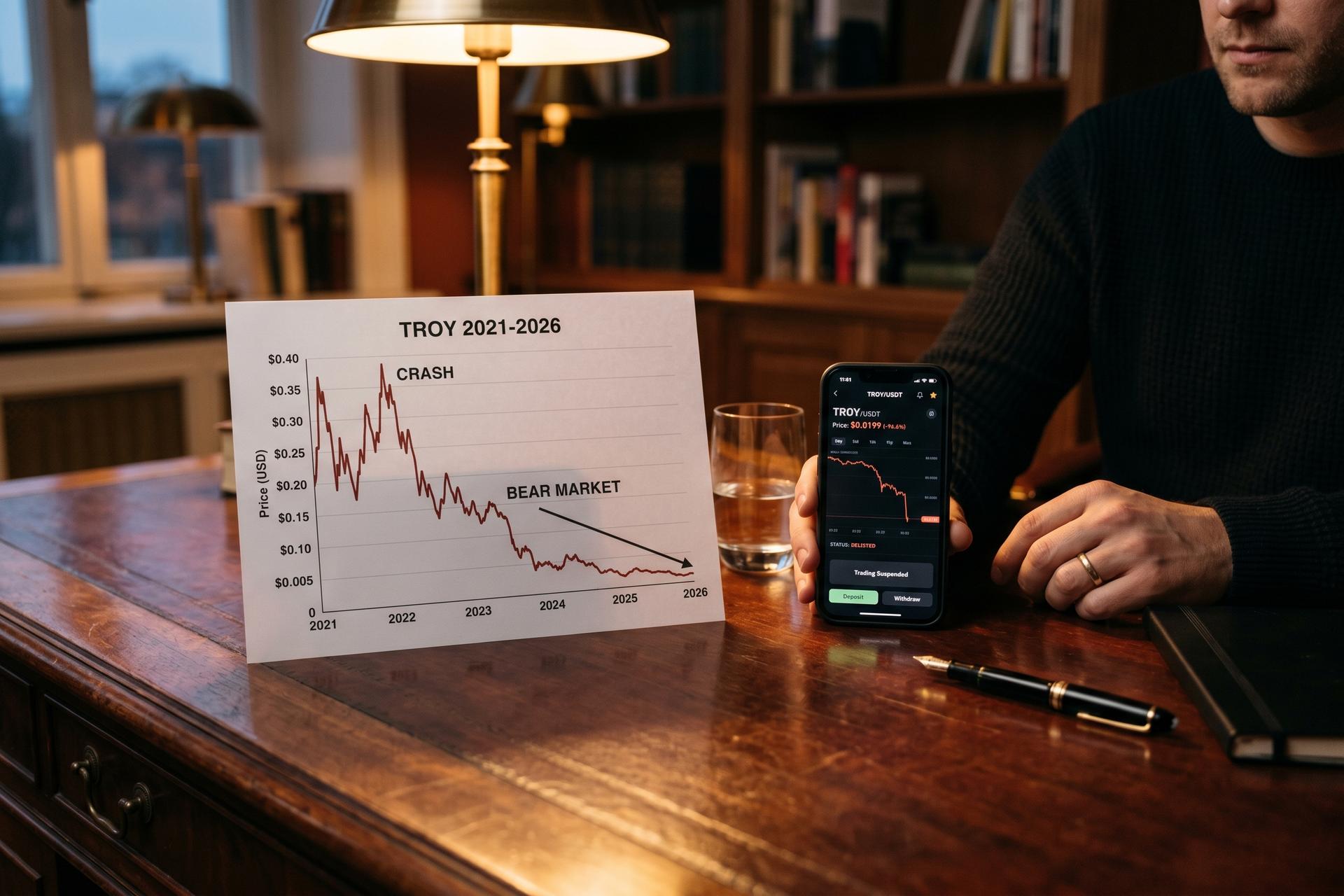
Minus ninety-nine point nine seven percent. That is the drop in Troy Coin (TROY) price from its 2021 peak to its current trading range in May 2026. Every other fact about this project sits underneath that one number. The Binance Launchpad IEO. The $12.4 million it raised in December 2019. The three pivots that followed across institutional brokerage, GameFi, and AI agents. The community-driven delisting in April 2025. All of it stems from the same loss curve.
This is the version of the Troy Coin story the official marketing pages do not tell. The token is not technically dead in the legal sense. No rug pull. No team disappearance was ever formally announced. A contract address still exists on Ethereum and BNB Chain. But by every functional measure — trading volume, exchange listings, development activity, community engagement — TROY in 2026 is what a quietly-failed crypto launch looks like. The article below walks through how it got here, what the verified facts are, and what risks remain for anyone holding or considering buying the token today.
What Is Troy Coin? The Original Prime-Broker Pitch
Troy Coin was launched in December 2019 as the native token of Troy Trade, a platform pitched as a global prime broker for cryptocurrency. The founding team — Kira Sun (CEO), Qihan Lin, and Clark Tong — built the project to compete in the institutional crypto brokerage segment. At the time, that segment was thinly served by a handful of incumbents. (One persistent claim that the project descended from Henry He's Sesameseed network surfaces in unverified blog posts, but no primary source supports it.)
The pitch was straightforward. Troy Trade would aggregate liquidity across both centralized exchanges and decentralized markets. It would route orders intelligently to minimise slippage. It would run an OTC desk for large block trades, provide margin trading and lending services, and offer professional-grade asset custody. Institutional clients and professional traders were the stated target audience — a segment that needed consolidated access to spot and margin trading, derivatives, and trading and asset management tools from a single interface. The TROY token would sit underneath as a fee-payment unit, a staking instrument, a governance vehicle, and a node-operator reward — the standard utility-token bundle of that era.
Token mechanics were specified up front. Total supply was capped at 10 billion TROY, and the circulating supply of Troy tokens at launch represented just eight percent of that ceiling. The Binance Launchpad sale on December 4, 2019, distributed that tranche at $0.005 per token. The remaining allocation broke down as sixty percent mining and ecosystem rewards over time, twelve percent to private-sale investors, ten percent to the team, and ten percent to a long-term ecosystem fund. Holders paying trading fees in TROY received a discount — the standard token-utility lever used to drive demand against the circulating supply. The Launchpad sale raised approximately $12.4 million in BNB, a respectable result for that cohort, and earned Troy Coin the standard Binance Research write-up.
The token contract shipped on Ethereum as a standard ERC-20, with a BEP-20 wrapper added later for BNB Chain liquidity. Trading began on Binance shortly after the sale. Audits at launch came from PeckShield and, later, Zokyo. Custody integrations were promised with Vulcan Forged and several smaller custodians. None of those partnerships ever turned into meaningful institutional flow, which became the central problem.
Troy Coin Price History 2019–2026: From IEO to ATL
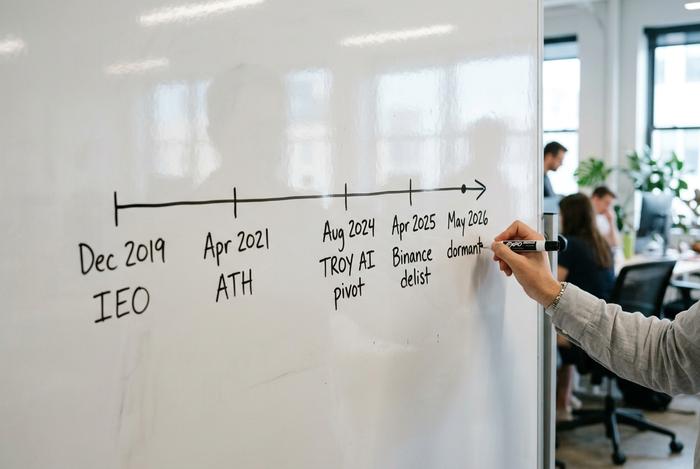
The price arc is the substance of the project's story. A clean timeline:
| Date | Event | Price (approximate) |
|---|---|---|
| Dec 4, 2019 | Binance Launchpad sale | $0.005 |
| Q1 2020 | Binance spot listing, initial volume | $0.01–$0.02 |
| April 17, 2021 | All-time high (CoinGecko) | $0.03652 |
| Sept 20, 2021 | Secondary peak (CoinMarketCap reading) | $0.03874 |
| 2022–2023 | Bear-market erosion | $0.001–$0.005 |
| Aug 2024 | TROY AI / AgentLayer announcement, brief speculation | $0.0003 |
| April 16, 2025 | Binance delisting effective | $0.0001 |
| Q4 2025 | Liquidity collapse on remaining venues | $0.00005 |
| May 2026 | Price feeds disagree, mcap effectively $25K | $0.0000019 to $0.05 |
The 2021 ATH was the only moment when Troy Coin traded above its launch price by a meaningful multiple. Roughly seven-and-a-third times the IEO price at peak. Every other observation along the curve is decline. By the end of 2024, the token had shed ninety-seven percent of its peak value. CoinCodex recorded a further single-year drop of 98.81 percent through 2025.
The May 2026 price feeds disagree among themselves, which is itself a diagnostic signal. CoinMarketCap shows a last-trade reading near $0.0525, with a market capitalisation around twenty-five thousand US dollars and a daily trading volume of seventeen cents. CoinGecko shows a fully-diluted valuation near $25,195. CoinGecko also notes that the token "stopped trading twenty days ago on all listed exchanges." CoinCheckup quotes $0.0000019. Each feed reports whatever its last upstream data point was. When liquidity drops to zero, price discovery stops. That is exactly what has happened to TROY.
The all-time low varies by source for the same reason. Both CMC and CoinGecko report ATL events in April 2026, but at different values. The honest read here: no single reliable price exists for Troy Coin in May 2026. Pick a feed, treat it as one data point, and look at the trend instead.
The Pivots: Prime Broker, GameFi, Then TROY AI
Five years, three different product directions, none of them landing. The pattern matters because it is common to the broader cohort of 2019 IEO tokens.
The first pivot was the original thesis itself: institutional crypto prime brokerage. From 2019 through roughly 2022, Troy Trade marketed aggregated liquidity, smart order routing, OTC, margin, and custody to professional traders. The competition was real and well-capitalised — FalconX, BitGo Prime, Genesis Trading, and (later) Hidden Road built the category that Troy had hoped to occupy. These rivals offered leverage, real-time fund transfer and settlement, and crypto brokerage services that Troy could not match at scale. By 2022, the institutional broker market had clear winners, and Troy Coin was not among them.
The second pivot, through 2022 and 2023, leaned into GameFi and the metaverse. A "TROY War" game was announced, branded as a blockchain-and-NFT hybrid in a metaverse setting. The announcement timing was unfortunate. Axie Infinity's collapse in 2022 had soured the broader GameFi narrative, and consumer appetite for blockchain games crashed alongside the broader bear market. The TROY War product did not develop into a meaningful user base.
The third pivot, announced in August 2024, was the rebrand to TROY AI in partnership with AgentLayer. The new positioning framed the token as a consumer-AI infrastructure play, riding the agent narrative that dominated crypto in 2024–2025. The announcement produced a brief speculative rally, but the structural problems — low liquidity, weak development cadence, and an aging unaudited contract — remained. The pivot did not prevent the Binance delisting eight months later.
The lesson buried in this arc is not that any individual pivot was wrong. Pivots are how startups survive. The lesson is that a token already in price decline carries narrative debt that fresh pivots cannot resolve. Investors learn to wait for evidence; without evidence, each new pivot is read as confirmation that the previous one did not work. The AgentLayer partnership did produce documentation, a partnership announcement, and a Medium post in August 2024. What it did not produce was visible product traction, user growth, or sustained development cadence in the months that followed. By the time the Binance vote landed in April 2025, the market had already drawn its conclusion.
The April 2025 Binance Delisting Explained
Binance introduced its "Vote to Delist" mechanism in April 2025 as a community-input layer over the existing delisting review process. The first round of votes, announced April 9, 2025, included fourteen tokens proposed for removal. TROY was one of them.
The stated rationale for the proposal, per Binance's announcement, covered three areas. First, weak ongoing development activity as measured by the protocol's open-source contributions and team communications. Second, sustained low trading volume on Binance pairs and across the broader market. Third, compliance concerns associated with the token's status under emerging regulatory frameworks.
The community vote on TROY drew 4,985 ballots in favour of removal — a relatively decisive signal given the participation rates on other tokens in the same batch. Binance executed the delisting on April 16, 2025, removing TROY/USDT and TROY/BTC pairs from spot trading. CoinTR, a regional exchange, followed within a few weeks with its own delisting notice. Gate.io kept TROY listed but recorded daily volumes that, by mid-2025, had fallen below the noise floor.
The delisting was the operational end of TROY as a tradeable asset on major exchanges. It did not formally close the project, but it removed the principal mechanism by which retail investors had been able to enter and exit the token.
Is Troy Coin Alive in 2026? The Honest Answer
By strict definition the project still exists. The contract is on-chain, troytrade.com still resolves, and the smart contracts do what they were programmed to do. By every functional measure, however, the answer is no.
Gate.io remains the only meaningful exchange listing as of May 2026, with daily trading volume in the low single-digit dollars. CoinGecko's tracking dashboard notes that the token has not been actively traded in twenty days. Social channels show the same pattern. The @TROY_DAO handle on Twitter/X last posted a substantive update in mid-2024; later activity, where it exists, could not be independently verified. The Telegram and Discord communities, where they still operate, are essentially empty. GitHub activity for the original Troy Trade repositories slowed dramatically after 2023, and there is no evidence of meaningful releases since.
The project is best described as dormant rather than dead. Nobody has formally shuttered it. Nobody is actively building on it either.
Risks of Buying TROY Token in 2026
Liquidity risk is the first and largest. A market capitalisation in the low tens of thousands of dollars means that buying any meaningful position will move the price, and selling it back will move the price further. The displayed quote on a price-tracker site is not a price you can transact at.
Counterparty risk is the second. Gate.io is the only remaining venue with measurable activity. Any disruption to that single listing — voluntary delisting, regulatory action, exchange downtime — removes the last centralised exit. Decentralised exchanges hold the contract but with near-zero pool depth.
Smart contract risk is the third. The TROY contract has not received a meaningful audit since the original PeckShield and Zokyo reviews around launch. Standards have changed, and old contracts deserve fresh scrutiny that this one has not received.
Regulatory risk is the fourth. TROY launched before MiCA, before the GENIUS Act, and before most jurisdictions clarified the legal status of utility tokens. The project has not registered as a security or a payment stablecoin in any regime. Selling residual TROY for a documented capital loss is legitimate; treating it as a long-term hold is not.
Wash-trading risk is the fifth and least discussed. When a token's reported daily volume is in the low single digits but its price feed still shows movement, the most common cause is wash trading by a small number of remaining participants. Wash trades distort technical-analysis signals and make any RSI, SMA, or momentum read on TROY effectively meaningless. Anyone studying TROY price charts for entry timing is studying noise — the current troy price data is too thin, and no live price feed offers a reliable conversion rate for the token today.

TROY vs Other 2019 Launchpad Tokens
Binance ran a handful of Launchpad and Launchpool sales through 2019. The cohort makes a useful comparison set. Same exchange, same era, roughly the same fundraising mechanics. Wildly different outcomes.
| Token | Category | Status May 2026 |
|---|---|---|
| Polygon (POL, ex-MATIC) | L2 scaling | Top-30 by market cap, mainstream adoption |
| Fetch.ai (FET) | AI infrastructure | Mid-cap, reinvented around AI/agents, recovered |
| Celer Network (CELR) | Cross-chain messaging | Mid-cap, niche but operational |
| BitTorrent (BTT) | File-sharing token | Diluted, still trades, micro-cap |
| Harmony (ONE) | L1 blockchain | Damaged by 2022 bridge hack, low cap |
| Troy (TROY) | Prime brokerage / pivots | Effectively dormant, delisted from Binance |
The cohort tells one clear story. Surviving an IEO required sustained team execution and a willingness to keep building through the multi-year bear-market trough. Polygon did. Fetch.ai did. TROY did not. The price history reflects exactly that gap.
Where Can You Still Buy Troy Coin Today?
The practical paths are narrow. Gate.io spot pairs remain open for both TROY/USDT, though daily volume is negligible. The ERC-20 contract on Ethereum is accessible through Uniswap with near-zero pool depth; the BEP-20 version on BNB Chain is accessible through PancakeSwap with the same constraint. Self-custody via MetaMask or Trust Wallet works for either chain. Anyone considering a purchase should treat the question of how to exit as more important than the question of how to enter.
The Lesson: What TROY Tells Us About IEOs
Most exchange-launched tokens from the 2019–2021 wave have followed similar arcs. The Launchpad and Launchpool format produced hundreds of tokens; the majority now trade below five percent of launch price. The handful of survivors share two attributes: a sustained team committed to building past the initial pitch, and a willingness to find product-market fit beyond the original whitepaper. Troy Coin's arc is the more common outcome, not the exception. The price of Troy today reflects what happens when a cryptocurrency trading project loses exchange support, development cadence, and community engagement in the same window — each factor compounds the others until even the market data becomes unreliable.



