Ondo Finance: How Tokenized Treasuries Bridge Wall Street to Crypto
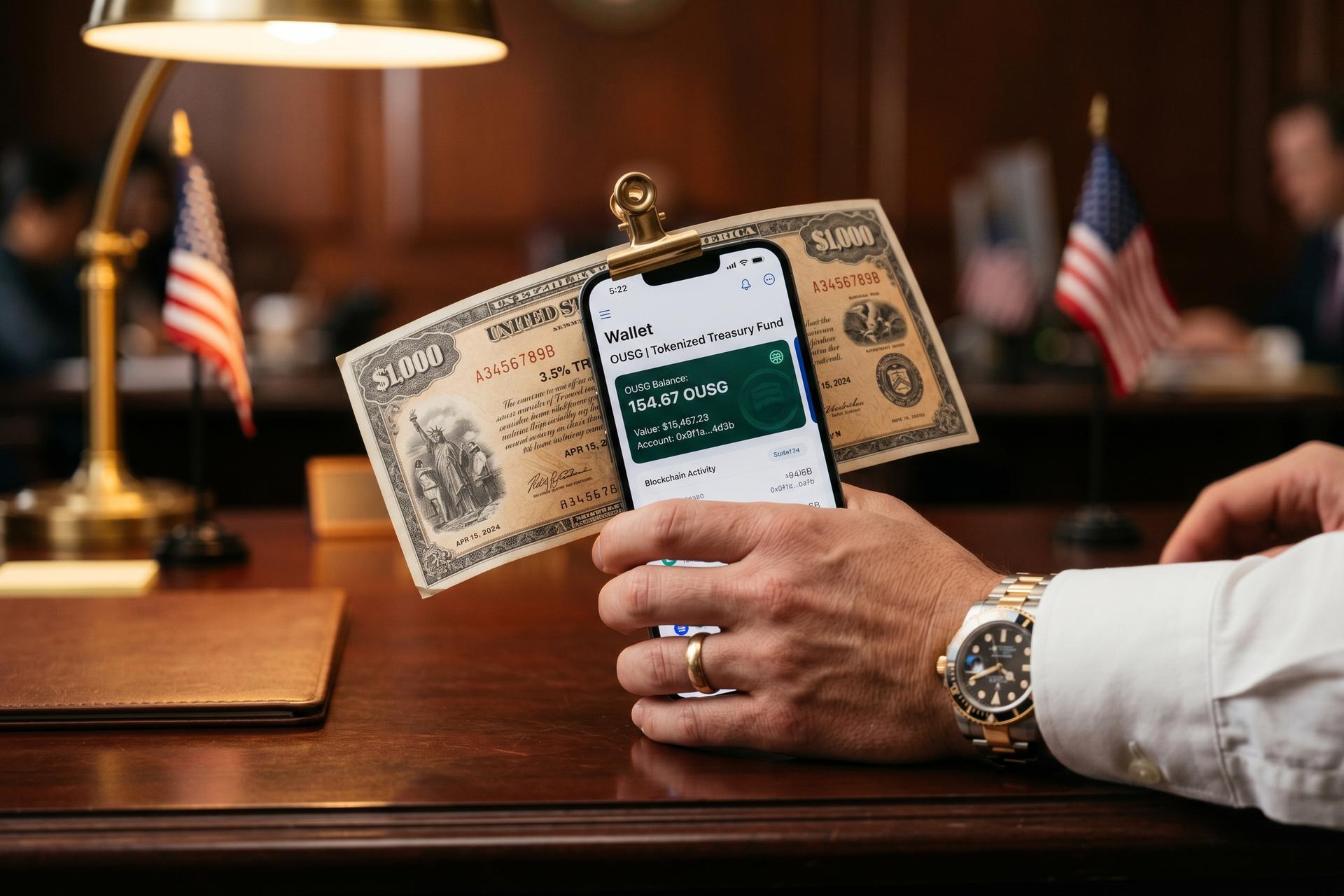
Five seconds. That is how long it took, on May 6, 2026, for a tokenized US Treasury position issued by Ondo Finance to settle across four institutions. JPMorgan's Kinexys network, Mastercard's Multi-Token Network, Ripple's XRPL, and Ondo itself. The transaction was the first cross-border, cross-bank redemption of tokenized Treasuries that did not pass through a single legacy clearing house. The press release was polite. The trade desks that watched were not. A settlement window that usually takes a full business day, sometimes two, had collapsed into the time it takes a barista to froth a latte.
That trade is the one-line summary of what Ondo Finance has become. Not "another DeFi protocol." Not a yield farm. It is a piece of institutional-grade financial infrastructure. Some of the largest names in traditional finance — BlackRock, Mastercard, Franklin Templeton, JPMorgan — are now using it as their on-chain bridge into crypto. The interesting question is no longer whether real-world assets will move on-chain. The question is who controls the rails when they do. As of May 2026, more of those rails run through Ondo than through any single competitor.
This article walks through how that happened. Who built Ondo. What each of its products actually does. Which institutional partnerships are real (versus logo-wall theatre). What the ONDO token does. Where the regulatory wind is blowing. And where the risks still sit. Some risks are bigger than the protocol's marketing wants to admit.
From Goldman Sachs Spinout to a $3.77B RWA Powerhouse
Ondo Finance was founded in 2021 by Nathan Allman and Pinku Surana. Both came out of Goldman Sachs's Digital Assets group. Their thesis was simple. The next wave of crypto adoption would not be driven by tokens with cartoon mascots. It would be driven by tokenized versions of the assets that institutional balance sheets already hold: short-term Treasuries, money-market fund shares, investment-grade credit. They raised a $4 million seed in August 2021. A $20 million Series A from Founders Fund, Pantera Capital, and Coinbase Ventures followed in 2022. Most of the crypto press treated the round as a footnote. With hindsight, it was the seed of one of the most influential infrastructure pieces in the RWA category.
Four years on, the numbers are no longer footnotes. DefiLlama puts total value locked across Ondo's contracts at $3.77 billion on May 24, 2026, spread across thirteen blockchains. The broader tokenized real-world assets market, according to RWA.xyz, is now worth roughly $33.99 billion in distributed value. Tokenized US Treasuries alone account for $15.33 billion of that. Ondo's combined OUSG-plus-USDY footprint is roughly $2.77 billion. That is close to eighteen percent of the entire tokenized Treasury market.
A number that size invites a question. How did a four-year-old crypto company end up holding eighteen percent of an asset class? The whole financial industry has been trying to digitise that asset class for decades. The honest answer is that the team built for cap-tables before they built for retail. OUSG, the company's flagship product, has been a qualified-purchaser instrument from day one. USDY is the retail-facing yield-bearing dollar token. It was designed under non-US distribution constraints. Most of its early growth came from Asia and Latin America, not the noisier US DeFi market. Ondo Chain was unveiled in February 2025. It was pitched not at the Ethereum-or-Solana faithful, but at banks. Those banks wanted a permissioned settlement layer they could point compliance at, without losing the speed advantages of a public chain.
This part of the Ondo Finance story gets squashed in most explainers. The growth curve looks like crypto. The product choices look like fixed-income capital markets. That mismatch is the reason BlackRock, Mastercard, and JPMorgan now put trades through it. Crypto-native rails. Fixed-income use cases.
OUSG, USDY and the Ondo Product Stack Explained
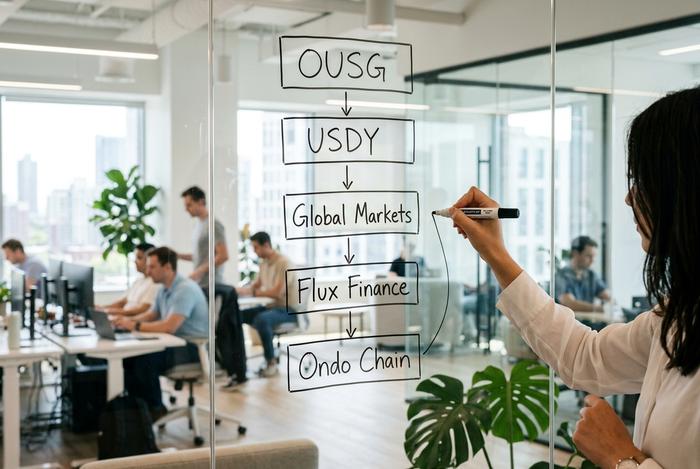
The product stack is wider than most overviews capture. Five distinct offerings sit under the Ondo umbrella. Each targets a different regulatory perimeter. That split, more than the tokenization tech itself, is the company's moat.
OUSG (Ondo Short-Term US Government Treasuries) is the flagship. It is a tokenized share class wrapping a portfolio that, today, holds a significant majority of its assets in BlackRock's BUIDL fund. Reserved for qualified purchasers, OUSG carried $625.3 million in assets under management and a 3.43 percent annualised yield as of May 2026. Daily NAV strikes, a $5,000 minimum redemption, and a daily redemption cap make it institution-friendly. It is not fit as a payment instrument.
USDY (Ondo US Dollar Yield) is the retail-accessible cousin, issued by Ondo USDY LLC. Backed by short-term US Treasuries and bank deposits, it pays treasury yields directly to non-US holders. USDY supply was around $2.14 billion in May 2026 — the second-largest tokenized Treasury product globally — and the last verified yield was 4.65 percent. USDY transfers freely between wallets. That is why most cross-border settlement work runs on it, not on OUSG.
Ondo Global Markets is the newest leg, and arguably the most aggressive. It tokenises individual US equities and ETFs — 200-plus by January 2026 — and is the only place to access most of them on Solana. Global Markets crossed $1 billion in total value locked by May 2026. Cumulative trading volume is around $18 billion. Market share in tokenized equities is over seventy percent. That single number — seventy-plus percent — is the part of the Ondo story that the price-tracker explainers tend to miss entirely.
Flux Finance is the decentralized lending side. The Flux Finance protocol is permissionless and governed by the Ondo DAO. It lets users borrow stablecoins against OUSG and a small set of other yield-bearing collateral. Flux Finance has been deliberately under-marketed since 2024; its last verified TVL was around $37.67 million in October 2025. Read it as a strategic choice, not as decline. The company is steering the lending protocol toward lower leverage and higher custody standards. The aim is to support decentralized protocols without amplifying risk.
Ondo Chain is the permissioned L1 announced on February 6, 2025. More on it in its own section below.
| Product | Type | AUM / TVL (May 2026) | Yield | Who can hold |
|---|---|---|---|---|
| OUSG | Tokenized Treasury | $625.3M | 3.43% | US qualified purchasers + non-US |
| USDY | Yield-bearing stablecoin | $2.14B | ~4.65% | Non-US retail and institutions |
| Global Markets | Tokenized equities/ETFs | $1B+ TVL | Underlying dividend | Non-US accredited |
| Flux Finance | DeFi lending | ~$37.67M | Variable | Open |
| Ondo Chain | Permissioned L1 | n/a | n/a | Invite-only validators |
Take that table together. The institutional-grade financial products story stops being abstract. There is a product for the qualified-buyer Treasury bid. A product for the international retail bid. A product for tokenized equities. A product for leverage. And a product for settling the others. Five perimeters, one issuer.
The Institutional Bridge: BlackRock, Mastercard, JPMorgan
Crypto press releases age badly. Most "institutional partnership" announcements turn out, twelve months later, to mean a single research paper and a shared press photo. Ondo's case is unusual. The press releases were followed by actual settled trades.
The Mastercard Multi-Token Network deal landed first. On February 26, 2025, Ondo became the first real-world asset provider invited onto MTN. MTN lets approved institutions use Mastercard's rails to move tokenized money and assets between banks. OUSG was the inaugural asset. That is not a logo wall; that is a payments network admitting a crypto-native issuer into its core book.
BlackRock came in through a different door. Rather than partner publicly, BlackRock simply became the largest underlying holding of OUSG, via its BUIDL tokenized money-market fund. In one widely-reported deposit, Ondo moved $95 million of OUSG backing into BUIDL. The world's largest asset manager is, in operational terms, Ondo's sub-custodian on a big chunk of the product.
Franklin Templeton tokenized five of its own ETFs — FFOG, FLQL, FGDL, FLHY, and INCE — through Ondo on March 26, 2026. Franklin already runs its own tokenized money-market fund (FOBXX). So this was not "Franklin's first crypto experiment." It was Franklin choosing Ondo's rails over building or buying its own for the equity side of the lineup.
The May 2026 cross-border redemption that opened this article is the clearest demonstration of the bridge. JPMorgan's Kinexys (the rebranded blockchain division), Mastercard's MTN, Ripple's XRPL, and Ondo's own issuance contracts all spoke to each other. Together they redeemed a tokenized US Treasury position across borders and across banks, in under five seconds. None of those parties are crypto-curious newcomers. They are infrastructure operators picking infrastructure.
| Date | Partner | What shipped | Settlement chain |
|---|---|---|---|
| Feb 26, 2025 | Mastercard MTN | First RWA provider on MTN; OUSG live | MTN |
| Feb 6, 2025 | (Self) | Ondo Chain unveiled | Ondo Chain |
| Sep 3, 2025 | Multiple US issuers | Global Markets rolls out tokenized stocks | Ethereum |
| Jan 21, 2026 | Solana ecosystem | 200+ tokenized US stocks/ETFs live on Solana | Solana |
| Mar 26, 2026 | Franklin Templeton | 5 ETFs tokenized through Ondo | Ethereum |
| May 6, 2026 | JPMorgan + Mastercard + Ripple | First cross-border tokenized Treasury redemption | XRPL |
A fair reader might ask why this matters for crypto. The short answer: settlement risk. Every financial institution that learns to redeem a tokenized Treasury on-chain becomes less able to argue that crypto rails are unfit for institutional flow. This is a shift in financial services that compounds until it cannot be ignored. Each integration is small. Eighteen months of them is not.
Ondo Chain: A Permissioned L1 for Tokenized Securities
Ondo Chain is the part of the stack most likely to be misread. Calling it "another L1" puts it in the wrong mental bucket. It is closer to a permissioned settlement layer purpose-built for tokenized securities. It is the kind of chain a regulated bank can validate on. No risk committee meltdown about anonymous validators.
The design choices follow from that audience. Validators are invite-only. The set is institutional. Transactions settle with finality calibrated to securities-clearing expectations rather than to retail DeFi throughput. The chain's intended workloads are OUSG, Ondo Global Markets, and third-party RWA issuers that want to use Ondo's compliance scaffolding without inheriting its issuance pipeline.
Public information on Ondo Chain's mainnet status is still thin in the spring of 2026. The February 2025 unveiling positioned it as a multi-stage rollout, and most of the testable activity to date has been within Ondo's own product line. Read it as a strategic position rather than a finished platform. The pitch to banks is: keep your validator, keep your compliance posture, settle on a chain that other regulated peers also validate. Whether that pitch wins depends partly on Ondo's execution and partly on whether Hyperledger-style consortium chains continue to lose ground to public, EVM-compatible alternatives.

ONDO Token: Governance, Supply, and the 2027 Unlock Cliff
The ONDO token is governance, not equity. It steers the Ondo ecosystem and, at present, holds primary governance rights over Flux Finance. Holders vote on protocol parameters, smart contracts upgrades, and treasury allocations. The token does not represent a claim on revenue from OUSG, USDY, or Global Markets — those flow to the Ondo operating company.
The key numbers as of late May 2026: Ondo price sits at roughly $0.44 per ONDO token. Market cap is $2.14 billion. The rank is around #37. About 4.86 billion of a 10 billion maximum supply is in circulation. The all-time high was $2.14 on December 16, 2024. The all-time low was $0.08217 on January 18, 2024. The 79 percent drawdown from the December 2024 peak is largely a 2025 unlock story. The next major cliff arrives in January 2027. At that point a substantial tranche of insider and ecosystem allocations becomes eligible to move. That cliff, not the macro tape, is the largest single structural risk hanging over the token price for the next eighteen months. Anyone buying ONDO for the underlying business case should keep that calendar visible.
Regulatory Tailwinds: SEC, the GENIUS Act, and MiCA
Three regulatory developments in eighteen months have done more for Ondo's institutional adoption than any single product launch.
The SEC closed its investigation into Ondo on December 8, 2025, without filing charges. The probe had been a quiet overhang on the company for most of 2025 and a key reason some US institutions had stayed at arm's length. With the investigation closed, the gating concern for the largest US asset managers shifted from "regulatory tail risk" to "operational fit." Different conversation entirely.
The GENIUS Act (S.1582, 119th Congress) created the first comprehensive federal framework for payment stablecoins, with explicit safe-harbour treatment for tokenized Treasury-backed instruments. It rewards exactly the structure USDY is built on. Whether USDY ends up registering under GENIUS or restructures to qualify is a question for Ondo's general counsel. The broader signal — Washington has stopped trying to force tokenized Treasuries into legacy securities boxes — is what matters strategically.
MiCA in Europe pulled in the same direction. As of May 2026, USDY-class products have working approvals in roughly thirty EU jurisdictions, opening retail access in the largest economic block outside the US. That is a real step toward democratizing access to institutional-grade finance for retail investors. It makes USDY one of the few non-US tokens with a credible European retail path.
Ondo vs Securitize, Franklin OnChain, Superstate, Backed
None of this means Ondo Finance invented the real-world assets category. The honest framing is "leader, not monopolist." Securitize is structurally larger by AUM if you credit them with the full BUIDL fund they administer for BlackRock. That single product is the largest tokenized Treasury vehicle in the world. Institutional investors in it have no direct exposure to the Ondo ecosystem. Franklin Templeton's FOBXX has been live since 2021 and predates Ondo's Treasury work entirely. Superstate built a competitive USTB Treasury token before being acquired by Invesco in March 2026. Backed Finance's bIB01 has the largest non-US retail footprint for tokenized Treasuries outside USDY.
| Protocol | Primary category | Approximate AUM/TVL | Distinct edge |
|---|---|---|---|
| Ondo Finance | Treasuries + equities + L1 | $3.77B TVL | Product breadth + Mastercard/JPM integration |
| Securitize (BUIDL admin) | Tokenized Treasuries | $2.9B+ (BUIDL) | BlackRock issuer |
| Franklin OnChain | Tokenized money market | $400M+ (FOBXX) | First-mover, brand |
| Superstate (Invesco) | Tokenized Treasuries | ~$900M (now Invesco) | Acquired by major fund manager Mar 2026 |
| Backed Finance | Tokenized stocks/Treasuries | Mid-hundreds of millions | EU regulatory footprint |
Ondo's distinguishing edge is breadth across products plus the integration depth with payment networks. None of the competitors above is sitting on Mastercard's MTN as the first RWA provider. None has shipped a five-second cross-border Treasury redemption with JPMorgan. That gap explains why ONDO trades at a premium to the AUM-implied valuation a pure tokenization shop would deserve.
Risks: Counterparty, Liquidity, and Unlock Pressure
The institutional bridge story is real, but the risks around Ondo Finance compound rather than offset. Counterparty concentration is the biggest. With BlackRock's BUIDL fund as the underlying for most of OUSG, a custodial failure at BlackRock would propagate into OUSG holders. The event is very unlikely. It is not impossible. Liquidity is the second risk. OUSG's $5,000 minimums and daily redemption caps mean that tokenized assets held there cannot be exited instantly; that right is theoretical, not contractual. The January 2027 unlock cliff is the third — predictable supply pressure on the ONDO token. Regulatory risk is the fourth, particularly on tokenized equities, where the legal status of cross-border distribution remains untested in court.
How to Buy ONDO Token, USDY and Get OUSG Exposure
ONDO trades on most major centralised exchanges — Binance carries the highest volume around $41.7 million daily, with Coinbase Exchange, OKX, and Kraken close behind. The token is available on Ethereum, with bridged versions on several other chains; trading volume and live Ondo price data appear on CoinGecko and CoinMarketCap. USDY is open to non-US retail through the Ondo Finance app and a growing list of broker integrations in Asia and Europe. USDC is accepted as a minting currency at onboarding. OUSG remains qualified-purchaser only and is onboarded directly through Ondo's institutional desk. Self-custody works for ONDO and USDY; OUSG requires a regulated wallet.