
What Is a Liquidity Provider? How LPs Work in Financial Markets Explained
Try swapping a random altcoin at 4 AM on a Sunday. Two years ago that trade might have sat there for twenty minutes before someone took the other side, if anyone did at all. Today it fills in seconds. The difference? Somebody deposited their tokens into a pool so you wouldn't have to wait. That somebody is a liquidity provider.
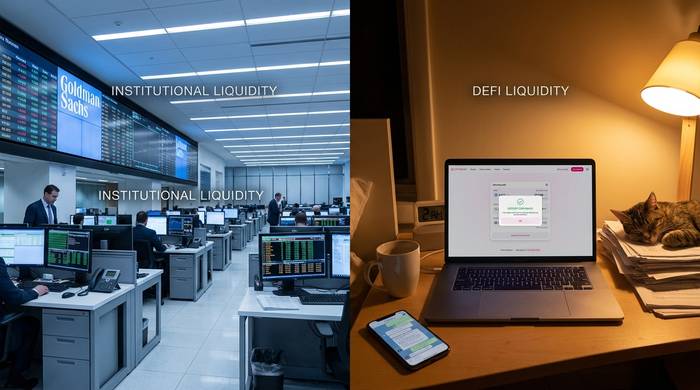
The concept goes way beyond DeFi, though. A forex broker in Singapore quoting tight EUR/USD spreads during the Tokyo overlap? That's a liquidity provider too, just a bank-sized one. JPMorgan feeding prices into the interbank market and a 22 year old depositing $5,000 worth of ETH and USDC into Uniswap are doing fundamentally the same thing: parking assets where someone else needs them, so trades happen fast and prices stay fair.
I've been covering DeFi and tradfi liquidity for years, and the thing that still surprises people is how different the mechanics are on each side, even though the goal is identical. Below, I'll walk through how LPs work in forex, how they work in DeFi, and what the actual data says about who makes money and who doesn't.
Why liquidity matters in financial markets
Liquidity, at its simplest, means you can buy or sell something without the price moving against you. Sell 10,000 shares of Apple and the price barely twitches. Try selling 10,000 tokens of some microcap altcoin and the price might crash 15% before your order fills. That gap between those two experiences? That's the liquidity gap, and it determines your trading costs, your execution quality, and whether big money shows up to trade at all.
It also shifts all the time. Bitcoin on Binance? Plenty of liquidity. The same Bitcoin on a small exchange in a country with three hundred users? Thin order book, wide spreads, and slippage if you try to move any size.
Liquidity providers exist to close that gap. They stand ready to buy when the market is selling and sell when it's buying. Not out of charity. As an intermediary, they pocket the bid-ask spread, the tiny margin between their buy price and sell price. Across millions of trades a day, those tiny margins compound into serious revenue.

Types of liquidity providers: from Tier 1 banks to DeFi protocols
The term "liquidity provider" covers a wild range. At the top end you've got JPMorgan, Goldman Sachs, Citi, Deutsche Bank, Barclays. These Tier 1 liquidity providers feed prices directly into the interbank FX market, government bonds, equities. Billions in balance sheet behind every quote. When a broker advertises "Tier 1 liquidity" that's what they mean: prices sourced from these banks.
Below the banks, a growing category of non-bank market makers has been eating into their share. Citadel Securities, Virtu Financial, Jump Trading. Tech driven, faster, leaner. Their revenues grew 22% between 2023 and 2024, and they're outpacing traditional banks in several asset classes now.
Then you've got Prime-of-Prime providers, or PoPs. These are firms like B2Broker and LMAX that aggregate liquidity from multiple Tier 1 banks and sell access to smaller brokers. A forex broker in Lithuania doesn't have a direct line to Goldman's FX desk, but they can get Goldman's prices through a PoP.
On the crypto side, two very different animals. Centralized market makers like Wintermute (roughly $5 billion in daily volume) operate trading desks that quote prices on exchanges. And then there's DeFi liquidity providers, which is anyone with a wallet. You, me, your neighbor. Deposit tokens into a pool on Uniswap and you're an LP. The barrier to entry is basically zero, which is both what makes DeFi interesting and what makes a lot of people lose money.
| Provider type | Examples | Typical market | Capital required |
|---|---|---|---|
| Tier 1 banks | JPMorgan, Goldman Sachs, Citi | Forex, bonds, equities | Billions |
| Non-bank market makers | Citadel Securities, Virtu, Jump | Equities, options, crypto | Hundreds of millions |
| Prime-of-Prime (PoP) | B2Broker, LMAX | Forex, CFDs, crypto | Tens of millions |
| Crypto market makers | Wintermute, GSR, Amber Group | Centralized crypto exchanges | Millions |
| DeFi liquidity providers | Any wallet holder | Decentralized exchanges | Any amount |
How liquidity providers work: order books vs automated market makers
Two completely different systems exist for providing liquidity, and they have almost nothing in common except the end result: trades get filled.
On centralized exchanges and in traditional finance, market makers post limit orders on both sides of the order book. Buy ETH at $3,495, sell at $3,505. That $10 spread is their profit margin. A trader hits the market order button, it matches against the closest limit order, done. The market maker then adjusts their quotes, manages inventory, hedges across other instruments. All of this happens in milliseconds through smart order routing systems and the FIX protocol, which is how brokers and LPs communicate orders. Two main execution modes: Fill or Kill (your whole order fills at your price, or nothing happens) and Immediate or Cancel (partial fills allowed, remainder dropped).
DeFi threw away the order book. Automated market makers, AMMs, replaced it with liquidity pools. A pool is a smart contract holding paired tokens that people deposited. The math that prices your trade is usually the constant product formula: x * y = k. The "x" and "y" are token quantities, "k" stays constant. When you swap one token for the other, the ratio changes, and that change IS the new price.
I always explain it with a concrete example. Pool has 100 ETH and 300,000 USDC. You want 1 ETH. You send USDC to the pool, the contract does the math, you get your ETH. The catch: the bigger your trade relative to the pool, the more the price shifts. A $1,000 swap in a $10 million pool? Barely moves. Same swap in a $50,000 pool? You'll eat 3% slippage.
Uniswap has processed over $3.45 trillion in total trading volume, deployed across about 40 chains. It holds 35.9% of all DEX volume. PancakeSwap has 29.5%. Between the two, that's roughly 65% of every decentralized trade happening on chain.
The role of liquidity providers in crypto and DeFi
Pull the LPs out of DeFi and there is no DeFi. No order book exists to fall back on. No human market maker desk picks up the phone. If a Uniswap pool is empty, that trading pair is dead until somebody refills it. That's the deal: protocols need LP capital the way a car needs fuel.
So how do they attract it? Trading fees, primarily. Every swap through a pool costs the trader 0.01% to 0.3% depending on the pool tier. That fee splits among all LPs proportional to their deposit. Uniswap LPs alone have collected $4.94 billion in fees since the protocol went live. During 2025, the number was roughly $985 million.
On top of fees, many protocols dangle governance tokens. Deposit into our pool, get our token as a bonus. This was the playbook for DeFi Summer in 2020. Compound, SushiSwap, and dozens of forks offered insane yields to bootstrap their liquidity. Some early LPs made life changing money when those tokens pumped. Others watched the governance tokens crash to near zero while impermanent loss ate their principal.
The rise and fall of DeFi total value locked, or TVL, tells you everything about how this cycle played out.
| Year | Approximate DeFi TVL | Context |
|---|---|---|
| May 2020 | $1 billion | DeFi Summer begins |
| December 2020 | $10 billion | 900% growth in seven months |
| November 2021 | $174 billion | Bull market peak |
| December 2022 | $38 billion | Post-Terra/LUNA collapse |
| Mid-2025 | ~$150 billion | Recovery and stabilization |
| Early 2026 | $105-130 billion | Market selloff, holding relatively well |
Look at those numbers. $1 billion to $174 billion in eighteen months. Then back down to $38 billion after Terra/LUNA blew up. Trillions in capital flowed through liquidity pools during that run. When it flowed back out, a big chunk didn't just evaporate. It transferred from LP wallets to trader wallets, largely through impermanent loss.
LP tokens, yield farming, and the economics of liquidity provision
When you deposit tokens into a DeFi liquidity pool, you receive LP tokens in return. These tokens are a receipt: proof of your share in the pool, redeemable at any time for your underlying deposit plus any fees accrued. If you deposited 1% of a pool's total liquidity, your LP tokens entitle you to 1% of the pool's assets when you withdraw.
LP tokens have become financial instruments in their own right. You can use them as collateral to borrow on lending platforms like Aave. You can stake them in additional "farming" contracts to earn a second layer of yield. This practice, yield farming, essentially means using the receipt from one deposit as fuel for another. Stack enough layers and you get what DeFi users call "degen farming": chaining together multiple protocols, squeezing yield out of yield. More return, more risk, more complexity. It can unravel fast.
The fees that LPs earn vary enormously depending on the pool. Stablecoin pairs (like USDC/USDT) generate lower fees per trade but come with minimal impermanent loss since both tokens stay close to $1. Volatile pairs (like ETH/MEME) can generate higher fee income but carry substantial impermanent loss risk. Uniswap v4 pools currently average 56.43% APY across 4,689 tracked pools, though that number is heavily skewed by a few high-volume, high-volatility pairs.
In December 2025, Uniswap implemented its "UNIfication" fee switch, which changed the LP economics meaningfully. Under the new structure, the protocol itself takes a cut of LP revenue: 16.7% to 25% of fees on v3 pools and a fixed 0.05% on v2 pools. Before this change, 100% of trading fees went to liquidity providers. After it, LPs are sharing their income with the protocol treasury. It's the DeFi equivalent of a platform fee, and it was one of the most debated governance decisions in Uniswap's history.
Risks of being a liquidity provider: impermanent loss and beyond
The biggest risk specific to DeFi liquidity providers has a name that is frankly misleading: impermanent loss. There's nothing impermanent about it if you withdraw at the wrong time. A more honest name would be "divergence loss," which is what some protocols have started calling it.
Here's how it works. AMMs force you to hold a shifting mix of two tokens as prices move. Say you deposit equal values of ETH and USDC. ETH doubles. The AMM auto-rebalances: you end up with less ETH and more USDC than you started with. If you had just held the tokens in a wallet, you'd have more total value. That gap is impermanent loss.
The math scales with price divergence. A 2x price change in either direction produces roughly 5.7% impermanent loss. A 5x change produces about 25%. These are permanent portfolio drags that only disappear if the token prices return exactly to their original ratio, which in volatile crypto markets, they often don't.
A study by Topaz Blue and Bancor (one of the most referenced pieces of LP research in DeFi) found that 49.5% of Uniswap v3 liquidity providers experienced negative returns after accounting for impermanent loss. Across 17 major pools representing 43% of TVL, LPs suffered $260.1 million in impermanent loss against only $199.3 million in earned fees. More recent data from MEXC Research in 2025 puts the number even higher: 54.7% of LPs in volatile pairs lost money on net.
A Bank for International Settlements working paper (No. 1227) adds another dimension. It found that 65-85% of the liquidity on major DEXs comes from sophisticated, often institutional participants. These professional LPs use concentrated positions and active hedging that give them a systematic edge over passive retail providers. The retail LP who deposits and walks away for three months is, statistically, the one subsidizing the more active participants.
Beyond impermanent loss, LPs face smart contract risk (a bug in the protocol's code could drain the pool), oracle manipulation attacks, and the basic market risk of holding volatile tokens. In unaudited protocols, there's also rug pull risk: the developers could drain the entire liquidity pool overnight.
How brokers and traders choose a liquidity provider
For traditional brokers, selecting a liquidity provider is one of the most important decisions they make. The quality of your LP directly affects your clients' execution quality: their fill speed, their spreads, and their slippage. A bad LP relationship means worse prices for your customers and, eventually, fewer customers.
What do brokers actually look at? Spread consistency, for one: is the bid-ask spread tight during all market conditions, or only when things are calm? Execution speed matters too, especially in forex where latency is measured in milliseconds. Depth of book is another big one: can the LP handle a large order without moving the market? And then there's regulatory standing, because working with an unlicensed LP creates compliance headaches nobody wants.
Most brokers don't rely on a single liquidity provider. Instead, they use liquidity aggregation: pulling price feeds from multiple LPs and routing each order to whichever one offers the best price at that moment. This aggregation happens through Straight Through Processing (STP) systems that connect brokers to LP pools without a dealing desk in between. The result is competitive pricing and, theoretically, reduced conflicts of interest since the broker isn't taking the other side of the client's trade.
For individual traders in DeFi, "choosing" a liquidity provider means choosing which pool to trade through. The relevant questions are different: How deep is the pool? What's the slippage on your trade size? Are the fees reasonable? Is the smart contract audited? The DEX aggregators like 1inch and Jupiter handle this automatically, routing your trade across multiple pools to get the best possible price. You're interacting with liquidity providers whether you realize it or not, every single time you swap tokens on a DEX.
The future of liquidity provision
The LP world is changing fast, pushed by new technology on one side and regulatory pressure on the other.
Concentrated liquidity, introduced by Uniswap v3 and refined in v4, lets LPs allocate their capital to specific price ranges instead of spreading it across the entire price curve. This is far more capital efficient: an LP who concentrates around the current price provides more effective liquidity per dollar than one who covers the full range. But it also demands active management. If the price moves outside your chosen range, your position earns zero fees. Uniswap v3 currently tracks 2,527 pools with $2.785 billion in TVL, while the newer v4 has grown to 4,689 pools, which tells you where the market is heading.
Cross-chain liquidity is the next big problem to solve. As DeFi expands across dozens of blockchains, liquidity gets split up. An ETH/USDC pool on Ethereum, Arbitrum, Polygon, and Solana are four separate pools. None of them has enough liquidity on its own to compete with a centralized exchange. Protocols like Chainlink's CCIP and intent-based bridges are trying to stitch these pools together so a trader on Base can tap liquidity on Ethereum without moving tokens by hand.
On the traditional finance side, the biggest shift is the blurring line between DeFi and institutional markets. Wintermute and Jump Crypto already work both sides, making markets on Binance and providing liquidity on Uniswap. As MiCA in Europe and evolving SEC/CFTC rules in the US start to mature, the wall between regulated (KYC'd, permissioned) and open (permissionless DeFi) liquidity is getting thinner. Not everyone is optimistic about consolidation. A Finance Magnates survey found that 60% of OTC insiders expect fewer liquidity providers to survive through 2026 as compliance costs rise and competition thins the herd.
The DEX market keeps expanding regardless. DEX spot trading volume hit $876.3 billion in Q2 2025, up 25% quarter over quarter. Unique wallets interacting with DEXs grew from 6.8 million to 9.7 million over the same period. More traders means more demand for liquidity, which means more opportunity for providers. And more risk, too, but that's the deal.



