Shiba Inu Coin (SHIB) 2026: A Cryptocurrency Worth Buying?
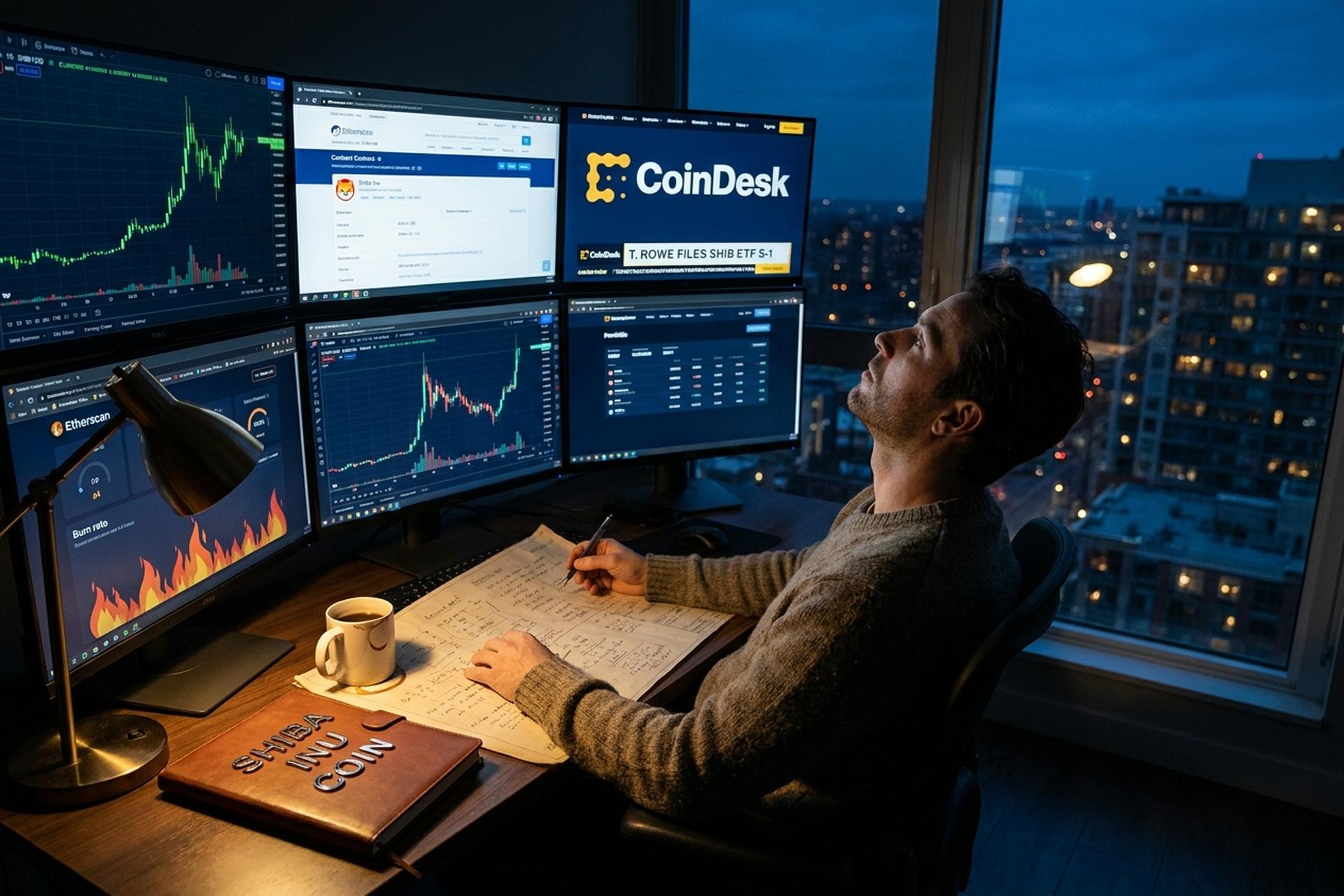
$0.0000057. That is the live shiba inu price as I write this, and it is roughly 93% below the all-time high SHIB printed on October 28, 2021. The strange part is that, by any reasonable read of the news cycle, the bull case for shiba inu coin is stronger now than it has ever been. American regulators just classified it as a digital commodity. A trillion-dollar asset manager filed paperwork to put it in an ETF. The Shibarium layer-2 network crossed a billion transactions. None of that, so far, has moved the price meaningfully.
This article is the one I wish existed when a friend asked me whether SHIB still made sense as a 2026 buy. We will go through tokenomics, the burn math, Shibarium's actual usage, the SEC and CFTC decision, and the T. Rowe Price filing. The goal is to leave you able to answer the question yourself, with numbers attached.
Shiba Inu Price Today: SHIB at 93% Below Its 2021 Peak
The shiba inu price today, in USD, sits at $0.0000057 with a market capitalization of roughly $3.4 billion. CoinGecko ranks SHIB at #33. Year-to-date in 2026 the token is up about 5.9%, but that figure is misleading: SHIB spiked to around $0.0000101 on January 5 and has drifted lower for most of Q1 and Q2 since. The one-year return is +60.1%, with 24-hour trading volume averaging around $64 million — numbers that mostly track the wider crypto cycle rather than anything specific to shiba inu crypto. The all-time high from October 2021 of $0.00008616 remains roughly 15x away. The price history since that peak has been a long, choppy descent: a 2022 collapse, a 2023 base, a 2024 grind, and a 2025 partial recovery, none of which retested the 2021 number.
How Ryoshi Built the Shiba Inu Token in August 2020
The shiba inu token was launched in 2020 by an anonymous developer known as Ryoshi. SHIB is an Ethereum-based ERC-20 token on the Ethereum blockchain, created with a maximum supply of one quadrillion. Ryoshi described the project as an "experiment in decentralized community building." Half of that supply was sent to Vitalik Buterin as a publicity move, and it backfired in the founders' favor. In May 2021 Vitalik burned about 410 trillion of those tokens and donated the rest to a COVID relief fund in India. Ryoshi himself disappeared from public view in May 2022, deleting his blog posts and social presence. That matters more than it sounds. A community-driven project whose anonymous creator left no forwarding address has, by definition, no one accountable for direction. The ecosystem has continued — ShibaSwap, Shibarium, and a layer 3 in development — but the original architect has been silent for three years.
SHIB Tokenomics: Why a 589 Trillion Supply Matters
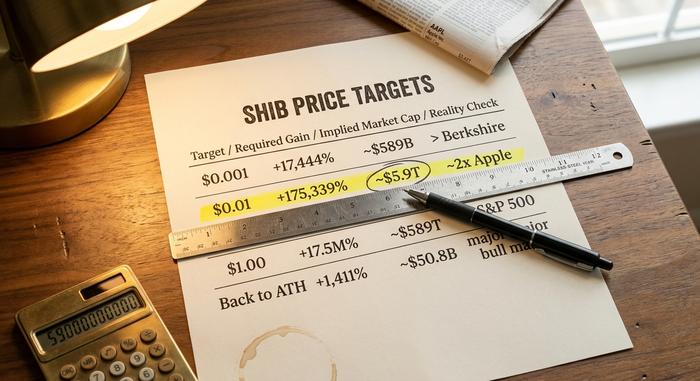
This is the section every SHIB-to-the-moon thread skips. The current circulating supply is 589.24 trillion tokens, with about 410 trillion already burned. The ecosystem around shib is a three-token model: SHIB itself, LEASH (originally pegged to Dogecoin, now a small-cap utility token), and BONE, which powers governance and is the gas token on Shibarium. The simple problem with reaching $0.01, let alone $1, is arithmetic. To hit $0.01 SHIB would need a market cap of about $5.9 trillion, larger than the entire S&P 500 sector for technology. Those are total supply numbers, not projections. Bitcoin at its 2025 peak was around $2.2 trillion. The numbers do not work without supply destruction on a scale that has not happened, despite the burn narrative.
Top-10 wallet concentration adds a separate risk. Roughly 62.65% of the circulating supply sits in ten addresses. The dominant position is the burn address itself, but the next nine are exchange wallets and a handful of identifiable whales. Exchange reserves dropped to a 2026 low of 82.31 trillion SHIB in early May, with 374 billion tokens withdrawn in a single week. Whether that signals accumulation or simply illiquid custody migration is contested.
Price target math
| Target price | Required gain | Implied market cap | Reality check |
|---|---|---|---|
| $0.001 | +17,444% | ~$589 billion | Larger than Berkshire Hathaway |
| $0.01 | +175,339% | ~$5.9 trillion | Roughly 2x Apple's market cap |
| $1.00 | +17.5 million% | ~$589 trillion | About 9x the entire S&P 500 |
| Back to ATH | +1,411% | ~$50.8 billion | Plausible in a major bull market |
A run back to the 2021 all-time high implies a 15x from here. Possible, but it requires the kind of broad crypto mania the market last saw in 2021 with retail and institutional flows aligned. Anything beyond that requires changes in supply, not just price.
SHIB Burn Math: 41% Gone, 38,000 Years to Empty
If tokenomics is the bear case from supply, the burn rate is the bear case from time. Of the original quadrillion, 410.84 trillion SHIB has been permanently destroyed — 41.08%. Headlines that quote that number out of context make burning sound like an ongoing decarbonization of supply. It is not. The bulk of that 410 trillion came from one event in May 2021, when Vitalik burned the tokens he had been gifted. Since then, the burn rate has been modest.
Shibburn.com puts the daily burn at about 2.4 million tokens over the last 24 hours, which is roughly $14 at current prices. The 30-day total is about 195 million SHIB, or $1,152. Headlines in January 2026 quoted a "10,728% burn rate increase," and that number is technically accurate. It is also meaningless: a 10,728% jump from a near-zero baseline is the kind of single-day comparison that newsrooms use to manufacture momentum. Across longer windows, the trend is flat.
Burn pace check
| Metric | Value |
|---|---|
| Total burned to date | 410.84 trillion SHIB (41.08% of original) |
| One-time Vitalik burn (May 2021) | ~404 trillion SHIB |
| Daily burn (May 2026) | ~2.4 million SHIB (~$14 USD) |
| Monthly burn (30-day) | ~194.6 million SHIB (~$1,152 USD) |
| Years to burn another 10% of remaining supply | ~38,000 years at current rate |
If you assume the monthly rate doubles every year for a decade, the math still does not reach a 10% supply reduction this century. The narrative is doing more work than the mechanism. Shibarium is supposed to change this by routing transaction fees into automatic burns, but Shibarium's transaction volume, while large in count, is small in value, so the burns it produces remain tiny in absolute terms.
Shibarium and the Shiba Inu Crypto Network
Shibarium is the Shiba Inu ecosystem's layer 2 blockchain solution on Ethereum, positioned as the project's Web3 infrastructure layer. The Shiba Inu team announced on April 27, 2026, that the network had crossed one billion cumulative transactions and that wallet count reached an all-time high of about 1.585 million. Both numbers are real. The harder question is what those transactions are doing. According to DeFiLlama (figure observed through secondary sources after a 403 on direct fetch), Shibarium's total value locked sits at roughly $487,800 as of May 2026. That is less than the marketing budget of most mid-size DeFi protocols. By comparison, Arbitrum's TVL is about $12.5 billion and Base's is about $8.4 billion.
What that gap tells you is that Shibarium is running a lot of low-value transactions — gaming, micro-payments, on-chain message-board activity — without attracting meaningful financial capital. The dApp ecosystem is thin: a handful of NFTs collections (the Shiboshi series being the most recognizable), a few games, and ShibaSwap itself. ShibaSwap, the native decentralized exchange, processes some volume but has not pulled liquidity away from Uniswap or other established decentralized finance venues. A new project, TREAT, raised $12 million in late 2025; its launch impact on the broader Shiba Inu ecosystem is still unconfirmed. Validator participation is healthy but the financial activity on the network is a fraction of what a layer 2 in the SHIB market-cap range would normally support.
My honest read is that Shibarium is real infrastructure with weak commercial gravity. That picture can change with one or two breakout dApps or a successful TREAT launch. It has not changed yet.
The SEC's 2026 Call on Memecoin Cryptocurrencies
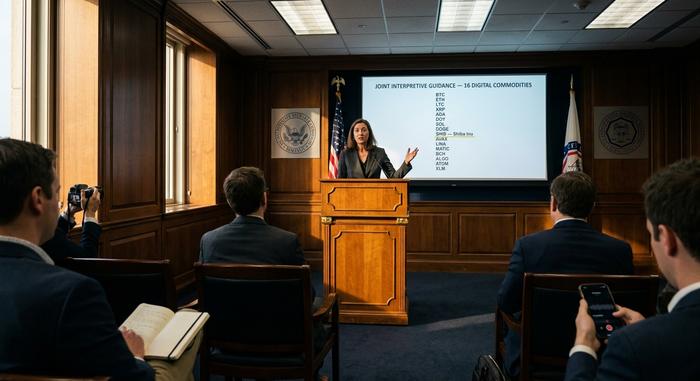
Here is the news that price pages do not write about. On March 18, 2026, the SEC and CFTC issued joint interpretive guidance classifying 16 major cryptocurrencies as digital commodities, and SHIB was one of them. So was DOGE. This is the first time a memecoin received that status, and it is a substantive regulatory shift. Being categorized as a digital commodity rather than a security closes one of the most damaging tail risks for SHIB and DOGE: forced delisting from US exchanges, enforcement actions against developers, or being treated as an unregistered security. A community-driven asset class without a clear issuer has historically lived in regulatory limbo. That limbo is over, at least in the US.
Two days before that, on March 16, T. Rowe Price filed an amended S-1 with the SEC for its "Price Active Crypto ETF" listing SHIB among the assets the fund is permitted to hold. T. Rowe Price manages roughly $1.8 trillion. CoinDesk first reported the filing. The ETF has not been approved as of May 2026, but the filing itself is the kind of signal SHIB holders waited four years for.
The picture outside the US is messier. Japan's Virtual Currency Exchange Association added SHIB to its Green List in early 2026, easing domestic exchange access. The Digital Asset Market Clarity Act passed the US Senate Banking Committee on May 14, 2026, and remains on track for a full vote. The European Union's MiCA framework reaches full enforcement on July 1, 2026, but MiCA does not explicitly carve out memecoins. SHIB, as a community-driven token without a formal issuer, sits in a gray zone under MiCA. So far no explicit EU action against SHIB has been recorded.
T. Rowe Price and the Shiba Inu Market Shift
A $1.8 trillion asset manager filing for an actively managed crypto ETF that lists shiba inu crypto among eligible holdings is new territory. The SHIB community has wanted this since 2021. A filing is a long way from an approval, though, and an approval is a long way from real inflows. Spot Bitcoin ETFs sat in the queue for years before the SEC said yes. If a T. Rowe SHIB ETF eventually arrives in 2027 with $50 million in initial flows, that would be a milestone with limited price impact.
The other shiba inu news worth holding in mind: SHIB is not the largest meme coin. Dogecoin is. DOGE's market cap is about $16.1 billion, roughly 4.7 times SHIB's $3.4 billion. The combined meme coin sector is about $35.5 billion, of which SHIB holds a 9.6% share. DOGE has its own proof-of-work blockchain, 14,000+ merchant integrations, and a longer institutional track record. SHIB has the richer ecosystem in pure technical terms (layer 2, native DEX, layer 3 in development), but DOGE has been the cycle's institutional favorite. Technical analysis from chartists is mixed and rarely useful at this market cap; the cleaner signal is which of the two ends up in the first major spot meme ETF, if one happens.
Three things will likely shape SHIB price movements through 2027, and they sit on top of the broader shiba inu market in roughly that order of importance. The first is the SEC's response to the T. Rowe filing — approval would unlock the first traditional-finance flows into a memecoin in US history. The second is Shibarium's ability to attract a flagship dApp or a serious DeFi protocol that finally puts capital onto the network. The third is the broader crypto cycle: SHIB has historically traded as a high-beta proxy for BTC and ETH, so a meaningful run on the majors typically lifts SHIB by more, both up and down. Market sentiment data tracked by Santiment suggests retail interest has been quiet for most of 2026, which has historically been a more constructive setup than the euphoric peaks. None of that is a prediction. It is a list of things to watch instead of price targets.
How to Buy Shiba Inu Crypto in USD: 4 Routes
If you decide to buy shiba inu after reading the above, there are four practical routes. Centralized exchanges (Coinbase, Kraken, Binance, KuCoin) take USD via card or wire and list SHIB directly. A decentralized exchange like Uniswap lets you swap stablecoins or ETH from a digital wallet (MetaMask, Coinbase Wallet) for SHIB directly on Ethereum. ShibaSwap, the native DEX, offers SHIB and allows you to stake into liquidity pools, though traffic is smaller than Uniswap's. Brokerage apps such as Robinhood and eToro list SHIB for fiat purchases with simpler interfaces but no on-chain custody. Most pages tracking cryptocurrency prices include a calculator so you can run a DCA plan in advance, which I would recommend over any single-purchase decision.