Berachain (BERA) Explained: Proof of Liquidity in 2026
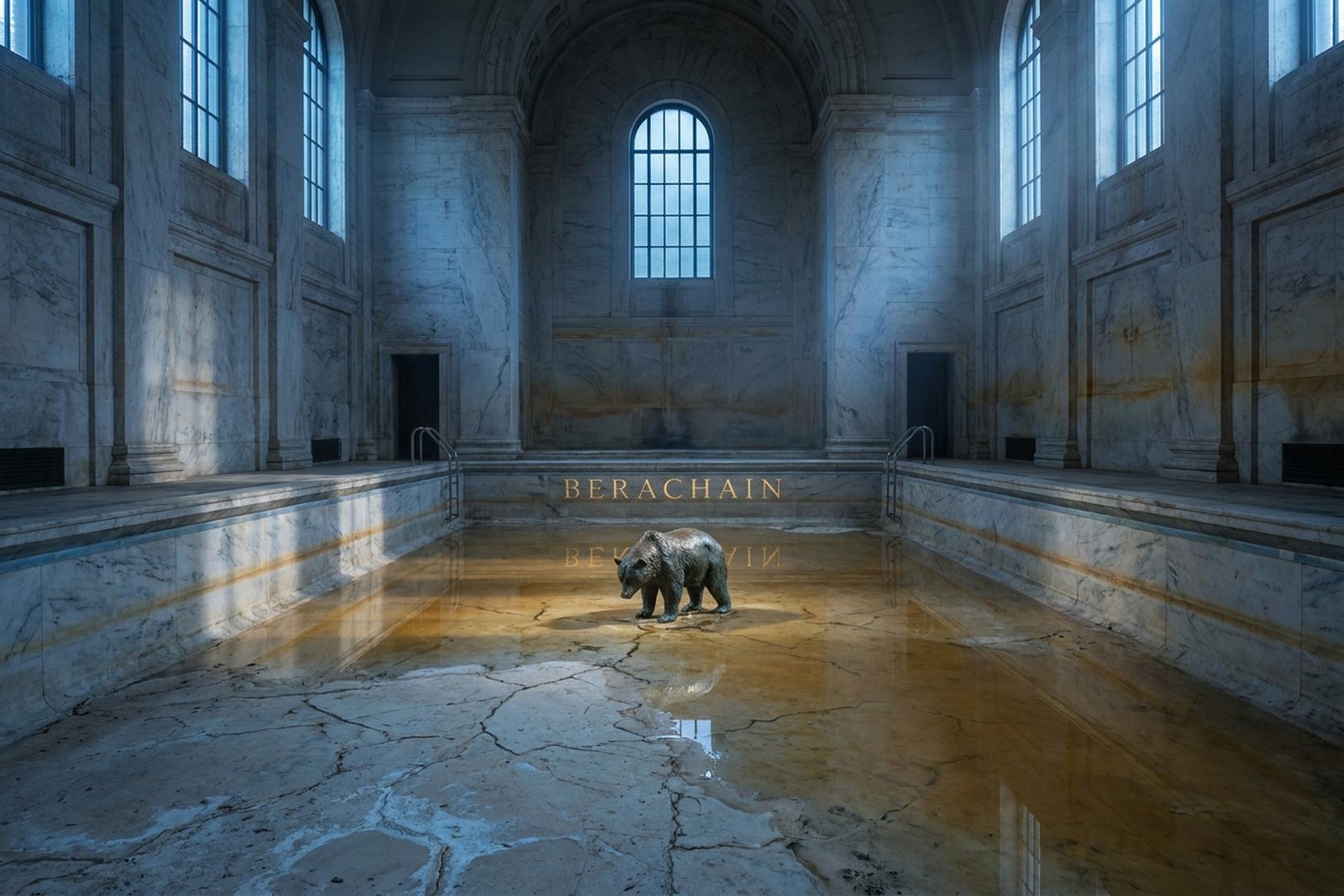
Berachain spent its first month as one of the ten most valuable places to park money in crypto. A year later it held less total value than a single mid-sized lending app. The BERA token is down roughly 98% from its peak, and it set a fresh all-time low this week. That gap — between the launch everyone watched and the chain that is left — is the most useful thing to understand about Berachain before you read another word about its technology.
This article covers what Berachain is, how its Proof of Liquidity system actually works, what the BERA, BGT, and HONEY tokens each do, how the tokenomics and airdrop were structured, and what the on-chain numbers say once the marketing is stripped out.
What Berachain is, in plain terms
Berachain is a Layer 1 blockchain that runs an exact copy of the Ethereum Virtual Machine. "EVM-identical" is the term the team uses, and it matters: a developer can take a contract written for Ethereum, deploy it on Berachain unchanged, and connect with the same wallet, the same Solidity, and the same tooling. From a builder's seat, it feels like Ethereum.
What makes it different is not the execution layer but how the chain pays for its own security. Most proof-of-stake networks ask you to lock up the native token and leave it idle. Berachain's pitch is that the capital securing the chain should also be working in its DeFi apps at the same time. That mechanism is called Proof of Liquidity, and the whole project is built around it.
The origin story is unusual. Berachain grew out of a 2021 NFT meme collection called the Bong Bears, run by pseudonymous founders who go by names like Smokey the Bera. After a long testnet phase, the mainnet went live on February 6, 2025. The joke became a chain that raised real money and, for a few weeks, real attention.
How Berachain works: Proof of Liquidity
Proof of Liquidity is Berachain's consensus mechanism and the reason the chain exists, so it is worth slowing down here. The short version: security is tied to useful capital rather than locked-and-idle capital. The elegant idea comes with a catch that most explainers skip, and we will get to it.
The execution layer: EVM-identical
Berachain is built with BeaconKit, a consensus framework that sits on the Cosmos SDK, but the part users touch is pure Ethereum. The EVM is reproduced byte for byte, so MetaMask, Foundry, and existing Solidity contracts work without changes. This is a deliberate choice. Rather than ask developers to learn a new language or a new virtual machine, Berachain competes on incentives and keeps the technical surface familiar.
Proof of Liquidity versus Proof of Stake
Here is the real departure. On a standard network you secure the chain by staking the native token. On Berachain you do not stake BERA to earn rewards or steer the chain. Instead, you provide liquidity to whitelisted reward vaults, and in return you earn BGT, a separate governance token. Validators are not ranked by how much BERA they hold; they are ranked by how much BGT applications and users direct toward them. Liquidity, not idle stake, becomes the basis of network security and the thing that steers the chain.
Validators, BGT emissions, and the flywheel
The validator set is capped at 69, and running one requires a minimum stake of 250,000 BERA. Validators receive BGT emissions and pass most of them to the vaults and applications that attract the most liquidity. Apps, in turn, bid for that flow by offering their own incentives. The result is a loop the team calls a flywheel: users supply liquidity, apps bid for it with bribes, validators direct emissions, and more liquidity arrives. When it works, security and DeFi activity grow together.
The catch is the part the flywheel diagram leaves out. BGT can be burned one-to-one for BERA, and that is the only way to turn the reward token into something tradable. So the system constantly mints BGT, converts it into BERA, and sends that BERA to market. That is structural sell pressure baked into the design, running at an estimated 27% annualized rate. Proof of Liquidity makes capital productive, but it also manufactures a steady supply of sellers.
The tri-token model: BERA, BGT, HONEY
Berachain's tri-token model runs on three tokens, and the split is not complexity for its own sake. Each token does one job that Proof of Liquidity needs kept separate: paying for transactions, distributing rewards, and holding a stable value. The same split is also what makes the economics hard to follow and easy to extract value from.
BERA: gas and the unit of value
BERA is the native gas token. Every transaction fee is paid in it, and it is the asset most people mean when they talk about "the Berachain price." The genesis supply was 500 million, but the max supply is uncapped, because PoL keeps minting new tokens through emissions. BERA is the liquid, tradable end of the system, which also makes it the place where all that sell pressure lands.
BGT: non-transferable rewards and votes
BGT is Berachain's reward and governance token, and it cannot be bought or sold. It is "soulbound," meaning users earn rewards only by providing liquidity, and it cannot be transferred to another wallet. Holders use it to direct emissions to validators and to vote. The one exit is the burn: convert BGT to BERA at a one-to-one ratio. That design keeps governance in the hands of active participants rather than speculators, which is the upside, but it also funnels every reward back into BERA sell pressure.
HONEY: the native stablecoin
HONEY is the chain's native stablecoin, soft-pegged to the US dollar. It is minted through a vault router contract and backed by reserves such as USDC and PYUSD. HONEY is the unit of account that lets the DeFi apps quote prices and settle trades in dollars without leaving the chain.
| Token | Type | Transferable? | How you get it | Main job |
|---|---|---|---|---|
| BERA | Gas token | Yes | Buy or earn via burn | Pay fees, trade |
| BGT | Governance/reward | No (soulbound) | Earn by supplying liquidity | Direct emissions, vote |
| HONEY | Stablecoin | Yes | Mint with collateral | Stable unit for DeFi |
Berachain tokenomics and the airdrop
This is where the branding and the cap table part ways. Berachain marketed itself as community-first, but the genesis allocation tells a different story. Investors received 34.3% of the 500 million genesis BERA and core contributors another 16.8%, so insiders held 51.1% between them, per Berachain's tokenomics documentation. The community airdrop was 15.8%, less than a third of the insider share. Tokens for investors and the team came with a one-year cliff followed by a three-year vest, which delays the unlocks but does not change the ratio.
The funding backs this up. In April 2024, Berachain closed a $100 million Series B led by Brevan Howard Digital and Framework Ventures at a reported $1.5 billion valuation. Reporting later surfaced a side letter giving Brevan Howard a $25 million refund right on its investment, a protection ordinary buyers of BERA never had. Add the uncapped emissions, and you get a token that inflates while a small group holds most of the supply.
| Genesis allocation | Share of 500M BERA |
|---|---|
| Investors | 34.3% |
| Core contributors | 16.8% |
| Community and airdrop | 15.8% |
| Ecosystem, future, and other | ~33.1% |
None of this is illegal or even unusual for a venture-backed chain. The problem is the distance between the message and the math. People who believed the community-first framing were buying into a structure built for early investors first.

Berachain statistics: price, TVL, the fall
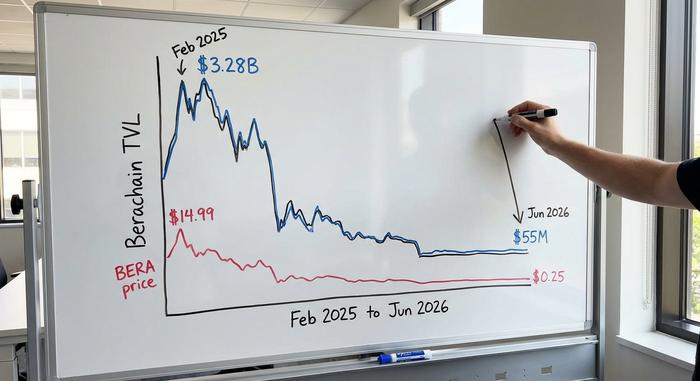
The numbers are the part competitors leave out, so here they are. Before mainnet, Berachain attracted more than $2 billion in pre-launch deposits through its Boyco vaults, and the chain opened with around $1.77 billion in total value locked, good for roughly seventh place among all chains. Within weeks the figure peaked above $3.2 billion, briefly putting Berachain among the top six DeFi networks, ahead of Base and Arbitrum on that metric.
Almost all of it was rented. When the Boyco vaults unlocked, the capital left as fast as it arrived. According to DeFiLlama, more than $1.5 billion drained in a single month in May 2025, and the decline did not stop there. As of June 2026, Berachain's total value locked sits near $55 million, a drop of more than 98% from the peak. The BERA price followed the same curve: an all-time high of $14.99 on launch day, against roughly $0.25 as of June 2026, per CoinGecko.
| Metric | Near launch (Feb 2025) | June 2026 |
|---|---|---|
| BERA price | $14.99 (ATH) | ~$0.25 |
| BERA market cap | ~$1B+ | ~$68M |
| Total value locked | $3.28B (peak) | ~$55M |
| DeFi chain rank | Top 6 | Outside top 50 |
The exodus was not only financial. As liquidity drained, the project cut much of its retail marketing team and watched developers drift to other chains, and commentators began calling Berachain a "ghost chain," the label for a network with working tech and almost no one using it. The kindest reading is that Berachain proved Proof of Liquidity can attract enormous capital. The harder truth is that it could not keep any of it, and that distinction is the whole ballgame for a chain whose security depends on liquidity staying put.
The Berachain ecosystem and its dApps
There is still a real ecosystem here, just a much smaller one. Roughly 91 protocols touch the chain, and the activity is concentrated in a handful of them. Infrared, a liquid staking app, holds the largest share of remaining value, followed by Kodiak, which combines a decentralized exchange with liquidity management, and Concrete, an on-chain capital allocator. Dolomite and BEND cover lending. Notably, BEX, the chain's own native exchange, now holds barely a million dollars in liquidity, a sign of how far the flagship apps fell from the launch frenzy.
Beyond DeFi, Berachain hosts the usual mix of NFTs, launchpads, and games, a nod to the chain's Bong Bears roots. The decentralized applications work, and the EVM compatibility means more can be ported over cheaply. The question is no longer whether builders can ship on Berachain, but whether enough users and liquidity stay to make shipping worthwhile.
Berachain versus Ethereum: the real difference
Berachain and Ethereum run the same virtual machine, so the contracts and tooling overlap almost completely. The difference is philosophy. Ethereum secures itself by asking validators to stake idle ETH; capital sits still and earns a yield for doing nothing but existing. Berachain asks that capital to work in DeFi apps while it secures the chain, and lets applications bid for that security with incentives.
There is a decentralization cost to weigh. Ethereum is secured by close to a million validators. Berachain caps its set at 69. That makes coordination and incentives simpler, but it concentrates power in far fewer hands, which is a real trade-off for anyone who values how decentralized a network actually is rather than how it markets itself.
Is Berachain taxed, and how it's handled
Berachain itself does not tax anything; your local tax authority does, and the rules are the same as for any crypto. In the United States, selling or swapping BERA is a taxable event, and you owe capital gains on the difference between your cost and the sale price. Tokens received from the airdrop, and rewards earned in the system, are generally treated as ordinary income valued at the moment you receive them. This is general information, not tax advice, and the soulbound nature of BGT raises questions a professional should answer for your situation.
The bottom line on Berachain in 2026
Proof of Liquidity is a genuinely original idea, and it is worth taking seriously on its own terms. It turned security from a cost into an activity and pulled in billions of dollars on the strength of that pitch. What it has not shown — and what I would want to see before trusting it — is that a chain can survive once the rented liquidity walks out the door, which is exactly what happened to Berachain through 2025 and into 2026. The mechanism works; the open question is whether anything sticks to it. If you are looking at BERA today, that is the question to answer for yourself before the price chart answers it for you.