What Is a Wallet Drainer? How Crypto Drainers Work
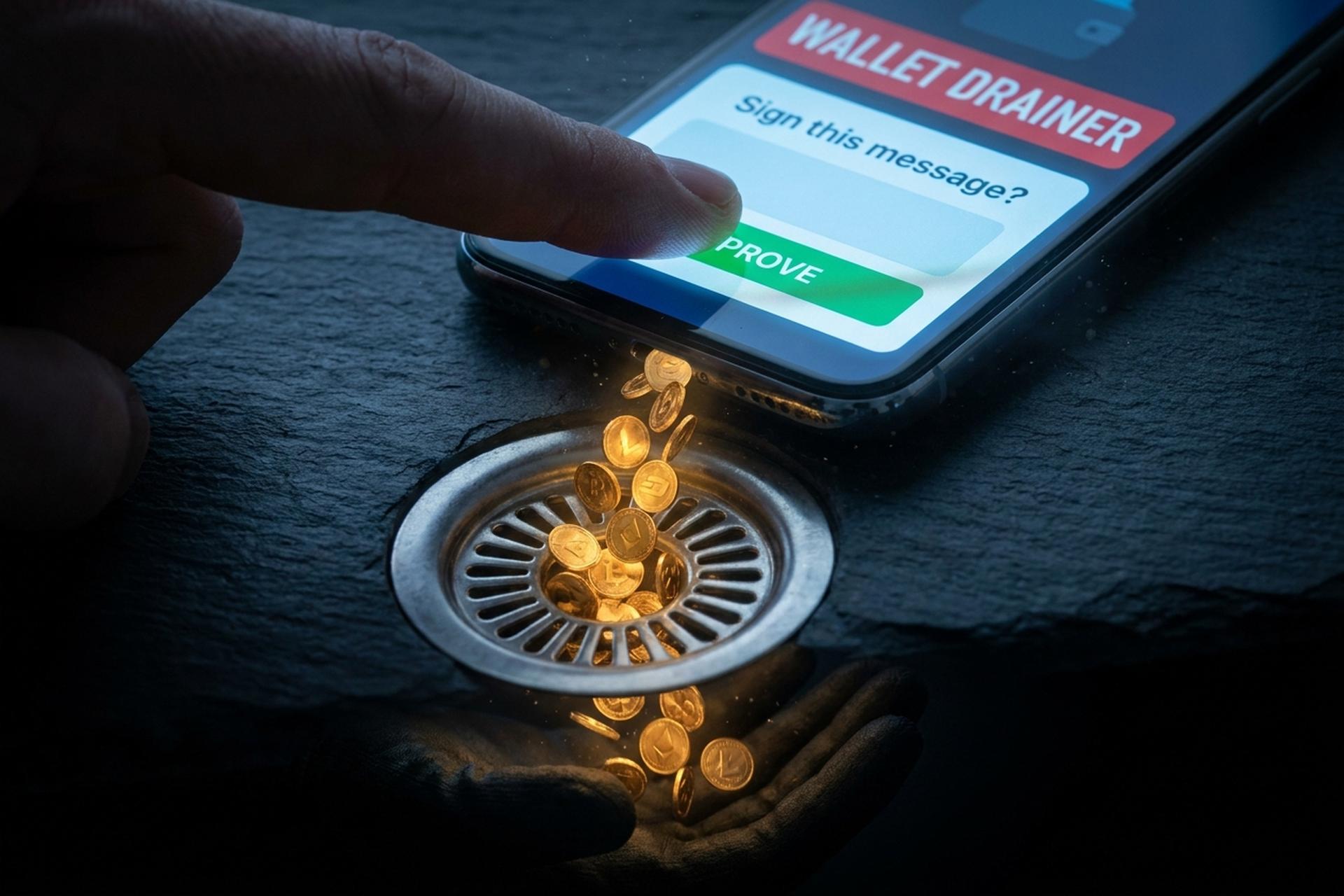
You do not have to hand over your seed phrase to lose everything. With a wallet drainer, you lose it by clicking "approve." Picture a slick site offering a free airdrop. You connect your wallet, a signature box pops up, you tap confirm because that is what every dApp asks for, and seconds later your crypto and NFTs are gone. No password was stolen. No device was hacked. You authorized the theft yourself, usually with a signature that cost no gas and looked completely harmless. That is the whole trick, and it worked well enough to steal $494 million in 2024 alone.
This guide breaks down what a wallet drainer is, the exact moment the theft happens, how the criminals turned it into a paid service, how much they take, and the two habits that stop almost all of them.
What a Wallet Drainer Is and Why It Works
A wallet drainer is not malware sitting quietly on your computer. It is a malicious smart contract or script, one of the malicious dApps that now haunt Web3, dressed up as a friendly one, that tricks you into granting it access, then sweeps your assets the instant you do. Drainers live almost entirely in decentralized finance, or DeFi — that is where money moves on a signature instead of a login, and your cryptocurrency and other crypto assets are exactly what they aim at. The drainer never guesses your private key and never breaks any cryptography. It just gets you to sign a transaction or an approval that hands a stranger's smart contract permission over your funds.
Once that permission exists, the rest is automatic. The drainer reads your wallet to find your most valuable tokens, NFTs, and other digital assets, builds the transfer, and moves everything to an attacker-controlled address, often within a single block. Because the request came dressed up as a normal Web3 action, most victims do not realize what happened until the wallet is already empty. The danger is not a virus. It is a permission you grant without reading it.
How a Wallet Drainer Empties Your Wallet
Every drain follows the same arc: lure, signature, sweep. The middle step is where the money is lost, and it is the step almost nobody looks at closely.
The bait
First you have to land on the trap. Scammers seed fake airdrops, NFT mints, and token claims, then push them hard. They hijack verified accounts on X and post links from a stolen social media account, they drop messages in Telegram and Discord, and they buy sponsored search ads so the fake site sits above the real one. The pitch is always urgency, a limited mint or a claim that expires, because social engineering works best when you do not have time to think. Unlike old-school phishing that hunts for a password or a login credential, a drainer does not need your secrets at all. It just needs to trick users into one action: connect their wallets to the fake site and approve a single request. That lower bar is exactly why drainers spread so fast, and why even careful people get caught in a hurried moment. Click through and you reach a clone that looks exactly like a project you trust, asking you to connect your wallet.
The trap is the signature
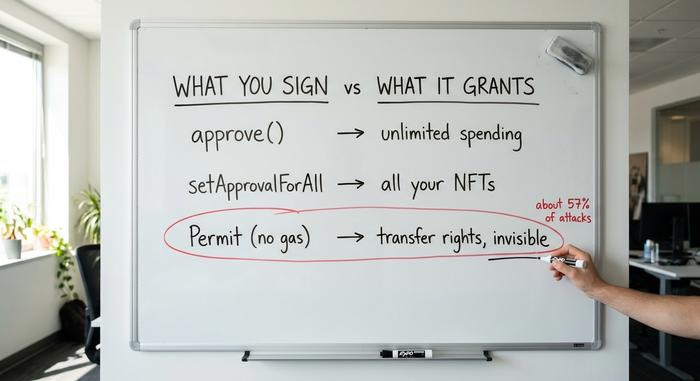
This is the part that matters. When you approve, you are not "logging in" — you are signing a specific permission, and a few of them are devastating. An ERC-20 `approve()` can hand over an unlimited allowance, letting a contract spend that token forever. `setApprovalForAll` gives away every NFT in a collection at once. The nastiest is the offline Permit or Permit2 signature. It costs no gas. It shows up as a plain message, not a transaction. And it still authorizes a transfer. That is the trap most people walk straight into: according to one SlowMist analysis, Permit-style signatures made up 56.7% of phishing approvals in 2024, precisely because they look like nothing. Attackers follow the upgrades too, abusing obscure calls like `setOwner` and, right after Ethereum's Pectra release, the brand-new EIP-7702 delegation.
The drain
Once you sign, the wallet drainer has everything it needs, and there is no second confirmation to save you. The goal is simple and brutal: steal funds before you react. It already mapped your assets, so it fires off the transfer and your tokens leave in one block. Blockchain transactions are final. No bank to call, no charge to reverse. By the time the airdrop "fails to load," the unauthorized transfer has already settled on-chain.
| What you are asked to sign | What it looks like to you | What it actually grants |
|---|---|---|
| ERC-20 `approve()` | A routine token approval | Unlimited spending of that token |
| `setApprovalForAll` | "Approve collection" | Control of every NFT in it |
| Permit / Permit2 | A gasless signature message | Transfer rights with no on-chain trace until used |
| `setOwner` / EIP-7702 | An unfamiliar prompt | Ownership or delegation of your account |
Drainer-as-a-Service (DaaS): Crime With a Dashboard
Drainers did not scale because attackers got smarter. They scaled because someone turned the tool into a product and, with it, turned wallet theft into organized cybercrime with a published price list.
How DaaS works
In the Drainer-as-a-Service model, one developer builds and maintains the wallet drainer kit and rents it out to anyone who wants to run a campaign against cryptocurrency wallets. The affiliate, often a low-skill threat actor, handles the phishing. The kit handles the theft. They split the take, and the split copies the ransomware playbook almost exactly: developers keep about 20% of everything stolen, affiliates keep the other 80%. For that cut the buyer gets ready-made phishing pages, a control dashboard, anonymity tools, and, yes, real customer support. A teenager who cannot write a line of code can be running a professional operation by lunchtime.
Inferno, Pink, and the revolving door
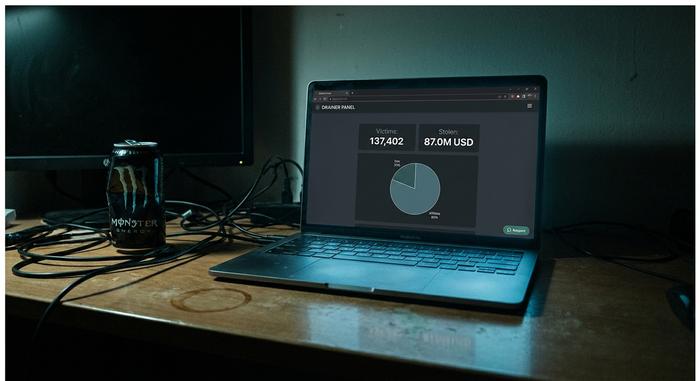
The headline kits show the scale. Inferno Drainer ran from late 2022 to late 2023 and stole roughly $87 million from more than 137,000 victims, spread across over 16,000 phishing domains that spoofed at least 100 crypto brands. Pink Drainer cleared about $85 million before its operators announced they were quitting. Notice the pattern. One crew retires, cybercriminals shift to the next kit, and Inferno itself came back in a "reloaded" form. Killing one operator does not kill the market — the market is the service, not the scammer.
How Much Wallet Drainers Steal
The totals are huge, jumpy, and easy to misread. A single crypto wallet drainer campaign can take more in one transaction than a full exchange hack, and the yearly numbers lurch around.
The clearest source, Scam Sniffer, counts it year by year. Losses hit about $295 million in 2023 across 324,000 victims, jumped 67% to $494 million in 2024, then fell sharply to roughly $84 million in 2025. That drop looks like a win. It is not. It mostly reflects quieter on-chain activity and kit turnover, and early 2026 already showed a steep monthly spike. The single biggest drain on record took $55.47 million in DAI from one victim in 2024. Wherever the totals land, the stolen crypto exits the same way: washed through mixers and decentralized exchanges within minutes, which is why almost none of it comes back.
| Year | Stolen by drainers | Victims |
|---|---|---|
| 2023 | $295.5 million | 324,000+ |
| 2024 | $494 million | 332,000 |
| 2025 | $83.85 million | 106,106 |
And the victims are not all beginners. Mark Cuban lost around $900,000 to a drainer. Even Ethereum co-founder Vitalik Buterin had his X account hijacked to push a fake mint that drained roughly $700,000 from his followers. If it reaches them, the "I would never fall for it" line is thinner than it feels.
Warning Signs of a Wallet Drainer
The red flags of a wallet drainer nearly all circle one demand: sign this, right now. When you see them, slow down.
Watch for a prompt asking for an unlimited token allowance when all you wanted was a single purchase. Be warier still of a signature request that charges no gas and shows a message you cannot fully read. That is the classic gasless drainer move. Treat "claim now," "limited mint," and ticking countdowns as pressure tactics, not luck. Distrust any link that lands in a DM or a Telegram group. Never reach a dApp through a sponsored search ad, where scammers routinely outbid the real project for the top slot. And always check the exact domain, because a lookalike with one swapped letter is the oldest move in the fraudulent-site playbook, and still the one that works.
How to Protect Your Wallet From Drainers
You do not need to track every new exploit. Two boring habits block almost every drain on their own.
Use a hardware wallet and a burner
Keep the bulk of your crypto on a hardware wallet. The key stays offline, and every transaction needs a physical tap on the device, so a malicious site cannot move a thing without the hardware in your hand. Then spin up a second, near-empty "burner" wallet for minting, airdrops, and any dApp you do not know. If the throwaway gets emptied, you are out lunch money, not your savings. Plugging your main wallet into a random Web3 site is the one habit that keeps this whole crime profitable.
Read every signature and revoke old ones
The second habit is simply reading what you sign. Modern wallets and simulation tools spell out what a signature grants before you confirm. Use them, and never blind-sign a message you cannot follow. Then clean house and revoke approvals you no longer need. A revoke tool shows every contract that can still spend your tokens and lets you cancel the ones you forgot, shutting doors an attacker could stroll through months later. If a site looks unfamiliar, glance at its contract on a block explorer first, because a brand-new contract with zero history is a classic setup. That unlimited approval you clicked back in 2021? Still live until you kill it.
What to Do If a Wallet Drainer Hits You
If it happens, speed is everything. Work in order. Move whatever the attacker has not grabbed yet to a fresh, secure wallet right away, because they often circle back for the rest. Then revoke every approval on the compromised address so no leftover permission can be reused. Treat that wallet as burned and stop using it for good. Document the transaction hashes and report the addresses to a service like Chainabuse or Scam Sniffer, which map this infrastructure. And be honest with yourself about recovery. On-chain transfers are final and stolen funds rarely come back, so the real win is stopping the bleeding fast.
A Wallet Drainer Needs Your Signature, Not Your Keys
Strip away the dashboards and the kit names and a wallet drainer has exactly one weapon: a signature you approve. It cannot take your private key, it cannot break the chain, and it cannot move a cent until you click confirm. That is also the good news — the counter is just as simple. Keep the bulk in cold storage, treat every "connect wallet" prompt as a stranger asking for your keys, and read the permission before you sign it. Do that and a billion-dollar industry runs straight into a wall at your screen. So the next time a free mint asks you to sign, ask yourself the only question that matters: what exactly am I authorizing?