
Telegram scams in 2026: how to spot them, crypto red flags, and how to protect yourself
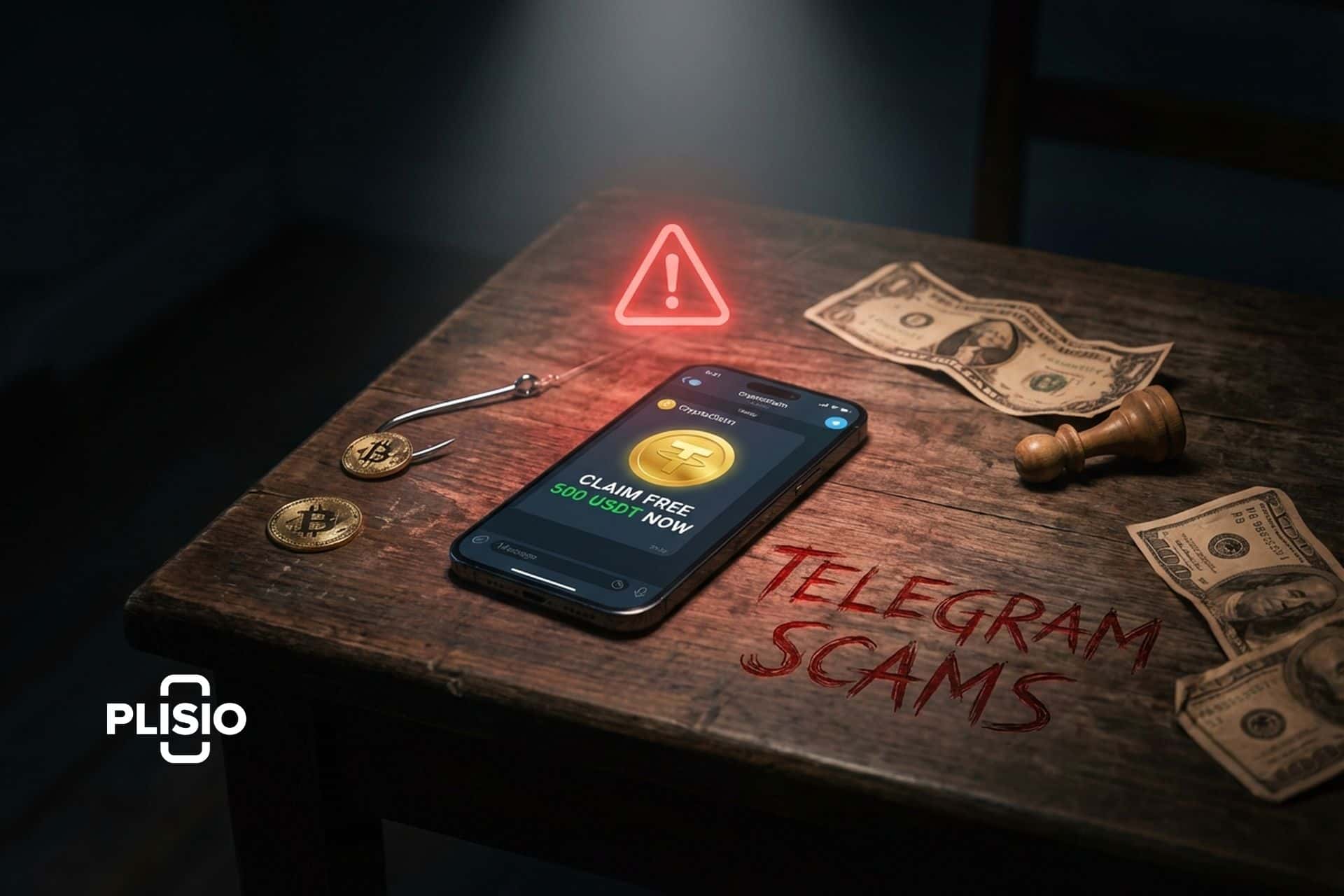
Telegram hit 1 billion monthly active users in March 2025. That same year, scam activity on the platform jumped 43%, with losses exceeding $200 million from Telegram-specific fraud alone. Crypto phishing attacks on Telegram surged 2,000% between November 2024 and January 2025. The FBI counted $11.37 billion in crypto-related fraud losses in the US for 2025, and a massive chunk of it started with a message on Telegram.
This is not a coincidence. The same features that make Telegram great for crypto communities, large groups, bots, privacy, no phone number sharing, make it a paradise for scammers. They run fake airdrop channels, impersonate project founders, deploy phishing bots, and operate pump-and-dump networks with hundreds of thousands of members.
This article covers every type of Telegram scam you need to know about, the crypto-specific tactics scammers use in 2026, the new AI-powered threats that did not exist two years ago, and exactly how to stay safe on Telegram without giving up using the app.
Why scammers love Telegram
If you do crypto, you use Telegram. That is just how it is. Alpha groups, project announcements, community chats, airdrop news. Every major crypto project runs a Telegram channel. Which means every scammer who wants to reach crypto users knows exactly where to find them.
The platform practically rolls out a red carpet. Groups hold 200,000 people. Bots look official with zero verification. Usernames get spoofed with one character swap. You can message complete strangers. Encryption makes scammers hard to trace. It is built for privacy. Scammers exploit that.
Telegram blocked 43.5 million groups and channels in 2025 for scam-related activity. In the first half of 2025 alone, 14 million were taken down. After Pavel Durov's arrest in France in August 2024 and the resulting pressure to crack down on criminal use, daily takedowns jumped from 10,000-30,000 to 80,000-140,000. On peak days, Telegram nuked over 500,000 channels.
Still not enough. Kill a channel, another one pops up the same day. It is whack-a-mole at industrial scale, and the moles have AI tools now.
The most common Telegram scams in crypto
Fake airdrop and giveaway scams
Your DM lights up: "Claim your free 500 USDT airdrop now!" Link included. You click it. The site looks legit. Connect wallet. Approve a transaction. And just like that your tokens are gone. Took about 20 seconds.
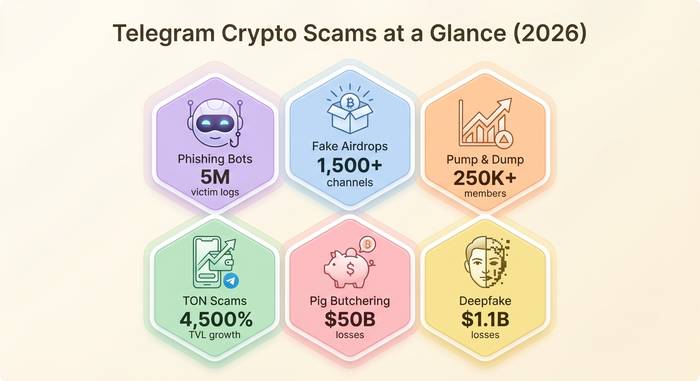
At any given time, 1,500+ channels are running this exact play. It works because real airdrops do exist. Real projects give away real tokens. But here is the tell: a real airdrop will never come through a random DM with a link. If you did not go looking for the airdrop yourself, it is looking for you. That is never good.
Impersonation scams
Scammers create Telegram accounts that look nearly identical to real project admins. Same profile picture. Same display name. Username differs by one character. They message you pretending to be support: "I noticed an issue with your wallet. Click here to verify your account." Or they pose as a project founder offering a "private investment round."
The fake profile trick works because Telegram makes it easy to copy someone's public identity. Unless you check the exact username character by character, a scammer pretending to be @VitalikButerin (with a capital I instead of lowercase l) looks indistinguishable from the real account.
Pump-and-dump groups
Groups with names like "Crypto Pump Club" (254,000 members) or "Big Pump Signal" (270,000 members) coordinate synchronized token buys. The playbook: group admins pre-buy a micro-cap token, announce the "pump" to their members, members pile in, the price spikes, and the admins sell at the top. Members who bought late get stuck holding a worthless token.
Solidus Labs documented PumpCell, a Telegram ring that netted $800,000 in a single month (October 2025) using sniper bots and meme-driven hype campaigns. Academic research identified 2,079 pump-and-dump events on Telegram using NLP analysis.
Phishing bots
Scammers deploy Telegram bots that mimic legitimate services. A bot pretending to be "Uniswap Support" or "MetaMask Verification" asks for your seed phrase or private key to "resolve an issue." No legitimate service will ever ask for your seed phrase. Ever. But under pressure, people comply. Kaspersky reported that victim logs across roughly 1,800 malicious Telegram bots exceeded 5 million entries in 2024-2025.
Pig butchering (long-con investment scams)
This is the long con. Someone messages you. Friendly. Good-looking profile photo. Actually interested in talking. Over weeks or months, you build what feels like a real connection. Then one day: "I have been making great returns on this platform, you should try it." They walk you through signing up. You deposit money. The dashboard shows you making profits. You deposit more. Then you try to withdraw and the money, the platform, and the person all vanish.
$50 billion lost globally in 2025 to pig butchering, per FTC and UNODC numbers. Average victim: out $177,000. These operations ran through Huione Guarantee, a Telegram-based marketplace that moved $27 billion before getting banned in May 2025. It provided the escrow, the money laundering tools, and even the victim data. Within weeks of the ban, replacement platforms were already processing 70x the daily volume.
TON ecosystem scams
The TON blockchain's integration with Telegram created a new attack surface. Fake mini-apps mimicking popular games like Notcoin and Hamster Kombat tricked users into connecting wallets. Phishing bots posed as "TON Giveaway" or "Wallet Support" and drained funds through malicious smart contracts. Kaspersky documented a Toncoin referral scheme that used a multi-level structure with fake boosters to lure victims. TON's TVL grew 4,500% in 2024, and scammers followed the money.
| Scam type | How it works | Scale | Red flag |
|---|---|---|---|
| Fake airdrop | Link to phishing site that drains wallet | 1,500+ active channels | Unsolicited DM with "claim now" link |
| Impersonation | Fake admin contacts you for "support" | Constant | Username differs by 1 character |
| Pump-and-dump | Coordinated buy/sell to inflate micro-cap tokens | Groups with 250K+ members | "Next 100x coin, buy NOW" |
| Phishing bot | Bot asks for seed phrase or private key | 5M+ victim logs | Any bot requesting credentials |
| Pig butchering | Weeks-long relationship scam leading to fake platform | $50B+ global losses | Unsolicited romantic or friendship contact |
| TON mini-app scam | Fake game/app that connects wallet | Growing fast | Clones of popular mini-apps asking for fees |
AI-powered scams: the 2025-2026 escalation
AI broke the scam business wide open. 1,210% surge in AI-enabled fraud in 2025. $1.1 billion in deepfake losses alone. Chainalysis says AI scams pull 4.5x more money than the old-school versions. And Telegram is ground zero for distribution.
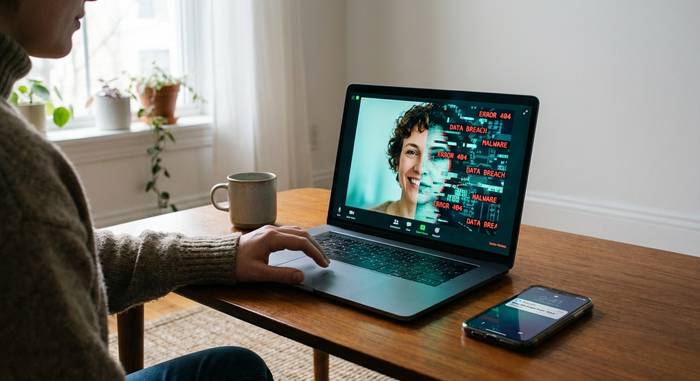
The deepfake video call is the one that scares me. A scammer generates a real-time video deepfake of a project founder, calls you on Telegram, and you see what looks exactly like the real person moving and talking. "Deepfake-as-a-Service" bots on Telegram sell subscriptions to generate these clones. You can buy a convincing fake of anyone with enough public video footage.
Voice cloning is even easier. Got a podcast? A YouTube video? A Twitter Space recording? That is enough audio for a scammer to clone your voice in under a minute. Then they send audio messages to your contacts: "Hey, I need you to send me 2 ETH, I will explain later."
AI chatbots run the long game. A bot pretends to be a human investment advisor. It holds real conversations, answers questions, sounds knowledgeable. Gradually steers the victim toward a fake trading platform. One bot runs hundreds of conversations at the same time. A human scammer could never scale like that.
8 million deepfake files exist online as of 2025. That number was 500,000 in 2023. Growth rate: 900% a year. If that trajectory holds, projected AI fraud losses hit $40 billion by 2027.
How to protect yourself from Telegram scams
None of this is complicated. But people skip these steps every day and lose money every day.
Random DM with a link? Do not touch it. I do not care if it looks like it came from Vitalik himself. Go to the project's real website by typing the URL. Never follow a link from a message.
Usernames: read them letter by letter. Scammers swap lowercase L for capital I. They use rn to fake the letter m. The display name on a profile means absolutely nothing. Anyone can set it to anything. The @username is the only thing that counts.
Your seed phrase is yours. End of story. Nobody from Uniswap support, nobody from MetaMask, nobody from any project on earth needs it. If someone asks, they are stealing from you. I cannot make this clearer. Write the seed phrase on paper. Put it in a drawer. Never type it into a website or a bot.
Two-factor authentication takes 30 seconds to set up. Settings, Privacy and Security, Two-Step Verification. Set a real password. If a scammer grabs your SMS code through a SIM swap, 2FA still blocks them.
Privacy settings matter too. Go to Settings, Privacy, Groups. Change "Who can add me to groups" to "My Contacts." That one toggle stops scammers from dumping you into fake pump channels at 3 AM.
And report everything. Long-press the message. Hit Report. Tag @notoscam for scam channels. It works. Telegram is banning 80,000-140,000 channels a day now. Your report contributes to that.



