Litecoin Payment Gateway: Merchant’s 2026 Guide
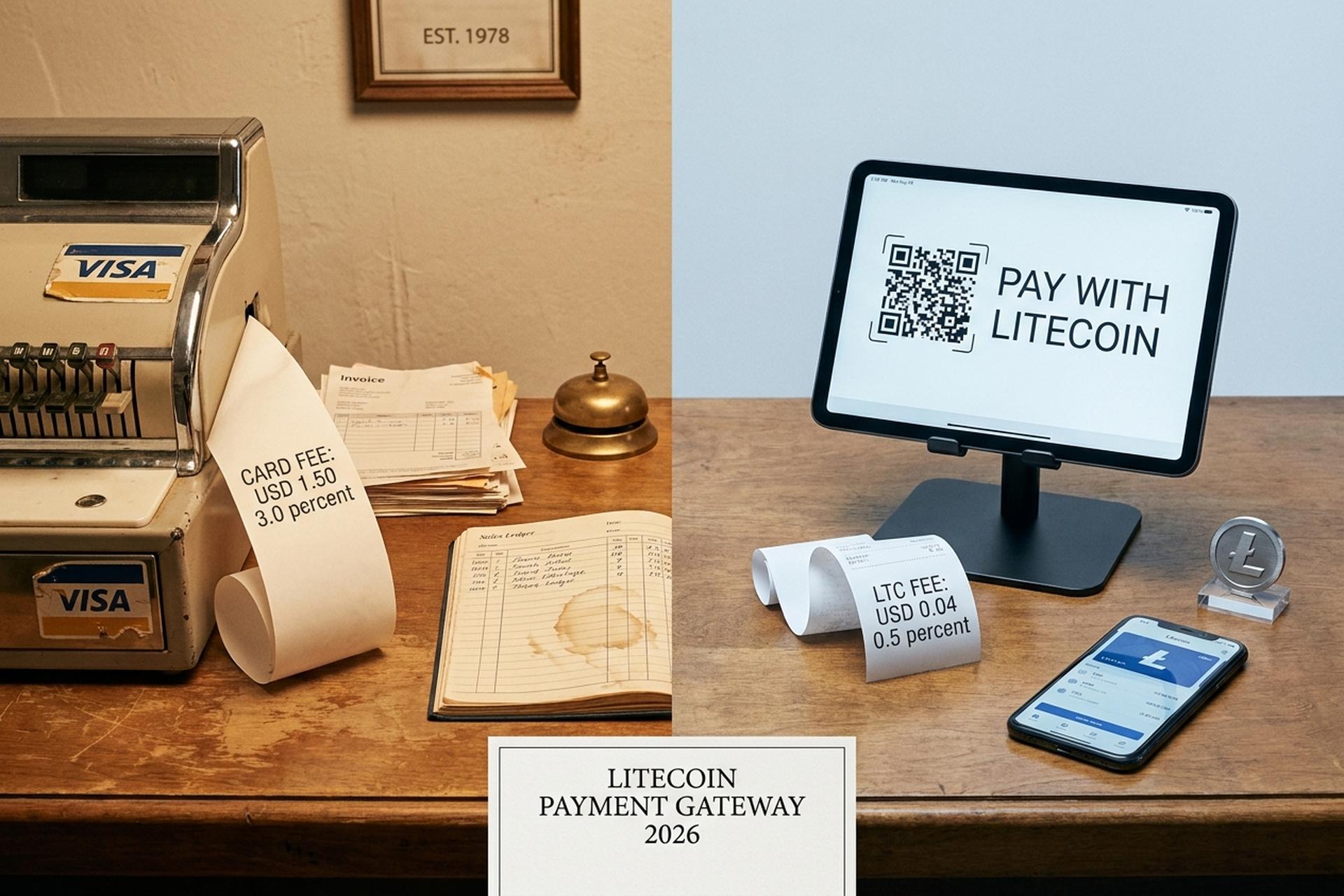
A Litecoin payment gateway is not a niche product in 2026. CoinGate's 2025 report puts LTC at 14.4 percent of all crypto payments processed on its platform, third overall and briefly second around June and July of last year. The volume of litecoin payments today is real, not promotional, and the lower fees that LTC enables for sub-thousand-dollar checkouts are the main reason businesses to accept it lean toward Litecoin rather than holding out for Bitcoin. Web hosting, proxies, and gaming account for roughly seven in ten merchants. Average on-chain transaction fees sit between two and fifteen cents, somewhere between fifty and a hundred times cheaper than Bitcoin at the base layer. This guide explains why merchants are picking LTC over BTC or stablecoins for sub-thousand-dollar checkouts, how a Litecoin payment gateway actually works, and which of the major providers (BitPay, CoinPayments, CoinGate, Plisio, NOWPayments, OxaPay, B2BINPAY, 0xProcessing) fits which kind of business.
The short answer on Litecoin payment gateways
LTC payment gateways are a mature, commodity layer at this point. Fees cluster between 0.4 and 1 percent across the major providers. KYC requirements vary widely. BitPay runs full enterprise compliance. Plisio runs a no-KYC standard plan. Integration to start accepting Litecoin is usually one of three paths. The first is prebuilt plugins for WooCommerce, Magento, or PrestaShop. The second is a REST API to receive Litecoin payments programmatically. The third is no-code payment links and QR codes. A crypto payment gateway built around LTC works as the payment solution layer between your storefront and the litecoin blockchain. It lets you accept payments in litecoin cryptocurrency with low transaction fees. Settlement routes to a litecoin wallet, a fiat account, or a stablecoin. The right choice depends on volume, region, and settlement flexibility.
Why Litecoin for payments: faster and cheaper than Bitcoin
The numerical case for LTC is short. Block time is 2.5 minutes, four times faster than Bitcoin's roughly ten. Theoretical capacity is around 56 transactions per second versus Bitcoin's seven. Median on-chain fees, per BitInfoCharts and Bitget Academy, run two to fifteen cents per transaction. Bitcoin at the same moment is typically two to eight dollars for a standard send, and ten to twenty-five for a priority one. For a checkout of $20 to $1,000, that fee gap is decisive.
Litecoin is a cryptocurrency that was created in 2011 by Charlie Lee, then a Google engineer, as a Bitcoin fork. Litecoin is a decentralized peer-to-peer digital currency that uses the same proof-of-work design but with faster blocks and a Scrypt mining algorithm. Faster transaction times and lower transaction costs follow from that design choice. Like Bitcoin, the protocol is open-source and unaffiliated with any company. Maximum supply is 84 million coins. As of May 2026, roughly 77.17 million LTC are circulating, about 91.9 percent of the cap. The third halving fired on August 2, 2023, dropping the block reward from 12.5 LTC to 6.25. The fourth halving is projected for around July 27, 2027 at block 3,360,000. PayPal added LTC for US customers in October 2020 via its Paxos partnership, letting people pay with Litecoin alongside Bitcoin and Ethereum. The Litecoin BlockCard, a Foundation collaboration with Bibox and Ternio, has been issuing prepaid Visa-network cards since 2019, letting holders spend LTC anywhere in the world that accepts Visa.
How a Litecoin payment gateway actually works
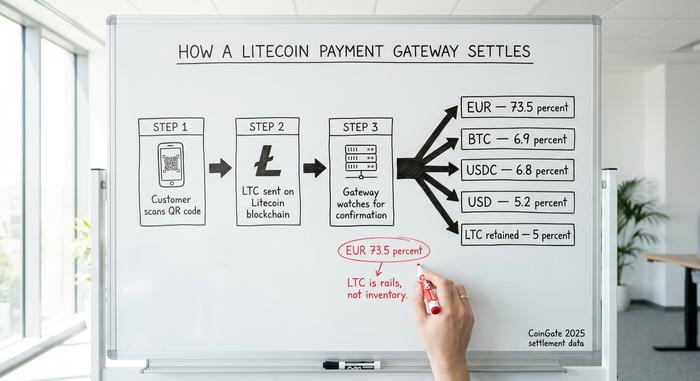
The mechanics of LTC payment processing are simpler than the fintech vocabulary suggests. A merchant connects a Litecoin address or business wallet to the gateway through an API key. When a customer reaches checkout and selects Litecoin as a payment method, the gateway generates an invoice that pegs the LTC amount to the merchant's fiat price at the moment of issue, with the rate locked for a short window so price movements between issue and confirmation do not break the order. That invoice usually appears as a QR code, a payment link, or a one-time deposit address on the page, and it allows you to accept LTC payments from any Litecoin wallet without a custodian in the middle. The customer scans or pastes, sends Litecoin from a personal wallet, and the gateway watches the blockchain network for the transaction. Most platforms also support recurring payments and subscription billing for businesses that accept LTC on a monthly cadence.
Confirmation matters because Litecoin is probabilistic, not instant. Most gateways require one or two block confirmations before the transaction is confirmed and the order is marked paid. That is two to five minutes on average. A fast transaction is part of why LTC works for retail checkout. Network congestion almost never spikes the way Bitcoin's mempool can. Transaction processing stays predictable through high transaction volumes. Few customers will wait the thirty to sixty minutes that a pure on-chain Bitcoin payment can require. Once cleared, the gateway settles in one of three ways: keep the LTC in your business wallet, convert automatically to fiat currencies like USD or EUR via a partner exchange, or convert to a stablecoin such as USDC for businesses that want price stability without leaving crypto rails. Auto-conversion is how most merchants avoid the volatility hold problem entirely.
The blockchain side is almost always invisible to the merchant. Webhooks notify the storefront when the transaction confirms, the order moves to "paid," and accounting sees a clean line item with transaction details, gateway fee, and net deposit to the merchant's business account or bank account; merchants who accept payments on your website at scale typically push withdrawal events into their accounting system through the same webhook stream. Per CoinGate's 2025 settlement data, 73.5 percent of LTC merchants on the platform auto-convert to EUR, 6.9 percent to BTC, 6.8 percent to USDC, 5.2 percent to USD, and only 5 percent receive payments in LTC and keep it. In other words, LTC is treated as rails, not inventory. The same logic applies whether you accept crypto payments at a one-person shop or run a marketplace processing transaction volumes in the millions.
| Payment rail | Block / settlement time | Avg fee per tx | Volatility hold risk |
|---|---|---|---|
| Litecoin (LTC) | ~2.5 min | $0.02–$0.15 | Auto-convert removes most |
| Bitcoin (BTC) | ~10 min | $2–$8 standard | Auto-convert removes most |
| USDT / USDC (ERC-20) | ~12 sec | $0.50–$5 | None (stablecoin) |
| Credit card (Visa/MC) | Instant auth, T+1 settle | 1.5–3% + $0.10 | Chargeback risk |
This is what makes LTC defensible in 2026 even with stablecoins eating broader on-chain payments volume.
Gateway comparison: BitPay, CoinGate, Plisio, OxaPay, NOWPayments
Six providers dominate the LTC payment-gateway market, with the rest mostly clones of those models.
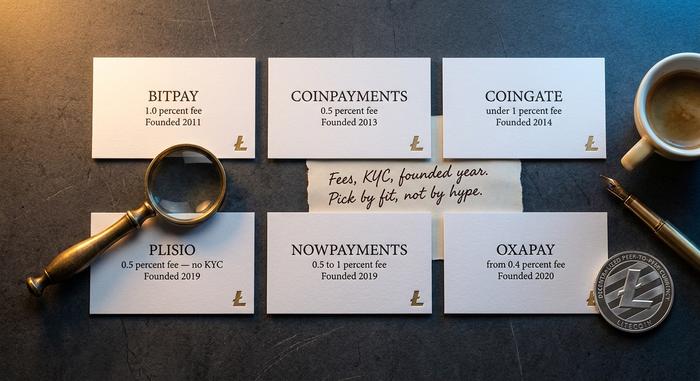
BitPay is the Atlanta-based incumbent, founded in 2011 by Tony Gallippi and Stephen Pair. It charges a flat 1 percent per transaction, requires full KYC for merchants above modest thresholds (EU customers over €1,000 since May 2023, US over $3,000 per year on its card product), and operates the BitPay Card on the Mastercard rails. Newegg integrated BitPay LTC in July 2021. AT&T has accepted crypto bill payments through BitPay since 2019.
CoinPayments was founded in 2013 and is based in Vancouver. Per-payment fee is 0.5 percent and the platform supports over 2,350 coins including LTC. It is one of the older non-BitPay options and has retained a long roster of SMB merchants on the strength of price and breadth.
Plisio was incorporated in Manchester, UK as PLISIO LTD (company number 12374919) in 2019. Fee is 0.5 percent. Standard merchant onboarding requires no KYC, settlement is non-custodial and direct to the merchant wallet, and the platform competes hardest in the SMB hosting, proxy, gaming, and privacy-aware verticals — the same categories that CoinGate's 2025 data shows are over 70 percent of LTC payment volume.
NOWPayments charges 0.5 percent for mono-currency payouts and 1 percent when the gateway converts on the merchant's behalf. No mandatory merchant KYC. Supports 350+ coins.
Coinbase Commerce charges a flat 1 percent and requires the merchant to onboard through a Coinbase parent account (which is itself fully KYC'd). Useful for merchants already inside the Coinbase ecosystem; price-uncompetitive otherwise.
CoinGate undercuts most competitors at under 1 percent, runs WooCommerce, Magento 2, PrestaShop and OpenCart plugins, and has substantial enterprise references including Surfshark and Hostinger.
| Gateway | Founded | Fee | Merchant KYC | Settlement options | Plugins |
|---|---|---|---|---|---|
| BitPay | 2011 | ~1% | Full (EU >€1k, US >$3k/yr) | Fiat, crypto, card | Shopify, WooCommerce, Magento |
| CoinPayments | 2013 | 0.5% | Tiered KYC | Crypto, fiat (partner) | WooCommerce, Magento, OpenCart |
| Plisio | 2019 | 0.5% | None on standard plan | Direct-to-wallet, fiat option | WooCommerce, Magento, PrestaShop, OpenCart |
| NOWPayments | 2019 | 0.5–1% | None | Crypto, fiat | WooCommerce, Shopify, custom API |
| Coinbase Commerce | 2018 | 1% | Inherited from Coinbase | Fiat (Coinbase account) | Shopify, custom API |
| CoinGate | 2014 | <1% | Tiered KYC | Fiat (USD, EUR, GBP), crypto | WooCommerce, Magento 2, PrestaShop, OpenCart |
A naming note worth flagging: CoinsPaid is not CoinPayments. The two are routinely confused in coverage. CoinsPaid was hit for $37.3 million in July 2023 in a Lazarus-linked social-engineering attack, with an additional $7.5 million follow-on breach within six months. CoinPayments has no comparable public security incident on record. Either way, any reputable Litecoin payment gateway should let you store funds securely, including Litecoin and other cryptocurrencies, without exposing private keys to the platform.
Integration paths: plugins, API, payment links
Most gateways offer three entry points and a serious merchant uses at least two.
Pre-built payment plugins are the path of least resistance. Every major LTC gateway ships official WooCommerce and Magento integrations; most also ship PrestaShop, OpenCart, and OpenCart-derivative builds. Shopify is BitPay-dominated through the native Shopify app, with CoinPayments and Coinbase Commerce as alternates. Install, paste an API key, set the supported currencies (including Litecoin), save. That is the whole integration for most merchants who accept LTC on a storefront. The plugin allows merchants to accept payments directly into their wallets without writing code, and merchants accept LTC at the checkout the same way Visa or PayPal is offered as another option.
The REST API path is for custom builds: SaaS billing, marketplaces, subscription products, gambling and forex desks, anything where the storefront is not an off-the-shelf CMS. Endpoints are similar across providers — create invoice, watch webhook, mark paid, send Litecoin payouts. Sandbox keys are universally available. A backend engineer should be able to ship a working LTC payment flow on a custom site within a day for a single gateway, with a different payment provider added later for redundancy.
Payment links and QR codes are the no-code path. Most gateways offer hosted payment pages where a merchant generates a one-off invoice or a static recurring-payments link and sends it over email, chat, or social. For invoicing freelancers, donation buttons, payments to anyone with a wallet, and one-off B2B remittances, this is the cleanest option and requires no developer at all. What gateway marketing calls a "seamless payment" experience is, more honestly, just less friction than the alternative, and it is one of the strongest arguments for accepting cryptocurrency over credit card payments for international invoicing, where card fees plus FX often total 3 to 5 percent. For a business that wants to accept cryptocurrency payments alongside legacy rails using Litecoin as the cheapest option, this is the simplest path.
MWEB, privacy, and the 2022 Korean delisting episode
Litecoin's MimbleWimble Extension Blocks (MWEB) activated on May 19, 2022, exactly four years before this article. MWEB introduces opt-in confidential transactions and CoinJoin-style coin mixing inside a separate block structure, leaving the base chain transparent for everything that does not opt in.
The fallout was concentrated. On June 8, 2022, Upbit, Bithumb, Coinone, Korbit, and Gopax — the five largest Korean exchanges — delisted LTC, citing conflict with South Korea's Act on Reporting and Use of Specific Financial Transaction Information. As of May 2026, no public relisting on Upbit or Bithumb has been confirmed. Payment processors handle MWEB by either treating MWEB-flagged inbound transactions as policy-restricted or by routing them through compliance review before crediting the merchant. Non-MWEB LTC is fully compliant with Travel Rule and MiCA expectations; MWEB is treated as the optional risk surface.
The episode is the cleanest case study for why payment-rail decisions diverge from pure-economic decisions. LTC's underlying privacy upgrade made one region cut off the asset entirely, while leaving the dominant non-MWEB ltc transactions completely usable elsewhere.
Compliance: KYC, MSB registration, MiCA
The 2026 compliance picture has three jurisdictions worth understanding.
In the United States, FinCEN's 2013 guidance still controls. A payment processor that facilitates a purchase or settles a payment under an agreement with the seller is generally exempt from Money Services Business registration. A processor that handles funds outside that exemption needs to file FinCEN Form 107, register as an MSB within 180 days of operation, and maintain a written AML program with transaction monitoring.
In the European Union, MiCA has been the dominant force since the December 2024 application date, with the hard cutoff for unlicensed crypto-asset service providers on July 1, 2026. After that date, an unlicensed CASP cannot legally service EU customers. Travel Rule alignment is mandatory, KYC thresholds are codified, and MWEB-flagged Litecoin payment processing is allowable but requires the processor to demonstrate adequate AML controls.
In the rest of the world the picture is more fragmented, but the trend is the same. No-KYC merchant onboarding still exists at Plisio, NOWPayments, and a few others, but the runway is shorter than it was two years ago.
Which Litecoin payment gateway should you choose?
The decision framework is mostly about fit, not features.
For enterprise and regulated industries — large e-commerce, telecoms, regulated card programs — pick BitPay or B2BINPAY. The KYC overhead is real, but so is the audit trail and the named-customer reference list.
For mainstream SMB e-commerce on WooCommerce, Magento, PrestaShop, or OpenCart, the choice is between CoinGate and Plisio. CoinGate's plugin ecosystem and tiered KYC fit merchants comfortable with light compliance; Plisio's no-KYC standard plan and 0.5 percent fee fit merchants who want minimum friction and non-custodial settlement.
For custom builds, marketplaces, and no-KYC priorities, NOWPayments, Plisio, and OxaPay are the three most-cited options. OxaPay's fee starts at 0.4 percent, which is the lowest in the sample; its automated USDT conversion and forty-plus fiat pricing options are notable for high-volume merchants.
For high-risk verticals (gambling, forex, adult, gray-area SaaS) where mainstream Visa and Mastercard rails are restrictive, 0xProcessing and B2BINPAY have explicit support, and Plisio is widely used because the segment maps directly to its no-KYC strength. Memory of the 2020 Visa/Mastercard cut of Pornhub is the long shadow over that whole vertical; LTC payment rails (and crypto rails generally) are the practical alternative.
If you have no idea where to start, pick CoinGate and run a one-week pilot. Their public LTC adoption data is the most transparent in the market, and the plugin-first integration is the fastest path to a real number.