
Blockchain Payment Processing 2026 : How the Rail Actually Works
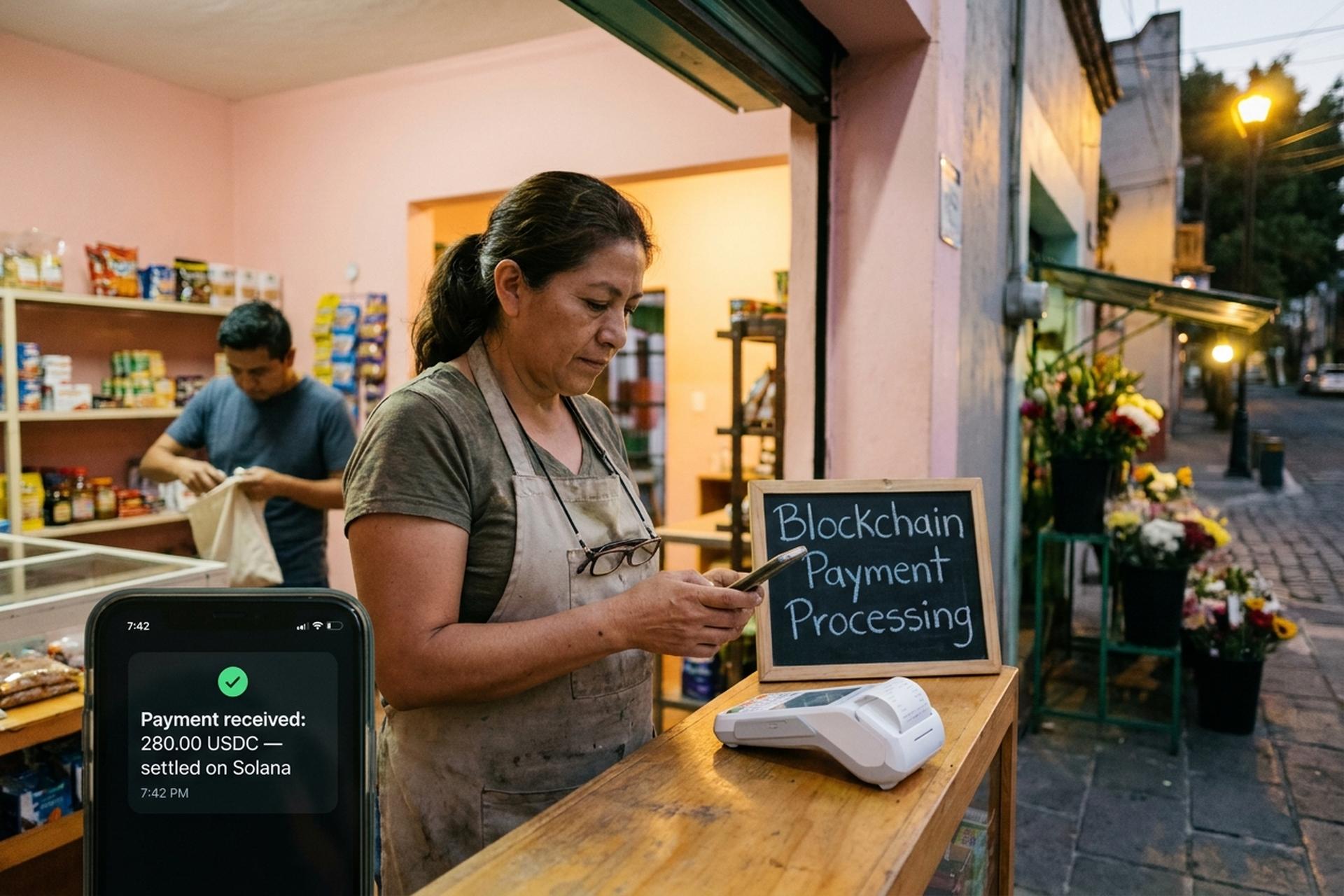
A SWIFT wire takes about 27 hours to land on the other side of the world. The same dollar moved as USDC on Solana lands in roughly thirteen seconds, for a fraction of a cent. That gap is the practical reason blockchain payment processing stopped being a thought experiment and turned into infrastructure. Shopify, Coinbase and Stripe rolled out stablecoin checkout for merchants across 34 countries on June 12, 2025. Visa is now settling card transactions in USDC on Solana at a multi-billion-dollar annualized run rate. JPMorgan's Kinexys network is moving over $2 billion a day in tokenized deposits. None of those numbers existed two years ago.
This article covers what blockchain payment processing is. It walks through the lifecycle of a single transaction. It looks at which chains the processors prefer. It explains why stablecoins reshaped the rail. It compares the rail to cards and SWIFT. It maps what the GENIUS Act and MiCA mean for businesses planning to use blockchain rails in 2026. The goal is the working knowledge a finance lead needs before signing with a payment provider.
What blockchain payment processing actually is
Blockchain payment processing is the infrastructure layer that moves value as on-chain ledger entries between addresses on a decentralized network. It is the rail itself, not the checkout button on top of it. The checkout button is the consumer-facing crypto payment; the rail is the part that handles transaction construction, cryptographic signing, broadcast, validator inclusion, confirmation, and settlement. Blockchain technology turns this end-to-end flow into a single payment flow with no intermediary bank in the middle. Stablecoin transaction volume hit roughly $33 trillion in 2025, which puts the rail in the same conversation as Visa and Mastercard rather than alongside it. A merchant does not need to understand the rail to use it, but anyone choosing a payment processor in 2026 should know the difference between the infrastructure and the digital assets that ride it.
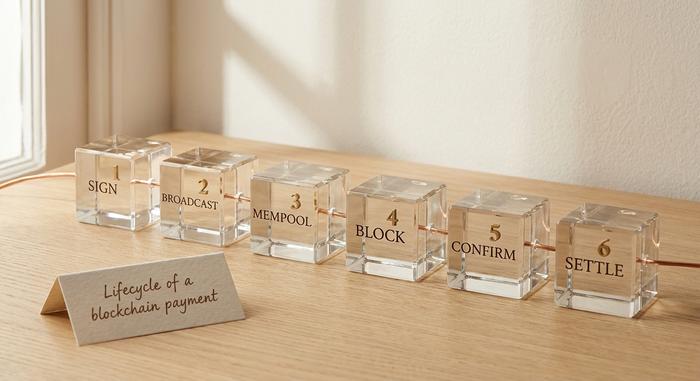
Inside the lifecycle of a blockchain payment
Walk through it. A digital wallet assembles a transaction. The sender's private key signs a payload that names the recipient wallet address, the amount, a nonce and a fee. That signed bundle goes out to the blockchain network. Nodes pass it around until it shows up in the mempool, the public queue of unconfirmed transactions. The fee parameter sets priority — higher fee, faster pickup.
Miners on Bitcoin, validators on Ethereum, Solana, Tron and Base sort transactions out of the mempool and pack them into a candidate block. That block is broadcast. Other nodes verify it against consensus rules and propagate it. Each new block on top adds depth. The processor watches the depth grow and credits the merchant once its confirmation policy is met. Then comes settlement. Three flavors: the processor holds the stablecoin balance, off-ramps to fiat through partners like Circle Mint or a banking API, or routes the funds onward.
Now finality, which is the moment a transaction can no longer be reversed. There are two flavors. Bitcoin runs proof-of-work, so finality is probabilistic — confidence climbs with each new block stacked on top. Convention: one confirmation for low value, three for retail, six for high value (roughly an hour). Ethereum, post-Merge in September 2022, runs proof-of-stake and reaches deterministic checkpoint finality in about 12.8 minutes. Solana, Tron and the leading L2s land at near-instant finality, measured in seconds.
| Chain | Block time | Practical finality | Median fee per transaction |
|---|---|---|---|
| Bitcoin | ~10 min | ~60 min (6 confirmations) | $1–$3 |
| Ethereum L1 | ~12 s | ~12.8 min (checkpoint) | $0.30–$3 |
| Solana | ~400 ms | ~13 s | <$0.001 |
| Tron | ~3 s | ~3 s | ~$0.30 (TRC-20 USDT) |
| Base (L2) | ~2 s | ~12 min (economic) | ~$0.005 |
| Arbitrum, Optimism | ~250 ms / ~2 s | minutes to hours to L1 | ~$0.01 |
Fee mechanics differ too. Ethereum uses EIP-1559, a base fee that gets burned plus an optional priority tip. Bitcoin runs a simple fee-per-byte auction. Layer-2 rollups (Base, Arbitrum, Optimism) batch many transactions into a single L1 settlement, cutting per-transaction cost by 100 to 1,000 times. Lightning Network keeps Bitcoin retail payments off-chain in payment channels for sub-cent settlement.
Bitcoin, Ethereum, Solana, Tron: which blockchains processors use
Chain selection is an economic choice rather than an ideological one. The major public blockchains carry the bulk of payment processing activity, and each piece of blockchain infrastructure has a distinct cost profile. Bitcoin is the brand and the deepest liquidity among cryptocurrencies for store-of-value transactions, but its fees and block times make it impractical for high-frequency retail flows. Ethereum L1 fees can spike from a normal $0.50 to over $30 during network congestion (NFT mints, large airdrops), which is why most stablecoin payment volume migrated off L1. Solana is the favored rail when processors need throughput and predictable sub-cent fees; Visa picked it for USDC settlement specifically because of the cost profile. Tron carries an enormous share of cross-border USDT flows because TRC-20 transfers are cheap and confirm in roughly three seconds. Base and Arbitrum, two Ethereum rollups, are increasingly the default for merchants who want Ethereum's developer tooling without its fees. A processor that supports only one chain is now a serious limitation.
The 2026 stablecoin shift in blockchain payment processing
The defining shift of the past two years is that stablecoins, not cryptocurrency, became the wire format of the payments industry's blockchain rails. Digital currencies pegged 1:1 to fiat removed the volatility argument that had kept most merchants and treasurers away from on-chain payment methods. Stablecoin transaction volume reached $33 trillion in 2025, up roughly 72% from the year before, according to Artemis Analytics figures published by Bloomberg in January 2026. USDC accounted for $18.3 trillion of that and USDT for $13.3 trillion. Chainalysis's stricter "real economic" figure (filtering out bot wash trading and MEV) was $28 trillion, with projections of $719 trillion by 2035.
The institutional buy-in tells more than the volume numbers do. Visa hit a $3.5 billion annualized run rate on USDC settlement by November 2025. The run rate hit $4.6 billion across 130-plus stablecoin-linked card programs in 50-plus countries by March 2026. JPMorgan's Kinexys network (formerly Onyx) cleared over $1.5 trillion in cumulative notional. It now averages over $2 billion a day, with payment activity growing tenfold year over year. PayPal's PYUSD market cap jumped from $1.28 billion in September 2025 to $3.8 billion in roughly 90 days. The driver: Solana and Arbitrum deployments via LayerZero.
Stripe bought Bridge in October 2024 for $1.1 billion (the deal closed February 4, 2025). That was the largest crypto acquisition ever made by a payments company and Stripe's biggest deal since the firm was founded. The Bridge stack now powers the Shopify, Coinbase and Stripe USDC checkout announced on June 12, 2025. The launch enabled stablecoin payment for Shopify merchants across 34 countries, with auto-conversion to local fiat. The implementation uses a custom smart contract on Base to mirror the familiar credit-card pattern of "authorize, then capture later" — the first time blockchain payments fully matched card UX, including delayed capture and partial refunds.
This is the part most observers underestimate: blockchain payment processing did not displace cards. It is now the back-end settlement layer underneath card programs from Visa, Mastercard and a wave of issuers, while also operating as an independent rail for direct merchant flows.
Where blockchain payments actually work today
Five concrete workflows for international payments. Remittances first: Western Union charges around $35 to send $500 from the United States to Mexico and the funds arrive in three days. The same transfer on stablecoin rails costs under $3 and settles in under ten minutes. Bitso processed roughly $6.5 billion in US-Mexico crypto-routed remittances in 2024, which is around 10% of the entire $66 billion corridor. Felix Pago routes USDC remittances over WhatsApp, no wallet install required, and has moved over $1 billion that way.
Payroll for global contractors is second. Deel rolled out stablecoin payouts (USDC, EURC, USDT) across its employer-of-record and direct-employee flows in February and March 2026 through MoonPay's Iron rails; employees can take a portion of net salary in stablecoins. Rise and Toku offer comparable contractor flows.
E-commerce checkout is the third, anchored by the Shopify-Stripe-Coinbase June 2025 launch. Card-network settlement is the fourth: Visa settles to Cross River Bank and Lead Bank in USDC on Solana, live in the US since December 2025; Mastercard and Circle enabled USDC and EURC settlement across EEMEA in August 2025; Mastercard and Thunes added stablecoin wallet payouts in November 2025. Corporate treasury is the fifth — SpaceX has been reported converting Starlink revenue from soft currencies in long-tail markets into stablecoins to hedge FX and avoid local banking delays, a global payment workflow that would be impossible on the SWIFT rail. Merchant adoption rounds it out: AMC, Regal Cinemas, Newegg and Travala all accept stablecoins through BitPay, Coinbase Commerce, Flexa or direct integrations.

Blockchain vs traditional payment systems and rails
Compare three rails head to head and the trade-offs land in different places. The numbers below come out of the BIS Committee on Payments and Market Infrastructures and from provider pricing pages published in 2026.
| Dimension | Card networks | SWIFT wire | Blockchain rail (stablecoin) |
|---|---|---|---|
| Cost per transfer | 1.5–3.5% + interchange | $25–$50 flat + 1–3% FX | $0.001 (Solana) to ~$1 (ETH L1) |
| Speed (sender → receiver) | Auth instant, settle T+2 to T+3 | 27h median; 4.6 days with FX | Seconds (Solana) to ~10 min (BTC) |
| Finality | Reversible (chargebacks up to 120 days) | Reversible via SWIFT recall | Irreversible after confirmations |
| Operating hours | 24/7 auth, weekday settlement | Banking hours, weekdays | 24/7/365 |
| Coverage | 200+ countries | 200+ countries | Anywhere with internet access |
| Counterparty risk | Acquirer plus issuer | Correspondent bank chain | Stablecoin issuer plus chain |
So where does each rail still win? Cards own consumer fraud protection and the muscle memory merchants built around them. SWIFT owns regulator comfort and the very largest wholesale corridors. Blockchain owns the cost-and-speed bracket across cross-border B2B, payroll and stablecoin checkout, plus an exit from the high fees traditional payment rails put on small international tickets. The honest read: blockchain payment processing is now the third rail, not a replacement for the older two.
Regulation 2026 for blockchain payment processing
The regulatory perimeter caught up to the rail in 2024 and 2025, and that, more than any technical breakthrough, is what made enterprise adoption tractable. The largest holdouts on adopting blockchain payment processing were not technical teams but compliance officers; the GENIUS Act and MiCA gave them something to point at. Two laws define the field in 2026.
The GENIUS Act was signed by President Trump on July 18, 2025. It is the first federal framework for payment stablecoins in the US. Issuers must hold 100% reserves in cash or short-dated US Treasuries. They must publish monthly attestations. They can operate under a federal OCC charter or under a qualifying state regime. Holders get priority in issuer insolvency. The key shift: payment stablecoins from permitted issuers are explicitly not securities and not commodities. That removed the SEC and CFTC overhang that had paralyzed institutional adoption.
MiCA, the EU's Markets in Crypto-Assets Regulation, has been fully in force since December 30, 2024. It splits stablecoins into e-money tokens (fiat-pegged) and asset-referenced tokens. Issuers need a license. "Significant" stablecoins fall under direct EBA supervision. The EU Transfer of Funds Regulation also rolled out a zero-threshold Travel Rule on the same date. Every transfer from an EU-licensed processor needs originator and beneficiary identification, regardless of size.
Beyond the two big regimes, the FATF Travel Rule is now in force or in roll-out across 99 jurisdictions as of mid-2025. Thresholds vary: zero in the EU, $3,000 in the US, SGD 1,500 in Singapore. A blockchain payment processor working cross-border must collect originator and beneficiary data and pass it to the other side. In the US, FinCEN money-services-business registration applies on top of state money transmitter licenses unless GENIUS preempts them.
The same-risk-same-regulatory-outcome principle that the Financial Stability Board pushed in 2022 is now the operating model. Stablecoins look like payments, so they are regulated like payments.
Is blockchain payment processing secure?
Yes, but the failure modes are different. The chain itself is hard to break — modifying a confirmed block would mean overwriting every subsequent block on every honest node in a decentralized network, which is computationally and economically impractical for the major networks. That is what makes the rail blockchain-secure at the protocol layer. The risks sit elsewhere. Irreversibility is the first: there are no chargebacks, so a payment sent to the wrong address is gone unless the recipient chooses to return it. Wrong-chain sends are the second: USDC exists on Ethereum, Solana, Base, Polygon, Arbitrum, Optimism and Stellar, and a USDC transfer routed to the wrong destination chain is typically lost permanently. Custodial risk is the third: the Prime Trust collapse in June 2023 entered receivership with an $85-million-plus fiat shortfall after the custodian lost access to a 3-of-6 multisig wallet, then plugged the gap with customer deposits invested in TerraUSD. Pick the processor and custody model as carefully as the chain.
Choosing a blockchain payment processor
Six questions, in this order. First, is the licensed payment processor authorised where your customers actually live (MiCA in the EU, FinCEN-registered and state-licensed in the US)? Second, which chains does it cover? At minimum you want Ethereum and Solana for stablecoins, plus Tron if you serve emerging-market USDT flows. Third, settlement: stablecoin, fiat, mixed payouts, and what is the auto-conversion spread? Fourth, custody. Is the processor custodial or non-custodial, and what is the architecture underneath: multi-sig, MPC, segregated cryptocurrency wallet design? Fifth, the actual cost. Total fee including network gas, processing fees, conversion and withdrawal, not the headline percentage. Sixth, integrations. Which ones does your platform actually require — Shopify, WooCommerce, Magento, REST API, point-of-sale, payroll connectors?
What I keep coming back to is that the answer almost never points to a single processor. A US merchant focused on USDC may settle on Stripe with the Bridge stack. A European merchant doing direct stablecoin checkout often picks CoinGate. A non-custodial payment provider at the lowest published fee currently runs through Plisio. A self-hosted Bitcoin-first shop runs BTCPay Server. Each combination encodes a different bet on which way the rail evolves next; treat the choice as a portfolio question, not a winner-takes-all comparison of payment solutions.



