Crypto Taxation in Venezuela: Bitcoin Rules in 2026

A bakery cashier in Chacao reads a USDT QR code, confirms the transfer on her phone, and hands back a paper receipt printed in bolívares she never expects to deposit. The transaction is settled in seconds. The tax, somehow, follows.
Venezuela sits at a strange intersection. The bolívar has lost so much of its purchasing power that roughly 60 to 70 percent of retail transactions are now done in dollars or stablecoins, with the share climbing past 90 percent in towns near the Colombian border. Crypto used in Venezuela now reaches almost every retail corner: the country ranks ninth globally for adoption per capita in Chainalysis's 2025 index, and 18th overall, with on-chain volume of $44.6 billion in the year through June 2025. Yet the same state whose monetary failure drove citizens into crypto also taxes those transactions through one of the densest legal stacks in Latin America.
How Venezuela Came to Tax Crypto Transactions
You cannot read the Venezuelan tax code on cryptocurrency without first reading the inflation chart that sits behind it. Between November 2017 and December 2021, Venezuela was in continuous hyperinflation. The peak annual rate reached around 130,060 percent in 2018, by Banco Central de Venezuela figures, and the IMF at one point projected 10,000,000 percent for 2019. Three separate currency redenominations stripped fourteen zeros from the bolívar between 2008 and 2021, and the most recent one, the so-called bolívar digital, removed six zeros on its own.
Citizens responded by exiting the bolívar. They held dollars, used USDT for everything from car purchases to grocery bills, and, in growing numbers, mined Bitcoin against subsidized electricity. The government tried to ride this on its own terms. The Petro, launched on 20 February 2018 at a listed price of $60 per token and supposedly backed by five billion barrels of Orinoco crude, was the world's first national cryptocurrency. Six years later it died quietly: on 15 January 2024 the Patria platform liquidated remaining Petro balances into bolívares, ending the experiment with no public funeral.
Sanctions did the rest of the work. After the US Treasury added PDVSA to its sanctions list in January 2019 under Executive Order 13850, dollar-denominated oil receivables became politically radioactive. Crypto, particularly tether routed through offshore intermediaries, filled the gap, eventually becoming central to the PDVSA-Cripto scheme that exploded into public view in 2023. The tax authorities had to react to a financial reality the central bank no longer controlled. The result was the IGTF crypto surcharge, the income tax law's treatment of crypto as property, and a string of decrees the Executive can amend without ever returning to the legislature. There is, properly speaking, no crypto tax law in Venezuela. There is the general tax code, plus carve-outs.
Tax on Large Financial Transactions: IGTF Explained
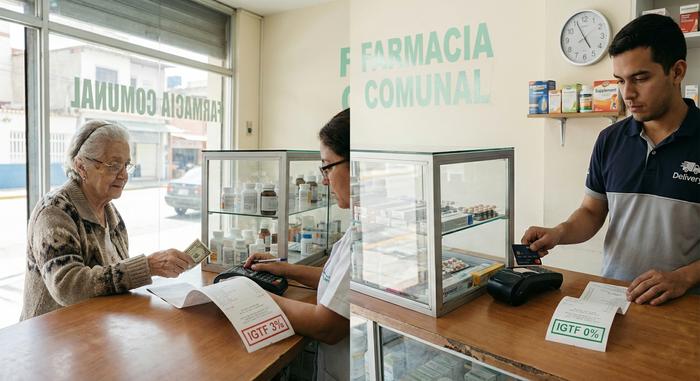
The Tax on Large Financial Transactions began life in 2007 as a levy on wire transfers between accounts at Venezuelan banks. It was overhauled in February 2022 through a Constituent Decree published in Gaceta Oficial Extraordinaria 6.687, and that overhaul is what dragged crypto into its scope. From late March 2022 onward, any payment in foreign currency, in crypto, or in any asset other than the bolívar and the Petro became a taxable event under IGTF.
Two features make this tax unusual. First, the statute defines a band rather than a fixed rate. The Executive can set the IGTF anywhere between 0 and 20 percent, by decree, with no congressional vote. Second, the seller acts as the withholding agent for transactions paid in foreign currency or crypto by non-special taxpayers. In practice that means a Caracas restaurant that accepts USDT must collect IGTF on top of the meal price and remit it to SENIAT.
The rate history is short but revealing. Decreto 4.647 in March 2022 fixed the rate at 3 percent for the new foreign-currency and crypto category. Decreto 4.929 in August 2022 kept the 3 percent but extended an exemption for certain securities trades on the Bolsa de Valores de Caracas. Decreto 4.972 in July 2024 was the most consequential: it cut the IGTF on special-taxpayer-to-special-taxpayer bank payments to 0 percent, signalling regulatory relief for large industry, but it preserved the 3 percent rate on consumer-level foreign-currency and crypto deals. A small business paying a domestic supplier in USDT still hands over the IGTF; a multinational paying through the banking system in bolívares does not.
| Payer / instrument | IGTF rate (2026) | Withholding agent | Notes |
|---|---|---|---|
| Special taxpayer → special taxpayer, bolívares via banks | 0% | Bank | Cut by Decreto 4.972, Jul 2024 |
| Consumer → merchant, USD cash | 3% | Merchant | Decreto 4.647 / 4.929 |
| Consumer → merchant, USDT or BTC | 3% | Merchant | Same band; crypto explicitly included |
| Statutory maximum, any category | 20% | Set by decree | Executive can move within 0–20% |
The combined effect, when you sit with it, is regressive. A retiree paying a clinic in USD cash pays the 3 percent surcharge; a corporate group settling intercompany invoices in bolívares has no tax due at all. The tax is levied on the very transactions ordinary citizens cannot avoid. That distributional gap is the tax's defining feature and the most visible cost of Venezuela's dollarization.
Income Tax Rules for Crypto in Venezuela
Income tax in Venezuela is governed by the Ley de Impuesto Sobre la Renta, last reformed in 2015. SENIAT classifies crypto as incorporeal movable property rather than legal tender, treating crypto on par with other movable assets, so realized gains, mining receipts, and crypto-denominated wages all feed into the same brackets that apply to consulting fees or rental income. Residents in Venezuela, defined as anyone present for more than 183 days in a calendar year, file a Venezuelan income tax return on Forma DPN-99025 covering the calendar tax year.
The income tax law uses a progressive scale of 6 to 34 percent across eight brackets, with the brackets themselves measured in Unidades Tributarias, or tax units. The UT is an inflation-indexed unit, adjusted by SENIAT whenever the bolívar slips badly enough to justify it. By Providencia SNAT/2025/0048, published in Gaceta Oficial 43.140 on 2 June 2025, the UT now sits at Bs. 43.00. That value drives everything from bracket thresholds to penalties, so a single number quietly indexes the entire tax system to the bolívar's parallel decline.
A filing obligation begins at roughly 1,000 UT of annual income for services or 1,500 UT for other sources. Translated through the parallel exchange rate that most Venezuelans actually face, the trigger lands somewhere near $30 to $40 of monthly income, low enough that any active USDT trader on Binance P2P is technically in scope. The return is due 31 March of the following year, filed online through the SENIAT portal. Legal entities apply the corporate income tax at roughly the same scale, with a flat 34 percent on the top bracket, and they treat annual income from crypto gains identically to other taxable income. Individuals and legal entities both make payment of the tax through the SENIAT online portal once the return is accepted.
Two practical points cause most of the disputes. The first is conversion: gains must be expressed in bolívares at the BCV official rate, which often diverges from the street rate by 10 to 40 percent. The second is timing: the taxable event happens at the moment of conversion or sale, not at year-end, so traders carry a recordkeeping burden the law assumes but does not subsidize.
Value-Added Tax and Other Levies on Crypto
The 16 percent value-added tax does not fall on crypto itself, which the Tax Code treats as a financial instrument outside IVA's scope. It falls on the goods and services priced in it. If a barbershop charges 12 USDT for a haircut, it owes IVA on the bolívar equivalent at the BCV rate, exactly as if the same haircut had been paid in cash. The 2022 IGTF reform added a separate alícuota adicional, an additional rate of 5 to 25 percent on luxury items paid in foreign currency or crypto. The exact rate still depends on a future Executive decree, which had not been published as of mid-2026. Urban property tax assessments, municipal economic-activity taxes (between 1 and 6 percent of gross revenue) and stamp taxes round out the bill for any business that accepts crypto payments routinely within Venezuela. A separate high net wealth tax of 0.25 percent kicks in on net worth above 150 million tax units, with crypto assets included in the calculation alongside real estate and securities. Payroll taxes and stamp taxes apply on the employment and contract side but do not interact directly with crypto holdings.
Crypto Mining and SUNACRIP After the Collapse
Legalized Bitcoin mining in Venezuela has gone from quasi-legal to formally banned in roughly four years. The Superintendent on Cryptoassets of Venezuela, SUNACRIP, was created by Decreto 3.196 in December 2017 to license miners, register exchanges, and shepherd the Petro. In March 2023, after the PDVSA-Cripto scandal broke, the Executive issued Providencia 037-2023 and placed SUNACRIP under intervention by an ad-hoc administrative board. Joselit Ramírez, its director since 2018, was arrested. Exchange licensing froze. Domestic platforms such as Criptolago wound down.
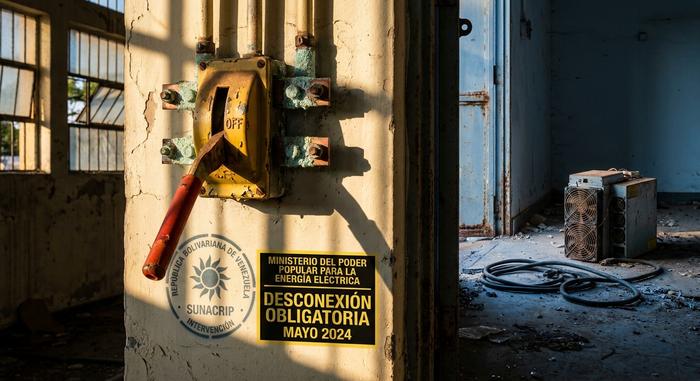
In May 2024 the Ministry of Electric Energy ordered all known crypto miners disconnected from the national grid, citing strain on a power system already prone to rolling blackouts. The decision functionally killed industrial mining inside Venezuela, although small home operations persist on private generation. The trial of more than fifty defendants in the PDVSA-Cripto case began in Caracas in April 2026, with missing funds estimated between $3 billion and $23 billion; Transparencia Venezuela and Ecoanalítica converge on roughly $16.9 billion. No successor agency has been formally established. Regulatory authority now sits, in practice, with SENIAT for tax, BCV for foreign exchange, and the Vicepresidencia for everything that does not fit elsewhere.
Filing, Penalties, and Tax Authorities in Practice
The tax authorities most Venezuelan crypto users meet are not SUNACRIP, which no longer functions, but SENIAT for declarations and the commercial banks for the IGTF surcharge. The personal income tax filing window closes on 31 March, with extensions rarely granted. Recordkeeping has to cover five years and must include the date of each transaction, the counterparty (where known), the wallet address, and the bolívar value at the BCV rate at the moment of disposal.
Penalties are designed to be heavier than the underlying tax. The Código Orgánico Tributario, reformed in 2020, sets a fine of 100 to 300 percent of unpaid tax for omitted or incomplete returns, and up to 500 percent plus six months to seven years' imprisonment for outright fraud. Late filing alone draws a baseline 150 UT, which at the current UT of Bs. 43 amounts to roughly Bs. 6,450 in nominal terms. Interest accrues at the BCV active lending rate multiplied by 1.2, applied monthly. None of this is unusual by Latin American standards; what is unusual is the gap between the rate book and on-the-ground enforcement, narrowed only recently by a 2025 data-sharing protocol between BCV and SENIAT that flags large USDT cash-out wires routed through Venezuelan banks. Tax collection in Venezuela is still a national tax operation in the legal sense, but it now depends on the banking system for visibility into crypto flows.
Venezuela vs Latin America: Crypto Tax Compared
Set against its regional peers, Venezuela is not the highest-rate jurisdiction. What I keep coming back to is that it is one of the most complicated. The table below collects the headline numbers; the qualitative gap matters more.
| Country | Treatment | Headline rate | Exemption | Filing |
|---|---|---|---|---|
| Venezuela | ISLR (income) + IGTF (transaction) | 6–34% + 3% IGTF | ~1,000–1,500 UT (~$30–40/month) | 31 March, SENIAT online |
| Argentina | Capital gains (Ley 27.430, Ley Bases 2024) | 15% flat | Held coins exempt; CARF reporting from 2027 | Annual AFIP/ARCA |
| Brazil | Capital gains (Lei 14.754/2023; MP 1.303/2025) | 17.5% flat from 12 Jun 2025 | R$35,000/month exemption ended Jun 2025 | Monthly DARF + DIRPF |
| Mexico | ISR on sale of goods | Up to 35% individuals; 16% IVA on services | Standard ISR brackets | Annual SAT |
Argentina taxes profits at a clean 15 percent and is rolling toward CARF reporting in 2027. Brazil moved in June 2025 from a tiered 15 to 22.5 percent regime to a flat 17.5 percent, and it abolished the long-standing monthly exemption that had let small traders skip the form. Mexico's ISR can top out at 35 percent for individuals and 30 percent for corporations, but Banxico Circular 4/2019 prevents domestic banks from offering custody, which contains the on-shore crypto market to specialized intermediaries.
Venezuela's top marginal tax rate of 34 percent slots between Argentina and Mexico. Stack the 3 percent IGTF on a USDT trade and the effective rate can creep above 37 percent. But the harder problem is not the rate. It is the UT indexing, the BCV–parallel-rate split, the absence of a dedicated crypto statute, and the withholding scheme that pushes compliance onto small merchants who were not designed to be tax collectors.
Cryptocurrency Taxation in Venezuela After the Petro
The current types of crypto taxes — IGTF as a proportional tax on transactions, ISLR as a progressive levy on gains — survived the death of the Petro and the implosion of SUNACRIP because it sits in the income tax law and a handful of executive decrees, not in a dedicated crypto code. That is precisely why it is fragile. A political transition could rewrite the IGTF in an afternoon, or it could leave the framework intact and start enforcing it in earnest for the first time. Either outcome reshapes the calculus for anyone who chooses to use Bitcoin or stablecoins on Venezuelan soil. I am not convinced the current framework survives a transition intact, but I would not bet on its disappearance either. Both outcomes are worth planning for.